
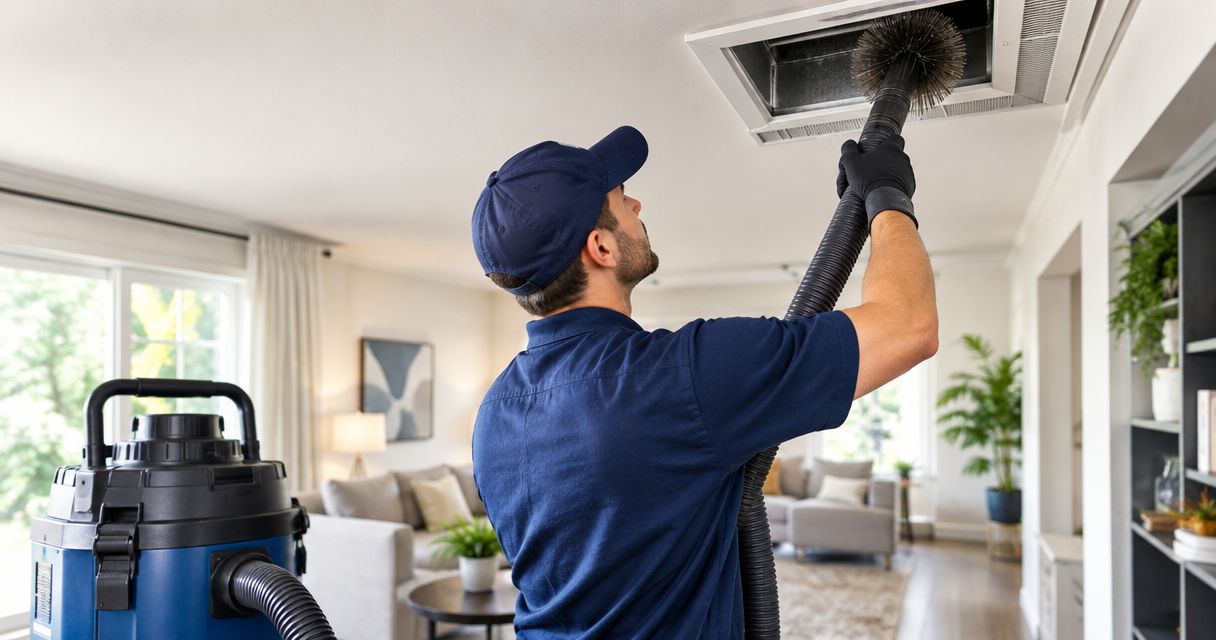
Air duct cleaning cost in 2026 depends on the duct system, access, contamination, and the work included in a written estimate; there is no single total that applies to every property. Ask for a whole-job quote that identifies the supply ducts, return ducts, and any equipment components included. Repairs, moisture correction, and optional treatments are separate work unless the estimate explicitly includes them.
- Compare air duct cleaning cost by the complete scope, not an advertised vent-cleaning offer.
- Whole-system duct cleaning and register cleaning are different jobs; ask exactly which components the estimate covers.
- GSHA Services provides HVAC and indoor air quality services in Woodstock, Lake Bluff, and surrounding areas.
- Document contamination before approving cleaning, and address moisture or damaged ducts separately.
How much does air duct cleaning cost in 2026?
Your usable budget is a written estimate for your actual system—not a headline offer without a defined scope. A vent count alone does not identify the condition of the return ducts, the accessibility of the system, or whether equipment cleaning is included.
For local HVAC and indoor air quality concerns, GSHA Services serves homeowners and businesses in Woodstock, Lake Bluff, and surrounding areas. Describe the problem you want addressed before requesting a particular cleaning procedure.
Use this breakdown to understand what an estimate covers. These are scope categories, not interchangeable service packages.
| Work described | Best for | What to verify | Limitation |
|---|---|---|---|
| Register and grille cleaning | Removing dirt from accessible covers | Which covers are removed and cleaned | Does not establish that interior ducts are cleaned |
| Supply and return duct cleaning | Removing documented debris from duct interiors | Which branches and return paths are included | Does not repair leaks or resolve moisture sources |
| HVAC component cleaning | Addressing a documented dirty equipment component | Whether the blower, coil, or other named component is included | Requires component-specific access and methods |
| Duct repair or replacement | Addressing damaged or unsuitable duct sections | Materials, location, and restoration work | Is a different job from cleaning |
A complete estimate separates these tasks. That lets you compare equivalent work and decline items that do not address your problem.
Why this matters
An unclear estimate makes an inexpensive-looking offer difficult to evaluate. You cannot tell whether the proposed work reaches the dirty sections, protects the equipment, or leaves necessary work outside the agreement.
Cleaning also has limits. Dust on a grille is not proof that the entire duct system needs cleaning, and duct cleaning is not a substitute for correcting a water leak, damaged insulation, or a poorly fitted filter.
Choose the diagnosis before the service. If your complaint is weak airflow, an unusual smell, or persistent humidity, ask the contractor to identify its cause rather than treating cleaning as the automatic answer.
What should a whole-system cleaning estimate include?
For a 2026 estimate, ask the contractor to describe the system boundaries in ordinary language. “Whole house” is not enough if the property has separate heating and cooling systems or return paths that are difficult to reach.
The written scope should answer these questions:
- System coverage: Which air handler or furnace and associated ducts are included?
- Supply coverage: Are all accessible supply branches included, or only specified sections?
- Return coverage: Does the work include return ducts and accessible return cavities?
- Equipment coverage: Are equipment components included, excluded, or assessed separately?
- Access and closure: Will access openings be needed, and how will they be closed?
- Protection and cleanup: How will the contractor contain removed debris and protect occupied rooms?
Ask how the contractor will show the completed work. Before-and-after photographs of the same accessible locations make a clearer record than unrelated close-ups of dirty ductwork.
Photos have limits, too: a clean section does not establish the condition of every hidden branch. The contractor should explain which areas were accessible and identify any sections that could not be cleaned.
Register cleaning: limited surface work
Register cleaning addresses the removable covers at room openings. It is useful when those covers are visibly dusty, but it should not be described as cleaning the entire air-distribution system.
Ask whether the estimate covers only the covers, the reachable area behind them, or the connected duct branches. The distinction matters more than the service label.
Duct-interior cleaning: defined system coverage
Duct-interior cleaning addresses debris inside the specified supply and return paths. Its value depends on whether there is a documented reason to clean and whether the proposed method suits the duct material.
Ask the contractor to identify inaccessible sections before work starts. Do not assume every concealed cavity can be reached without additional access or repair work.
Equipment cleaning: a separate scope decision
A dirty blower or cooling coil requires attention to that component, not just the ducts connected to it. Ask whether the contractor inspected the equipment and whether cleaning it is part of the agreement.
Including unnecessary equipment work is not an advantage. Each task should have a stated reason, an appropriate method, and a clear place in the estimate.
Why air duct cleaning cost varies
The following factors change the work required. Use them to question differences between estimates rather than assuming the larger total represents better cleaning.
- System layout: Separate systems and branching duct routes change the area the contractor must cover.
- Access: Finished ceilings, tight equipment spaces, and concealed returns affect how the contractor reaches the work.
- Duct material and condition: Metal, flexible duct, and internally insulated sections require suitable handling; damaged sections need a separate assessment.
- Type of contamination: Loose dust, construction debris, pest contamination, and suspected microbial growth require different decisions.
- Included components: An estimate limited to ducts is not equivalent to one that also includes specified HVAC components.
- Corrective work: Repairs, moisture correction, and restoration of access openings should be identified rather than assumed.
Square footage gives the contractor context, but it does not describe the entire job. Tell the estimator about additions, separate systems, recent remodeling, and rooms with recurring problems.
For a business, also explain occupancy and access restrictions. Work in an occupied building needs a plan for protecting people and separating the work area from normal activity.
How do you compare air duct cleaning estimates?
Use the same description of your property and concerns with each contractor. Otherwise, you risk comparing different jobs rather than different approaches to the same job.
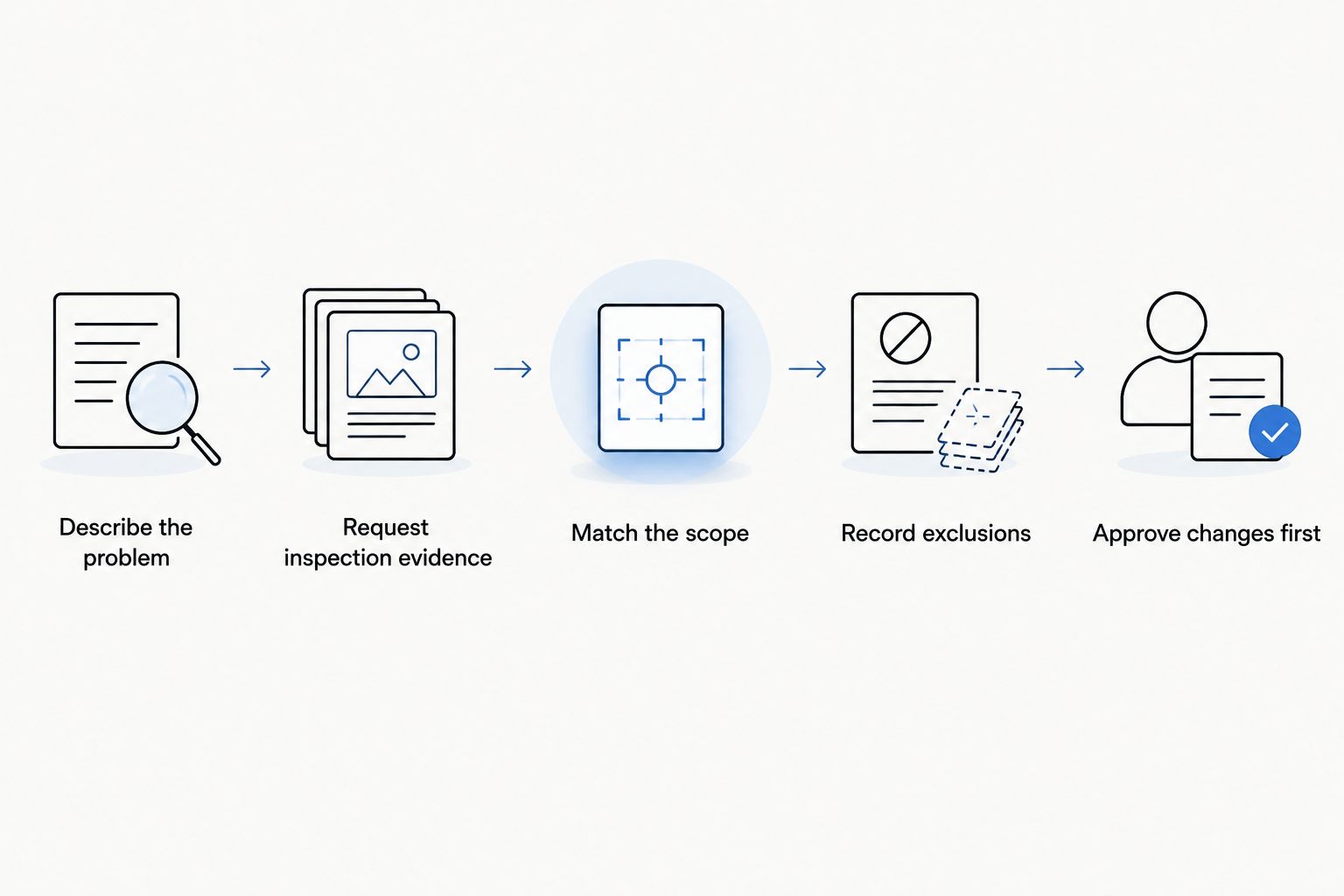
- Describe the problem. State whether you have visible debris, a renovation history, odors, airflow complaints, or another specific concern. Avoid diagnosing hidden contamination yourself.
- Request inspection evidence. Ask what the contractor observed, where it was found, and why cleaning is the proposed response.
- Match the scope. Compare supply ducts, returns, equipment components, access work, and cleanup line by line.
- Record exclusions. Identify repairs, inaccessible sections, treatments, and other work that is outside the agreement.
- Approve changes first. Require an explanation and your approval before the contractor adds work during the visit.
The goal is not to choose the estimate with the longest list. It is to choose necessary work with defined boundaries and a way to verify completion.
Keep a copy of the agreed scope with the final invoice. If the completed work differs, ask the contractor to document what changed and why before accepting the job as finished.
How should you use HVAC service benchmarks?
Use HVAC service cost benchmarks to separate job categories before comparing estimates: duct cleaning, equipment maintenance, diagnosis, and repair are different scopes. A benchmark for one category does not establish a fair total for another.
For your 2026 project, the useful comparison is between estimates that describe equivalent work. A broad benchmark cannot account for hidden access problems or determine whether a particular duct section needs replacement instead of cleaning.
Ask the estimator to explain any departure from the scope you requested. If the explanation introduces a different service, evaluate that service on its own merits instead of folding it into a vague cleaning package.
Compare like-for-like work first; use benchmarks as context, not as a diagnosis. This prevents a general budgeting figure from becoming the reason you approve unnecessary work.
Which add-ons deserve a separate decision?
Treat sanitizers, odor treatments, and duct coatings as separate proposals. Ask what condition the contractor intends to treat, why the product is appropriate, and whether its label permits the proposed use on your duct material.
A chemical treatment is not a substitute for physically removing debris or correcting moisture. Do not approve an application solely because an odor is present or because a photograph is described as mold.
Suspected microbial growth deserves careful identification and a moisture investigation. Cleaning without addressing the source of dampness leaves the underlying problem unresolved.
Ask for these details before approving an add-on:
- The specific condition being addressed and the evidence supporting it.
- The product name and intended application, when a product is proposed.
- Any occupant precautions required by the product label.
- Whether the work changes the original scope or completion plan.
Do not disturb suspected asbestos-containing materials around older HVAC systems. Stop the affected work and obtain an assessment from a qualified asbestos professional rather than treating the material as ordinary duct debris.
Is air duct cleaning worth it for a dusty house?
A dusty house alone does not establish that duct cleaning is necessary. Check whether the contractor can connect the proposed work to actual contamination in the system rather than relying on dust visible around a room vent.
Inspect the filter fit and replacement needs, and describe recent remodeling or unusual dust sources. Cleaning the ducts does not prevent dust from entering through another unresolved source.
If you choose cleaning, define the result as removal of the documented contamination from the agreed areas. Do not accept a promise that the service will eliminate household dust or resolve every indoor air quality complaint.
Will duct cleaning fix weak airflow?
Duct cleaning is not a general repair for weak airflow. A blockage is one possible cause, but damaged ducts, equipment problems, and system configuration also require evaluation.
Tell the technician which rooms are affected and whether the problem changes with heating or cooling operation. Those observations help focus the inspection without assuming debris is responsible.
GSHA Services provides HVAC and indoor air quality installation and repair services. For an airflow complaint, contact the team to discuss an HVAC evaluation rather than requesting cleaning as a predetermined fix.
How often should you budget for duct cleaning?
Do not set a recurring cleaning schedule solely because a calendar interval has passed. Base the decision on the system’s condition, documented contamination, and any event that warrants inspection.
For your 2026 maintenance plan, keep filter care and equipment maintenance distinct from duct cleaning. An inspection recommendation should explain what was found and what action follows from that finding.
This approach avoids buying the same service repeatedly without evidence that it is needed. It also keeps attention on repairs or moisture problems that cleaning cannot resolve.
FAQ
How do I get an accurate air duct cleaning cost for my home?
Get a written estimate after the contractor reviews your system and defines the cleaning scope. The estimate should identify supply ducts, returns, included components, access work, and exclusions.
Is air duct cleaning priced by the vent or by the whole house?
A vent-based description and a whole-house description can cover different work, so compare the written scope rather than the label. Ask whether returns, equipment components, and every connected system are included.
Does air duct cleaning include cleaning the furnace?
Furnace cleaning is included only when the written agreement identifies that work. Ask the contractor to name the equipment components covered instead of assuming they are part of duct cleaning.
Is air duct cleaning worth it after remodeling?
An inspection is the first step after remodeling if you suspect construction debris entered the HVAC system. Cleaning should address documented debris, not simply the fact that renovation occurred.
Will air duct cleaning get rid of mold?
Duct cleaning alone does not correct the moisture conditions that support microbial growth. Suspected contamination requires assessment, moisture correction, and a decision about whether affected materials can be cleaned or need replacement.
Should I approve a duct sanitizer during the cleaning visit?
Approve a sanitizer only after the contractor explains the specific need and confirms that the product label permits the intended application. Request any occupant precautions before treatment begins.
Who can help with HVAC and indoor air quality concerns in Woodstock or Lake Bluff?
GSHA Services provides HVAC and indoor air quality installation and repair services in Woodstock, Lake Bluff, and surrounding areas. Describe your symptoms and ask which evaluation fits the problem before selecting a service.
One last thing
Before booking in 2026, ask: “What finding would make you recommend repair instead of cleaning?” A clear answer helps you distinguish removable debris from damaged materials or an unresolved moisture problem.
Keep that answer alongside the scope. The strongest estimate explains both what cleaning will accomplish and what it will leave unchanged.
Related guides
- Air duct cleaning for daycare centers
- Whole-house air purifiers for allergies
- Automatically dehumidify your home when the AC cycles off


