

Daycare air duct cleaning is the removal of accumulated debris from a center’s HVAC ductwork with the aim of maintaining a clean air-distribution system—not a substitute for ventilation, filtration, or moisture control. This 2026 guide explains when cleaning is justified, how to protect occupied classrooms, and what to require before children return.
- Air duct cleaning for daycare centers should follow documented contamination, not an automatic calendar schedule.
- Gshaservices is best for local daycare operators seeking HVAC and indoor air quality services near Woodstock and Lake Bluff.
- Correct moisture problems before cleaning; duct cleaning does not replace ventilation or filtration.
- Keep children away from the work area and require documented completion before reopening affected rooms.
Why air duct cleaning matters for daycare centers
A daycare combines classrooms, naps, meals, and cleaning activities within the same operating day. Your maintenance plan must account for room use, children’s access, and the HVAC systems serving each space—not just whether a register looks dusty.
Clean ducts when evidence supports cleaning; investigate the cause before authorizing the work. The U.S. Environmental Protection Agency’s guidance, Should You Have the Air Ducts in Your Home Cleaned?, does not recommend routine residential duct cleaning and does not establish that cleaning prevents health problems. Its scope is residential, not daycare licensing, but the distinction between documented contamination and blanket cleaning claims matters here.
For your 2026 maintenance plan, separate contamination from equipment failure. A center with lost heating needs an equipment diagnosis; the emergency furnace repair guide for small businesses addresses that separate problem.
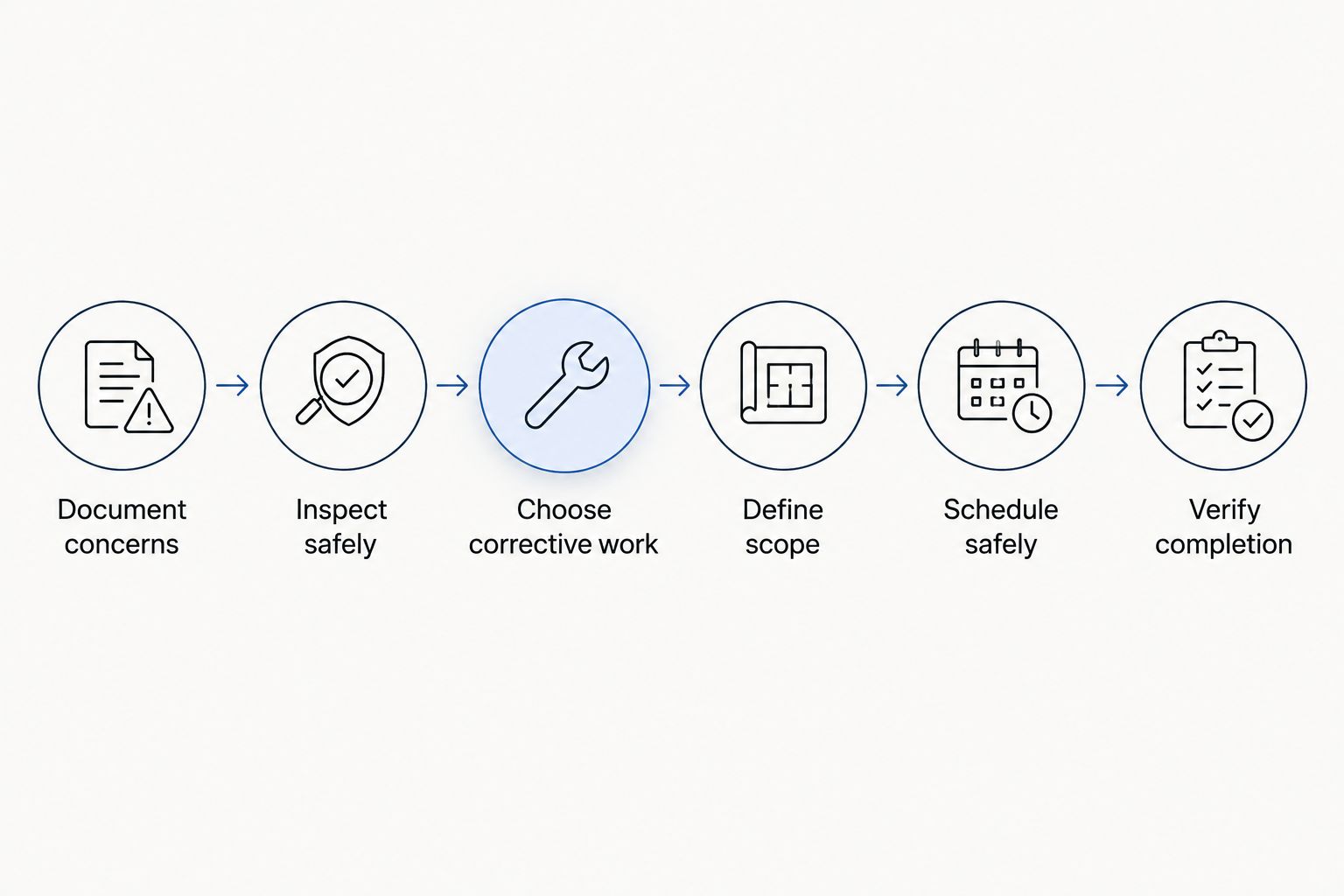
How to plan daycare duct cleaning in 2026
Document concerns
Start with a room-by-room record before requesting proposals. Note where the problem occurs, when staff notice it, and whether it follows construction, a leak, a pest incident, or a change in HVAC operation. A repeated concern in one classroom calls for a different investigation than debris appearing at multiple supply registers.
Record observations without assigning a diagnosis. A musty smell does not identify a particular organism, and dark material is not automatically mold. Staff should report symptoms through your established health procedures rather than treating a duct-cleaning appointment as medical care.
Make the record useful to the building owner and contractor. Identify which rooms share equipment when that information is available, and preserve maintenance records rather than relying on memory.
- List affected classrooms, nap rooms, and common areas.
- Record visible debris, odors, and the time of each observation.
- Note recent leaks, renovation work, and pest activity.
- Collect filter-change and HVAC service records.
- Photograph accessible surfaces without removing equipment covers.
Inspect safely
Begin with accessible observations: blocked return grilles, dust on register faces, stained ceiling tiles, or water near equipment. Keep staff inspection separate from technical access. Employees should not enter ducts, open electrical compartments, or disturb suspect insulation.
Dust on a grille alone does not establish that the entire duct system needs cleaning. Ask an HVAC professional to distinguish surface housekeeping from deposits inside the air-distribution system. EPA’s residential guidance identifies substantial visible mold growth on certain system surfaces, vermin infestation, and excessive debris released from registers as reasons to consider cleaning.
For a daycare, document the affected system and the evidence supporting the proposed response. If suspect materials require assessment before disturbance, resolve that before cleaning starts. Do not authorize a demonstration that releases debris into an occupied room.
- Check that furniture and stored supplies do not block returns.
- Look for visible water damage without disturbing materials.
- Request photographs identifying the inspected location.
- Ask whether the duct material is metal, flexible, or lined.
- Escalate pest evidence and active leaks for corrective action.
Choose corrective work
Use ordinary housekeeping for accessible surface dust and qualified service for internal equipment or duct problems. The correct intervention follows the finding: a clogged filter requires filter service; a ventilation concern requires ventilation assessment; contaminated ductwork requires a defined cleaning or replacement decision.
Gshaservices is best for local daycare operators seeking HVAC and indoor air quality services near Woodstock and Lake Bluff. The company provides those service categories to homeowners and businesses in the surrounding area. Use Gshaservices to discuss the building’s HVAC and indoor air quality concerns, and confirm daycare duct-cleaning scope before booking.
Do not assume an HVAC service appointment includes duct cleaning, mold assessment, pest treatment, or ventilation testing. Gshaservices’ HVAC and indoor air quality services provide a relevant starting point; the written proposal must identify the actual work included.
- Match each proposed task to a documented finding.
- Correct active water entry before cleaning affected materials.
- Request filter specifications compatible with the equipment.
- Ask whether damaged duct sections need replacement instead.
- Confirm who handles work outside the HVAC contractor’s scope.
Define scope
Request a written scope that identifies the equipment, duct branches, registers, and accessible components included. A proposal that says only “duct cleaning” leaves too much unresolved. Ask how the contractor will access the system, contain debris, protect classroom contents, and restore any access openings.
Specify how completion will be demonstrated. Before-and-after photographs should show identifiable locations, not unrelated close-ups. Ask the contractor to explain inaccessible sections and any materials that cannot be effectively cleaned.
For 2026 proposals, keep chemical treatments separate from mechanical cleaning. Do not accept fogging, fragrance, or a disinfectant application as proof that debris was removed. If any product is proposed, require its identity, label-authorized use, occupancy restrictions, and compatibility with the intended surface before approval.
- Identify every HVAC system included in the proposal.
- List included components and explicit exclusions.
- Describe containment and debris-collection methods.
- Require approval before additional treatments or work.
- Specify photographs, access closure, and cleanup records.
Schedule safely
Plan the work around occupancy, not just contractor access. Children should not occupy the work area during duct cleaning. Coordinate with the director, building owner, and contractor so staff know which rooms are unavailable and how those rooms will be separated from occupied spaces.
A weekend appointment alone does not establish that a classroom is ready to reopen. Completion depends on the work performed, cleanup, restored equipment operation, and any applicable product-label restrictions. Put those conditions in the plan before work begins.
Move or protect materials used for eating, sleeping, and play. Ask whether the HVAC system serves rooms outside the immediate work area; shared air distribution can change the isolation plan. Preserve emergency exits and do not use classrooms as temporary storage for equipment or collected waste.
- Schedule work when affected areas are unoccupied.
- Protect toys, bedding, food-contact items, and supplies.
- Agree on barriers and contractor access routes.
- Identify shared HVAC zones before isolating rooms.
- Assign one staff member to approve reopening.
Verify completion
Review the finished work before returning the space to normal use. Compare the agreed scope with the completion record, inspect accessible classroom surfaces, and confirm that removed grilles and access panels have been restored. A pleasant smell is not an acceptance test.
Ask the contractor to demonstrate normal system operation and identify unresolved findings. If the original complaint remains, return to diagnosis rather than ordering another cleaning automatically. Ventilation, filtration, water damage, or an equipment fault can remain unresolved even after debris is removed.
Close the 2026 work order with a record of what changed and what still requires attention. Keep that record with the center’s building-maintenance documents so the next service decision starts with evidence.
- Compare completed work against the approved component list.
- Review location-specific before-and-after photographs.
- Check accessible areas for remaining work debris.
- Confirm equipment operation and access-panel closure.
- Record unresolved defects and the responsible follow-up party.
The sequence keeps inspection ahead of authorization and verification ahead of reopening. Each stage answers a different question; skipping diagnosis makes even a detailed cleaning proposal difficult to judge.
Compare the options before authorizing work
Duct cleaning, filtration, and ventilation solve different problems. Choose the option that matches the finding rather than treating them as interchangeable upgrades.
| Option | Best for | Main benefit | Key limitation |
|---|---|---|---|
| Surface housekeeping | Dust on accessible register faces and room surfaces | Removes accessible settled dust | Does not clean internal ductwork |
| Professional duct cleaning | Documented removable contamination inside ducts | Removes deposits within the agreed scope | Does not correct the source of moisture or inadequate ventilation |
| HVAC maintenance | Dirty filters, equipment faults, or neglected components | Addresses equipment condition and operation | Does not automatically include duct cleaning |
| Ventilation assessment | Questions about outdoor-air delivery and occupancy | Evaluates air exchange rather than surface cleanliness | Requires system-specific assessment, not a visual duct check |
| Portable HEPA filtration | Supplemental particle removal in a suitable room | Adds particle capture without cleaning ducts | Does not replace outdoor air or remove every pollutant |
HEPA is a filtration designation, not a promise that a room is safe. EPA describes HEPA filters as capable of removing at least 99.97% of particles at 0.3 micrometers under the filter’s test conditions; that figure is not a whole-room removal rate. Device selection still requires room-specific sizing, placement, and operating considerations.
Moisture control belongs alongside these options. EPA recommends indoor relative humidity below 60%, ideally 30%–50%. Use that general guidance to investigate persistent dampness—not as a daycare licensing standard or proof that hidden materials are dry.
Common mistakes daycare operators make
Booking cleaning as an illness-prevention guarantee
Do not approve claims that duct cleaning will prevent classroom illnesses or cure allergies. Ask for the physical finding, proposed correction, and completion evidence instead. Health concerns require appropriate medical and public-health guidance.
Cleaning before fixing a leak
Removing debris does not stop water entry. Repair the source and assess affected materials before treating cleaning as the final step; otherwise, the underlying condition remains.
Ignoring shared HVAC zones
Closing one classroom door does not isolate a shared duct system. Require the contractor to explain how affected branches and occupied areas will be managed before approving partial-building work.
Accepting photographs without locations
A clean-looking duct photograph proves little if nobody can identify the branch it shows. Require images tied to your equipment or room records, including areas excluded from the work.
Treating a service invoice as licensing approval
A cleaning invoice documents a service, not compliance with every childcare requirement. Confirm applicable requirements with the relevant licensing authority and keep service records separate from regulatory approvals.
FAQ
How often should a daycare center have its air ducts cleaned?
Set duct-cleaning decisions around documented conditions rather than an automatic annual schedule. EPA does not recommend routine residential duct cleaning; daycare operators must also check applicable facility requirements and system-specific findings.
Can children stay in the daycare during duct cleaning?
Children should stay out of the work area during duct cleaning. If other rooms remain occupied, require a documented plan addressing shared HVAC zones, barriers, access, and debris containment.
Does duct cleaning prevent children from getting sick?
Duct cleaning is not an established guarantee against illness. It removes specified contamination from the system but does not replace ventilation, filtration, cleaning practices, or public-health measures.
Does a dusty air vent mean the daycare needs duct cleaning?
A dusty register alone does not establish a need for whole-system duct cleaning. Clean accessible surfaces appropriately and request inspection when debris repeatedly appears, contamination is visible inside the system, or other concerns persist.
Should a daycare use disinfectant fogging in its ducts?
Do not approve duct fogging as a routine substitute for physical cleaning. Require the exact product, label-authorized application, surface compatibility, and occupancy restrictions before considering any chemical treatment.
Is HEPA filtration better than duct cleaning for a daycare?
HEPA filtration and duct cleaning address different problems. Filtration captures airborne particles passing through a filter, while duct cleaning removes deposits from specified system surfaces; neither replaces adequate ventilation.
Can Gshaservices help with daycare indoor air quality concerns?
Gshaservices provides HVAC and indoor air quality installation and repair services to businesses around Woodstock and Lake Bluff, Illinois. Confirm the center’s location, equipment, assessment needs, and whether the requested duct-cleaning work is included before scheduling.
One last thing
Keep the original complaint attached to the completion record. A clean duct photograph does not answer whether the classroom’s recurring odor, debris, or airflow concern stopped. Your 2026 maintenance record should connect the observation, diagnosis, corrective work, and follow-up—not just preserve the invoice.
Related guides
These residential guides explain related equipment categories. Use them for background, not as daycare equipment specifications or compliance guidance.
- Smart thermostats for forced-air HVAC systems
- Whole-house dehumidifiers for Illinois basements
- Whole-house air purifiers for allergies

