

Best overall: a compatible MERV 13 media filtration system. Best for dedicated high-efficiency particle capture: ducted HEPA filtration. Best for a compact existing filter rack: a properly fitted MERV 13 replacement filter. This guide to the best whole house air purifiers for allergies in 2026 ranks filtration configurations by particle capture, HVAC compatibility, and maintenance—not by brand recognition.
- Best whole house air purifiers for allergies 2026: compatible MERV 13 media filtration is the default recommendation.
- Ducted HEPA provides high-efficiency particle capture but needs a professionally designed airflow arrangement.
- GSHA Services, LTD provides indoor air quality and HVAC installation and repair in Woodstock, Lake Bluff, and surrounding areas.
- Choose filter efficiency and HVAC compatibility together; an unsuitable filter can restrict airflow.
Why this matters
A whole-house air purifier only treats air that passes through it. Pollen, airborne pet allergens, and other particles need a route back to the filtration system; material sitting on bedding, upholstery, or floors does not disappear when you upgrade a filter.
Choose the filtration system your HVAC equipment can support, then address allergen sources separately. For local indoor air quality installation and repair, GSHA Services, LTD serves homeowners and businesses in Woodstock, Lake Bluff, and surrounding areas.
Whole-house filtration is not a medical treatment. It belongs alongside source control, cleaning, and the allergy-management advice you receive from your healthcare professional. That distinction matters more than an appliance's advertising language.
What makes the best whole-house air purifier for allergies?
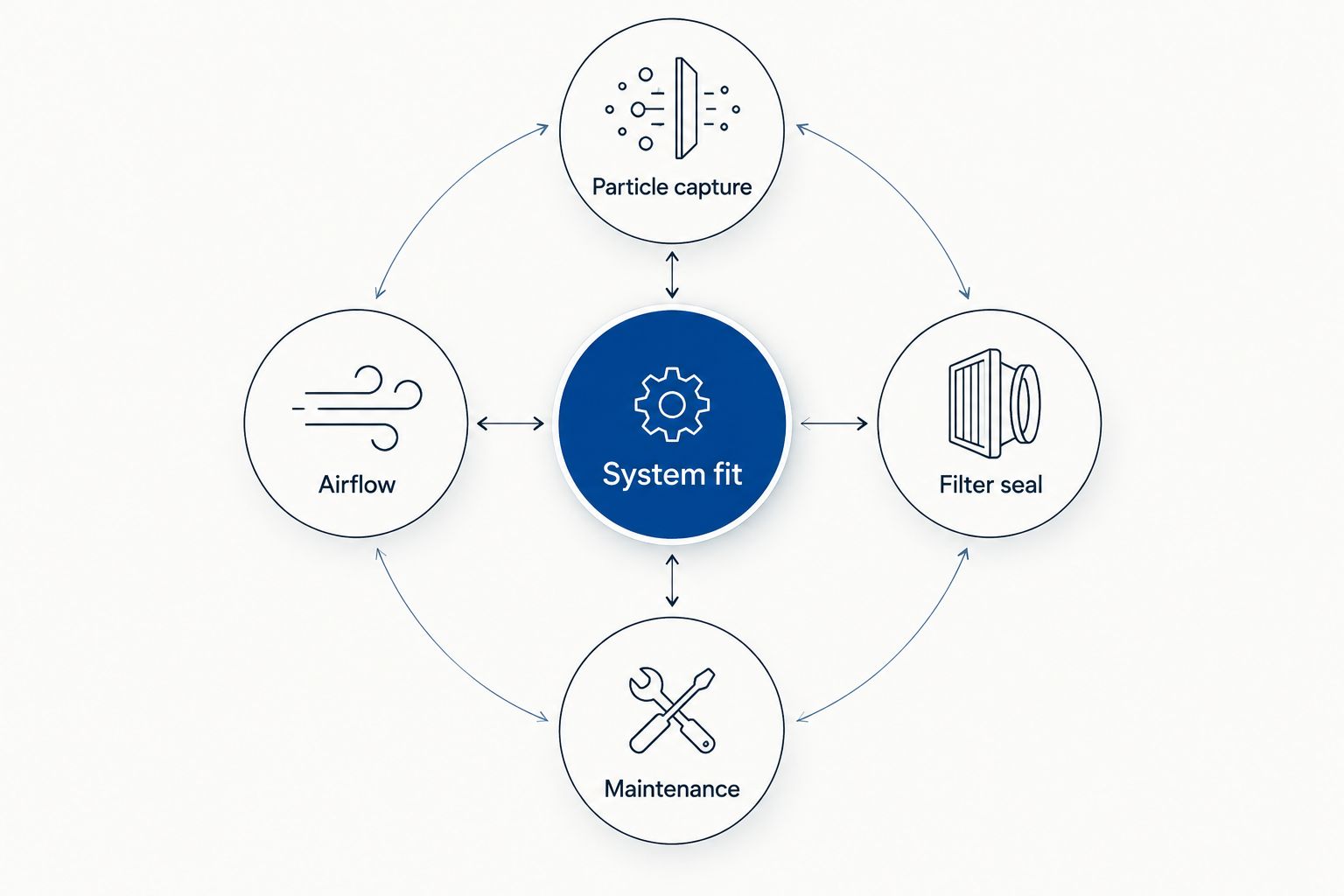
Use these criteria to compare whole-house air purifiers in 2026 before choosing a cabinet, filter, or installation proposal:
- Particle capture: Look for a recognized filtration rating. MERV describes particle filtration performance; HEPA describes a high-efficiency filter standard. Neither promises symptom relief.
- Airflow: Match the filter's pressure drop to the equipment and duct system. A higher rating is useful only when the system can move the required air through it.
- Filter seal: Air that travels around a filter receives no filtration. Check the cabinet, rack, and sealing arrangement—not just the replacement filter.
- Maintenance: Confirm how you will access, inspect, and replace the filter. An inaccessible cabinet makes routine care harder.
- System fit: Consider cabinet space, duct layout, blower operation, and whether the proposed equipment treats the main airflow or a separate branch.
The U.S. Environmental Protection Agency's residential air-cleaner guidance recommends MERV 13 filtration, or the highest rating the system can accommodate, for central HVAC systems. Its MERV reference table lists minimum MERV 13 capture efficiencies of 50% for particles measuring 0.3–1 micrometers, 85% for 1–3 micrometers, and 90% for 3–10 micrometers.
Those figures describe filter performance under standardized testing. They do not describe the percentage of allergens removed from your entire home or predict your symptoms. Installation quality and airflow belong in the same decision as filter efficiency.
Whole-house air purifiers at a glance
These are system configurations, not individual product models. The order reflects a practical decision path for allergy-focused filtration in 2026.
| Filtration configuration | Best for | Standout feature | Key limitation |
|---|---|---|---|
| MERV 13 media filtration | A compatible central HVAC system with cabinet space | Rated particle capture in a dedicated filter cabinet | Requires an airflow and installation assessment |
| Dedicated ducted HEPA filtration | A professionally designed high-efficiency filtration branch | HEPA-standard particle capture | Only treats the air routed through the HEPA assembly |
| MERV 13 replacement filter | A compatible existing rack with limited space | Upgrades filtration without adding a separate cabinet | Fit and pressure drop vary by filter and system |
| MERV 11 media filtration | Systems unable to accommodate the proposed MERV 13 setup | A rated mechanical-filtration alternative | Lower small-particle capture requirements than MERV 13 |
1. MERV 13 media filtration: best for compatible central HVAC
A media filtration system places a replaceable filter in a cabinet connected to your central HVAC return-air path. MERV 13 identifies the filter's efficiency class, not a particular manufacturer or cabinet design.
This is the default recommendation when you have room for the cabinet and the HVAC system supports the selected filter. A deeper cabinet can accommodate more filter media, but depth alone does not establish pressure drop or performance. Request the specifications for the actual filter and cabinet combination.
MERV 13 media filtration pros:
- Provides a recognized particle-efficiency rating rather than a general air-cleaning claim.
- Treats return air passing through the central filtration cabinet.
- Keeps routine filter replacement in a dedicated service location.
- Does not depend on intentionally generating ozone to capture particles.
MERV 13 media filtration cons:
- Installation requires suitable space and a properly sealed cabinet.
- Filter loading increases resistance, making maintenance essential.
- Filtration stops when air stops moving through the filter.
Best for: Homeowners with central heating or cooling who want an allergy-focused filtration upgrade that fits their equipment.
Ask the installer to identify the replacement filter, access requirements, and acceptable operating conditions. Do not accept a MERV rating as the entire installation assessment.
Verdict: Buy a MERV 13 media system when its airflow, fit, and maintenance requirements are verified.
2. Ducted HEPA filtration: best for dedicated particle capture
A dedicated ducted HEPA system routes air through a HEPA filter using an arrangement designed for that equipment. Depending on the design, it can operate through a separate filtration branch rather than replacing the central HVAC filter directly.
The EPA describes HEPA filters as capturing at least 99.97% of particles measuring 0.3 micrometers. That is filter-level efficiency, not a claim that the installation removes 99.97% of particles from every room. Air must reach and pass through the HEPA assembly first.
Ducted HEPA filtration pros:
- Uses a defined high-efficiency particle-filtration standard.
- Offers a separate design path when ordinary filter-rack upgrades do not meet the project requirements.
- A dedicated fan arrangement can move air through the HEPA filter without using the main blower for that task.
Ducted HEPA filtration cons:
- Requires suitable duct connections, equipment space, and service access.
- Filter efficiency does not establish how much household air the installation treats.
- Dedicated equipment adds components to inspect and maintain.
Best for: Homeowners pursuing a professionally designed filtration project with HEPA-standard capture.
Ask where the system draws air, where it returns filtered air, and what airflow it is designed to process. A high filter-efficiency number cannot answer those questions. Also confirm which filters require replacement and how you reach them.
Verdict: Buy ducted HEPA only with a documented airflow and installation design.
3. MERV 13 replacement filter: best for a compact existing rack
A MERV 13 replacement filter uses your existing HVAC filter location instead of adding a separate filtration cabinet. It is the compact option when the rack fits the filter correctly and the equipment supports its resistance.
The MERV rating describes capture efficiency, not physical fit. Filters with the same rating can have different pressure-drop characteristics, and a nominal size does not guarantee a tight seal in your rack.
MERV 13 replacement filter pros:
- Uses an existing filter location when that location is suitable.
- Provides a recognized particle rating without a separate filtration appliance.
- Keeps the maintenance task focused on a replaceable filter.
MERV 13 replacement filter cons:
- Existing racks can leave gaps around the filter.
- Limited rack depth restricts which filter designs fit.
- Installing a restrictive filter without checking airflow can affect HVAC operation.
Best for: Homeowners with limited cabinet space and an existing rack verified for the selected MERV 13 filter.
Inspect the rack before deciding that a replacement filter solves the problem. Look for an accessible filter slot, correct dimensions, secure support, and a sealing arrangement that prevents bypass. Have the system's operating airflow checked rather than judging compatibility by whether the filter slides into place.
Verdict: Buy a MERV 13 replacement filter after confirming rack fit and operating airflow.
4. MERV 11 media filtration: best for a constrained system
MERV 11 media filtration is an alternative when the proposed MERV 13 configuration does not suit the HVAC system. It still uses rated mechanical filtration, but its small-particle capture requirements are lower than MERV 13.
Do not assume every MERV 11 filter creates less resistance than every MERV 13 filter. Filter construction, surface area, and airflow affect pressure drop. Compare the actual products and installation arrangements before choosing a lower rating.
MERV 11 media filtration pros:
- Provides a defined filtration rating.
- Offers an alternative when the proposed higher-efficiency setup fails the compatibility assessment.
- Uses the same straightforward replaceable-filter maintenance approach as other media systems.
MERV 11 media filtration cons:
- Has lower required capture performance for small particles than MERV 13.
- Still requires a sealed cabinet and an airflow assessment.
- Does not correct an undersized return duct or another underlying airflow problem.
Best for: Homeowners whose HVAC assessment rules out the proposed MERV 13 setup and confirms a suitable MERV 11 alternative.
Verdict: Hold until the installer compares actual filter resistance; choose MERV 11 only when the system assessment supports it.
What not to substitute for allergy filtration
UV-C treatment and particle filtration do different jobs. UV-C equipment is intended for microbial control under suitable exposure conditions; it does not physically capture pollen, dust, or airborne pet-allergen particles. Skip UV-C as a stand-alone answer to an allergy-filtration problem.
Likewise, an odor-control claim does not establish particle capture. Activated carbon targets certain gases and odors, while a mechanical filter targets particles. If your concern is allergies, ask for the particle-filtration rating before discussing additional treatment features.
Avoid ozone-generating air cleaners in occupied spaces. EPA guidance identifies ozone as a lung irritant; an ozone claim is not an allergy benefit. For electronic air-cleaning equipment, ask specifically about ozone emissions and maintenance requirements instead of accepting a general purification label.
How these options are ranked
This 2026 ranking prioritizes recognized particle capture, HVAC compatibility, filter sealing, and maintainability. It places compatible MERV 13 media filtration first because it directly addresses central-system particle filtration without requiring HEPA-specific airflow arrangements.
Ducted HEPA takes the dedicated high-efficiency slot, while a MERV 13 replacement filter serves the space-constrained installation. MERV 11 remains a conditional alternative—not an equivalent small-particle recommendation. The technical references are the EPA's residential air-cleaner guidance, MERV reference table, and HEPA definition; these are category comparisons, not laboratory tests of individual products.
Which whole-house air purifier should you choose?
Start with a compatible MERV 13 media filtration system. If cabinet space is limited, assess a MERV 13 filter in the existing rack. If the project calls for HEPA-standard filtration, request a dedicated ducted design rather than inserting a HEPA filter into an ordinary HVAC slot.
Before approving installation in 2026, get clear answers to these questions:
- What exact filter and cabinet are included?
- What airflow and pressure-drop checks establish compatibility?
- How will the installation prevent air from bypassing the filter?
- Where will you access the filter for replacement?
- How does blower operation affect when filtration occurs?
GSHA Services, LTD is best for homeowners in Woodstock, Lake Bluff, and surrounding areas who need HVAC and indoor air quality installation or repair. Match the service request to the problem: ask for filtration selection and system compatibility, not simply an air purifier by name.
FAQ
What’s the best whole-house air purifier for allergies in 2026?
A compatible MERV 13 media filtration system is the default recommendation for a home with central HVAC. Confirm filter resistance, cabinet sealing, and service access before installation.
Is ducted HEPA better than MERV 13 for allergies?
HEPA has higher filter-level particle capture, but that does not automatically make a ducted HEPA installation the better whole-house choice. Compare how much air each installation treats, its airflow arrangement, and its maintenance requirements.
Can I put a MERV 13 filter in my existing furnace?
Use a MERV 13 filter only when the furnace, duct system, and filter rack support the selected filter. Physical fit alone does not establish acceptable operating airflow.
Will a whole-house air purifier remove pet allergens?
Particle filtration can capture airborne pet-allergen particles that pass through the filter. It does not remove allergen material already deposited on bedding, furniture, or floors, so source control and cleaning remain necessary.
Does UV-C replace an allergy filter?
No, UV-C does not replace particle filtration for allergies. UV-C targets microorganisms under suitable treatment conditions; a mechanical filter physically captures particles passing through it.
How often should I replace a whole-house air filter?
Follow the equipment and filter manufacturer’s maintenance instructions, and inspect the filter for loading. Replacement needs depend on the filter, operating conditions, and household particle sources rather than one universal schedule.
Who provides indoor air quality installation in Woodstock and Lake Bluff?
GSHA Services, LTD provides indoor air quality and HVAC installation and repair in Woodstock, Lake Bluff, and surrounding areas. Ask about filtration selection and compatibility with your existing heating and cooling equipment.
One last thing
A highly rated filter cannot clean air that never reaches it. Before replacing equipment in 2026, check the return-air path, filter seal, and blower settings with your installer. Fix bypass and airflow problems before expecting a higher filtration rating to solve them.
Related guides
- AC installation costs and planning
- Gas furnace brands for Illinois winters
- Ductless mini-split brands for home additions


