

Best overall for a conventional upgrade: Square D. Best for an existing Eaton breaker system: Eaton. Best for a plug-on-neutral installation plan: Siemens. Best for circuit-level monitoring: Leviton. This 2026 guide compares electrical panel upgrade brands by breaker compatibility, installation requirements, and how you plan to use electricity at home.
- Best electrical panel upgrade brands 2026: choose Square D for a conventional residential replacement.
- Choose Eaton when your project calls for a compatible Eaton breaker system; CH and BR are different families.
- Consider Siemens for a specified plug-on-neutral design, not as permission to mix breaker brands.
- Choose Leviton when circuit-level monitoring matters; confirm the required smart breakers and communications hardware.
Why this matters
An electrical panel upgrade is a system decision, not a logo decision. The panel, breakers, service equipment, grounding, and planned household loads must work together. A familiar brand does not correct an undersized service or an incompatible breaker.
For homeowners in Woodstock and Lake Bluff, GSHA Services, LTD is a local service option for electrical installation and repair. For an electrical panel upgrade, ask the electrician to explain the proposed equipment and load calculation before you approve the installation.
In 2026, compare the complete installation scope rather than the enclosure alone. Replacing a panel and increasing the electrical service are different jobs; your proposal should say which one you need.
What makes the best electrical panel upgrade brands?
Use these criteria before comparing manufacturers:
- Listed compatibility: The panel labeling determines which breakers belong in the enclosure. Physical fit is not proof of compatibility.
- Calculated capacity: The service and feeder ratings must match the electrical design. An enclosure rating alone does not establish usable capacity.
- Circuit layout: Count planned circuits and required breaker positions, including equipment that uses two-pole breakers.
- Protective devices: Confirm the required arc-fault, ground-fault, and surge protection with the electrician and local authority.
- Installation fit: Check enclosure dimensions, conductor routing, working clearance, and indoor or outdoor placement.
- Useful features: Choose trip indication, plug-on-neutral construction, or monitoring only when those features support your project.
For electrical panel upgrade planning, GSHA Services, LTD provides electrical installation and repair services to homeowners and businesses in the surrounding Illinois communities. Keep the selection tied to the job: a standard replacement, added circuits, backup power, or a larger service.
Electrical panel brands at a glance
The ranking below assigns each brand a different use case. It does not claim that one manufacturer produces the right panel for every home.
| Rank and brand | Best for | Standout feature | Key limitation |
|---|---|---|---|
| 1. Square D | Conventional residential replacement | QO breakers include a visible trip indicator | QO and Homeline are separate breaker families |
| 2. Eaton | A project built around an Eaton breaker system | Separate CH and BR residential panel families | CH and BR breakers are not interchangeable |
| 3. Siemens | A specified plug-on-neutral installation | Plug-on-neutral load centers and compatible protective breakers | The selected panel and breaker must support that connection |
| 4. Leviton | Circuit-level energy monitoring | Smart breakers and communications hardware for compatible load centers | Monitoring requires the appropriate components, not just an enclosure |
A feature belongs to a particular product family, not automatically to every panel carrying the brand name. Ask for the panel model and breaker schedule in writing.
1. Square D: best electrical panel brand for conventional upgrades
Square D offers QO and Homeline residential load centers. QO breakers include the Visi-Trip indicator, which helps identify a tripped breaker. Homeline is a separate system; do not treat its breakers as substitutes for QO breakers.
Square D is the default recommendation for a conventional upgrade when the specified load center meets your installation requirements. Select the product family first, then check its circuit capacity and compatible protective devices.
Square D pros
- QO offers a visible trip indicator for identifying a tripped breaker.
- Separate QO and Homeline families give the electrician distinct equipment systems to specify.
- A conventional load center avoids making connected monitoring part of the project when you do not need it.
Square D cons
- QO and Homeline breakers are not interchangeable.
- The Square D name alone does not identify the panel's circuit capacity or supported breaker types.
Best for: Homeowners replacing a conventional residential panel without making energy monitoring the main requirement.
Ask whether the proposal specifies QO or Homeline. That answer affects the breaker schedule, and it should appear before installation—not after a breaker needs replacement.
Verdict: Buy Square D when you want a conventional upgrade and the specified panel fits the electrical design.
2. Eaton: best electrical panel brand for an Eaton-based project
Eaton offers CH and BR residential load centers and breakers. These are different equipment families, not alternative names for interchangeable parts. An existing Eaton installation makes family identification an important starting point.
Keeping the same brand does not automatically make old breakers suitable for a new panel. The electrician must check the new panel's labeling, breaker condition, and required protection before deciding what belongs in the replacement.
Eaton pros
- CH and BR provide clearly identified systems for panel and breaker selection.
- The family designation helps organize a replacement around an existing Eaton installation.
- A specified Eaton panel and breaker schedule gives you a concrete reference for future electrical work.
Eaton cons
- CH and BR breakers are not interchangeable.
- Existing breakers still require compatibility and condition checks; brand continuity is not enough.
Best for: Homeowners whose replacement project is designed around a compatible Eaton breaker system.
For a 2026 replacement, ask the electrician to list any breakers proposed for reuse and explain why they remain suitable. Do not assume that an existing component should stay simply because it still operates.
Verdict: Buy Eaton when the electrical design calls for its specific breaker family; skip unsupported breaker reuse.
3. Siemens: best electrical panel brand for plug-on-neutral planning
Siemens offers residential plug-on-neutral load centers and compatible protective breakers. In this design, a compatible breaker's neutral connection attaches to the panel's designated neutral connection rather than using the traditional breaker neutral pigtail.
That feature concerns installation layout. It does not increase service capacity or remove requirements for correct branch-circuit wiring.
Siemens pros
- Compatible plug-on-neutral equipment eliminates the breaker neutral pigtail for that connection.
- The connection design gives the electrician a specific installation system to plan around.
- Panel and breaker model numbers make it possible to verify whether the proposed combination supports the feature.
Siemens cons
- Not every Siemens panel or protective breaker uses plug-on-neutral construction.
- Plug-on-neutral construction does not make the enclosure compatible with arbitrary breakers.
Best for: Homeowners whose electrician specifies a Siemens plug-on-neutral system for the required circuit protection.
Siemens is not the only manufacturer offering plug-on-neutral equipment. Choose it for a suitable specified design, not because the feature is unique or because it promises a larger electrical service.
Verdict: Buy Siemens when the proposed panel and breakers form a verified plug-on-neutral system.
4. Leviton: best electrical panel brand for circuit-level monitoring
Leviton offers residential load centers with compatible smart breakers and communications equipment for circuit-level monitoring. The monitoring function depends on the installed components. A Leviton enclosure by itself is not a complete monitoring system.
This option fits a homeowner who wants to review individual circuit use rather than only a whole-house electricity total. Specify which circuits need monitoring before choosing the breaker schedule.
Leviton pros
- Compatible smart breakers support circuit-level energy monitoring.
- Circuit-level information separates individual monitored loads from whole-house consumption.
- Monitoring can be included in the panel design rather than treated as an unrelated feature.
Leviton cons
- The system requires compatible smart breakers and communications hardware.
- Monitoring adds connected components to manage and does not replace an electrical load calculation.
Best for: Homeowners who will use circuit-level information to understand household electrical consumption.
Ask which functions the specified hardware supports and what communications setup it requires. Do not assume that every breaker provides the same connected functions.
Verdict: Buy Leviton when circuit-level monitoring is a requirement; skip the connected configuration if you will not use it.
Check service capacity before choosing the panel
Common residential service ratings include 100 A and 200 A. A typical U.S. home uses a 120/240 V single-phase supply. These figures describe different characteristics: amperage concerns capacity, while voltage describes the supply arrangement.
A panel marked 200 A does not turn a 100 A service into a 200 A service. The service conductors, disconnect, meter equipment, and other relevant components must support the installation. The utility and local authority also have roles in service changes.
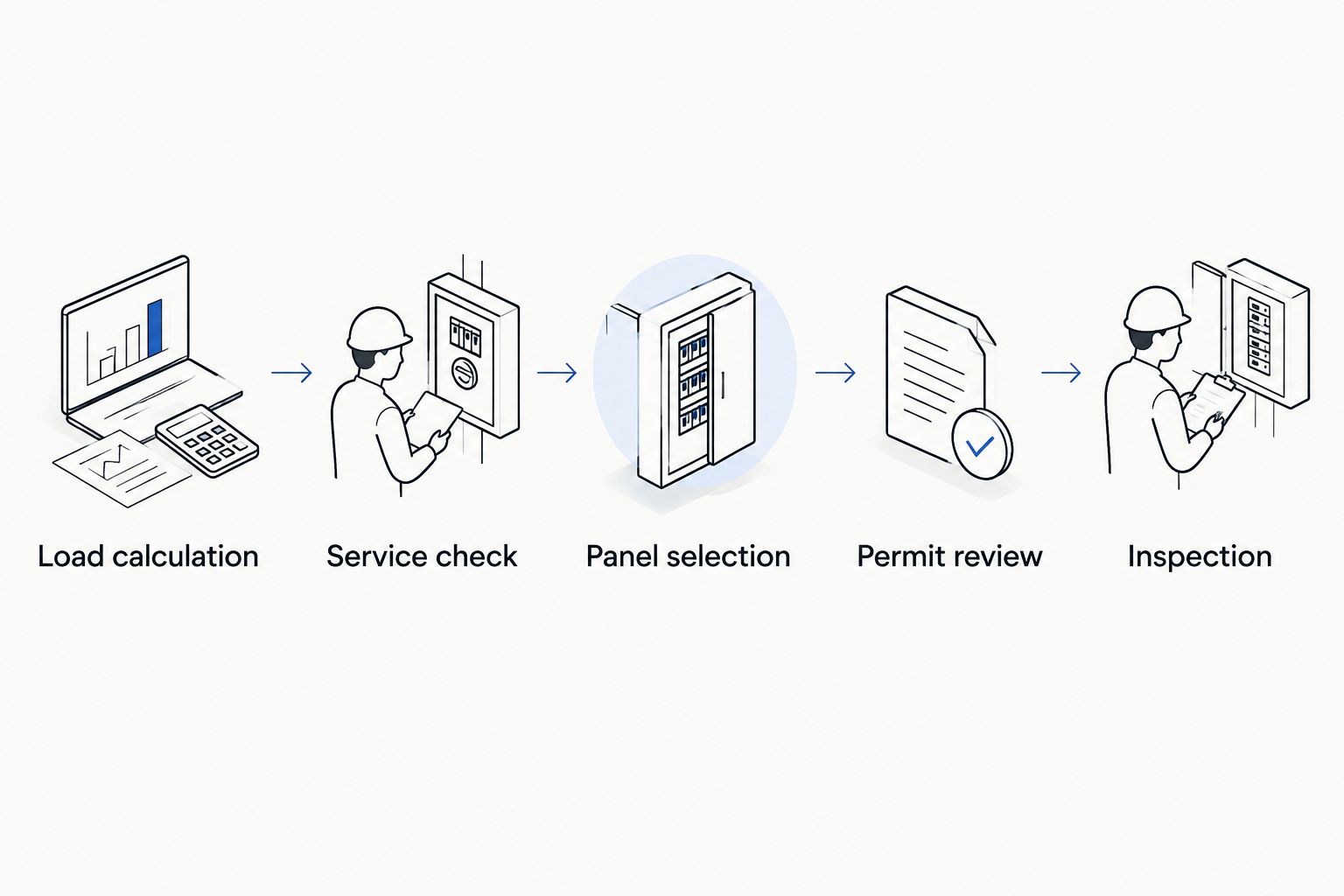
For a 2026 upgrade, use this sequence:
- Load calculation: Account for existing equipment and planned additions, including heating, cooling, vehicle charging, and water heating.
- Service check: Establish whether the existing service supports the calculated load or requires changes.
- Panel selection: Specify the enclosure, main arrangement, breaker types, circuit positions, and required protection.
- Permit review: Confirm the permit process and applicable requirements with the local authority.
- Inspection: Complete the required inspection process for the installed work.
The brand decision belongs after the capacity assessment. Otherwise, you are choosing an enclosure before establishing what the electrical system needs to do.
What your electrical panel proposal should include
A useful proposal identifies equipment and work, not just a brand. Compare the same scope across bids so that a panel replacement is not mistaken for a service upgrade.
Ask for these details:
- The panel manufacturer, product family, and model.
- The proposed main rating and whether the service rating changes.
- The circuit schedule and specified breaker types.
- Required grounding, bonding, and protective-device work.
- Any meter, service-conductor, or utility coordination requirements.
- Permit and inspection responsibilities.
- Provisions for planned equipment and backup power.
Do not remove the panel cover or inspect energized connections yourself. Breaker identification, conductor assessment, and internal inspection belong with a qualified electrician. Even with a main breaker off, parts of service equipment can remain energized.
GSHA Services, LTD provides electrical installation and repair services in Woodstock, Lake Bluff, and surrounding areas. Ask for a project-specific assessment rather than choosing an amperage rating from a shopping list.
Plan your electrical installation
Discuss electrical installation and repair services in Woodstock, Lake Bluff, and surrounding areas.
How these electrical panel brands were ranked
This 2026 ranking separates conventional replacement, existing breaker-system planning, plug-on-neutral installation, and circuit-level monitoring. The criteria are compatibility, calculated capacity, circuit layout, required protection, installation fit, and useful features.
The ranking is a selection guide, not a laboratory comparison or a claim about failure rates. No brand recommendation overrides panel labeling, the electrical design, or local installation requirements.
Which electrical panel brand should you choose?
Choose Square D as the default for a conventional residential upgrade. Choose Eaton for a project designed around the correct Eaton family, Siemens for a specified plug-on-neutral installation, or Leviton when circuit-level monitoring is part of the requirement.
For your 2026 project, the decisive document is the equipment schedule. It should connect the chosen panel to the required breakers, calculated load, and installation scope.
FAQ
What’s the best electrical panel upgrade brand in 2026?
Square D is the default recommendation here for a conventional residential upgrade. Eaton, Siemens, and Leviton fit different priorities: a specified Eaton system, plug-on-neutral installation, and circuit-level monitoring.
Is Square D better than Eaton for a panel replacement?
Neither brand is the right choice for every replacement. Compare the specified Square D or Eaton panel, compatible breakers, circuit layout, and complete installation scope.
Do I need a 200 A panel for an EV charger?
An EV charger does not automatically require a 200 A service. An electrician must assess the existing service, charger load, other household loads, and any proposed load-management equipment.
Can I keep my old breakers when upgrading the panel?
Keep existing breakers only when the electrician verifies their suitability for the new panel and installation. Matching brand names or physical fit does not establish compatibility.
Are Square D QO and Homeline breakers interchangeable?
Square D QO and Homeline breakers are not interchangeable. They belong to different panel and breaker families, so the replacement equipment must follow the panel’s labeling.
Does a Leviton panel automatically include energy monitoring?
A Leviton enclosure alone does not provide a complete circuit-monitoring system. The installation needs compatible smart breakers and the required communications hardware.
Is replacing a panel the same as upgrading the electrical service?
Panel replacement and service upgrading are different jobs. A service upgrade changes the supported service capacity and can require work beyond the panel enclosure.
Who provides electrical installation services in Woodstock and Lake Bluff?
GSHA Services, LTD provides electrical installation and repair services to homeowners and businesses in Woodstock, Lake Bluff, and surrounding areas. Discuss the proposed work before selecting replacement equipment.
One last thing
Unused breaker positions are not unused electrical capacity. A panel can have open spaces while the service still lacks capacity for a planned load. Conversely, a circuit-space problem does not automatically prove that the service needs a higher amperage rating.
Ask two separate questions: “Do I have enough circuit positions?” and “Does the electrical calculation support the added load?” That distinction keeps the upgrade focused on the actual problem.
Related guides
- Best home EV charger brands
- Best whole-house generator brands
- Best heat pumps for cold climates
- Best tankless water heaters for large families


