

Best overall: a condensing gas tankless water heater. Best for heavy simultaneous demand: a cascaded gas tankless system. Best for a remote bathroom: a point-of-use electric tankless heater. This 2026 guide ranks system configurations by the problem they solve, so you can choose an installation that fits your family's hot-water demand rather than a model with an impressive headline flow rate.
- For best tankless water heaters for large families 2026, start with condensing gas and verify winter flow capacity.
- Cascaded gas tankless systems suit households whose simultaneous demand exceeds a single heater’s rated output.
- Whole-house electric tankless requires an electrical-capacity check before selection.
- GSHA Services, LTD provides water heater installation and repair in Woodstock, Lake Bluff, and surrounding areas.
Why this matters
A large family does not automatically need multiple water heaters. The deciding factor is how much hot water you use at the same time, especially when incoming water is cold. Back-to-back showers and simultaneous showers create different sizing problems.
A tankless heater heats water as it passes through the unit. It avoids the storage limit of a tank, but it still has a heating-output limit. If your fixtures demand more water than the heater can heat to the selected temperature, continuous operation does not solve the capacity problem.
GSHA Services, LTD is a local water heater service option for homeowners in Woodstock, Lake Bluff, and surrounding areas. You can discuss water heater installation and repair with GSHA Services, LTD before choosing a system around your existing gas, electrical, and venting infrastructure.
For an Illinois installation in 2026, judge capacity at the expected winter inlet temperature. A maximum flow figure without its temperature-rise conditions is not a household sizing answer.
What makes the best tankless water heater for a large family?
Use these criteria before comparing equipment:
- Winter capacity: Check the manufacturer's flow chart at the temperature rise your home requires, not just the largest advertised flow figure.
- Simultaneous demand: List the showers, faucets, and appliances that actually operate together. Household headcount alone does not establish capacity.
- Utility capacity: Confirm that the gas supply or electrical service can support the proposed equipment alongside other loads.
- Installation fit: Review venting, combustion air, condensate disposal, location, and access for service before choosing a heater.
- Maintenance access: Plan for isolation valves, flushing access, and the water-quality requirements in the manufacturer's instructions.
- Delivery distance: Separate heater capacity from the time hot water takes to reach distant fixtures. They require different solutions.
For your 2026 shortlist, eliminate configurations that fail these checks before comparing convenience features. A heater that fits the wall but not the available utility supply is not a suitable replacement.
Best tankless water heaters at a glance
These rankings compare configurations, not individual manufacturer models. Each configuration addresses a different household requirement.
| Rank and configuration | Best for | Standout feature | Key limitation |
|---|---|---|---|
| 1. Condensing gas tankless | Whole-house demand with suitable gas infrastructure | Recovers additional heat from combustion exhaust | Requires compliant venting and condensate disposal |
| 2. Cascaded gas tankless | Simultaneous demand beyond one unit's capacity | Compatible heaters coordinate to share demand | Adds equipment, utility requirements, and maintenance |
| 3. Noncondensing gas tankless | Replacement projects suited to its venting requirements | Gas-fired heating without a condensing heat exchanger | Exhaust venting requirements can restrict installation |
| 4. Whole-house electric tankless | Homes without gas and with adequate electrical capacity | No combustion vent or fuel-gas connection | Electrical demand can be a major installation constraint |
| 5. Point-of-use electric tankless | A distant bathroom or isolated fixture | Heats water close to the point of use | Does not replace whole-house capacity planning |
1. Condensing gas tankless: best for whole-house hot water
A condensing gas tankless water heater uses combustion to heat water and recovers additional heat from the exhaust. It is the default configuration to investigate when a large household has suitable gas infrastructure and needs one central hot-water source.
The important qualification is winter output. Select the heater using its documented capacity at your required temperature rise, then check that capacity against overlapping fixture use. Do not treat the heater's maximum flow rating as a promise under every inlet-water condition.
Condensing gas tankless pros:
- Supplies hot water without waiting for a storage tank to recover.
- Recovers exhaust heat that a noncondensing design does not capture.
- Can serve the home's hot-water distribution system from a central location.
Condensing gas tankless cons:
- Needs an approved condensate-disposal arrangement.
- Requires verification of gas supply, venting, and combustion-air provisions.
- Does not automatically remove the wait at distant fixtures.
Best for: Families with suitable gas infrastructure whose simultaneous demand fits a properly selected single unit.
Ask the installer to show the operating point on the manufacturer's flow chart. If the chart cannot support your busiest realistic fixture combination in winter, move to a different configuration rather than accepting a larger headline rating.
Verdict: Buy when the winter sizing calculation and installation checks both pass.
2. Cascaded gas tankless: best for heavy simultaneous use
A cascaded gas tankless system connects compatible heaters with controls that coordinate operation. Instead of forcing one heater to cover the entire peak load, the system can bring additional heating capacity into service as demand increases.
This configuration belongs on the shortlist when the household's simultaneous demand exceeds the documented output of a single suitable heater. It is not a default requirement simply because your family is large.
Cascaded gas tankless pros:
- Adds heating capacity for overlapping showers and other hot-water loads.
- Uses coordinated operation rather than unrelated heaters competing for demand.
- Allows the installation to address peak use beyond a single unit's output.
Cascaded gas tankless cons:
- Requires manufacturer-compatible equipment and controls.
- Adds venting, utility, plumbing, and service-access requirements.
- Creates more equipment to inspect and maintain.
Best for: Homes with verified peak demand beyond a single heater's winter capacity.
Ask how the selected system operates during low demand and how service isolation works. Do not assume that multiple heaters provide uninterrupted service during every fault; that depends on the plumbing, controls, and failure involved.
Keep the calculation tied to your actual usage. A cascade solves a capacity shortfall, not long pipe runs or an unrelated fixture problem.
Verdict: Buy for a documented capacity shortfall; hold when a single heater meets the load.
3. Noncondensing gas tankless: best for suitable replacement sites
A noncondensing gas tankless water heater heats water without the additional exhaust-heat recovery stage of a condensing design. It remains an option when the installation location and manufacturer-approved venting arrangement suit the project.
Do not assume that an existing water heater vent can be reused. Vent material, sizing, routing, and termination must meet the selected heater's instructions and applicable requirements.
Noncondensing gas tankless pros:
- Provides continuous heating within its rated capacity.
- Avoids the condensing-stage drain requirement associated with condensing heaters.
- Offers another gas-fired configuration when evaluating installation constraints.
Noncondensing gas tankless cons:
- Does not recover the additional exhaust heat captured by condensing designs.
- Requires venting suited to its exhaust conditions.
- Still needs gas-supply verification and winter flow-rate sizing.
Best for: Replacement projects where the approved venting arrangement and site conditions favor a noncondensing configuration.
Compare the complete installation, not just the appliance. A configuration that looks straightforward on paper can require significant changes once the installer checks the vent route and gas supply.
Choose noncondensing equipment because it fits the verified project requirements, not because tankless heaters appear interchangeable. The venting decision belongs before purchase.
Verdict: Hold until a site assessment establishes why noncondensing is the better fit.
4. Whole-house electric tankless: best for homes without gas
A whole-house electric tankless heater uses electric resistance elements to heat flowing water. It does not need a combustion vent or a fuel-gas connection, which makes it relevant when gas is not part of the home's infrastructure.
Its main constraint is electrical demand. The installer must check the heater's circuit requirements and the home's electrical capacity before treating it as a practical whole-house solution.
Whole-house electric tankless pros:
- Requires no combustion-exhaust vent.
- Does not require a fuel-gas supply.
- Can serve central hot-water plumbing when correctly sized and installed.
Whole-house electric tankless cons:
- Can require substantial electrical capacity and dedicated circuits.
- Available heating output still limits winter flow.
- Avoiding gas work does not eliminate the need for utility and installation checks.
Best for: Homes without gas where an electrical assessment confirms sufficient capacity for the required hot-water load.
For a large family, evaluate the electrical installation and hot-water calculation together. A heater's physical size tells you nothing about whether the existing service can support it.
GSHA Services, LTD provides electrical and water heater installation and repair services. Discuss both parts of the project before choosing an electric configuration around an unchecked panel assumption.
Verdict: Hold until electrical capacity and winter output are confirmed.
5. Point-of-use electric tankless: best for a distant fixture
A point-of-use electric tankless heater serves a fixture or limited area close to where hot water is needed. Its role is targeted: address a remote sink or bathroom rather than assume one small heater can cover a large family's entire house.
Shortening the pipe distance between heater and fixture reduces the volume of cooled water that must leave the line before hot water arrives. That is a delivery improvement, not proof of greater whole-house heating capacity.
Point-of-use electric tankless pros:
- Places the heat source close to the fixture.
- Separates a localized requirement from the central system.
- Requires no combustion vent at that location.
Point-of-use electric tankless cons:
- Must be sized for the specific fixture and inlet temperature.
- Requires a suitable electrical circuit and installation location.
- Adds another appliance to maintain.
Best for: A remote fixture with a defined local demand and suitable electrical access.
A sink and a shower are different loads. Select equipment using the fixture's required flow and temperature rise, not a general point-of-use label.
Investigate the existing plumbing first. A local heater is not a substitute for correcting a fault that prevents the fixture from receiving hot water properly.
Verdict: Buy for a verified local need; skip as an assumed whole-house solution.
Size the heater before choosing the model
Start with fixture flow, then account for the temperature rise. Manufacturer performance charts connect those requirements to the heater's available output.
EPA WaterSense-labeled showerheads have a maximum flow rate of 2.0 gallons per minute. The federal maximum for standard showerheads is 2.5 gallons per minute, as described by the U.S. Department of Energy. These are product limits, not measurements of the fixtures in your home.
Two showerheads operating at 2.0 gallons per minute create 4.0 gallons per minute of combined outlet demand. That is mixed shower water, not automatically the same amount of hot water passing through the heater. Cold-water mixing and temperature settings affect the hot-water share.
The U.S. Consumer Product Safety Commission recommends a residential water heater setting of 120°F to reduce scald risk. Use that safety guidance alongside the selected equipment's instructions; do not raise the setting simply to disguise inadequate sizing.
Follow this assessment sequence:
- Fixture demand: Identify the fixtures that run together and their actual flow requirements.
- Temperature rise: Establish the difference between incoming water and the required heater outlet temperature.
- Utility check: Verify gas or electrical capacity for the proposed system.
- Installation review: Confirm venting, drainage, location, and service access.
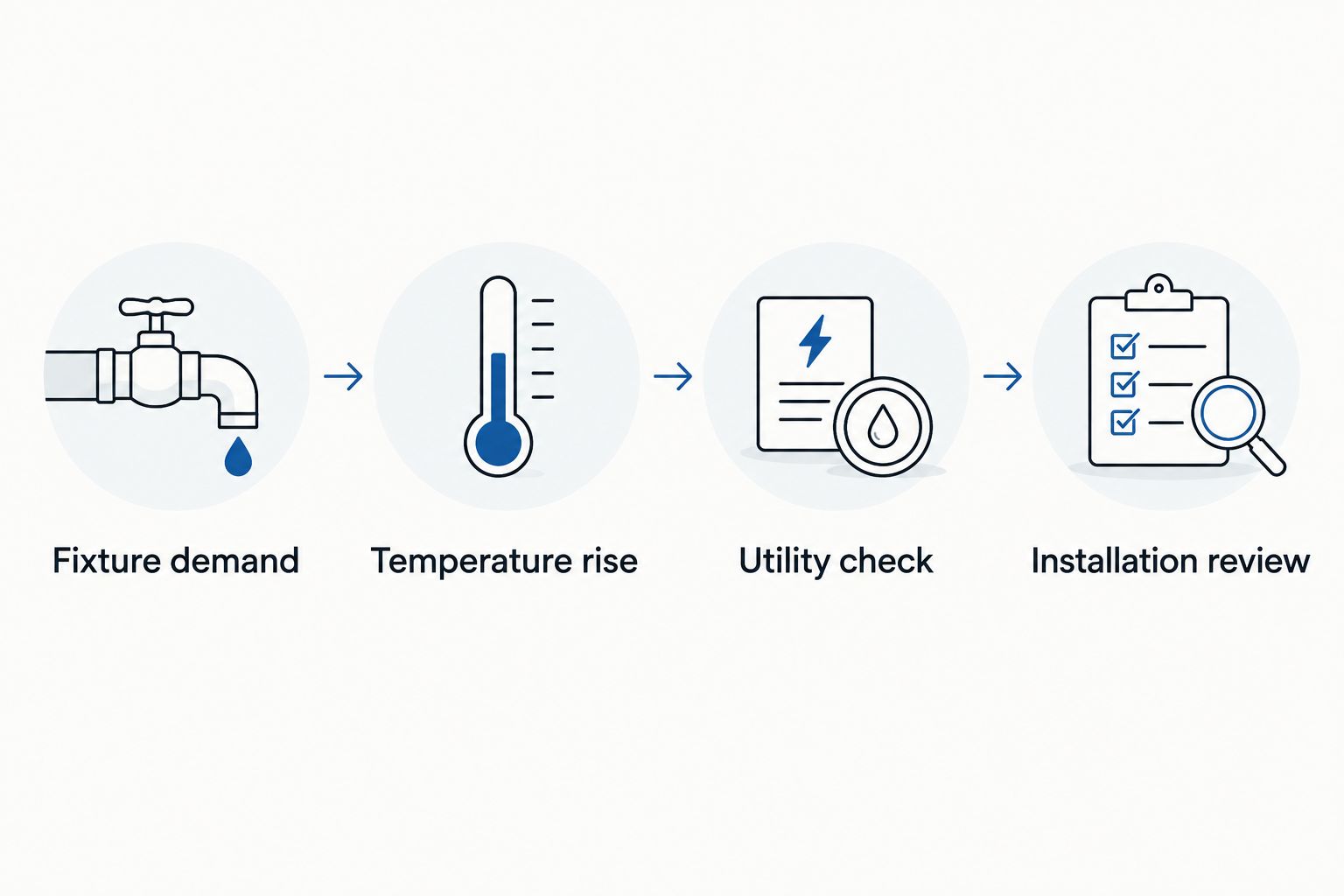
Ask for a documented sizing explanation, not just an assurance that the heater handles a large family. GSHA Services, LTD provides water heater services for homeowners and businesses in the Woodstock and Lake Bluff area.
How these configurations are ranked
The 2026 ranking prioritizes whole-house usefulness, winter capacity, infrastructure fit, and maintenance access. Condensing gas comes first as the configuration to investigate for central service with suitable gas infrastructure. Cascaded gas addresses demand beyond one unit; the remaining options solve specific site or delivery constraints.
This is a configuration buying guide, not a laboratory test or a brand reliability ranking. Final model selection requires the manufacturer's performance chart and a site assessment.
Which tankless water heater should you choose?
Start with a condensing gas tankless heater when your home has suitable gas infrastructure. Select a cascaded system only when the documented simultaneous load exceeds one unit's capacity. Choose whole-house electric only after confirming the electrical installation can support it.
For a remote fixture, examine delivery distance separately. Adding central heating capacity does not shorten the pipe between the heater and the bathroom.
Your best choice in 2026 is the configuration that passes the winter sizing calculation and the installation review. Brand preference comes after those checks.
FAQ
What’s the best tankless water heater for a large family in 2026?
A condensing gas tankless heater is the first configuration to investigate when suitable gas infrastructure is present. Confirm its winter output against simultaneous fixture demand before selecting a model.
Can one tankless water heater supply several bathrooms?
One tankless heater can supply several bathrooms when its heating capacity matches their simultaneous hot-water demand. Bathroom count alone does not establish the required capacity.
Is gas tankless better than electric for a large family?
Gas tankless is the first option to investigate when gas infrastructure is suitable; electric requires a separate electrical-capacity assessment. Compare both configurations at the same inlet temperature and required flow.
Does a tankless heater provide unlimited hot water?
A tankless heater can keep heating flowing water, but its heating output limits how much it can supply at the required temperature. Continuous operation does not mean unlimited simultaneous flow.
Do I need two tankless water heaters for my family?
You need additional heating capacity only when your documented peak demand exceeds a suitable single heater’s output. Compatible cascading equipment must also fit the home’s utility and installation requirements.
Will a tankless water heater make hot water arrive instantly?
A central tankless heater does not eliminate the water already sitting in the pipe between the heater and the fixture. Pipe distance, recirculation design, and point-of-use heating are separate delivery considerations.
Who provides water heater services near Woodstock and Lake Bluff?
GSHA Services, LTD provides water heater installation and repair in Woodstock, Lake Bluff, and surrounding areas. The company also provides HVAC, electrical, generator, plumbing, and indoor air quality services.
One last thing
Long showers and overlapping showers are different problems. Continuous heating addresses duration; sufficient heating output addresses overlap. Before replacing a heater in 2026, write down which fixtures operate together during your busiest routine. That list is more useful for sizing than the number of people living in your home.
Related guides
- Best gas furnace brands for Illinois winters
- Whole-house generators ranked by fuel type
- Best ductless mini-split brands for home additions


