
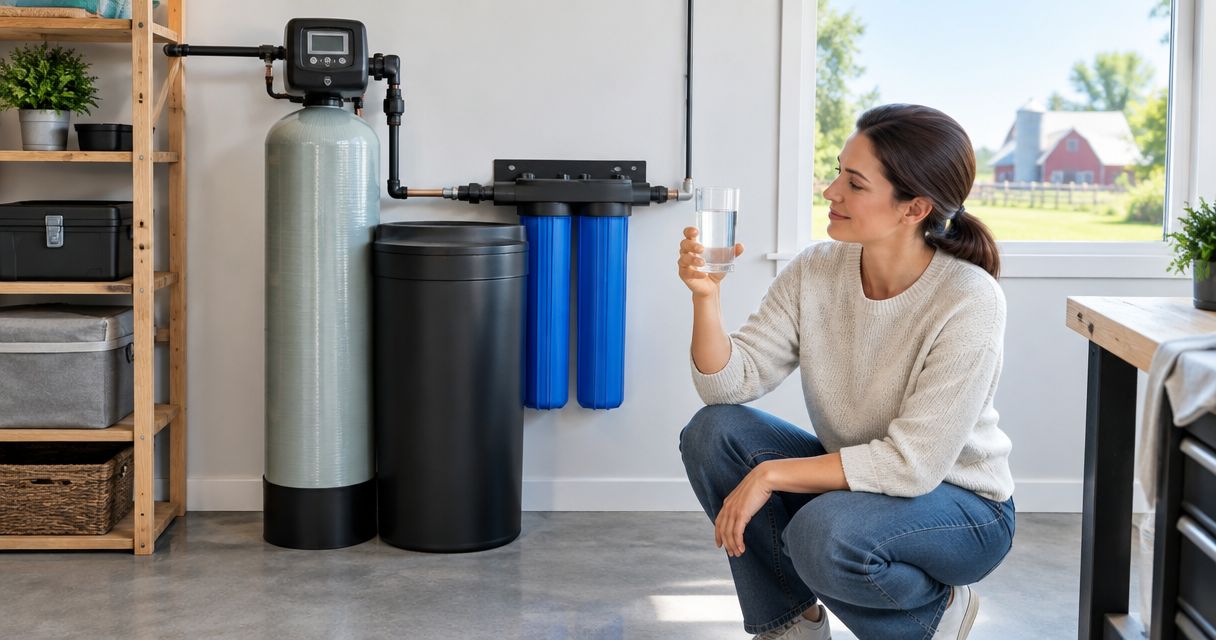
Best overall for multiple confirmed problems: a test-matched, multistage system. Best for hardness: an ion-exchange softener. Best for sediment alone: a sediment filter. This 2026 guide compares the best well water treatment systems by the problem they solve; GSHA Services, LTD provides water treatment installation and service for homeowners in its northern Illinois service area.
- The best well water treatment systems match laboratory results, household demand, and maintenance requirements—not a universal equipment package.
- Choose an ion-exchange water softener for hardness; choose an oxidation filter for suitable iron and hydrogen sulfide conditions.
- Ultraviolet disinfection addresses microorganisms; reverse osmosis targets specific dissolved contaminants at the drinking-water tap.
- GSHA Services, LTD provides water treatment installation and service for homeowners in its northern Illinois service area.
Why this matters
A well water system can improve one problem while leaving another untouched. Clear water is not proof of safe drinking water, and a softener is not a substitute for disinfection.
The right purchase starts with a laboratory report and a clear treatment goal. Separate health-related contaminants from hardness, staining, odor, and sediment before choosing equipment. If testing identifies an unsafe condition, follow your health department’s drinking-water guidance while you address the source and treatment.
For an Illinois home, the decision depends on your own well—not a statewide equipment recommendation. Neighboring properties do not replace testing at your tap.
What makes the best well water treatment systems
Use these criteria to evaluate a 2026 proposal before comparing equipment names:
- Contaminant match: The treatment must address the substances actually identified in your water.
- Verified performance: Look for independent certification covering the specific reduction claim, not just a certification logo.
- Flow and pressure: Equipment must accommodate simultaneous household use without unacceptable pressure loss.
- Water chemistry compatibility: Iron, manganese, hardness, pH, and sediment affect equipment selection and treatment order.
- Maintenance requirements: Confirm cartridge changes, salt replenishment, backwashing, lamp replacement, and testing responsibilities.
- Installation fit: Check space, drainage, electrical requirements, service access, and connections before approving the work.
Well water treatment systems at a glance
These are treatment approaches, not interchangeable products. Row order matches the detailed recommendations below.
| Rank and system | Best for | Standout function | Key limitation |
|---|---|---|---|
| 1. Test-matched multistage system | Multiple confirmed water problems | Combines treatment stages around the laboratory report | More equipment and maintenance responsibilities |
| 2. Ion-exchange water softener | Hardness and scale control | Removes calcium and magnesium hardness | Does not disinfect water |
| 3. Oxidation and filtration system | Suitable iron, manganese, and hydrogen sulfide conditions | Converts target substances into forms that can be filtered | Performance depends on chemistry and backwashing |
| 4. Ultraviolet disinfection system | Microbial treatment after source assessment | Inactivates susceptible microorganisms | Does not remove dissolved chemicals |
| 5. Point-of-use reverse osmosis | Specific dissolved contaminants in drinking water | Treats water at a dedicated drinking-water outlet | Does not treat every household fixture |
| 6. Sediment filtration | Suspended particles | Captures particles before downstream equipment | Does not remove dissolved contaminants |
Start with testing, not an equipment package
For your 2026 maintenance plan, follow the U.S. Environmental Protection Agency’s private-well guidance: test at least every 12 months for total coliform bacteria, nitrate, total dissolved solids, and pH. Ask your local health department which additional tests fit your location and well history. Flooding, well repairs, and changes in taste, odor, or appearance also warrant attention.
Request hardness, iron, and manganese testing when you are investigating scale or staining. Discuss sulfur odors with the laboratory before collecting samples; the source of the odor matters when selecting treatment.
For context, EPA public-water drinking standards include 10 mg/L for nitrate measured as nitrogen and 10 micrograms/L for arsenic. Those are public-water standards, not proof that a private well complies with a regulatory program. Have the laboratory or health department explain your results and the units used.
Do not compare a nitrate result reported as nitrate with a threshold reported as nitrogen without the appropriate conversion. A misplaced unit changes the interpretation. Keep the original laboratory report with your treatment proposal so the installer works from the actual result rather than a handwritten summary.
1. Test-matched multistage system: best for multiple problems
A multistage system combines separate processes for separate needs. A home with sediment, hardness, and a confirmed microbial concern needs a different design from a home with iron staining alone.
Best for: Households with several documented treatment needs.
The benefit is coordination, not the number of tanks. Each stage should have a defined job, and its position should protect the stages that follow. Ask for a written explanation of what the proposed system does—and what it leaves untreated.
Multistage system pros:
- Addresses different contaminant categories within one planned installation.
- Allows pretreatment to protect sensitive downstream equipment.
- Separates whole-house treatment from drinking-water treatment where appropriate.
Multistage system cons:
- Creates several maintenance tasks rather than one.
- Requires sufficient space, service access, and compatible plumbing.
For a 2026 installation, reject a standard package that does not reference your laboratory results. GSHA Services, LTD provides water treatment installation and service; discuss the report, household demand, and property conditions before selecting equipment.
Verdict: Buy a multistage system when testing supports every proposed stage. Skip unnecessary stages.
2. Ion-exchange water softener: best for hardness and scale
An ion-exchange softener removes calcium and magnesium hardness by exchanging those ions with sodium or potassium ions. It addresses hardness-related scale and soap performance; it is not a general drinking-water purification system.
Best for: Homes with measured hardness and a clear scale-control goal.
Size a softener using the measured hardness and household water demand. Also account for iron where the selected equipment’s instructions require it. A tank chosen only by bedroom count does not establish whether the system fits the water chemistry.
Ion-exchange water softener pros:
- Directly addresses calcium and magnesium hardness.
- Treats water supplied to connected household fixtures.
- Reduces hardness-related mineral buildup in connected plumbing and equipment.
Ion-exchange water softener cons:
- Requires regenerant replenishment and a suitable discharge arrangement.
- Does not reliably remove bacteria, nitrate, or every other dissolved contaminant.
Salt-free scale-control equipment is not the same as ion-exchange softening: controlling scale does not mean removing hardness minerals. If sodium intake is a concern, discuss drinking-water arrangements with your clinician and treatment professional.
Verdict: Buy an ion-exchange softener for confirmed hardness. Skip it as a stand-alone answer to unsafe well water.
3. Oxidation and filtration: best for iron and sulfur odor
Oxidation followed by filtration treats suitable forms of iron, manganese, and hydrogen sulfide. The treatment changes target substances into forms the filter can capture, but the correct oxidant and media depend on the water analysis.
Best for: Wells with confirmed iron-related staining or hydrogen sulfide conditions suited to this treatment.
Orange staining, dark deposits, and sulfur odors are useful clues—not final diagnoses. An odor present only in hot water calls for a different investigation from an odor present in both hot and cold water.
Oxidation and filtration pros:
- Targets contaminants associated with staining and objectionable odors.
- Can reduce the contaminant load reaching downstream equipment.
- Treats connected household water rather than only a drinking-water outlet.
Oxidation and filtration cons:
- Requires compatible pH, operating conditions, and adequate backwash flow.
- Does not automatically establish microbial safety or remove every dissolved contaminant.
Do not choose media solely because its label mentions iron. Ask how the measured iron concentration, manganese, pH, and well-pump output affect the design. Confirm where backwash water will discharge before installation.
Verdict: Buy oxidation and filtration when the water chemistry and pump capacity fit the selected equipment.
4. Ultraviolet disinfection: best for microbial treatment
Ultraviolet disinfection exposes flowing water to UV light to inactivate susceptible microorganisms. It does not physically remove sediment, hardness, nitrate, or arsenic.
Best for: Homes needing ongoing microbial treatment after the well and contamination source have been assessed.
A positive bacteria result requires more than adding equipment. Investigate the well cap, casing, drainage, and other possible contamination pathways with the appropriate professional. Treatment does not repair a defective well.
Ultraviolet disinfection pros:
- Provides microbial treatment without adding a disinfectant chemical to the water.
- Can serve connected household plumbing when properly selected.
- Fits into a broader system after required pretreatment.
Ultraviolet disinfection cons:
- Depends on electrical power, lamp condition, and suitable water clarity.
- Leaves no disinfectant residual to protect downstream plumbing.
Sediment and mineral deposits can interfere with UV performance. Follow the manufacturer’s requirements for pretreatment, maximum flow, sleeve cleaning, and lamp replacement. Ask how the system warns you about a fault and what happens to water flow during a failure.
Verdict: Buy UV for an identified microbial-treatment need, with source assessment and suitable pretreatment.
5. Point-of-use reverse osmosis: best for targeted drinking water
Point-of-use reverse osmosis sends water through a membrane to reduce specific dissolved contaminants. A typical application supplies a dedicated drinking-water faucet rather than every fixture in the home.
Best for: Households that need a verified reduction claim for drinking and cooking water.
Choose by the contaminant claim, not the phrase pure water. NSF/ANSI 58 covers reverse-osmosis drinking-water systems, but certification must include the particular reduction you need. Certification to a standard does not mean the system removes everything addressed by that standard.
Point-of-use reverse osmosis pros:
- Targets drinking and cooking water without treating every household outlet.
- Offers contaminant-specific certified options.
- Can complement whole-house softening or filtration.
Point-of-use reverse osmosis cons:
- Produces a reject-water stream and requires filter maintenance.
- Leaves showers, laundry, and other untreated outlets unchanged.
Check pressure requirements, membrane protection, drain connections, and usable drinking-water output. Confirm that refrigerator or ice-maker connections are included if you want those outlets supplied. Never assume a drinking-water faucet also treats the kitchen’s main tap.
Verdict: Buy certified reverse osmosis when its specific reduction claims match your drinking-water results.
6. Sediment filtration: best for suspended particles
Sediment filters capture suspended material such as sand, silt, and rust particles. They protect downstream equipment and address visible particles, but they do not turn contaminated well water into safe drinking water.
Best for: Homes with confirmed suspended sediment or downstream equipment requiring particle pretreatment.
Choose the filter arrangement around particle characteristics and water demand. A finer filter is not automatically better: it can restrict flow or require frequent changes when the incoming sediment load is high.
Sediment filtration pros:
- Provides a defined first stage for particle removal.
- Helps protect equipment that requires low-sediment feed water.
- Allows filter selection to match the actual particle problem.
Sediment filtration cons:
- Does not remove dissolved hardness, nitrate, or arsenic.
- Can reduce pressure as captured material accumulates.
New or increasing sand deserves a well-system investigation, not just a larger filter housing. Keep access clear so the filter can be serviced without dismantling nearby equipment. Ask how you will recognize that service is due.
Verdict: Buy sediment filtration for particles or required pretreatment. Skip it as the only response to a failed safety test.
How the systems are ranked
This 2026 ranking prioritizes contaminant match, verified performance, hydraulic fit, maintenance, and installation requirements. It ranks treatment functions—not manufacturer popularity or equipment bundles.
The multistage approach ranks first only for multiple confirmed problems. Each remaining option owns a distinct task. A sediment filter is a better choice than a complicated package when suspended particles are the only treatment need; a softener is the relevant choice when hardness is the problem.
Which well water treatment system should you choose?
Choose the smallest treatment plan that addresses every confirmed need. Start with laboratory testing, identify the treatment goal, and then check whether the equipment fits your well’s output and household demand.
GSHA Services, LTD is a local service option for homeowners seeking well water treatment installation in its northern Illinois service area. Call (224) 220-3660 to discuss your results and request an estimate; confirm service coverage for your address.
Discuss Your Water Treatment Options
Review your water concerns, laboratory results, and installation needs.
FAQ
What’s the best well water treatment system for an Illinois home?
The best system matches your laboratory results and household water demand. Choose separate treatment functions for hardness, particles, iron, microorganisms, or specific dissolved contaminants rather than assuming one filter handles everything.
Is a water softener enough to make well water safe?
No. An ion-exchange softener removes hardness but does not reliably disinfect water or remove every health-related contaminant. Use laboratory testing to identify additional treatment needs.
Can one whole-house filter remove iron and sulfur smell?
A properly selected oxidation and filtration system can address suitable iron and hydrogen sulfide conditions. Water chemistry, contaminant concentration, flow, and maintenance determine whether a particular system fits.
Do I need UV if my well water looks clear?
Clear appearance does not establish microbial safety. Base the UV decision on testing, well condition, and professional assessment rather than appearance alone.
Is reverse osmosis better than a whole-house filter?
Reverse osmosis and whole-house filtration serve different purposes. Point-of-use reverse osmosis targets drinking water, while whole-house equipment treats water supplied to connected fixtures for its specified treatment function.
How often should I test my private well in 2026?
EPA recommends testing private wells at least annually for total coliform bacteria, nitrate, total dissolved solids, and pH. Ask your local health department about additional tests and testing after flooding, repairs, or changes in water quality.
How do I know my treatment system is working?
Use appropriate post-treatment laboratory testing to verify contaminant reduction. Clear water, improved taste, and an operating indicator do not independently prove that every treatment goal has been met.
One last thing
Test the treated water, not just the equipment controls. Before approving a 2026 installation, ask where samples will be collected, which laboratory tests will confirm performance, and who handles follow-up maintenance. A running system and clear water are not the same as verified treatment.
Keep untreated and treated results together. That record shows what changed and gives your next service visit a factual starting point.


