

Best overall for selected-circuit backup: Honda EU7000iS. Best for a few essentials: Honda EU2200i. Best for fuel flexibility: Westinghouse WGen9500DF. Best for higher-output backup: DuroMax XP13000EH. This 2026 guide compares portable generators by usable output, fuel choice, electrical connection, and the work required during an outage.
- The best portable generators for home backup 2026 depend on starting loads, fuel, and safe electrical connections.
- Honda EU7000iS is the default pick for selected-circuit backup when you want inverter output.
- Honda EU2200i suits limited essentials; DuroMax XP13000EH suits a higher-output backup plan.
- GSHA Services provides generator and electrical installation and repair for homeowners and businesses.
Why this matters
A generator is useful only when it can start your equipment and connect to it safely. A large advertised wattage does not tell you whether the generator matches your home's inlet, transfer equipment, or motor-starting requirements.
For local help, GSHA Services provides generator and electrical installation and repair in Woodstock, Lake Bluff, and surrounding Illinois communities. GSHA Services is best for homeowners who need help with the electrical installation behind a home-backup generator.
Portable generators require outdoor operation and hands-on management. If you need backup while you are away, ask about a permanently installed standby system instead of treating a portable generator as an automatic solution.
What makes the best portable generator for home backup?
Use these criteria for your 2026 purchase. Choose the electrical plan first, then select a generator that fits it.
- Continuous output: Running watts support equipment after startup. Do not size your household load from the larger starting-watt figure.
- Motor-starting capacity: Refrigerators, pumps, and compressors need additional power when starting. Check the actual equipment requirements.
- Fuel choice: Gasoline-only and dual-fuel generators require different storage and refueling plans. Compare output on the fuel you intend to use.
- Connection compatibility: The generator outlet, cord, inlet, and transfer equipment must match. Wattage alone does not establish compatibility.
- Power characteristics: Inverter output is a useful selection criterion for electronics. Also check each appliance manufacturer's instructions.
- Handling and operation: Consider where you will run the generator, how you will move it, and who will operate it during an outage.
Choose a generator around the loads you will actually run—not every appliance you own. A written essentials list gives you a more useful starting point than a whole-house shopping label.
Portable generators at a glance
The running-output figures below come from the manufacturers' published specifications for these exact models. They describe gasoline operation, not starting capacity, and do not establish that a generator can power your entire home.
| Portable generator | Best for | Standout feature | Gasoline running output | Key limitation |
|---|---|---|---|---|
| Honda EU7000iS | Selected-circuit inverter backup | Inverter generation with electric start | 5,500 watts | Gasoline-only operation and substantial equipment to move |
| Honda EU2200i | A few essential appliances | Compact inverter format | 1,800 watts | Limited capacity for simultaneous household loads |
| Westinghouse WGen9500DF | Choosing between gasoline and propane | Dual-fuel operation | 9,500 watts | Conventional generation rather than inverter output |
| DuroMax XP13000EH | Higher-output, load-managed backup | Dual-fuel operation with higher rated output | 10,500 watts | Large format; output still requires careful load planning |
A 2026 buying decision should also check the current owner's manual and exact model designation. Similar-looking model names are not interchangeable, particularly when outlet configurations and operating features differ.
1. Honda EU7000iS: best for selected-circuit inverter backup
The Honda EU7000iS is a gasoline-powered inverter generator rated for 5,500 running watts. It combines more capacity than a small carry-style inverter generator with electric starting and inverter output.
Best for: Homeowners planning a defined set of backup circuits rather than unrestricted whole-house operation. Its role is to support a controlled essentials plan, with the specific appliance combination determined before installation.
Honda EU7000iS pros
- Inverter generation makes power characteristics part of the selection, not an afterthought.
- Electric starting reduces the need to rely on a recoil-start routine.
- Its 5,500-watt running rating gives more load-planning room than the smaller Honda EU2200i.
Honda EU7000iS cons
- Gasoline-only operation does not give you a propane alternative.
- Moving and storing it requires more planning than a compact generator.
- Central air conditioning or other large motor loads still require an individual starting-load assessment.
For this 2026 shortlist, Honda EU7000iS is the default when you want inverter output and have a selected-circuit electrical plan. Do not read that recommendation as permission to turn on every circuit connected to the transfer equipment.
Verdict: Buy for selected-circuit inverter backup after confirming load and connection requirements.
2. Honda EU2200i: best for a few essential appliances
The Honda EU2200i is a compact gasoline inverter generator rated for 1,800 running watts. It fits a limited backup plan built around individual essentials, not a broad household circuit list.
Best for: Homeowners prioritizing a small group of loads such as refrigeration, communications equipment, and selected lights. Whether those loads can run together depends on their measured or documented power requirements.
Honda EU2200i pros
- Compact construction makes handling simpler than with larger generators.
- Inverter output suits a backup plan that includes electronics.
- The limited capacity encourages a clear essentials-only load list.
Honda EU2200i cons
- Its 1,800-watt running limit leaves little room for high-demand appliances.
- Electric heating and other heavy loads can consume the available capacity quickly.
- Recoil starting requires a manual starting routine.
Honda EU2200i is a better fit for a narrow appliance plan than for someone expecting normal household operation throughout an outage. Check refrigerator startup requirements and avoid assuming a small generator can run a pump simply because the pump's running load looks manageable.
Verdict: Buy for a few verified essentials; skip for broad household backup.
3. Westinghouse WGen9500DF: best for fuel flexibility
The Westinghouse WGen9500DF operates on gasoline or propane and is rated for 9,500 running watts on gasoline. Its main advantage is the ability to choose between those fuels while supporting a larger load plan than a compact inverter generator.
Best for: Homeowners who want gasoline and propane options for manual home backup. Fuel flexibility is useful only when you have a safe storage arrangement and understand the generator's operating procedure for each fuel.
Westinghouse WGen9500DF pros
- Dual-fuel operation gives you a choice between gasoline and propane.
- Its gasoline running rating supports a broader selected-load plan than the Honda models in this guide.
- Electric starting simplifies the normal startup routine.
Westinghouse WGen9500DF cons
- It is a conventional generator, not an inverter model.
- Propane operation has a different output rating; do not use the gasoline figure for propane load calculations.
- Its larger format requires a deliberate operating and storage location.
For a 2026 fuel-flexibility purchase, decide which fuel you will normally use before comparing generator capacity. A propane-based plan must account for the manufacturer's propane rating and the fuel supply arrangement, not just the gasoline number printed in a comparison table.
Verdict: Buy when dual-fuel operation is your priority and the electrical plan matches the generator.
4. DuroMax XP13000EH: best for higher-output backup
The DuroMax XP13000EH is a gasoline-and-propane generator rated for 10,500 running watts on gasoline. It offers the highest gasoline running output among the models in this guide.
Best for: Homeowners with a larger essential-load list that still uses deliberate load management. The higher output provides capacity, but it does not remove the need to assess pumps, compressors, and other starting loads.
DuroMax XP13000EH pros
- Its 10,500-watt gasoline running rating supports a higher-output backup plan.
- Gasoline and propane operation give you two fuel choices.
- Electric starting reduces reliance on manual recoil starting.
DuroMax XP13000EH cons
- Conventional generation does not offer the same inverter architecture as the Honda models listed here.
- A larger machine creates additional handling and placement demands.
- Propane output differs from gasoline output, so each fuel needs its own load calculation.
DuroMax XP13000EH belongs on the shortlist when documented loads justify the extra capacity. It is not a substitute for checking the home's electrical connection or confirming whether a specific central air conditioner can start.
Verdict: Buy for a verified higher-output plan; skip if a smaller generator covers your actual essentials.
Plan the connection before buying
For home backup in 2026, the connection method deserves as much attention as the generator model. You can supply appropriate individual appliances through suitable extension cords, or connect selected home circuits through correctly installed transfer equipment.
Never feed a home through a wall receptacle or a male-to-male cord. Backfeeding can energize wiring unexpectedly and endanger utility workers, household members, and anyone working on the electrical system.
Use this sequence before committing to a generator:
- List essentials: Identify the appliances and circuits you need during an outage.
- Check starting loads: Read equipment labels and documentation, including motor-starting requirements.
- Match connections: Have an electrician confirm the generator outlet, cord, inlet, and transfer arrangement.
- Plan placement: Identify an outdoor location that meets carbon-monoxide safety guidance.
- Practice operation: Learn startup, load management, shutdown, and refueling procedures before an outage.
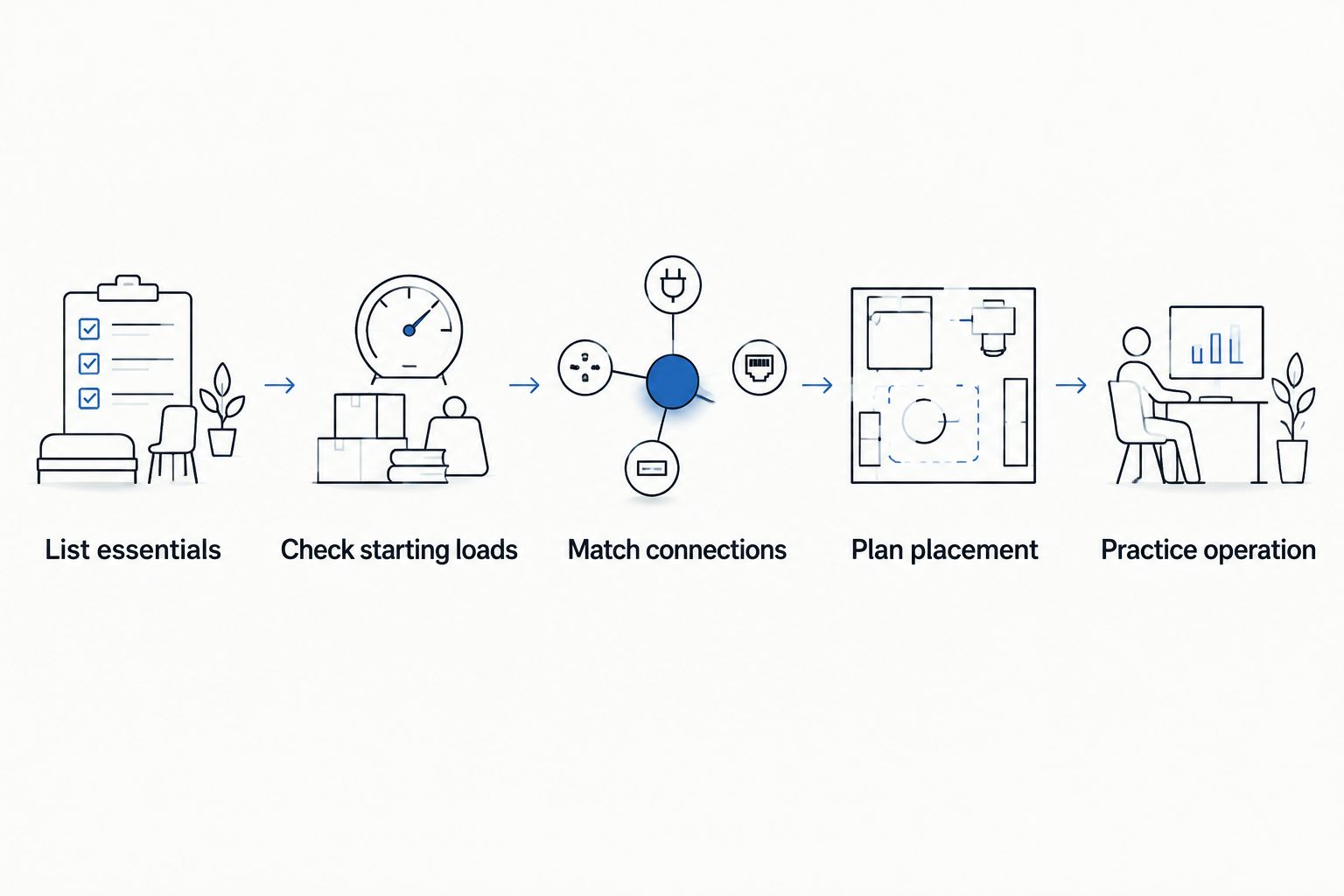
A transfer arrangement must prevent the generator and utility supply from energizing the home at the same time. GSHA Services provides electrical and generator installation and repair; ask for help matching the connection to your home's backup requirements.
Plan your generator connection
Discuss generator and electrical installation for your home’s backup requirements.
Carbon monoxide and refueling rules
The U.S. Consumer Product Safety Commission advises operating portable generators outside, at least 20 feet from the home, with exhaust directed away from the home and other occupied buildings. Follow the owner's manual and keep exhaust away from doors, windows, and vents.
A garage is not an outdoor operating location, even with the door open. Neither is a basement, enclosed porch, or other enclosed space.
- Use carbon-monoxide alarms according to their installation instructions.
- Keep the generator dry without enclosing its exhaust or restricting ventilation.
- Shut the generator down and let it cool before refueling.
- Keep cords and connections suitable for the load and operating conditions.
A carbon-monoxide shutoff feature does not make indoor operation safe. Placement remains your responsibility regardless of the generator's protective features.
How these generators are ranked
This 2026 ranking separates four useful buying decisions: selected-circuit inverter backup, a few essentials, fuel flexibility, and higher output. The comparisons use manufacturer-published model specifications and the practical criteria listed above.
Honda EU7000iS takes the default position because it combines inverter generation with capacity for a defined circuit plan. The other models win narrower use cases. No ranking position establishes compatibility with your home or documents a field-test result.
Which portable generator should you choose?
Choose Honda EU7000iS for a selected-circuit inverter plan, Honda EU2200i for limited essentials, Westinghouse WGen9500DF for fuel flexibility, or DuroMax XP13000EH for a verified higher-output requirement.
If you are undecided, finish the load list before choosing. That list determines whether additional capacity solves a real need or simply gives you a larger machine to store, move, and maintain.
For homeowners in Woodstock, Lake Bluff, and surrounding communities, GSHA Services provides generator and electrical services that support the installation side of home backup. Keep the purchasing decision and the connection decision together.
FAQ
What’s the best portable generator for home backup in 2026?
Honda EU7000iS is this guide’s default pick for selected-circuit inverter backup. Its 5,500-watt running output still requires a load calculation and a compatible electrical connection.
Can a portable generator power my entire house?
A portable generator can power only the loads its output and connection can safely support. Whole-house operation is not established by the generator’s advertised starting wattage; check simultaneous loads and motor-starting requirements.
Is an inverter generator better for home backup?
An inverter generator is the better fit when inverter output is a priority for your selected loads. A conventional generator can suit a higher-output plan, but you must check appliance requirements and electrical compatibility.
Is propane better than gasoline for a backup generator?
Neither fuel is the best choice for every household. Propane and gasoline require different storage and operating arrangements, and a dual-fuel generator’s rated output differs by fuel.
Can I plug a generator into a wall outlet?
No. Feeding a home through a wall outlet creates a backfeeding hazard; use suitable appliance cords or correctly installed transfer equipment instead.
How far from my house should a portable generator run?
The U.S. Consumer Product Safety Commission advises at least 20 feet from the home, with exhaust directed away from occupied buildings. Operate outside and keep exhaust away from doors, windows, and vents.
Can a portable generator run central air conditioning?
A portable generator can run central air conditioning only when its output, motor-starting capacity, and electrical connection meet that system’s requirements. Have the specific air-conditioning equipment assessed rather than relying on a generic generator wattage recommendation.
One last thing
Write down what must stay off during generator operation, not just what must stay on. A clear load-management plan prevents an electric heater, cooking appliance, or other heavy load from taking capacity away from essential equipment.
Before the next outage, practice the complete routine with the approved connection and your actual essential loads. Finding a connection mismatch during a planned check is better than discovering it in the dark.


