

For tankless vs tank water heater cost, tankless equipment generally has a higher initial purchase and installation cost; a storage-tank replacement is the simpler comparison when you are keeping the same fuel and location. This 2026 guide separates installation scope from operating savings so you can compare complete proposals rather than equipment alone.
- Tankless vs tank water heater cost depends on installation scope, fuel supply, venting, and hot-water demand.
- Storage tanks suit straightforward replacements; tankless systems suit households prioritizing continuous hot water within the unit’s capacity.
- DOE reports tankless energy savings of 24%–34% for households using no more than 41 gallons daily.
- GSHA Services provides water heater installation and repair for homeowners and businesses around Woodstock and Lake Bluff.
Why this matters
Compare the installed system, not the appliance. A tankless conversion can involve gas piping, venting, electrical work, and condensate drainage that a like-for-like tank replacement does not require.
GSHA Services provides water heater installation and repair in Woodstock, Lake Bluff, and surrounding areas. For your 2026 replacement decision, ask for a proposal that separates equipment, required modifications, permits, removal, and commissioning.
Installation cost: compare the same scope
The U.S. Department of Energy states that tankless water heaters generally have a higher initial cost than conventional storage water heaters. That is a category comparison, not a local installed-price average: your existing utilities and the selected equipment determine the actual work.
| Comparison | Storage-tank water heater | Tankless water heater |
|---|---|---|
| Initial-cost direction | Generally lower than tankless | Generally higher than conventional storage |
| Best for | Replacing an existing tank while retaining a suitable fuel source and location | Households prioritizing continuous hot water within the system’s flow capacity |
| Installation scope | Verify connections, venting, drainage, clearances, and required safety components | Verify those items plus available fuel or electrical capacity for on-demand heating |
| Main advantage | A like-for-like replacement can retain a suitable existing installation arrangement | No need to maintain a full tank of hot water |
| Main limitation | Stored hot water can run out before the tank recovers | Simultaneous fixture demand can exceed the unit’s heating capacity |
| Selection check | First-hour rating and household peak demand | Required flow at the actual temperature rise |
| Overall yardstick | Compare the complete installed scope for the same household demand | Compare the complete installed scope for the same household demand |
Storage tanks lead on the general initial-cost comparison; tankless systems trade a higher initial cost for reduced standby energy use. Neither system wins every installation because a difficult replacement and a straightforward replacement are different projects.
Source and methodology: U.S. Department of Energy, Energy Saver, Tankless or Demand-Type Water Heaters, undated national consumer guidance, referenced in this 2026 guide. The comparison describes system characteristics; it does not establish a Woodstock or Lake Bluff installation average.
What belongs in an installed proposal?
A useful proposal identifies the heater and the work needed to operate it safely at your property. Do not treat an equipment-only description as equivalent to a completed installation.
Ask each contractor to address:
- Equipment selection: Fuel type, heating capacity, and the sizing basis.
- Utility connections: Gas piping, electrical circuits, water connections, and shutoffs.
- Venting and drainage: Exhaust routing, combustion-air requirements, and condensate handling where applicable.
- Site work: Mounting, access, removal of the existing heater, and any relocation.
- Completion: Required permits, inspection responsibilities, startup, and operating instructions.
The benefit of this format is clarity. Its limitation is that hidden conditions still require written change-order terms, so ask how additional work will be documented before installation begins.
Energy savings: the benchmark behind operating cost
Energy savings measure reduced energy consumption, not the total installed cost or a guaranteed reduction in your utility bill. DOE reports that tankless water heaters can be 24%–34% more energy efficient than conventional storage heaters in homes using no more than 41 gallons of hot water daily.
| Household hot-water use | DOE tankless efficiency advantage over conventional storage |
|---|---|
| Lower-use households: 41 gallons per day or less | 24%–34% |
| Higher-use households: around 86 gallons per day | 8%–14% |
| Overall | Use the household-demand band rather than a blended average |
Lower-use households have the larger published efficiency advantage at 24%–34%; households using around 86 gallons daily have an 8%–14% advantage. These figures do not mean a lower-use household necessarily saves more money: total consumption and local energy rates also affect the bill.
Source and methodology: U.S. Department of Energy, Energy Saver, Tankless or Demand-Type Water Heaters, undated national household guidance, referenced for 2026. The figures compare tankless with conventional storage water heating; they do not compare every tankless model with every high-efficiency storage model.
How to use these benchmarks
- Match the demand band first. Do not apply the 24%–34% range automatically to a household with substantially greater hot-water use.
- Separate consumption from rates. A percentage reduction in energy consumption is not the same as a percentage reduction in your entire utility bill.
- Compare the actual alternatives. Use each proposed heater’s EnergyGuide information and the same local utility assumptions.
- Keep installation work in the calculation. Operating savings do not erase the initial scope difference between proposals.
For your 2026 comparison, ask whether the operating estimate assumes the same household demand for both systems. A comparison that changes fuel, usage, and equipment simultaneously makes it harder to identify what creates the projected savings.
Expected service life: another ownership-cost benchmark
Service life affects how long installation work supports your household, but it is not a warranty. DOE states that most tankless water heaters have a life expectancy exceeding 20 years, compared with 10–15 years for storage water heaters.
| Water heater category | DOE service-life guidance | Overall comparison |
|---|---|---|
| Conventional storage | 10–15 years | Shorter published service-life range |
| Tankless | More than 20 years | Longer published life expectancy |
| Overall | Compare installation, operation, and maintenance across your ownership period | Do not treat service life as guaranteed |
Tankless leads on DOE’s published service-life guidance at more than 20 years; storage water heaters are listed at 10–15 years. A longer expected life supports a longer ownership comparison, not a promise that every unit will reach that age.
Source and methodology: U.S. Department of Energy, Energy Saver, Tankless or Demand-Type Water Heaters, undated national consumer guidance, referenced in this 2026 guide. Actual equipment condition, water quality, maintenance, and installation affect service life.
When reviewing a GSHA Services water heater proposal, keep the manufacturer’s warranty separate from expected service life. Ask what maintenance the selected equipment requires and which tasks belong to the homeowner or a service technician.
What changes the installation scope?
Fuel supply
A gas tankless heater must receive enough gas to meet its input requirements. The existing line serving a storage heater is not automatically suitable for a different appliance.
Have gas capacity checked before approving a conversion. The assessment should consider the proposed heater and other connected gas appliances, not just whether a gas pipe reaches the installation location.
An electric tankless heater requires a separate electrical assessment. Available service capacity, panel space, circuit requirements, and conductor sizing determine whether the existing electrical installation can support the selected unit.
Venting and drainage
An existing vent is not automatically reusable with a replacement heater. Vent material, routing, termination, and combustion-air arrangements must match the selected equipment’s instructions and applicable requirements.
Condensing equipment also needs appropriate condensate handling. Ask the installer to show where that drainage will go rather than leaving it as an undefined installation detail.
Location and access
Keeping a heater in the same location can avoid relocation work, but the existing location still needs evaluation. Required clearances, service access, mounting, and connections apply to the replacement equipment.
A tankless installation can free floor space by moving storage off the floor. That advantage does not remove the need for accessible service valves, safe vent routing, and room to maintain the unit.
Water conditions
Scale formation matters when comparing maintenance responsibilities. Follow the selected manufacturer’s water-quality and maintenance instructions instead of assuming every heater needs the same service schedule.
Ask how the installer will provide access for required maintenance. A compact installation that blocks routine service is not a useful space-saving result.
Size the heater before comparing proposals
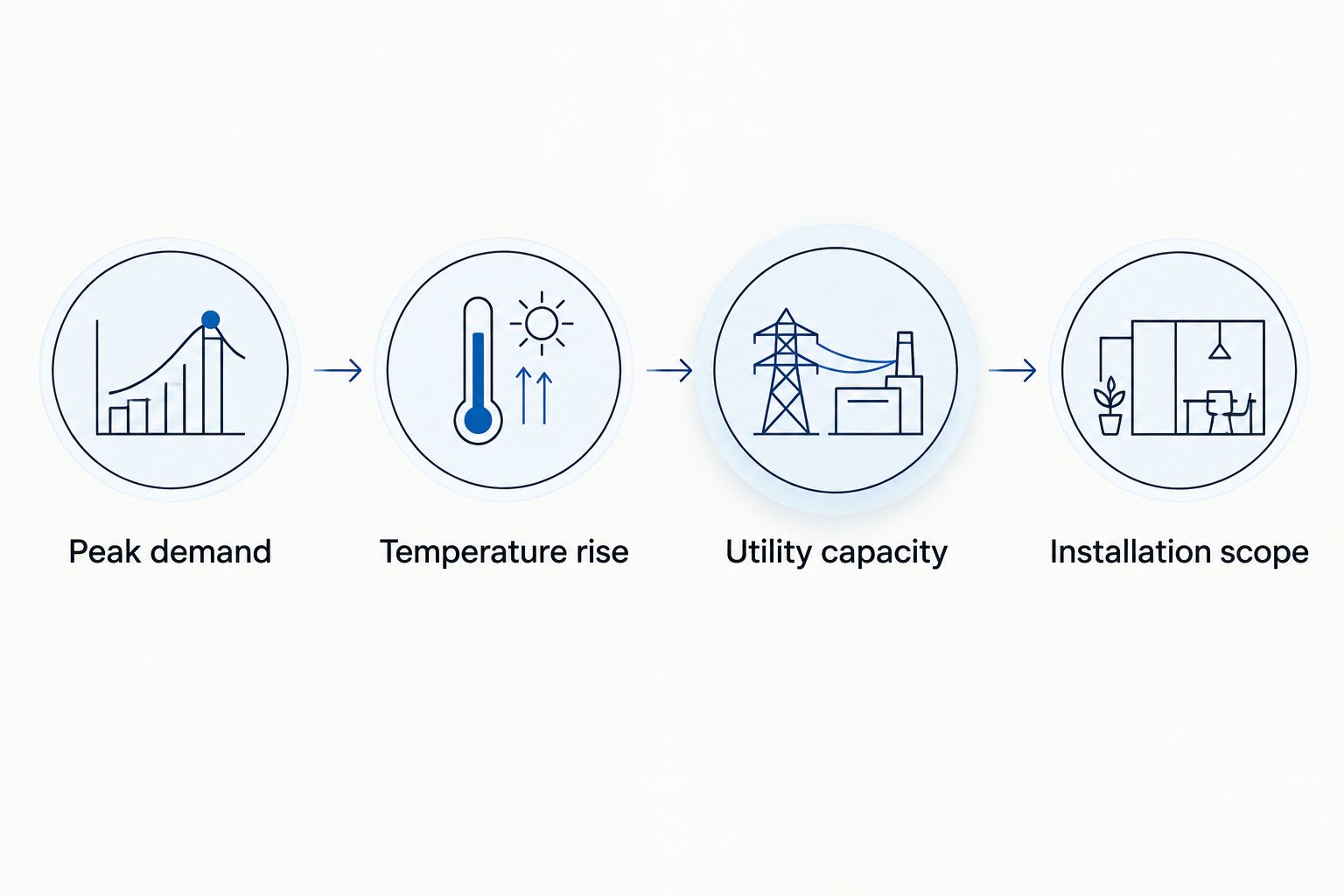
Tank capacity and tankless flow capacity answer different questions. A storage heater’s first-hour rating describes how much hot water it can supply during a peak hour; a tankless heater’s output depends on flow and the required temperature rise.
Use the following sequence before choosing equipment:
- Peak demand: Identify which showers, faucets, and appliances need hot water at the same time.
- Temperature rise: Establish the difference between incoming water temperature and the required outlet temperature.
- Utility capacity: Confirm that the property can support the proposed fuel or electrical input.
- Installation scope: Document the changes needed for the selected heater.
For households with overlapping showers and appliance use, the guide to tankless water heaters for large families provides a related starting point. Your proposal should still identify the actual demand used to select the equipment.
In Illinois, colder incoming water increases the temperature rise required to reach the same outlet temperature. Ask for tankless performance at the design inlet temperature, not only the maximum flow shown in general product information.
Which option fits your replacement?
A storage tank is the practical starting point for a straightforward like-for-like replacement. Its advantage is retaining a suitable installation arrangement; its limitation is a finite stored supply followed by recovery time.
Tankless is the practical starting point when you prioritize continuous hot water and reduced tank storage. Its advantage is heating water as it passes through the unit; its limitations include flow-dependent output and installation requirements that differ from an existing tank.
GSHA Services is a local water heater installation and repair provider for homeowners and businesses in Woodstock, Lake Bluff, and surrounding areas. Ask for both alternatives when either system fits your property, then compare the written scope rather than assuming the same work sits behind both totals.
Discuss your water heater replacement
Ask GSHA Services about water heater installation and repair in Woodstock, Lake Bluff, and surrounding areas.
FAQ
Is tankless or tank water heating less expensive to install?
Conventional storage water heaters generally have a lower initial cost than tankless systems, according to DOE. Compare complete installation proposals because fuel supply, venting, electrical work, and relocation change the scope.
Does a tankless water heater always save enough to justify conversion?
No. DOE’s efficiency ranges describe energy consumption, not guaranteed financial payback. Your installation scope, utility rates, demand, and maintenance requirements determine the ownership comparison.
Can I use my existing gas line for a tankless water heater?
The existing gas line must be checked against the selected tankless heater’s requirements and the property’s connected load. A pipe that serves the current storage heater is not automatic confirmation of adequate capacity.
Will a tankless water heater supply several showers at once?
A tankless water heater supplies simultaneous fixtures only within its output capacity at the required temperature rise. Ask the installer to size it for the fixtures you actually use together.
How long do tankless and tank water heaters last?
DOE lists life expectancy above 20 years for most tankless heaters and 10–15 years for storage heaters. Those figures are general guidance, not a warranty or a prediction for an individual installation.
Should I compare gas tankless with an electric storage heater?
Compare them only with the fuel change clearly identified. Include the new utility connections and use consistent demand assumptions when comparing projected operating energy.
What should a water heater installation proposal include?
A proposal should identify equipment, sizing assumptions, utility changes, venting, drainage, removal, permits, and startup responsibilities. Ask how additional work will be approved if concealed conditions appear.
One last thing
Continuous hot water is not unlimited simultaneous hot water. A tankless heater avoids running out of a stored supply, but its heating capacity still limits how much water it can deliver at your chosen temperature.
Before signing a 2026 proposal, ask one specific question: which fixtures can run together under the sizing assumptions? That answer connects installation spending to the performance your household actually needs.
Related guides
- Water heaters ranked by energy efficiency
- Water softeners for hard-water homes
- Electrical panel upgrade brands


