

Best overall: a staged system matched to your water test. Best for city-water chlorine: activated carbon. Best simple option for visible particles: sediment filtration. This guide to the best whole house water filtration systems 2026 compares treatment types, their limitations, and the checks you need before choosing equipment.
- The best whole house water filtration systems 2026 shortlist starts with a water test, not a brand ranking.
- Activated carbon targets chlorine; sediment filtration targets particles. Neither is a universal treatment.
- Iron treatment, ultraviolet disinfection, and reverse osmosis solve different water problems.
- GSHA Services, LTD provides plumbing installation and repair services in Woodstock, Lake Bluff, and surrounding areas.
Why this matters
A whole-house filter treats water where it enters your building. That makes the treatment relevant to showers, laundry, and other connected fixtures—not just the kitchen faucet. It also means an incorrectly sized system puts a restriction in the path of your household water supply.
Choose the treatment target before choosing the equipment. Chlorine taste, grit, iron staining, hardness, and microbial contamination require different approaches. A filter advertised as whole-house does not automatically address all of them.
For homeowners comparing whole house water filtration systems, GSHA Services, LTD provides plumbing installation and repair services in Woodstock, Lake Bluff, and surrounding areas. Start your project with a water report, a clear problem description, and an assessment of the existing plumbing.
What makes the best whole-house filtration system?
Use these criteria to judge a 2026 shortlist before comparing equipment:
- Treatment match: The system must address the contaminant or condition your test identifies. Appearance and taste alone do not establish water safety.
- Verified claims: Check certification for the exact model and reduction claim. A standards reference without a specific certified claim is not enough.
- Service flow: Compare treatment performance and pressure loss at the flow your household requires, including simultaneous fixture use.
- Maintenance access: Leave room to change cartridges, service tanks, operate valves, and reach any drain or electrical connection.
- Waste handling: Identify backwash water, regeneration discharge, or reverse-osmosis reject water before installation.
- Treatment order: Place each stage where it protects the next stage and addresses the incoming water conditions.
Whole-house filtration options at a glance
This 2026 ranking assigns each option a different job. The first choice is a system-design approach; the remaining choices are treatment technologies that belong in that design when the water test supports them.
| Rank and option | Best for | Standout feature | Key limitation |
|---|---|---|---|
| 1. Staged treatment system | Multiple confirmed water problems | Combines treatments in a planned sequence | More components to maintain |
| 2. Activated carbon filtration | City-water chlorine taste and odor | Targets chlorine and certain certified reduction claims | Does not remove hardness |
| 3. Sediment filtration | Sand, grit, and suspended particles | Captures particles before downstream equipment | Does not remove dissolved contaminants |
| 4. Iron and manganese treatment | Confirmed iron or manganese problems | Uses treatment selected for water chemistry | Requires testing and system-specific maintenance |
| 5. Ultraviolet disinfection | Microbial treatment within a tested design | Inactivates microorganisms under validated conditions | Does not remove chemicals or particles |
| 6. Whole-house reverse osmosis | Broad dissolved-contaminant treatment | Membrane separation addresses many dissolved substances | Requires reject-water handling and additional equipment |
1. Staged treatment: best for multiple confirmed problems
A staged treatment system combines separate technologies rather than asking one filter to do everything. Depending on the water test, the design can include sediment removal, carbon filtration, hardness treatment, or disinfection. The treatment sequence matters as much as the individual components.
This is the best overall approach when your water has more than one confirmed problem. It is not a reason to add every available stage: equipment without a defined treatment job adds maintenance without establishing a benefit.
Staged treatment pros:
- Addresses different problems with different treatment methods.
- Allows pretreatment to protect downstream equipment.
- Gives each stage a defined purpose and service requirement.
Staged treatment cons:
- Requires more installation space and service access.
- Adds multiple maintenance tasks and possible pressure restrictions.
Best for: Homes with several documented water-quality issues.
For a 2026 project, ask for a written explanation of what each proposed stage removes and why it belongs in that position. Keep hardness treatment separate in that explanation: a softener addresses calcium and magnesium, not every drinking-water contaminant.
Verdict: Buy a staged design when your test supports multiple treatments; skip unnecessary stages.
2. Activated carbon: best for city-water chlorine taste
Activated carbon is a practical choice when chlorine taste or odor is your main concern. Some carbon systems also carry specific contaminant-reduction certifications, but those claims belong to the exact model—not to carbon filtration as a whole.
Check whether your water supplier uses chlorine or chloramine. Do not treat a chlorine-reduction claim as proof of chloramine reduction. Choose equipment with documentation that matches the disinfectant and operating conditions.
Activated carbon pros:
- Targets chlorine taste and odor.
- Treats water before connected fixtures rather than at one faucet.
- Fits into a staged system with appropriate pretreatment.
Activated carbon cons:
- Does not soften hard water.
- Requires media or cartridge replacement to maintain treatment performance.
Best for: Municipal-water households with a confirmed chlorine concern.
For your 2026 comparison, distinguish NSF/ANSI 42 aesthetic reduction claims from specific NSF/ANSI 53 health-effect reduction claims. Certification to either standard does not mean a system removes every substance covered by that standard.
Verdict: Buy for a documented chlorine problem; hold until the exact reduction claim is verified.
3. Sediment filtration: best for visible particles
Sediment filters capture suspended material such as sand, grit, and rust particles. They often serve as a protective first stage ahead of other treatment equipment. They do not remove dissolved salts, hardness, or contaminants simply because the water looks clearer afterward.
Match the cartridge or filter to the particle problem and required flow. A finer filter is not automatically a better household choice; it also changes the restriction and maintenance demands.
Sediment filtration pros:
- Addresses visible particles directly.
- Helps protect downstream treatment from particulate loading.
- Provides a defined first stage when testing supports additional treatment.
Sediment filtration cons:
- Does not address dissolved contamination.
- Collected material increases restriction until the filter is serviced.
Best for: Homes with sand, grit, or other confirmed suspended solids.
Record where particles appear and whether they follow plumbing work or a change in water conditions. That information helps distinguish an incoming-water problem from material originating inside the building.
Verdict: Buy for confirmed particles; skip sediment-only treatment for dissolved contaminants.
4. Iron and manganese treatment: best for confirmed staining problems
Iron and manganese treatment requires more than selecting a generic cartridge. The right method depends on the substances present, their form, and the surrounding water chemistry. Treatment can involve oxidation followed by filtration, using equipment designed for the tested conditions.
For this 2026 guide, useful reference points come from the EPA's Secondary Drinking Water Standards: iron at 0.3 mg/L, manganese at 0.05 mg/L, and total dissolved solids at 500 mg/L. These are secondary aesthetic guidelines, not universal safety thresholds or automatic equipment-selection rules.
Iron and manganese treatment pros:
- Targets tested iron or manganese rather than treating staining as a diagnosis.
- Addresses substances ordinary sediment filtration does not necessarily capture.
- Integrates with other treatment when the water has additional problems.
Iron and manganese treatment cons:
- Selection depends on water chemistry and contaminant form.
- Backwashing or other maintenance requirements vary by treatment method.
Best for: Homes with laboratory-confirmed iron or manganese concerns.
A stain is a reason to investigate, not proof of a particular contaminant concentration. Ask for testing that supports the proposed treatment rather than buying media based on stain color alone.
Verdict: Buy after testing confirms the treatment need; hold a generic filter purchase.
5. Ultraviolet disinfection: best for microbial treatment
Ultraviolet disinfection inactivates microorganisms as water passes through a treatment chamber under the system's validated conditions. It does not physically filter particles or remove dissolved chemicals. Water clarity and pretreatment matter because material in the water can interfere with UV treatment.
UV is a disinfection stage, not a complete water-quality system. Follow the equipment's operating requirements, maintain the lamp and sleeve, and investigate the source of microbial contamination rather than relying on a device alone.
Ultraviolet disinfection pros:
- Provides a distinct treatment step for microorganisms.
- Fits into a design with suitable upstream filtration.
- Does not depend on adding a disinfectant chemical during UV treatment.
Ultraviolet disinfection cons:
- Requires electricity and scheduled component maintenance.
- Does not provide a disinfectant residual throughout downstream plumbing.
Best for: A professionally specified microbial-treatment system supported by water testing.
If your supplier or health authority issues an advisory, follow that advisory. An installed UV unit does not independently establish that every affected fixture is safe to use.
Verdict: Buy only within a tested, properly specified disinfection plan; skip as a standalone cure-all.
6. Whole-house reverse osmosis: best for dissolved-contaminant treatment
Reverse osmosis uses a membrane to separate treated water from a reject-water stream. It addresses many dissolved substances, but performance still depends on the contaminant, membrane, incoming conditions, and complete system design.
A whole-house installation requires planning beyond the membrane itself. Assess pretreatment, storage, delivery pressure, reject-water handling, and whether post-treatment is needed to suit the plumbing.
Whole-house reverse osmosis pros:
- Addresses dissolved substances that sediment filtration leaves behind.
- Provides a treatment approach for needs beyond taste and visible particles.
- Allows treatment before water reaches connected fixtures.
Whole-house reverse osmosis cons:
- Produces reject water that needs an appropriate disposal arrangement.
- Requires more equipment and design work than a simple cartridge installation.
Best for: Homes with tested dissolved-contaminant problems requiring treatment throughout the building.
For a 2026 decision, compare whole-house treatment with treatment at the drinking-water faucet. If the documented need concerns drinking and cooking only, treating every shower and toilet is not automatically the right scope. NSF/ANSI 58 concerns reverse-osmosis drinking-water treatment systems; do not assume a component claim certifies an entire custom whole-house installation.
Verdict: Hold until testing establishes both the treatment method and the need for whole-house coverage.
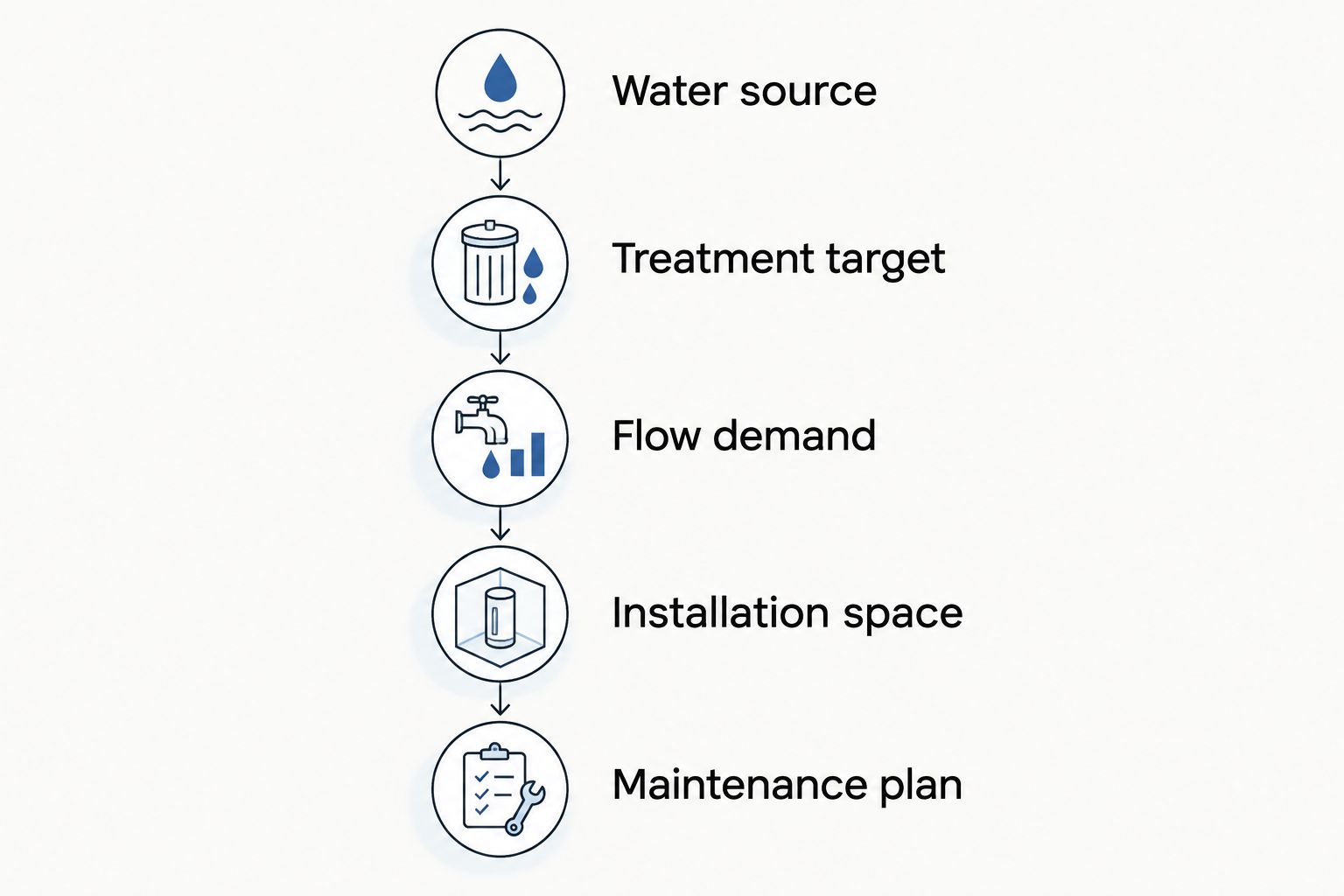
Before installation: use this decision sequence
Prepare these items before committing to equipment:
- Water source: Identify municipal supply or a private well and obtain the relevant report or laboratory results.
- Treatment target: Write down the contaminant or condition each proposed stage must address.
- Flow demand: Identify fixtures that run together and have the required treatment flow assessed.
- Installation space: Confirm access, bypass arrangements, and any required electrical or drain connection.
- Maintenance plan: Request the service tasks and replacement requirements for the exact equipment.
The sequence prevents a common mismatch: selecting an attractive filter first and discovering its treatment limits or installation requirements afterward.
For whole house water filtration systems, GSHA Services, LTD's stated plumbing installation and repair services provide a local starting point for discussing the building's plumbing requirements. Bring the water results and proposed equipment documents to that discussion.
Discuss your plumbing project
Bring your water results and proposed equipment details to a local plumbing discussion.
How these options are ranked
The ranking prioritizes treatment match, verified claims, flow suitability, maintenance, and installation requirements. It compares treatment approaches rather than assigning unsupported performance scores to named products. Each option owns a distinct use case; none is the best answer for every water supply.
Which system should you choose?
Choose a tested, staged design if you have multiple water problems. Choose carbon for a documented chlorine concern or sediment filtration for confirmed particles. Reserve specialized iron treatment, UV, and whole-house reverse osmosis for the conditions those methods address.
GSHA Services, LTD is a local plumbing service option for homeowners in Woodstock and Lake Bluff. The equipment decision still starts with the water—not with a brand name or the largest treatment package.
FAQ
What’s the best whole-house water filtration system in 2026?
The best whole-house water filtration system in 2026 is the design that matches your tested water conditions and household flow needs. A staged system is the default choice when several different problems require treatment.
Is activated carbon better than a sediment filter?
Activated carbon and sediment filters solve different problems. Carbon targets chlorine and specific documented reduction claims; sediment filtration captures suspended particles.
Will a whole-house water filter remove hard water?
A generic whole-house filter does not remove hardness. Hardness treatment requires equipment designed to address dissolved calcium and magnesium, such as a water softener.
Do I need whole-house reverse osmosis?
Choose whole-house reverse osmosis only when water testing and treatment requirements justify that scope. Compare it with drinking-water treatment at a dedicated faucet before committing to a building-wide installation.
Does ultraviolet treatment remove chemicals from water?
Ultraviolet disinfection does not remove dissolved chemicals. It treats microorganisms under validated operating conditions and requires appropriate water quality and maintenance.
How much maintenance does whole-house filtration need?
Maintenance depends on the exact equipment and incoming water conditions. Obtain the cartridge, media, backwash, lamp, and membrane requirements that apply to the proposed system.
Can clear water still need treatment?
Clear water can contain dissolved contaminants or microorganisms that you cannot see. Use a water report or appropriate laboratory testing rather than appearance to decide whether treatment is needed.
One last thing
Ask for the exact certified reduction claim, not just a certification logo. A certification is meaningful only when it matches the model, contaminant, and operating conditions relevant to your home. Keep that documentation with the maintenance instructions.
Related guides
- Best portable generators for home backup
- Whole-house generators ranked by fuel type
- Best gas furnace brands for Illinois winters


