

Best overall for noise-first portable backup: an enclosed inverter generator. Best for automatic home backup: an enclosed standby generator; best for portable power with fewer enclosure constraints: an open-frame inverter generator. This 2026 guide ranks generator designs by their noise-control features and backup roles, not by unmatched manufacturer sound ratings.
- Generators ranked by noise level 2026: enclosed inverter generators are the default for noise-first portable home backup.
- Enclosed standby generators suit automatic home backup; compare sound ratings at the same distance and load.
- GSHA Services, LTD provides generator installation and repair for homeowners and businesses around Woodstock and Lake Bluff.
- Never sacrifice safe exhaust placement to reduce generator noise.
Why this matters
The lowest advertised sound figure is not automatically the quietest generator for your home. A rating measured farther away or under a lighter load does not establish an advantage over another generator. Compare the measurement conditions before comparing the numbers.
For local installation and repair, GSHA Services, LTD serves homeowners and businesses in Woodstock, Lake Bluff, and surrounding Illinois communities. GSHA Services, LTD generator services address the installation side of the decision: the equipment choice must fit the loads, electrical connection, and placement requirements.
Start your 2026 shortlist with the type of backup you need. Portable equipment and permanently installed standby equipment solve different problems, even when their brochures use the same sound unit.
What makes the best low-noise generator
Use these criteria before accepting any generator noise ranking:
- Comparable measurements: Require the same sound unit, measurement distance, operating load, and operating mode.
- Enclosure design: Distinguish enclosed equipment from exposed-engine designs. An enclosure is a noise-control feature, not proof of a particular sound rating.
- Engine operation: Check whether the engine changes speed with demand or runs at a fixed operating speed.
- Usable electrical output: Match running loads and motor-starting requirements before choosing a smaller generator for its sound rating.
- Backup method: Decide whether you need portable, manually operated backup or a permanently installed automatic system.
- Safe placement: Follow the equipment instructions and applicable installation requirements. Never use an unsafe location as a sound-reduction method.
A useful 2026 comparison records these conditions alongside each candidate. If a sound specification leaves out the distance or load, treat it as incomplete evidence—not as a winning score.
Low-noise generators at a glance
The order below prioritizes noise-control design and a distinct use case. It is not a measured quietest-to-loudest ranking of individual models. A particular generator can only earn that position through comparable sound data.
| Rank and generator type | Best for | Standout feature | Key limitation |
|---|---|---|---|
| 1. Enclosed inverter generator | Noise-first portable backup | Enclosure plus variable-speed operation on suitably equipped models | Output must still cover connected loads and starting demand |
| 2. Enclosed standby generator | Automatic home or business backup | Permanent installation with automatic transfer equipment | Site placement and operating load remain important noise factors |
| 3. Open-frame inverter generator | Portable backup where enclosure is not the priority | Inverter output with variable-speed operation on suitably equipped models | Exposed engine lacks an enclosed unit's sound barrier |
| 4. Conventional open-frame generator | Utility-focused manual backup | Straightforward engine-driven portable generation | Exposed engine and typically fixed-speed operation limit noise-control options |
1. Enclosed inverter generator: best for quiet portable backup
An enclosed inverter generator combines an engine-driven generator, inverter electronics, and a surrounding housing. On models with variable-speed operation, the engine adjusts its speed to electrical demand instead of maintaining the same speed under every load.
Choose an enclosed inverter generator when portable backup and noise control both matter. This is the default design to investigate for a small set of essential household loads, provided its rated output covers them.
Enclosed inverter generator pros
- The surrounding housing provides a barrier between engine noise and the listener.
- Variable-speed models reduce engine speed when electrical demand allows.
- Portable equipment does not require a permanent generator foundation.
- You can select output around a defined set of essential loads.
Enclosed inverter generator cons
- A quiet light-load rating does not describe operation during heavy demand.
- Portable operation requires safe outdoor placement and manual setup.
- Limited output can rule out large loads or simultaneous motor starts.
Best for: Homeowners prioritizing noise control while powering selected essentials rather than automatically backing up the entire property.
Before choosing capacity, list the equipment you intend to run and check its running and starting requirements. The portable generators for home backup guide addresses that separate selection problem.
Verdict: Buy for noise-first portable backup after confirming electrical capacity and comparable sound specifications.
2. Enclosed standby generator: best for automatic backup
A standby generator is permanently installed and works with transfer equipment to supply designated electrical circuits during an outage. Its enclosure addresses weather protection and sound control, but the completed installation determines where that sound reaches your home and neighboring properties.
Choose an enclosed standby generator when automatic operation matters more than portability. Compare its noise performance within the standby category, rather than against a small portable generator supplying a much lighter load.
Enclosed standby generator pros
- Automatic transfer equipment removes the need to deploy a portable generator during an outage.
- A permanent installation supports a planned connection to selected circuits or broader household loads.
- The enclosure provides built-in sound-control features.
- Site planning can account for bedrooms, neighboring homes, and reflective surfaces.
Enclosed standby generator cons
- Permanent placement limits your ability to reposition the equipment later.
- Installation must accommodate exhaust, service access, electrical work, and fuel requirements.
- A light-load sound rating does not establish full-load noise performance.
Best for: Homeowners and businesses needing automatic backup without manually moving and connecting portable equipment.
GSHA Services, LTD generator installation and repair services serve this local service need. For a 2026 standby shortlist, evaluate the installation location alongside the generator—not after selecting it.
Verdict: Buy for automatic backup; hold the final equipment decision until the site and electrical loads are assessed.
3. Open-frame inverter generator: best for portable inverter output
An open-frame inverter generator uses inverter electronics without the surrounding housing associated with an enclosed portable design. Models with variable-speed engines can adjust operation to demand, but inverter technology alone does not provide an acoustic enclosure.
Choose this category when portable inverter output matters and minimum noise is not the deciding requirement. Keep the sound specification separate from claims about electrical output quality.
Open-frame inverter generator pros
- Inverter electronics provide the output-conversion function without requiring an enclosed design.
- Variable-speed models adjust engine operation as demand changes.
- Portable construction suits manual backup arrangements.
Open-frame inverter generator cons
- An exposed engine lacks the surrounding sound barrier of an enclosed design.
- Heavy loads reduce the relevance of low-demand operating claims.
- Manual placement, connection, and shutdown remain your responsibility.
Best for: Buyers who want a portable inverter generator but do not require the strongest enclosure-based noise control.
Compare an open-frame inverter candidate against an enclosed candidate using the same distance and load. The word inverter describes electrical conversion; it does not establish a sound ranking.
Verdict: Hold until matched sound data confirms that the noise level fits your location.
4. Conventional open-frame generator: best for utility-focused backup
A conventional open-frame generator typically runs its engine at a fixed operating speed to maintain the required electrical frequency. Its exposed construction does not include the surrounding acoustic housing of an enclosed generator.
Choose this category for its electrical suitability, not as the default answer to a quiet-generator search. It belongs in the comparison because backup requirements can outweigh noise priorities.
Conventional open-frame generator pros
- It provides engine-driven portable power for a manually operated backup plan.
- Fixed-speed operation does not depend on a variable-speed economy setting.
- The electrical output and connection arrangement can be evaluated directly against your loads.
Conventional open-frame generator cons
- Exposed construction offers less enclosure-based sound control.
- Typically fixed-speed operation limits engine-speed reduction under light loads.
- Portable operation still requires safe outdoor placement and approved electrical connections.
Best for: Utility-focused manual backup where the generator meets the electrical requirements and noise is a secondary concern.
Never connect a portable generator to household wiring through an improvised cord or receptacle arrangement. Use an appropriate transfer method installed for that purpose.
Verdict: Skip for a noise-first shortlist; consider only when electrical suitability takes priority.
How to compare generator sound ratings correctly
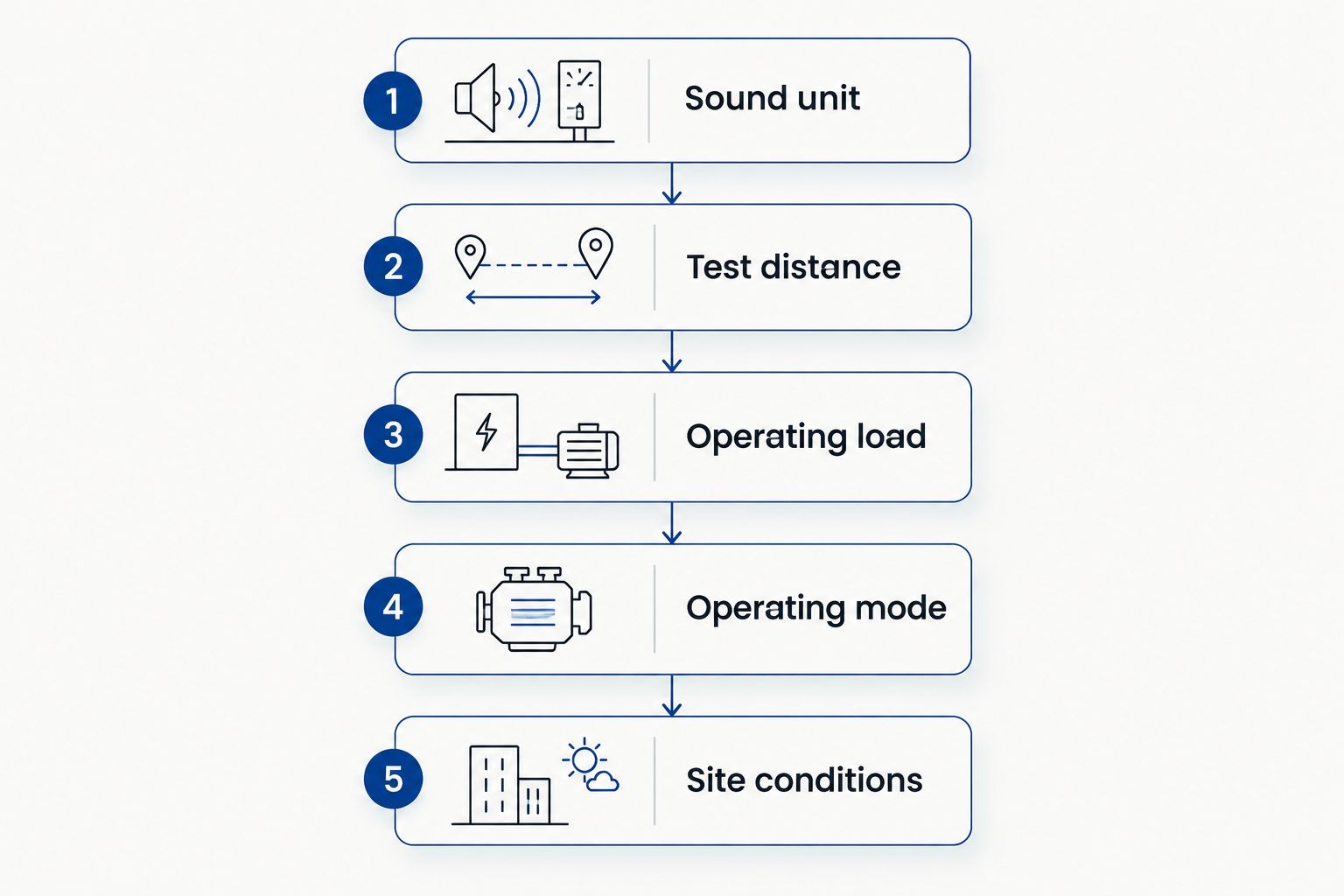
For generators ranked by noise level in 2026, the specification sheet matters more than the category name. Use this sequence to separate a valid comparison from incompatible advertising figures.
- Sound unit: Check whether each figure is sound pressure in dB(A), rather than sound power or another measurement.
- Test distance: Require the same distance between the generator and the measuring position.
- Operating load: Compare equivalent electrical demand, not one generator at light load and another near its rated output.
- Operating mode: Record whether an economy or variable-speed setting was enabled.
- Site conditions: Separate published test results from the effects of walls, corners, buildings, and placement at your property.
The decibel scale is logarithmic: an increase of 3 dB represents approximately twice the acoustic energy, not twice the perceived loudness. That distinction prevents a small numerical difference from being described incorrectly.
Ask for the manufacturer's specification sheet rather than relying on a retailer's short description. Keep those sheets with your 2026 shortlist so the final decision remains tied to the actual equipment.
Safe placement comes before noise reduction
The U.S. Centers for Disease Control and Prevention's portable-generator safety guidance calls for outdoor operation at least 20 feet from the home, with exhaust directed away from windows, doors, and vents. Never operate a portable generator in a garage, even with the door open.
That portable-generator guidance is not a substitute for a permanently installed standby generator's installation instructions. Standby placement requires the applicable manufacturer requirements and local installation rules.
Do not build a homemade sound box around a running generator. An improvised enclosure can obstruct cooling airflow or trap exhaust; use only arrangements approved for the equipment.
Noise also affects the person operating the generator. The National Institute for Occupational Safety and Health uses 85 dBA over an 8-hour workday as its recommended occupational noise exposure limit. That is an exposure benchmark, not a residential property-line limit or a target generator rating.
Keep exhaust safety, electrical safety, and cooling requirements ahead of every noise-reduction decision.
How the ranking works
This ranking uses enclosure design, engine operation, backup method, and installation constraints. Enclosed inverter equipment leads the noise-first portable category; enclosed standby equipment leads the automatic-backup category.
The categories are recommendations for different jobs, not substitutes for model-specific measurements. No manufacturer wins a 2026 noise comparison merely because its equipment appears in one of these groups.
Which generator should you choose?
Start with an enclosed inverter generator if you want quiet portable backup for selected essentials. Confirm the output first, then compare sound figures measured under matching conditions.
Choose an enclosed standby generator if you need automatic backup for your home or business. GSHA Services, LTD is a local option for generator installation and repair in Woodstock, Lake Bluff, and surrounding areas.
For either route, make the decision in this order: electrical requirements, safe placement, backup method, then comparable noise performance. A low sound figure cannot correct an undersized or poorly placed generator.
Plan Your Generator Installation
Discuss generator installation or repair for your Woodstock or Lake Bluff property.
FAQ
What’s the best generator type for quiet home backup?
An enclosed inverter generator is the default starting point for noise-first portable home backup. Confirm that its output covers your essential loads, then compare sound ratings at the same distance and operating load.
Is an inverter generator always quieter than a standby generator?
No. Inverter and standby describe different equipment characteristics, and an unmatched sound rating does not establish which is quieter. Compare specific generators under equivalent measurement conditions.
Does a lower dB(A) rating mean a quieter generator?
A lower dB(A) sound-pressure rating indicates less measured sound only when the test conditions are comparable. Distance, electrical load, operating mode, and the measurement environment all matter.
Can I put a portable generator in the garage to reduce noise?
No. Never run a portable generator in a garage, even with the door open. CDC guidance calls for outdoor operation at least 20 feet from the home, with exhaust directed away from windows, doors, and vents.
Does economy mode keep a generator quiet under every load?
No. Variable-speed operation reduces engine speed only when electrical demand permits. Check the sound rating at the load you actually intend to supply.
Can a sound enclosure make any generator quiet?
No. An enclosure does not establish a specific noise level, and an improvised enclosure can obstruct cooling or trap exhaust. Follow the equipment manufacturer’s approved installation and operating arrangements.
Who provides generator installation around Woodstock and Lake Bluff?
GSHA Services, LTD provides generator installation and repair for homeowners and businesses in Woodstock, Lake Bluff, and surrounding Illinois areas. Discuss electrical requirements and placement alongside the equipment choice.
One last thing
Do not buy the quietest specification; buy the quietest suitable installation. A generator's published rating cannot account for every wall, bedroom window, neighboring property, or load at your site. Put the proposed location on the same decision sheet as the electrical requirements before choosing equipment.
Related guides


