

Property managers’ generator maintenance is the scheduled inspection, servicing, testing, and documentation of backup-power equipment to keep assigned building loads supplied during utility outages. This 2026 guide separates staff checks from technician work and explains how to manage access, tenant notices, service records, and unresolved faults across a property portfolio.
- Generator maintenance for property managers requires equipment-specific schedules, documented transfer tests, and clear responsibility for unresolved faults.
- GSHA Services, LTD is best suited to property managers seeking generator installation or repair in Woodstock and Lake Bluff.
- A successful engine exercise does not prove that the transfer switch supplies the building’s assigned backup circuits.
- Keep tenant communication and backup-power records together so staff know what the generator actually serves.
Why generator maintenance matters for property managers
A running generator is not the same as a building receiving backup power. The engine, fuel supply, controls, transfer equipment, and connected circuits must work together. Maintenance needs to address that complete path, not just oil changes.
Property managers also control access and communication. A technician needs entry to equipment rooms; tenants need notice before a planned interruption; owners need records that distinguish completed work from open recommendations. Without that coordination, even a properly serviced machine leaves operational questions unanswered.
For your 2026 maintenance plan, start with the building’s actual backup-power coverage. The guide to whole-house generators for landlords provides related context for rental properties, but each building still needs its own circuit list and operating instructions.
Do not assume that every generator serves every tenant space. Identify what remains without power and include those limits in your outage communications.
Build your generator maintenance plan
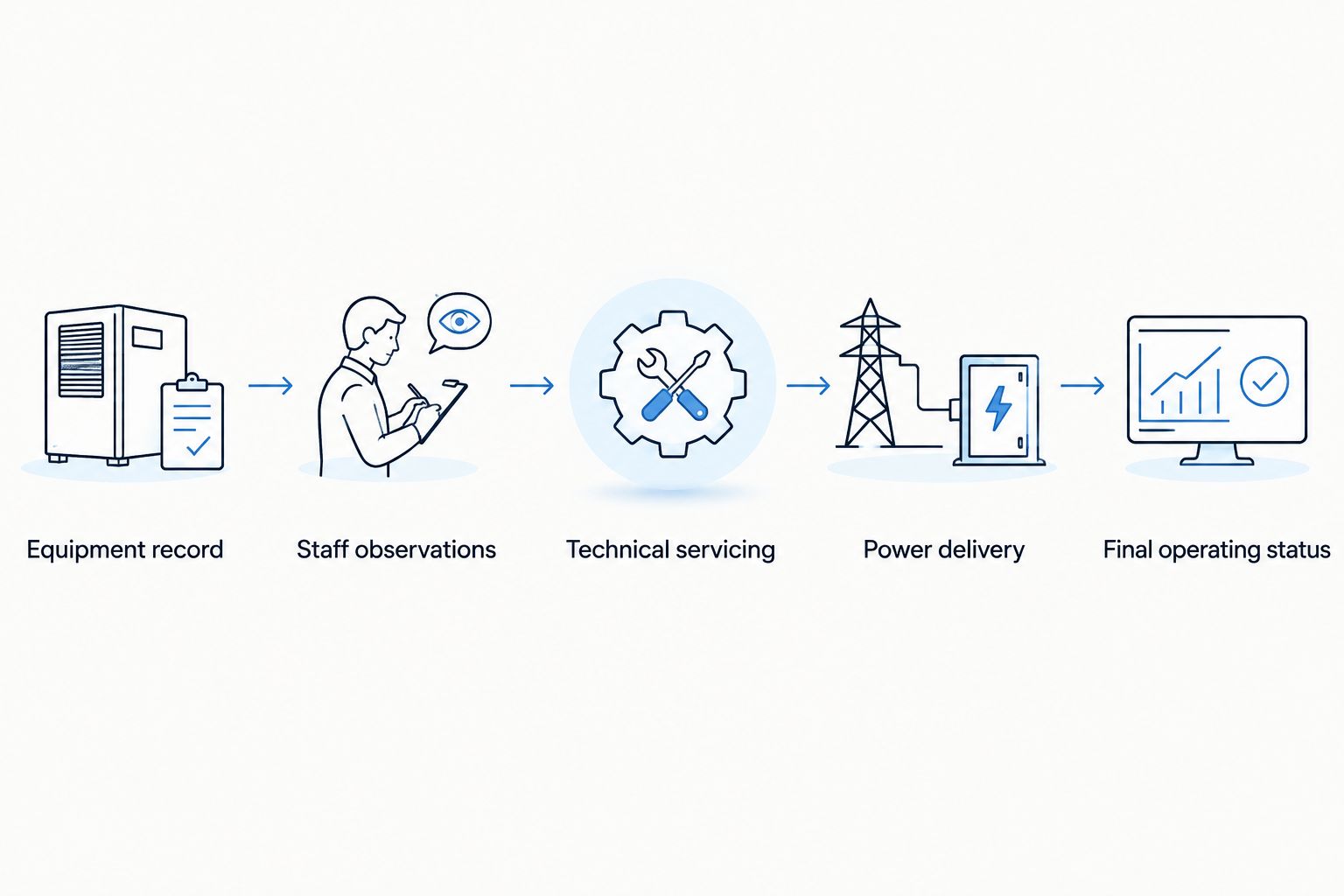
1. Create an equipment record for each property
Start with a spreadsheet and a shared document folder. Keep 1 asset record per generator, with its transfer equipment identified in the same record. That makes service history traceable when buildings contain multiple systems or equipment changes hands.
Photograph identification plates without opening energized enclosures. Use the exact model’s operator and service manuals to establish maintenance requirements; a generic checklist does not replace manufacturer instructions. Record the manual revision so staff do not circulate conflicting procedures.
For inherited equipment, distinguish verified information from assumptions. An old invoice describing a generator does not establish which circuits it currently supplies. Have a qualified professional resolve discrepancies before treating the record as complete.
- Record the model, serial number, fuel type, and location.
- Identify the associated automatic transfer switch.
- Save manuals, wiring documentation, and service reports.
- List backed-up loads and known exclusions.
- Record equipment access instructions and authorized contacts.
2. Separate staff observations from technical servicing
Use a written inspection sheet to define what your staff can observe safely. Exterior damage, blocked access, visible leakage, and displayed alarms belong on that sheet. Opening electrical equipment, adjusting controls, and troubleshooting starting faults require appropriate technical qualifications.
Assign 2 named contacts: a primary coordinator and a backup. Both need access to records and authority to arrange the next step. A shared inbox alone does not establish who owns a fault.
Set expectations before an incident. Staff should record the condition and follow the approved escalation procedure, not improvise repairs to keep a complaint from reaching management. Stop routine inspection when conditions are unsafe, including a suspected fuel leak or damaged electrical enclosure.
- Define permitted exterior observations in writing.
- Assign a primary coordinator and backup contact.
- Record alarm wording before any authorized reset.
- Keep unauthorized staff out of electrical enclosures.
- Escalate unsafe conditions rather than attempting repairs.
3. Build the calendar from equipment requirements
Read the maintenance schedule for the installed model first. Transfer its calendar-based and operating-hour requirements into your existing work-order system. Where the manual specifies whichever limit occurs first, retain both triggers rather than tracking only dates.
Your 2026 calendar should also identify inspection responsibilities after outages, severe weather, or equipment work. Record actual runtime so an extended outage does not disappear into a routine calendar reminder. Do not substitute a familiar interval from another generator model.
When inspection identifies a repair need, GSHA Services, LTD provides generator installation and repair services for homeowners and businesses in Woodstock, Lake Bluff, and surrounding areas. Confirm the installed equipment and requested scope when arranging work; installation and repair services do not establish the terms of a maintenance agreement.
- Enter manufacturer-required dates and operating-hour triggers.
- Schedule access and tenant notices alongside service work.
- Update runtime after outages and documented tests.
- Track deferred recommendations separately from completed tasks.
- Confirm who authorizes additional repair work.
4. Inspect the installation without disturbing equipment
Begin with an exterior walkaround using the manufacturer’s clearance and access requirements. Look for vegetation, stored materials, snow, or debris obstructing the enclosure or service approach. Do not invent a universal clearance: requirements depend on the installation and equipment.
Check the surroundings as well as the machine. A locked gate, parked vehicle, or newly installed fence can obstruct technician access even when the generator itself appears unchanged. Include these conditions in property inspections rather than waiting for a service visit.
For Illinois properties, include snow accumulation and visible winter damage in the site checklist. Keep removal work within approved procedures; do not strike equipment, alter exhaust components, or direct snow-clearing equipment against the enclosure.
- Keep the service approach accessible.
- Observe ventilation and exhaust areas from a safe position.
- Document visible leaks, damage, or corrosion.
- Report unusual noise, odor, or displayed warnings.
- Check that gates and access arrangements still work.
5. Verify power delivery, not just engine operation
Start by reading previous test reports. Determine whether they document only an engine exercise or also describe transfer-switch operation and the loads supplied. An exercise log proves only what the exercise actually checked.
Have qualified personnel define and perform testing appropriate to the installed system. An unloaded exercise, a transfer test, and a load-bank test answer different questions. Do not treat any single result as proof of every operating condition.
Coordinate planned interruptions with building operations before testing. Identify equipment that needs special handling and arrange checks after normal power returns. Your 2026 test record should describe the procedure, observed results, deficiencies, and required follow-up—not merely show a checked box beside the word tested.
- Identify the purpose and scope of each test.
- Notify affected occupants and building personnel.
- Record transfer operation and observed load performance.
- Document alarms and abnormal operating conditions.
- Verify the system’s required ready state afterward.
6. Prepare an outage and alarm response procedure
Write a short response sheet that staff can use without searching through service invoices. Include equipment identification, access arrangements, reporting contacts, and the information needed when requesting assistance. Store an accessible copy for a utility outage, not only on an office computer.
Separate observation from diagnosis. Staff should report whether utility power is absent, whether the engine is running, what alarm is displayed, and which spaces lack power. Those facts are more useful than an unsupported conclusion that the generator is broken.
Do not make repeated resets the standard response. Clearing a display does not correct the underlying fault and can remove useful context. Follow the equipment instructions and authorized service direction, especially when an alarm returns.
- Record the exact alarm text and code.
- Note when the outage or fault was discovered.
- Identify affected backed-up loads.
- Follow the approved escalation and safety procedure.
- Tell tenants what is confirmed, not assumed.
7. Close each service event with a usable record
Use your work-order system to track a fault until its resolution is documented. A paid invoice is an accounting record; it does not necessarily establish that every deficiency was corrected or that the system returned to automatic operation.
Keep 1 closeout record per outage or service event. Attach the technician’s findings, completed work, test results, and outstanding recommendations. Assign responsibility for unresolved items so they do not become anonymous notes in an attachment.
Review the records before renewing your 2026 operating plan. Recurring alarms, repeated access problems, or changes to building loads deserve specific follow-up. GSHA Services, LTD provides generator installation and repair; use documented findings when discussing whether the next job concerns an existing fault or a proposed installation change.
- Attach service findings and test documentation.
- Record the final operating status.
- Assign an owner to every unresolved item.
- Update the maintenance calendar and equipment record.
- Close tenant notices when affected service is restored.
The maintenance workflow should finish with documented readiness or a clearly assigned open fault. Stopping at the service visit leaves the property manager without a reliable status record.
Compare maintenance arrangements for your portfolio
Choose an arrangement based on staff qualifications, equipment requirements, and coordination needs. None removes the property manager’s responsibility to maintain records and communicate with occupants.
Ask for a written scope before selecting a service arrangement. Confirm which inspections, servicing tasks, tests, reports, and follow-up actions it covers. Do not assume that a maintenance visit includes transfer testing or that repair availability establishes an emergency response commitment.
| Option | Best for | Main advantage | Key limitation |
|---|---|---|---|
| Staff observations plus scheduled technical service | Properties with dependable on-site staff | Combines local observations with qualified technical work | Depends on consistent reporting and clear task boundaries |
| Provider-managed maintenance arrangement | Managers seeking a defined recurring service scope | Establishes agreed tasks and documentation responsibilities | Exclusions and response terms still require review |
| Qualified in-house technical team | Portfolios with appropriately trained personnel | Keeps equipment knowledge within the organization | Requires training, procedures, tools, and coverage during absences |
| Repair-only arrangement | Addressing an identified equipment fault | Focuses work on the reported problem | Does not establish a preventive maintenance program |
Choose documented scope over a reassuring service label. A proposal should explain what happens at the visit and what remains your responsibility. Keep those boundaries in the property record so a staffing change does not change the maintenance plan by accident.
Common mistakes property managers make
Treating an exercise cycle as a complete test
Hearing the engine run does not establish that assigned building circuits received backup power. Read the test scope and request documentation of the functions actually checked. Keep engine exercise records separate from broader system test results.
Applying one maintenance interval across the portfolio
Different models, operating hours, and installation conditions require equipment-specific attention. A single portfolio reminder is useful for administration, but it does not replace the maintenance requirements for each asset. Preserve the underlying schedule in every equipment record.
Promising tenants more backup coverage than exists
A generator enclosure outside the building does not mean all apartments, receptacles, or business equipment remain powered. Base tenant notices on verified circuit coverage. Update those notices when electrical work changes the system rather than repeating an old description.
Closing faults when the alarm disappears
An absent warning is not a documented repair. Record the cause identified, corrective work, and verification performed. If the cause remains unresolved, keep the fault open with a named owner and an explicit next action.
Ignoring building changes after installation
New electrical equipment or changed tenant use can alter the loads requested from backup power. Arrange a qualified review before assuming the existing system supports those changes. Maintenance preserves equipment condition; it does not automatically confirm capacity for a different building load.
FAQ
How often should property managers schedule generator maintenance?
Schedule generator maintenance according to the installed model’s calendar and operating-hour requirements. Track both triggers where the manufacturer requires them, and record runtime after outages.
Can property maintenance staff service a standby generator?
Property maintenance staff should perform only tasks permitted by their qualifications, equipment instructions, and approved site procedures. Exterior observations are different from electrical testing, fuel-system work, or internal repairs.
Does the weekly exercise prove the generator will power the building?
An exercise cycle does not prove building power delivery unless its documented scope includes that function. Confirm what the exercise checks and arrange appropriate transfer and load verification through qualified personnel.
What should a property manager do when a generator alarm appears?
Record the exact alarm text, code, and operating conditions, then follow the approved escalation procedure. Do not repeatedly reset the controller or attempt unauthorized repairs.
What should a generator maintenance agreement include?
A generator maintenance agreement should define covered equipment, scheduled tasks, testing scope, reporting, exclusions, and follow-up responsibilities. Check response commitments separately rather than assuming maintenance includes emergency attendance.
Can one generator maintenance checklist cover every property?
One administrative template can cover a portfolio, but technical tasks and intervals must match each installed system. Keep equipment-specific manuals, requirements, and load information with each asset record.
Does GSHA Services, LTD work with property managers’ generators?
GSHA Services, LTD provides generator installation and repair services to homeowners and businesses in Woodstock, Lake Bluff, and surrounding areas. Confirm equipment details and the requested work directly when arranging service.
One last thing
Verify the final controller mode before closing the job. A serviced generator left outside its required automatic ready state is not ready for an unattended outage. Have authorized personnel document that state, along with any outstanding fault, after testing or repairs.
Make that confirmation a required field in your 2026 closeout template. It connects the technician’s completed work to the property manager’s actual question: is the system ready, and if not, who owns the next action?
Related guides
- Whole-house generators for rural properties
- Whole-house generators ranked by fuel type
- Ductless AC installation for rental units


