
Hard water in Illinois is a reason to consider a water softener when a tap-water test confirms elevated hardness and you have recurring scale, soap residue, or equipment-maintenance problems. Your address alone does not establish the need, and a softener does not make contaminated water safe to drink.
- Is hard water bad in Illinois? Test your tap before choosing a water softener; statewide assumptions are not enough.
- USGS classifies water above 180 mg/L as very hard; measured hardness matters more than visible spotting alone.
- GSHA Services provides local plumbing and water heater service for homeowners in Woodstock, Lake Bluff, and surrounding areas.
- Choose treatment for the measured problem: hardness, iron, odor, and drinking-water safety require different decisions.
Is hard water bad enough in Illinois to need a water softener?
Install a softener to address measured hardness and recurring problems—not simply because you live in Illinois. Calcium and magnesium can leave scale on fixtures and heated surfaces, interfere with soap, and increase cleaning work. Those are practical reasons to evaluate treatment, but they do not establish a drinking-water emergency.
The U.S. Geological Survey’s Water Science School classifies hardness using the following concentrations, expressed as calcium carbonate. Use these established categories when reviewing your water test in 2026.
| Hardness category | Concentration as calcium carbonate | What it means for your decision |
|---|---|---|
| Soft | 0–60 mg/L | Hardness alone provides little reason to add a softener. |
| Moderately hard | 61–120 mg/L | Decide based on actual residue, cleaning needs, and equipment guidance. |
| Hard | 121–180 mg/L | Evaluate softening when scale or soap-related problems recur. |
| Very hard | Above 180 mg/L | Give softening serious consideration, while checking installation and maintenance requirements. |
These categories describe water; they are not mandatory installation thresholds. A result above 180 mg/L does not prove that a particular appliance is failing, and a lower result does not explain every stain.
Once you know your hardness, use the water softeners for hard-water homes guide to compare equipment against your household’s needs rather than selecting by advertising claims.
Why this matters
The wrong treatment leaves the original problem in place. A sediment filter catches particles, but it is not a substitute for hardness removal; a softener exchanges hardness minerals, but it is not a disinfectant.
For your 2026 decision, separate three questions: What is in the water? What problem does it cause? What treatment actually addresses that problem? Keeping those questions separate prevents an installation from becoming an expensive attempt to solve the wrong issue.
GSHA Services is best suited to homeowners in Woodstock, Lake Bluff, and surrounding areas who need local plumbing and water heater service. When scale and hot-water problems appear together, evaluate both the water chemistry and the equipment rather than assuming either one explains everything.
How do you check whether your home actually needs softening?
Start with untreated cold water and identify any treatment equipment already connected to the plumbing. Testing a softened tap tells you about the treatment’s output, not the hardness entering your home.
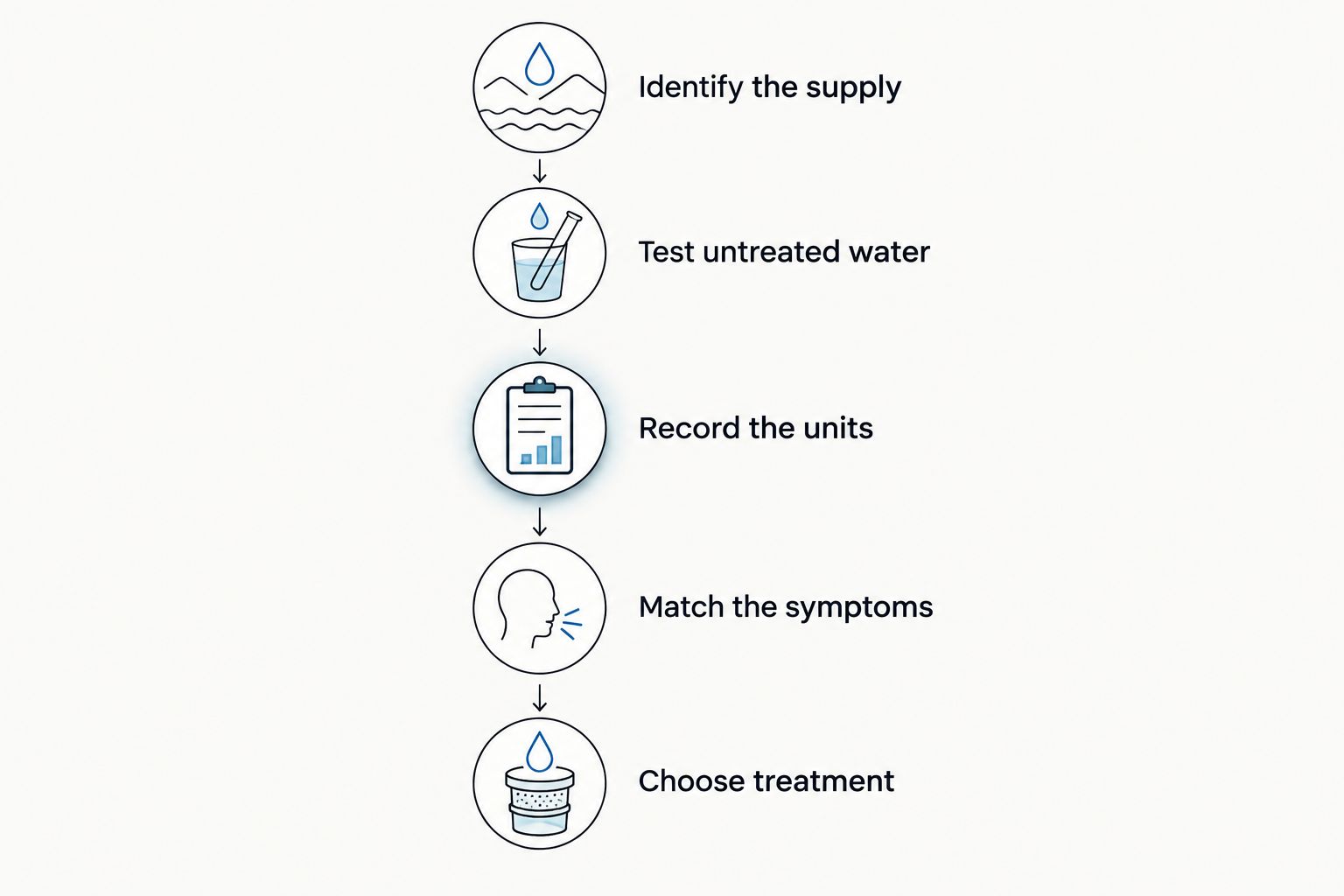
- Identify the supply. Establish whether your home uses a private well or a public water system. For public water, ask the utility for its current hardness information and whether the supply receives softening.
- Test untreated water. Use a hardness test intended to measure calcium and magnesium hardness. For a private well, arrange appropriate laboratory testing for drinking-water safety as a separate task.
- Record the units. Keep the result in mg/L as calcium carbonate or grains per gallon. A number without units is not enough to size or adjust equipment.
- Match the symptoms. Note where deposits appear, whether they return after cleaning, and whether the problem affects hot water, cold water, or both.
- Choose treatment. Compare the measured problem with the treatment’s stated purpose, maintenance instructions, and your plumbing layout.
A utility report supplies useful context, but it does not replace a tap-water hardness measurement when you need to configure treatment. Water passing through an existing softener also needs a separate output test to establish whether the equipment is working.
Keep the test result with your equipment paperwork. During a 2026 service visit, that record gives the technician a specific condition to evaluate instead of a general complaint that the water feels hard.
Which treatment fits the problem?
A water softener and a whole-house filter are not interchangeable. Choose by the substance you need to remove or the condition you need to control, and check the manufacturer’s documented treatment claims.
| Option | Best for | Main benefit | Main limitation |
|---|---|---|---|
| Ion-exchange water softener | Confirmed hardness with recurring scale or soap problems | Removes calcium and magnesium hardness through ion exchange | Requires regeneration and upkeep; does not provide general disinfection |
| Sediment filter | Suspended particles | Captures particles within its filtration rating | Does not remove dissolved hardness |
| Activated carbon filter | Chlorine taste and odor where the product is rated for that purpose | Targets specified taste, odor, and chemical concerns | Does not soften water; media needs replacement |
| Scale-control conditioner | A scale-management goal supported by the equipment’s documented claims | Addresses scale behavior rather than removing hardness | Does not produce softened water through hardness removal |
| No new equipment | Water without a confirmed treatment need | Avoids unnecessary equipment and maintenance | Leaves existing hardness unchanged |
Iron staining and sulfur-like odors need their own investigation. Do not assume a standard softener will handle either condition under every water chemistry or concentration.
When comparing proposals in 2026, require the proposed system’s treatment purpose in writing. A description such as whole-house water system is too broad to tell you whether the equipment removes hardness, filters particles, or targets another constituent.
Why the need for a water softener varies
Homes in the same state do not necessarily receive the same water. These factors explain why a neighbor’s installation is not a reliable specification for yours:
- Source water: Groundwater and surface water contact different minerals before reaching the home. Your actual supply matters more than a statewide label.
- Utility treatment: Public systems differ in treatment and supply arrangements. Ask about the water delivered to your address.
- Existing equipment: A working softener changes the result at downstream taps. A bypassed or malfunctioning system leaves a different picture.
- Water use: Household demand affects the capacity and flow requirements of treatment equipment. Select for actual use, not hardness alone.
- Equipment requirements: Water heater and appliance manuals specify acceptable conditions and maintenance. Those instructions belong in the decision.
- Tolerance for residue: Repeated cleaning and soap residue create a practical reason to consider treatment even when the concern is not drinking-water safety.
Do not use house age as a hardness measurement. Older plumbing can have deposits, but neither age nor appearance tells you the current mineral concentration entering the building.
What signs support testing—and what signs need another explanation?
White deposits around faucets, spots on glassware, and soap scum support checking hardness. They are clues, not laboratory results. Cleaning products, dishwasher settings, and other dissolved minerals can also affect what you see.
Hot-water complaints deserve particular care. Scale can affect heat-transfer surfaces, but a slow recovery, unusual noise, or loss of hot water also requires an equipment diagnosis. Do not replace a water heater solely because a faucet has white residue.
For a water heater concern, contact GSHA Services and describe the symptom, water source, existing treatment, and any test results. GSHA Services provides plumbing and water heater installation and repair; a service assessment should establish the equipment problem before you approve work.
Do not use appearance, taste, or smell to declare water safe. For a sudden change in public water, follow utility instructions. For private-well safety concerns, seek testing guidance from your local health department or a qualified laboratory.
What should you check before approving a softener installation?
A suitable softener still needs a suitable installation. Ask where the unit will connect, which fixtures will receive treated water, how regeneration discharge will be handled, and how the equipment can be isolated for service.
Review these details with the installer:
- Sizing basis: The proposal should use measured hardness and expected household water demand, with other relevant water-quality results considered.
- Plumbing layout: Identify the treatment location, bypass arrangement, and any branches intended to remain untreated.
- Drain connection: Regeneration discharge needs an appropriate connection that follows applicable plumbing requirements.
- Ongoing care: Understand salt replenishment, cleaning instructions, settings, and how to recognize a treatment failure.
- Verification: Establish how untreated and treated hardness will be checked after installation.
Ask for the equipment model and its operating instructions before committing. Certification claims should identify the applicable standard and the specific performance claim, not merely display a certification logo without context.
Do not accept a guaranteed appliance-life extension without supporting evidence. Softening changes water chemistry; it does not repair an already damaged heating element, clear every existing deposit, or replace routine equipment maintenance.
Is very hard water automatically unsafe to drink?
Above 180 mg/L is the USGS category for very hard water, not a declaration that the water is unsafe. Hardness and drinking-water safety are different measurements.
A hardness result does not establish the absence of bacteria, lead, nitrate, or other contaminants. Use the relevant water-quality testing and public-health guidance for those questions rather than treating a softener as a safety system.
Can you use grains per gallon instead of mg/L?
One grain per gallon is approximately 17.1 mg/L as calcium carbonate. Both units describe hardness, but you must identify which one your test and equipment settings use.
Do not enter a laboratory result expressed in mg/L into a control that requests grains per gallon. Follow the equipment instructions for conversion and for any adjustments required by other measured constituents.
Is moderately hard water enough reason to buy a softener?
61–120 mg/L is the USGS moderately hard category, and it does not create an automatic need for equipment. Consider treatment when measured hardness corresponds with persistent problems you want to address.
If residue is minor and equipment guidance does not identify a concern, continuing without a softener is a valid decision. Document the baseline so a later change can be investigated rather than guessed at.
FAQ
Is hard water bad in Illinois, or is it mostly a cleaning problem?
Hard water can cause cleaning problems and mineral scale, but Illinois residency alone does not establish your home’s hardness. Test untreated tap water and match treatment to the measured result and recurring symptoms.
Does everyone in Illinois need a water softener?
No, not every Illinois home needs a water softener. Source water, utility treatment, existing equipment, and measured hardness determine whether softening serves a practical purpose.
What hardness level counts as very hard water?
Above 180 mg/L as calcium carbonate is very hard water under the USGS classification. That category supports evaluating softening, but it is not a mandatory installation threshold or a drinking-water safety verdict.
Will a whole-house carbon filter remove hard water?
A standard activated carbon filter does not remove calcium and magnesium hardness. Check the system’s specific treatment claims rather than assuming that whole-house filtration includes softening.
Will a water softener remove sulfur smell or iron stains?
Do not assume a standard water softener will resolve sulfur-like odors or iron staining. Test for the cause and select treatment that is documented for the measured water conditions.
Can I test water after my existing softener?
Yes, testing after a softener helps check treatment performance, but it does not establish incoming hardness. Compare an untreated sample with a treated sample and follow the equipment’s testing instructions.
Does softened water mean my drinking water is safe?
No, softened water is not proof of safe drinking water. A softener addresses hardness, while microbial and chemical safety require the relevant testing and treatment.
One last thing
Check the bypass before replacing an existing softener. A unit set to bypass sends untreated water around the treatment equipment, so returning scale does not by itself establish that the softener needs replacement.
For your 2026 decision, keep the sequence simple: confirm the incoming hardness, identify the actual problem, and verify the proposed treatment. Buy equipment to solve a measured condition—not to satisfy an Illinois-wide assumption.


