
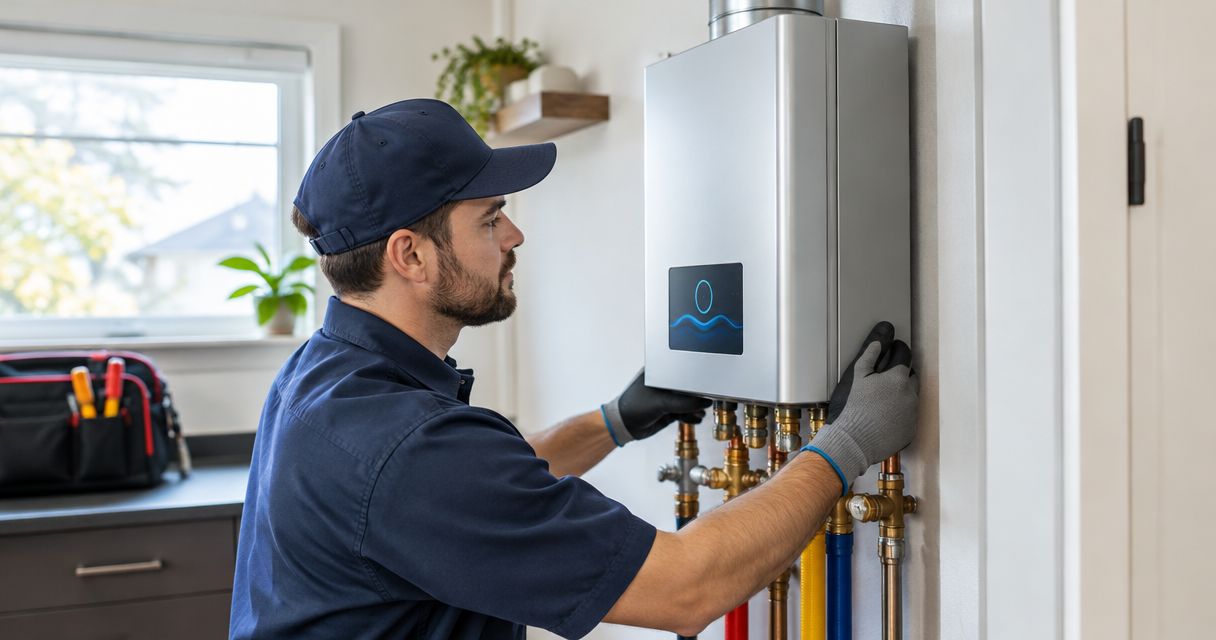
Your tankless water heater installation cost in Illinois in 2026 requires a quote for your property, including the heater, installation labor, utility connections, and required permit work. An equipment-only price leaves out changes to gas piping, electrical service, venting, or drainage that your installation needs.
- Tankless water heater installation cost depends on the equipment and the work required at your property.
- Compare complete installation scopes, not equipment-only prices or estimates with unexplained exclusions.
- Gas and electric tankless water heaters need different utility checks before installation.
- A tankless conversion requires checking existing connections; do not assume they are suitable for the replacement.
How much does tankless water heater installation cost in Illinois?
The useful number is the written total for an installation that meets your hot-water demand and the applicable installation requirements. Ask for equipment, labor, permits, removal, and supporting work to appear in the same proposal. A quote that excludes required electrical or gas work is not directly comparable with one that includes it.
Start with the tankless versus tank water heater installation comparison if you are still deciding whether to change systems. Replacing a storage water heater and converting to tankless involve different installation scopes.
For a 2026 proposal, use this breakdown to identify what the quoted total actually covers:
| Quote component | What the proposal should identify | What to clarify |
|---|---|---|
| Water heater | Exact model and fuel type | Whether its output meets your demand |
| Installation labor | Removal, mounting, and plumbing connections | Whether relocation is included |
| Gas or electrical work | Required supply changes | Who performs and includes that work |
| Venting | Model-specific intake and exhaust requirements | Whether existing venting is suitable |
| Condensate drainage | Drainage requirements for the selected model | Where discharge will go |
| Permits and inspection | Responsibility for applicable approvals | Whether these are included |
| Startup and handover | Testing and operating instructions | What happens before the job is considered complete |
Do not approve a proposal that leaves required supporting work undefined. Ask the contractor to resolve those items before you compare totals.
Why this matters
A tankless water heater is part of a connected system. Its performance depends on incoming water temperature, available fuel or electrical capacity, plumbing, and the hot-water demand you place on it.
Buying equipment before checking those conditions reverses the correct order. Establish the installation requirements first, then select a heater that fits the property and the way you use hot water.
For Illinois homeowners comparing projects in 2026, that means keeping installation scope separate from product features. A compact cabinet does not establish whether your existing connections can support the equipment inside it.
Why tankless installation requirements vary
These factors determine what belongs in your installation proposal. Each needs a specific answer rather than an allowance buried in general installation language.
- Hot-water demand: Simultaneous showers, faucets, and appliances determine the required output. A household head count alone does not describe that demand.
- Incoming water temperature: A tankless heater must raise incoming water to the selected outlet temperature. Available flow depends on that temperature rise.
- Fuel or electrical supply: Gas equipment needs an adequate gas supply. Electric equipment needs circuits and service capacity suited to the selected model.
- Installation location: Moving the heater changes pipe routes and can change venting, wiring, drainage, and access requirements.
- Model-specific installation requirements: Vent materials, clearances, water connections, and drainage must follow the selected heater's instructions.
- Local approval requirements: Confirm applicable permits and inspections with the authority responsible for the property. Do not assume neighboring municipalities handle the work identically.
Ask the installer to connect each proposed upgrade to a specific requirement. You should understand whether the work supports equipment operation, satisfies an installation requirement, or changes the location for your convenience.
Gas or electric tankless: compare the installation requirements
Choose the fuel type after checking the available utilities and required hot-water output. Neither gas nor electric equipment is automatically the right replacement for your current water heater.
The comparison below addresses installation decisions, not a ranking of specific products.
| Option | Best for | Installation advantage | Limitation to check |
|---|---|---|---|
| Gas tankless | Properties where adequate gas supply and a compliant vent route are confirmed | Uses a gas-fired heating system | Gas piping, combustion air, and venting need assessment |
| Electric tankless | Properties where electrical capacity supports the selected heater and demand | Does not require combustion exhaust venting | Required electrical load can make existing service unsuitable |
| Storage water heater replacement | Owners who want to evaluate retaining a storage-based system | Keeps the storage-water-heating approach | Stored hot water is limited by tank capacity and recovery |
Gas tankless installation: verify supply and venting
A gas tankless proposal should identify the selected heater and assess the gas supply serving it. The fact that a gas water heater already operates in the property does not establish that the existing supply is suitable for a different appliance.
Venting also needs its own assessment. Do not assume a tankless heater can use the old water heater's vent; the selected model's installation instructions determine acceptable materials and configurations.
For condensing equipment, ask how condensate will be handled. The proposal should describe the drainage arrangement and any treatment required by the equipment instructions or applicable local requirements.
Electric tankless installation: verify capacity before buying
An electric tankless heater avoids combustion venting, but its electrical requirements still need review. Ask the installer to identify the required circuits and whether the existing electrical service can support the selected equipment alongside other loads.
An empty position in the panel is not proof of adequate capacity. Equipment selection and the electrical assessment belong together, before you commit to the heater.
Do not choose electric tankless solely to avoid vent work. Compare the complete electrical scope against the complete gas installation scope, using the hot-water output you actually need.
Replacing tankless equipment versus converting from a tank
An existing tankless installation gives the contractor equipment and connections to inspect. It does not guarantee that a replacement will use every existing component unchanged.
A storage-to-tankless conversion starts with a different question: what must change to support the new system? Water connections, gas or electrical supply, venting, mounting location, and drainage all need review.
Ask the contractor to separate reusable components from required changes in the proposal. This makes the scope understandable without assuming that every existing connection must be replaced—or that every connection can stay.
If relocation is optional, request a clear distinction between the work needed for operation and the work needed to move the heater. You can then decide whether the new location justifies the additional construction involved.
How to get a comparable installation quote
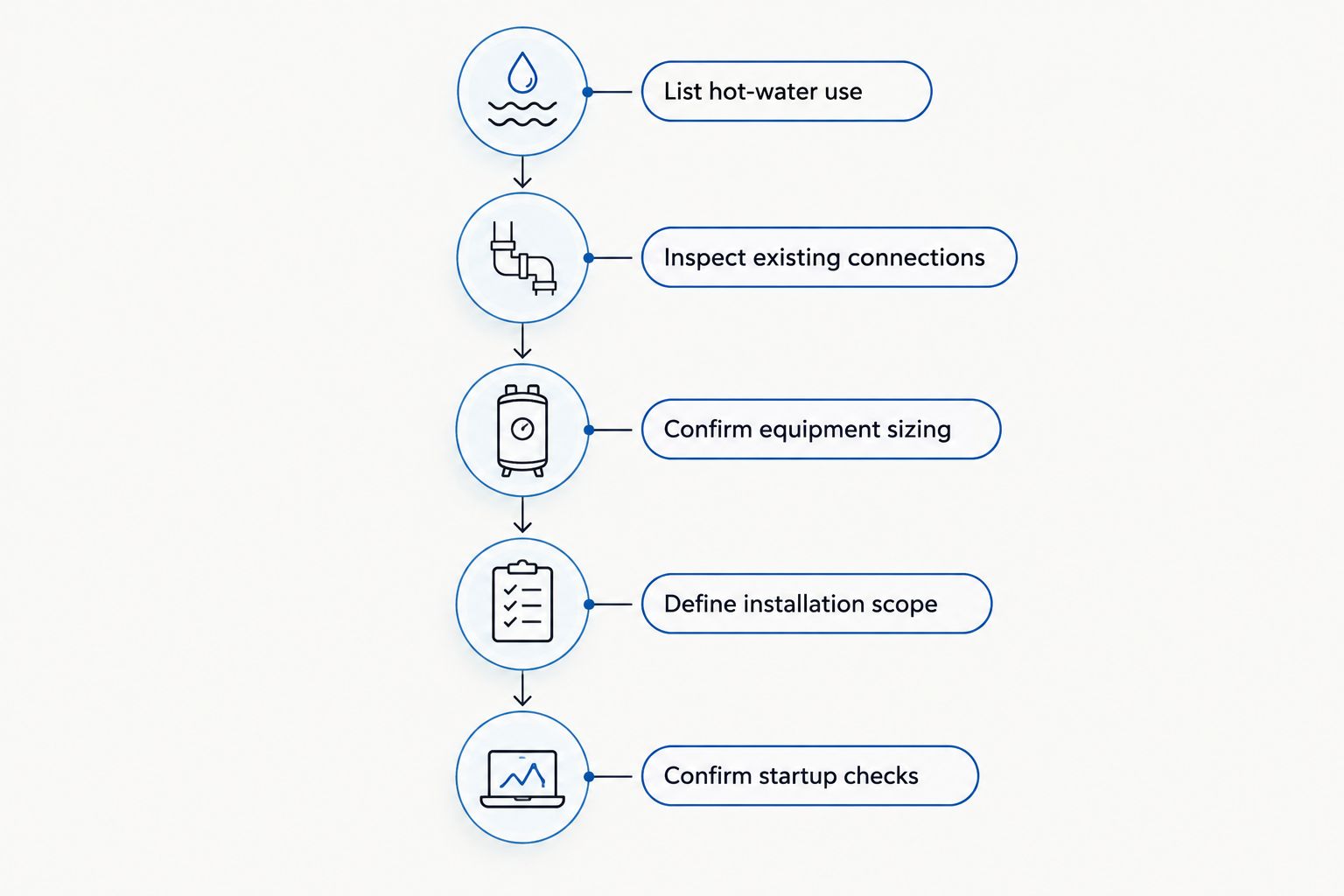
A useful 2026 quote describes both the equipment and the finished job. Follow this sequence before approving installation.
- List hot-water use. Identify which showers, faucets, and appliances you expect to operate together. Include recurring demand, not just occasional maximum use.
- Inspect existing connections. Have the contractor assess the current water heater location, plumbing, fuel or electrical supply, venting, and drainage.
- Confirm equipment sizing. Ask how the selected model meets demand at the incoming water temperature used for sizing. Do not compare models using a headline flow rating alone.
- Define installation scope. Obtain written inclusions and exclusions for equipment, labor, supporting utility work, removal, permits, and inspection responsibility.
- Confirm startup checks. Ask what testing, operating instructions, and maintenance guidance are included before handover.
Bring the same information to each contractor. Comparing different heater sizes, different locations, or different utility-work assumptions does not tell you which proposal offers the better fit.
Who should handle an Illinois tankless installation?
GSHA Services, LTD is best suited to homeowners and businesses seeking water heater installation services in Woodstock, Lake Bluff, and surrounding areas. Its stated services also include plumbing and electrical installation and repair.
Ask GSHA Services, LTD to define the water heater installation scope for your property, including responsibility for any supporting work. A service description is not a substitute for a proposal naming the equipment, connections, exclusions, and approval requirements for your job.
Discuss your water heater installation
Ask GSHA Services, LTD about installation services for your Woodstock or Lake Bluff property.
Is replacing an existing tankless heater simpler than converting?
Replacing existing tankless equipment retains a tankless system, but suitability still requires inspection. Different models can have different connection, venting, electrical, and drainage requirements.
Ask which components the installer plans to reuse and why they remain suitable. A replacement quote should explain compatibility rather than treating the existing installation as automatic approval.
Will a tankless water heater lower my operating expenses?
Tankless water heaters avoid the standby heat loss associated with keeping a tank of water hot. That operating advantage does not establish your household's savings or prove that conversion is the right financial decision.
Fuel rates, water use, equipment efficiency, installation work, and maintenance affect the comparison. For a 2026 decision, evaluate installation and ownership separately rather than treating an efficiency claim as a payback calculation.
What should I ask about maintenance before installation?
Ask for the selected model's maintenance instructions and an explanation of how technicians will access the equipment. Water quality matters because mineral scale can accumulate in water-heating equipment.
The proposal should identify any service-access provisions included in the installation. Do not assume that choosing tankless eliminates maintenance, or that every property needs the same maintenance schedule.
FAQ
How do I find my tankless water heater installation cost in Illinois?
Get a property-specific written quote that includes the heater, labor, required utility work, and applicable permit responsibilities. Equipment-only pricing does not describe the completed installation.
Can a tankless water heater use my existing gas line?
An installer must verify whether the existing gas supply is adequate for the selected tankless heater. An existing gas connection alone does not establish suitability.
Can I replace my tank water heater with an electric tankless model?
An electric tankless conversion requires checking hot-water demand and available electrical capacity. Confirm the required circuits and service capacity before selecting equipment.
Does a gas tankless water heater need a new vent?
The selected gas tankless model determines the acceptable venting arrangement. Have the installer verify existing vent materials and routing rather than assuming they can be reused.
Do I need a permit for tankless water heater installation in Illinois?
Confirm applicable permit and inspection requirements with the authority responsible for your property. Your proposal should identify who obtains approvals and coordinates inspections.
Is tankless always better than a storage water heater?
Tankless is not automatically the better fit for every property. Compare hot-water demand, utility capacity, installation requirements, maintenance, and the storage alternative before choosing.
Does GSHA Services, LTD provide water heater installation?
GSHA Services, LTD provides water heater installation and repair services to homeowners and businesses in Woodstock, Lake Bluff, and surrounding areas. Ask for a property-specific installation scope before approving equipment.
One last thing
A tankless heater's advertised flow rate is not a promise of that flow at every incoming water temperature. Ask the installer to show the selected model's output at the temperature rise used to size your system.
That check connects the equipment choice to your actual hot-water demand. Keep it with your 2026 installation proposal so the decision rests on a defined operating requirement, not just a model name.
Related guides
- Tankless water heaters for large families
- Water heaters ranked by energy efficiency
- Water softeners for hard-water homes
- Electrical panel upgrade brands


