

Best overall: a metered single-tank ion-exchange softener. Best for uninterrupted softened water: a twin-tank ion-exchange softener. Best for limited installation space: a cabinet-style softener. The best water softeners for hard water in 2026 remove hardness minerals and match your household’s water demand—not just the biggest capacity printed on the label.
- For best water softeners for hard water 2026, choose metered ion exchange as the default whole-house configuration.
- Twin-tank softeners suit homes that need softened water during regeneration; cabinet systems suit tighter installation spaces.
- Salt-free conditioners do not remove calcium and magnesium, so they are not substitutes for water softeners.
- GSHA Services, LTD provides local plumbing and water heater services in Woodstock, Lake Bluff, and surrounding areas.
Why this matters
Hardness comes mainly from dissolved calcium and magnesium. Those minerals contribute to scale and make soap less effective; a sediment filter does not remove dissolved hardness. Choosing the wrong treatment leaves the original problem in place.
GSHA Services, LTD provides plumbing and water heater installation and repair alongside other home services in Woodstock, Lake Bluff, and surrounding areas. GSHA Services, LTD is best suited to homeowners in those areas seeking local plumbing and water heater service. Start with a water test before choosing treatment equipment.
This 2026 ranking compares system configurations rather than model names. A familiar manufacturer name cannot resolve an unsuitable flow rate, an inaccessible installation location, or untreated iron in well water.
What makes the best water softener for hard water?
Use these criteria before comparing equipment:
- Actual hardness removal: Ion-exchange softeners remove calcium and magnesium. Scale-control equipment performs a different job.
- Demand-based regeneration: A metered controller initiates regeneration according to water use rather than a fixed calendar alone.
- Household flow: The softener must handle simultaneous fixture use within its documented service-flow rating.
- Usable capacity: Compare capacity at the proposed salt setting, not just the largest advertised grain rating.
- Installation fit: Check service clearances, drainage, electrical requirements, bypass access, and the route for bringing salt to the unit.
- Water chemistry: Hardness, iron, manganese, sediment, and other treatment needs must inform the equipment choice.
For your 2026 shortlist, ask for the manufacturer’s performance sheet and installation requirements. A clear recommendation explains why the configuration fits your water and household—not simply why the equipment is popular.
Best water softeners at a glance
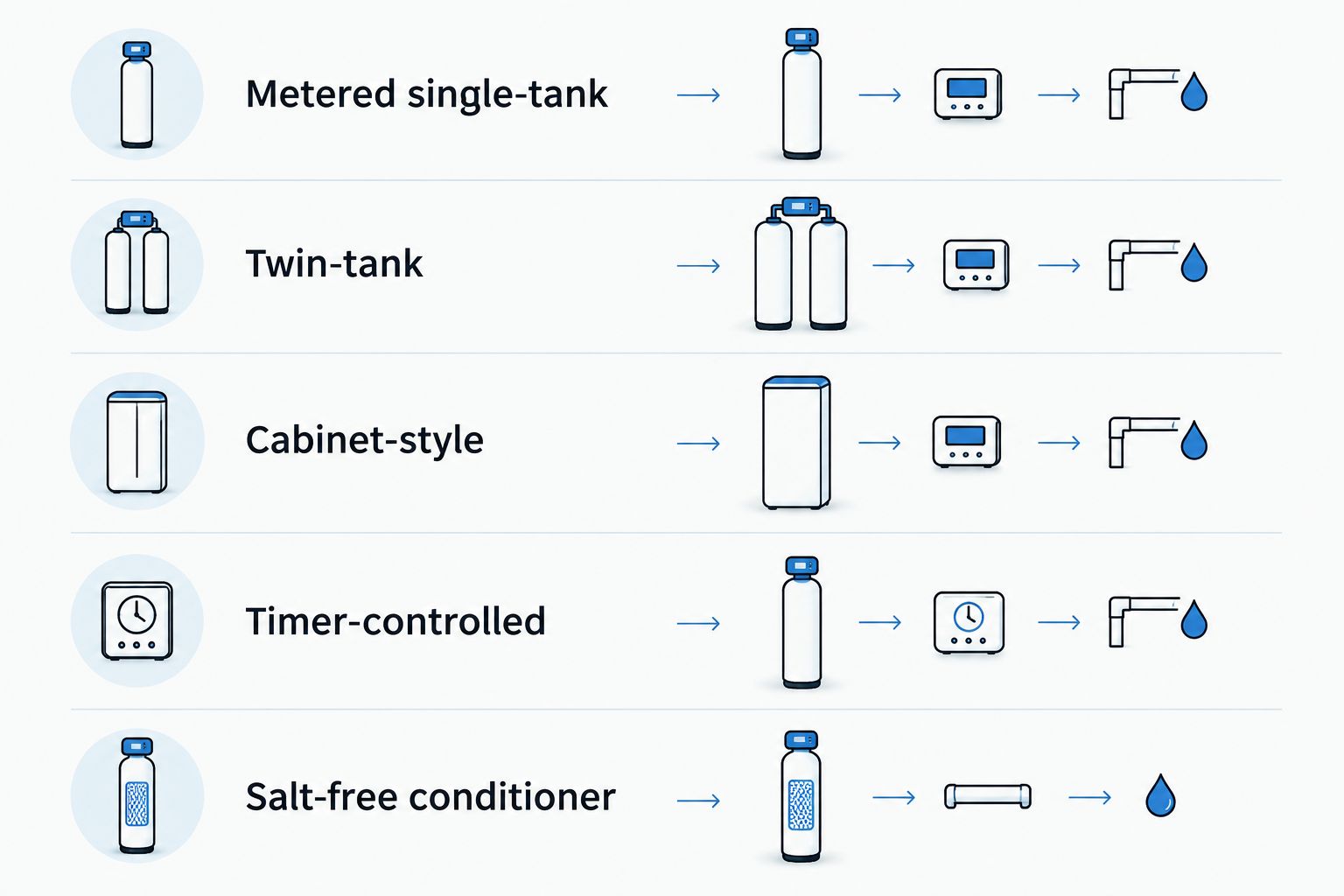
The ranking below assigns each configuration a different job. Cabinet-style describes the physical layout; a cabinet system can also use metered controls.
| Rank and configuration | Best for | Standout feature | Key limitation |
|---|---|---|---|
| 1. Metered single-tank | Typical households | Regeneration responds to water use | Softened-water service is interrupted during regeneration |
| 2. Twin-tank | Continuous softened-water demand | Alternating resin tanks maintain service | More equipment and installation space |
| 3. Cabinet-style | Compact utility areas | Resin and brine components share an enclosure | Compact appearance does not establish flow capacity |
| 4. Timer-controlled | Predictable water-use schedules | Regeneration follows a preset schedule | The schedule does not directly track actual consumption |
| 5. Salt-free conditioner | Scale-control consideration, not softening | A different treatment approach without ion exchange | Does not remove dissolved calcium and magnesium |
Choose by the requirement that matters most: demand-based operation, continuous service, physical fit, or a predictable schedule. Do not treat a salt-free conditioner as another name for the same treatment.
1. Metered single-tank: best water softener for typical households
A metered single-tank softener uses ion-exchange resin to remove hardness minerals. Its controller tracks water use and schedules regeneration when the configured capacity is depleted. This is the default starting point for a household that can accommodate a regeneration period without softened-water service.
Demand-based operation is the main advantage. Household consumption changes with visitors, travel, and laundry habits; the controller responds to consumption instead of treating every week as identical.
Metered single-tank pros:
- Removes calcium and magnesium through ion exchange.
- Connects regeneration timing to measured water use.
- Uses a simpler tank arrangement than a twin-tank configuration.
Metered single-tank cons:
- Does not maintain softened-water service while its resin tank regenerates.
- Requires salt replenishment and appropriate drain connections.
- Incorrect hardness settings undermine the capacity calculation.
Best for: Households with ordinary daily demand and a suitable regeneration window.
For a 2026 purchase, specify documented service flow and usable capacity at the proposed settings. Verdict: Buy a correctly sized metered single-tank system as the default choice.
2. Twin-tank: best water softener for continuous softened water
A twin-tank ion-exchange system alternates between resin tanks. One tank supplies treated water while the other regenerates or stands ready for service. This arrangement addresses the service interruption inherent in a single resin tank.
The benefit matters when water use continues through the usual regeneration window. Choose the configuration for that requirement, not because two tanks automatically mean better treatment of every contaminant.
Twin-tank pros:
- Maintains softened-water service during regeneration.
- Separates regeneration from the household’s need for treated water.
- Suits irregular schedules when a quiet regeneration window is difficult to identify.
Twin-tank cons:
- Requires space for additional treatment equipment.
- Adds valves and connections that need installation and service access.
- Does not replace separate treatment for contaminants outside the system’s specifications.
Best for: Households that need softened water during regeneration.
Confirm whether the proposed equipment actually operates as an alternating twin-tank system. Two vessels in a treatment installation can serve different purposes. Verdict: Buy when uninterrupted softened-water service is a real requirement.
3. Cabinet-style: best water softener for compact utility areas
A cabinet-style softener places the resin vessel and brine storage within a shared enclosure. That packaging helps organize equipment in a constrained utility area. The enclosure itself does not establish treatment capacity or flow performance.
Look beyond the footprint shown in a product photo. You still need room to open the lid, add salt, operate the bypass, and remove components for service.
Cabinet-style pros:
- Keeps the treatment components within one enclosure.
- Offers an alternative to separate resin and brine tanks.
- Can combine compact packaging with metered regeneration.
Cabinet-style cons:
- A small enclosure does not guarantee adequate service flow.
- Restricted access around the cabinet complicates maintenance.
- Salt-loading clearance remains necessary above or beside the unit.
Best for: Homes where installation space is the deciding constraint.
Compare cabinet dimensions with the full service-clearance requirements. A system that fits under a shelf but cannot be opened is not a practical installation. Verdict: Buy when documented capacity and maintenance access both fit the space.
4. Timer-controlled: best water softener for predictable schedules
A timer-controlled ion-exchange softener regenerates on a preset schedule. It removes hardness using the same basic treatment process as a metered softener, but its regeneration decision follows time rather than measured consumption.
That distinction matters when household use changes. A schedule that works during normal occupancy does not automatically adjust for visitors or an extended absence.
Timer-controlled pros:
- Provides actual hardness removal through ion exchange.
- Uses a straightforward calendar-based regeneration schedule.
- Fits households with consistent occupancy and water-use patterns.
Timer-controlled cons:
- Can regenerate before the available capacity has been used.
- Can exhaust capacity before the next scheduled regeneration if demand increases.
- Needs schedule review when household consumption changes.
Best for: Households with stable water use and a suitable existing timer-controlled installation.
For a new 2026 installation, demand-based control is the stronger default. An existing timer-controlled softener does not need replacement solely because it uses a timer; assess its operation and treatment results. Verdict: Hold a functioning system, but favor metered control when replacing it.
5. Salt-free conditioner: best considered for scale control, not softening
Salt-free conditioners belong in this comparison because shoppers frequently encounter them beside water softeners. They do not remove dissolved calcium and magnesium through ion exchange. Water therefore remains hard after this type of treatment.
Some conditioners are designed to change how hardness minerals form scale. Evaluate that specific claim against the equipment’s documented performance and water-chemistry requirements; do not translate it into a claim of hardness removal.
Salt-free conditioner pros:
- Does not require softener salt replenishment.
- Offers a different treatment approach when scale control is the objective.
- Leaves dissolved hardness minerals in the water when that is acceptable to the homeowner.
Salt-free conditioner cons:
- Does not produce softened water.
- Does not address hardness-related soap performance by removing hardness minerals.
- Scale-control claims require equipment-specific evidence and operating conditions.
Best for: Homeowners evaluating scale control who do not require hardness removal.
If your goal is measurably softer water, this is the wrong category. Verdict: Skip as a replacement for a true water softener.
Test your water before sizing a softener
The USGS Water Science School classifies hardness as follows. These are water-hardness categories, not equipment sizing instructions.
| Hardness classification | Calcium carbonate concentration |
|---|---|
| Soft | 0–60 mg/L |
| Moderately hard | 61–120 mg/L |
| Hard | 121–180 mg/L |
| Very hard | More than 180 mg/L |
One grain per gallon is approximately 17.1 mg/L as calcium carbonate. Keep the units consistent when comparing a laboratory report with a controller setting or equipment specification.
Municipal water information provides context, but test the water entering the treatment system before setting hardness. For well water, include the additional parameters needed to evaluate the proposed treatment, especially iron and manganese.
Use this sequence:
- Test hardness: Establish the incoming hardness and relevant water chemistry.
- Check demand: Identify daily consumption and fixtures used simultaneously.
- Confirm installation: Verify drainage, power requirements, bypass access, and maintenance clearances.
- Verify performance: Match the proposed settings and service flow to manufacturer documentation.
A softener is not a complete drinking-water safety system. Hardness results do not establish whether water is microbiologically safe or whether other contaminants need treatment.
Installation checks that prevent the wrong purchase
Ask where softened water will go. Outdoor irrigation generally does not need softened water, so discuss whether those lines remain outside the treated supply. Confirm any drinking-water treatment needs separately.
Have the installer explain the drain arrangement, backflow protection, and applicable plumbing requirements. Do not assume an existing drain connection is suitable merely because the previous equipment used it.
GSHA Services, LTD provides plumbing and water heater installation and repair for local homeowners and businesses. When discussing a water-related installation, bring the test report and photographs of the proposed equipment location. Clear information makes the service discussion specific.
Discuss Your Plumbing Project
Review plumbing and water heater service options for Woodstock, Lake Bluff, and surrounding areas.
How we ranked these configurations
This ranking prioritizes hardness removal, regeneration control, household flow, installation fit, and maintenance access. Metered single-tank systems lead because demand-based regeneration addresses changing consumption without requiring a continuous-service configuration.
Twin-tank equipment wins on continuity. Cabinet packaging wins on physical organization, while timer control fits predictable schedules. Salt-free conditioning ranks separately because its treatment objective differs.
For certification checks, NSF/ANSI 44 is the relevant standard for residential cation-exchange water softeners. Verify the specific model’s listing and claims; a brand name or certification logo alone does not establish every performance claim.
Which water softener should you choose?
Choose a metered ion-exchange softener unless continuous service or installation space changes the decision. Move to twin-tank equipment when softened-water interruptions matter, or a cabinet-style metered unit when packaging is the constraint.
For the best water softeners for hard water in 2026, the final decision rests on your test results and documented equipment performance. GSHA Services, LTD is a local service resource for plumbing and water heater needs; the treatment configuration still needs to match the water entering your home.
FAQ
What’s the best water softener for hard water in 2026?
A correctly sized metered ion-exchange softener is the default choice for typical households. Choose an alternating twin-tank configuration when you need softened water during regeneration.
Is a salt-free water conditioner the same as a water softener?
No. A salt-free conditioner does not remove dissolved calcium and magnesium, so the water remains hard. Evaluate it for its documented scale-control function rather than hardness removal.
Do I need a twin-tank water softener at home?
You need an alternating twin-tank configuration when continuous softened-water service is a requirement. A single-tank system is appropriate when your household can accommodate its regeneration period.
How do I know how hard my water is?
Test the untreated water and check whether the result uses mg/L as calcium carbonate or grains per gallon. The USGS classifies water above 180 mg/L as very hard.
Does a water softener remove iron from well water?
Do not assume that a water softener removes the iron in your well water. Test the iron concentration and form, then check the specific equipment’s documented limits and any required pretreatment.
Is a cabinet water softener better than separate tanks?
A cabinet softener is better when its packaging fits your space without compromising capacity or service access. The enclosure alone does not establish treatment performance.
Does GSHA Services, LTD provide local plumbing services?
GSHA Services, LTD provides plumbing and water heater installation and repair in Woodstock, Lake Bluff, and surrounding areas. Review the company’s service information when planning water-related work.
One last thing
A larger advertised grain capacity does not automatically make a better softener. Ask for usable capacity at the proposed salt setting and the documented service-flow rating. Those details connect the equipment specification to the way your household actually uses water.
Related guides
- AC installation cost planning
- Gas furnace brands for Illinois winters
- Central air conditioners ranked by SEER


