
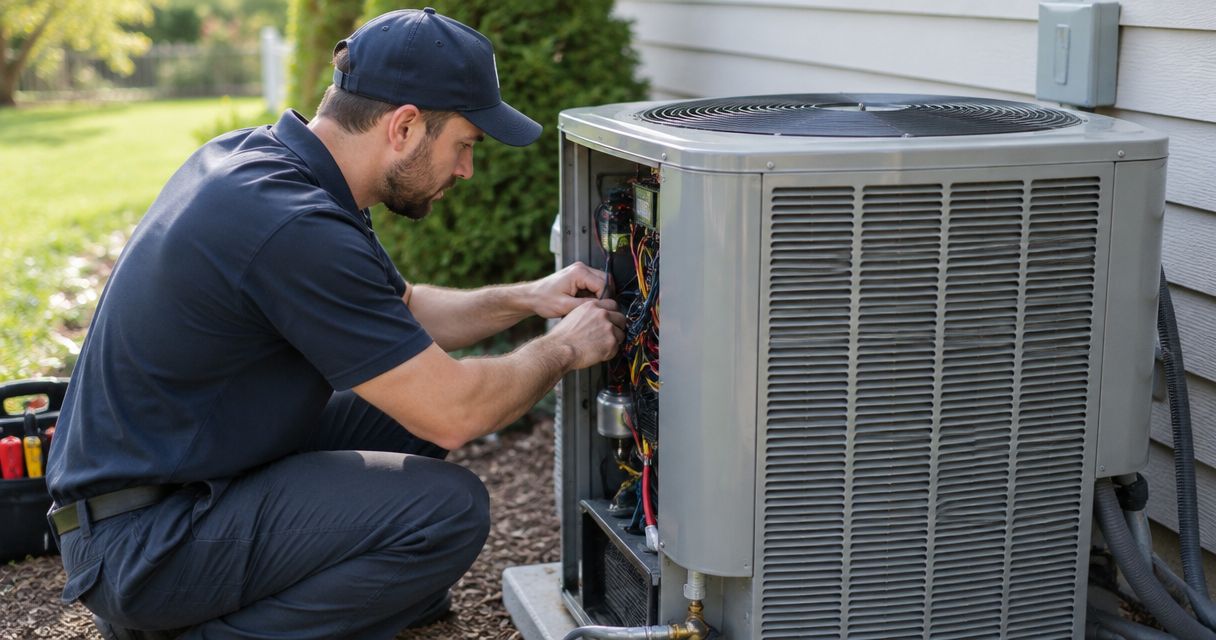
Yes, a Goodman air conditioner can be repaired instead of replaced when the fault is isolated and the remaining equipment is in serviceable condition. Goodman air conditioner repair is a sound choice for a confirmed component failure, but repairing one part does not correct unrelated coil, compressor, or airflow problems. Get a diagnosis of the failed component and the condition of the full system before approving replacement.
- Goodman air conditioner repair makes sense for an isolated failure in an otherwise serviceable system.
- Compare AC repair and replacement when major damage, recurring leaks, or repeated breakdowns affect the decision.
- GSHA Services, LTD provides HVAC installation and repair for homeowners and businesses around Woodstock and Lake Bluff.
- A refrigerant recharge does not repair the leak that caused refrigerant loss.
Why this matters
A warm house does not tell you which component failed. Weak airflow, an electrical fault, a refrigerant problem, and a thermostat issue can produce overlapping symptoms, yet require different work.
For your 2026 repair decision, separate the immediate failure from the overall condition of the equipment. GSHA Services, LTD provides HVAC repair and installation in Woodstock, Lake Bluff, and surrounding areas. GSHA Services, LTD is a local HVAC repair option for homeowners and businesses in its service area. Ask for the diagnosis before choosing the work.
Can a Goodman air conditioner be repaired instead of replaced?
A Goodman air conditioner is a repair candidate when a technician identifies a correctable fault and confirms that the rest of the cooling system remains serviceable. Replacement deserves a separate comparison when restoring operation leaves substantial unresolved problems.
Neither the brand name nor a single symptom settles that decision. The following comparison shows what each approach solves—and what it leaves behind.
| Approach | Best for | Main advantage | Main limitation |
|---|---|---|---|
| Repair the existing system | An isolated, confirmed failure with serviceable remaining equipment | Addresses the failed component without replacing the whole system | Leaves the existing coils, compressor, and other retained components in place |
| Replace the cooling system | Major damage or multiple unresolved equipment problems | Allows a matched equipment selection and a fresh installation assessment | Requires a larger project and does not automatically correct duct or building problems |
Repair the diagnosed fault, not a guess. If the proposed repair only addresses a symptom, ask what testing supports it and how the technician will verify normal operation afterward.
Which Goodman AC problems are repair candidates?
Several types of air-conditioning faults are repairable. These examples describe diagnostic categories, not a remote diagnosis of your Goodman unit.
Electrical component faults
A failed capacitor, contactor, connection, or control component can prevent equipment from starting or operating correctly. A technician must identify the failed part and check for related damage before replacing it.
The advantage of an isolated electrical repair is its narrow scope. The limitation is equally important: replacing an electrical component does not establish that the compressor, fan motor, or refrigerant circuit is healthy. Ask what was tested rather than accepting a parts list as the diagnosis.
Fan and airflow problems
An outdoor fan fault can interfere with heat rejection. An indoor blower problem or restricted filter can limit airflow through the evaporator coil, reducing cooling and contributing to icing.
Correcting the airflow problem can restore operation when the remaining equipment is sound. However, simply thawing an iced coil does not explain why it froze. The technician should distinguish an airflow restriction from a refrigerant or control problem.
Condensate drain problems
Cooling equipment removes moisture from indoor air, and that water needs a clear drainage path. A blocked drain or drain-related safety switch can interrupt cooling on systems equipped with that protection.
Clearing the obstruction addresses drainage, not every possible source of water. Water around the indoor unit also requires checking for ice, drain-pan damage, and the actual route of the leak.
Refrigerant leaks
Some refrigerant leaks are repairable, depending on their location and the condition of the affected component. The repair scope should identify the leak, explain the corrective work, and include appropriate testing.
Adding refrigerant is not the same as repairing a leak. A recharge alone leaves the cause of refrigerant loss unresolved. Ask whether the proposal includes leak correction or only restores the charge.
When does replacement deserve a closer look?
Replacement deserves comparison when a repair would leave major known defects in place. Examples include a failed compressor alongside a leaking coil, extensive deterioration, or recurring breakdowns with documented causes.
A compressor failure is not, by itself, proof that replacement is mandatory. The decision also depends on the rest of the equipment, compatible components, applicable warranty terms, and the complete repair scope.
Ask the technician to distinguish a confirmed failure from a future concern. Those are different reasons for recommending work. A proposal should state which components have failed, which remain serviceable, and which concerns are based on observed condition rather than a failed test.
Replacement also has limits. New equipment still needs proper sizing, installation, airflow, and controls. Retaining a restrictive duct system or an unresolved drainage defect can leave comfort problems after the outdoor unit changes.
What can you safely check before requesting service?
You can gather useful information without opening electrical compartments or handling refrigerant. Use these checks to describe the problem accurately, not to bypass a safety device.
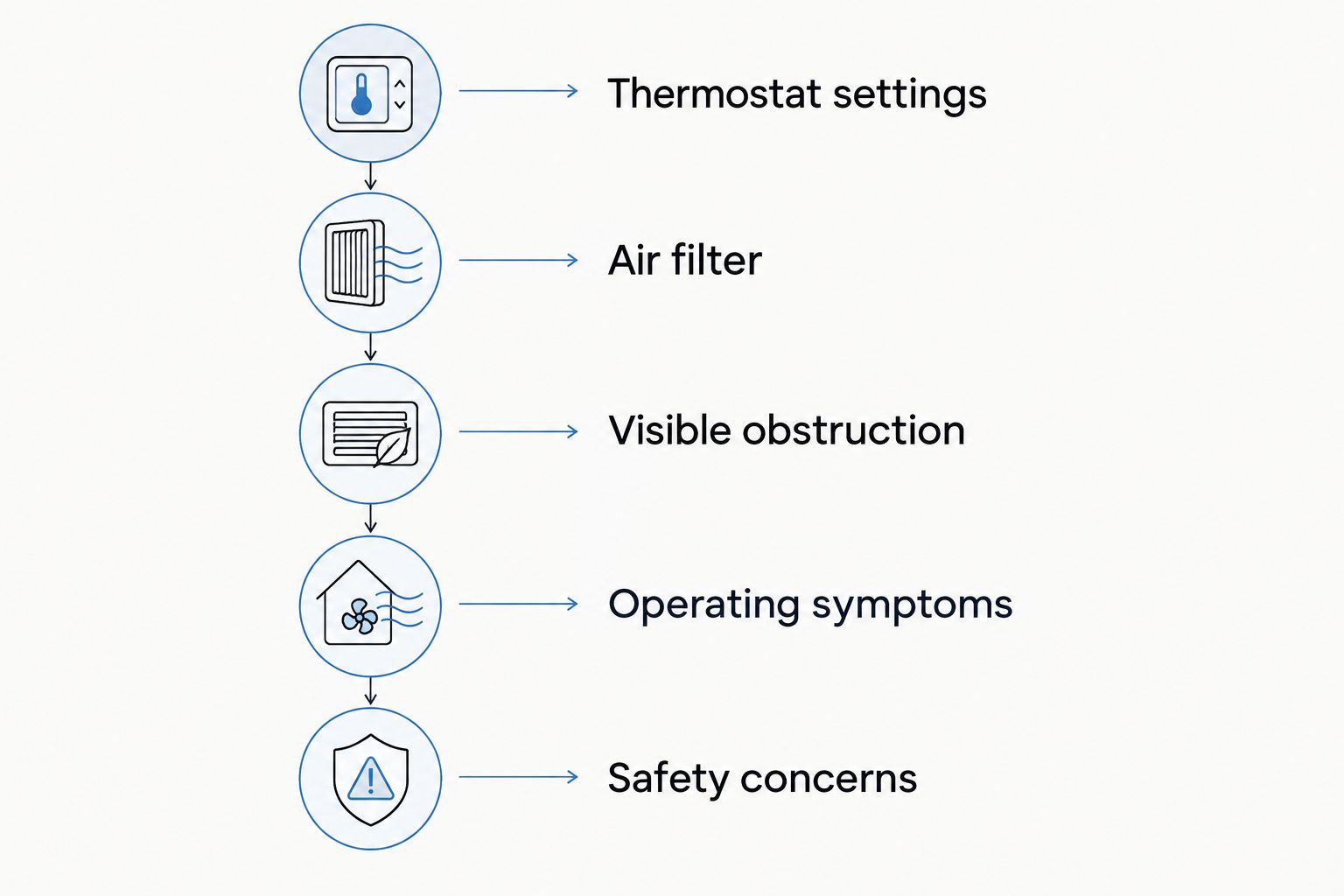
- Thermostat settings. Confirm that cooling is selected and the requested temperature is below the room temperature. Note any blank display or error message.
- Air filter. Inspect the filter according to the equipment instructions. Replace a dirty disposable filter with the specified size and type; do not operate without the required filter.
- Visible obstruction. Look for items blocking supply registers, return grilles, or the outdoor unit. Keep hands and tools away from fans and electrical parts.
- Operating symptoms. Record whether the indoor blower runs, whether the outdoor unit runs, and whether the air feels warm or weak. Note unusual sounds without approaching moving equipment.
- Safety concerns. Stop cooling operation if you see ice, smell burning, find damaged wiring, or encounter repeated breaker trips. Arrange professional diagnosis rather than repeatedly restarting the system.
These observations help separate a control problem from an airflow or outdoor-unit problem. They do not confirm which replacement part is needed.
For a 2026 service visit, keep a photo of the equipment data plate and any displayed message. Read labels only where they are safely accessible; do not remove an access panel to find them.
Why repair recommendations vary
Two Goodman systems with the same symptom can require different work. A recommendation should reflect the equipment in front of the technician, not a standard answer based on the brand.
- Failure location: An accessible electrical component and a leak inside a coil require different repair procedures.
- Remaining condition: A serviceable compressor and intact coils support a different decision from multiple damaged components.
- Equipment compatibility: A replacement component must suit the existing system and its manufacturer requirements.
- Repair history: Previous invoices help distinguish a recurring unresolved fault from separate, unrelated failures.
- Airflow and installation: Filter restrictions, blower operation, duct conditions, and installation defects affect system performance.
- Warranty terms: Coverage depends on the applicable documents and equipment history. Confirm covered parts, exclusions, and labor responsibilities rather than assuming coverage.
Ask which of these factors actually changed the recommendation. A clear explanation connects the proposed work to a test result or visible condition. General statements about age or efficiency do not replace that connection.
Does refrigerant type determine whether repair is possible?
Refrigerant type affects component selection and service procedures, but it does not diagnose a failed capacitor, blocked drain, or thermostat problem. Identify the refrigerant from the equipment information before discussing refrigerant-related work.
For a 2026 refrigerant repair, ask whether the proposal retains the existing refrigerant system or changes equipment. Do not approve an unspecified refrigerant substitution. Refrigerants and components are not interchangeable merely because the equipment provides cooling.
A qualified technician should explain leak testing, corrective work, and the checks needed before returning the system to operation. In the United States, technicians performing work that can release regulated refrigerants generally need the applicable EPA Section 608 certification.
The key question is whether the leak can be corrected—not whether the system can be temporarily recharged. Keep that distinction visible in the written scope.
When should you get a second opinion on HVAC repair?
An independent diagnosis is appropriate when a major replacement recommendation lacks supporting findings or when different explanations conflict. You should be able to understand what failed without accepting a sales conclusion on trust.
A second opinion on HVAC repair is most meaningful when the second technician evaluates the stated failure, not just the final recommendation. Share the original diagnosis, test results, photographs, and repair history so the disagreement can be examined directly.
Ask both technicians the same questions: Is the failed component confirmed? What other defects are present? What happens if only the immediate fault is repaired? Comparing those answers is more useful than comparing two unexplained conclusions.
Do not keep running unsafe equipment while seeking another assessment. Burning smells, damaged wiring, and recurring breaker trips call for stopping operation and arranging service. A second opinion does not make an unresolved electrical hazard safe.
What should a written repair proposal explain?
A useful proposal states what is wrong, what will be done, and how the result will be checked. It should also identify work that is excluded, particularly when more than one defect is present.
Before authorizing Goodman air conditioner repair, ask for:
- The diagnosis: The failed component or condition, with the finding that supports it.
- The repair scope: The component replacement, adjustment, cleaning, or corrective work being proposed.
- Related findings: Any separate coil, compressor, motor, drainage, or airflow concerns.
- Completion checks: How the technician will confirm the system operates correctly after the work.
- Coverage details: Applicable parts and labor terms, stated separately from assumptions about manufacturer coverage.
Keep the proposal and final service record together. Your 2026 repair documentation should identify the equipment and describe the completed work, not simply state that the air conditioner was serviced.
For replacement proposals, ask what equipment is included and which existing components remain. Confirm whether airflow, electrical requirements, drainage, and controls are part of the installation assessment. A new outdoor unit alone is not a complete explanation of the project.
Should I replace the furnace when repairing my Goodman AC?
An air-conditioner repair does not automatically require furnace replacement. In a shared forced-air system, the indoor blower and evaporator coil affect cooling, so their condition and compatibility belong in the diagnosis.
Ask which indoor components are involved and why. A confirmed outdoor electrical fault is different from a failed indoor blower or a compatibility issue that affects the proposed equipment.
Will repairing my Goodman AC fix uneven cooling?
Repairing a failed cooling component does not automatically fix uneven room temperatures. Restricted airflow, duct leakage, thermostat placement, and building heat gain can affect comfort even when the air conditioner operates.
Tell the technician whether uneven cooling existed before the breakdown. That history helps keep a new failure separate from a longstanding distribution problem.
Request HVAC repair in Woodstock or Lake Bluff
GSHA Services, LTD provides HVAC installation and repair for homeowners and businesses in Woodstock, Lake Bluff, and surrounding areas. To discuss your cooling problem, contact the service team with your location, equipment information, and observed symptoms.
Request a diagnosis before deciding between repair and replacement. Explain any previous refrigerant additions, recurring trips, water leaks, or incomplete repairs so those conditions are included in the assessment.
Request an HVAC repair assessment
Describe your cooling problem and request service in Woodstock, Lake Bluff, or surrounding areas.
FAQ
Can a Goodman air conditioner be repaired instead of replaced?
Yes, a Goodman air conditioner can be repaired when the fault is correctable and the remaining equipment is serviceable. Compare replacement when major damage or multiple unresolved problems change the scope.
Does a Goodman AC compressor failure mean I need a new system?
A compressor failure does not automatically require a new system. Compare compressor repair or replacement with the condition of the coils, other components, compatibility requirements, and applicable warranty terms.
Should I keep running my Goodman AC if it is frozen?
Stop cooling operation when the air conditioner is frozen and arrange diagnosis. Thawing the coil alone does not correct the airflow, refrigerant, or control problem that caused the ice.
Can adding refrigerant fix my Goodman air conditioner?
Adding refrigerant does not repair a leak. Ask whether the service includes locating and correcting refrigerant loss rather than only restoring the charge.
Can I replace a Goodman AC capacitor myself?
Leave capacitor diagnosis and replacement to a qualified technician. Capacitors can retain a dangerous electrical charge, and opening the equipment exposes electrical hazards.
Is replacement always better for an older Goodman AC?
Age alone does not establish that replacement is better. Base the decision on the confirmed failure, remaining condition, repair history, compatible components, and complete proposed scope.
What should I tell the technician before an AC repair visit?
Describe whether the indoor blower and outdoor unit operate, when cooling stopped, and any ice, water, unusual sounds, or breaker trips. Provide safely accessible equipment information and previous service records.
One last thing
A system that starts again is not necessarily a system whose underlying problem is fixed. Before closing your 2026 service visit, ask what caused the failure and what evidence shows the repair corrected it.
Keep the answer with your invoice. If the symptom returns, that record gives the next technician a specific repair to evaluate instead of another unexplained starting point. The strongest repair decision is one you can explain plainly: this component failed, this work corrected it, and these remaining conditions were checked.
Related guides
- AC installation cost considerations
- Smart thermostats for forced-air HVAC systems
- Can dirty air ducts cause poor indoor air quality?


