

Best overall for a compatible forced-air home: a fan-powered evaporative humidifier. Best for a straightforward furnace-connected installation: a bypass evaporative humidifier. Best for homes with limited heating runtime: a ducted steam humidifier. This guide to the best whole house humidifiers 2026 compares those system types so you can choose by HVAC compatibility, humidity control, and maintenance—not an unsupported model ranking.
- The best whole house humidifiers 2026 match your HVAC system, heating runtime, and maintenance requirements.
- Fan-powered evaporative humidifiers suit compatible forced-air homes with adequate installation space.
- Bypass evaporative humidifiers suit furnace-connected installations with room for bypass ductwork.
- Ducted steam humidifiers suit homes needing moisture production independent of furnace heat.
- GSHA Services, LTD provides indoor air quality installation and repair in Woodstock, Lake Bluff, and surrounding areas.
Why this matters
A whole-house humidifier adds moisture through your home's air-distribution system. Choosing the wrong type leaves you with an equipment problem rather than a humidity solution: an unsuitable mounting location, insufficient operating time, difficult servicing, or moisture collecting where it should not.
GSHA Services, LTD is a local service option for homeowners who need whole-house humidifier installation or repair in Woodstock, Lake Bluff, and surrounding areas. For your 2026 installation, start with an HVAC assessment through GSHA Services, LTD, not a purchase based only on a coverage claim.
Measure indoor humidity before selecting equipment. The U.S. Environmental Protection Agency's mold guidance recommends keeping indoor relative humidity below 60%, ideally between 30% and 50%; those figures describe moisture management, not a guarantee that every winter home can safely maintain the upper end.
Cold windows and other cold surfaces can collect condensation even when a room reading looks reasonable. If moisture appears on glass, reduce the humidifier setting and investigate the cause rather than continuing to add water vapor.
What makes the best whole-house humidifier?
Use these criteria to narrow your 2026 shortlist before comparing equipment:
- HVAC compatibility: Confirm the equipment works with your furnace, heat pump, duct layout, and blower controls. A duct-mounted unit is not a direct substitute for a portable humidifier in a ductless room.
- Moisture delivery: Select for the home's humidity demand and the system's actual operating conditions. Floor area alone does not describe air leakage, ceiling height, or heating runtime.
- Humidity control: Look for controls that respond to indoor humidity and account for outdoor conditions. The installation must also manage when the blower operates.
- Water and drainage: Verify the water connection, required drainage, and maintenance implications of local water quality. Different designs handle water differently.
- Service access: Leave usable space for cleaning, replacing an evaporative panel, or servicing a steam cylinder where the chosen equipment requires one.
- Condensation protection: Select a system that can reduce moisture delivery when conditions demand it. A higher output rating does not make excessive indoor humidity safe.
The strongest choice passes all these checks. A unit that fits the duct opening but cannot be serviced properly is not a good installation.
Whole-house humidifiers at a glance
The ranking below assigns each design a distinct use case. It compares operating principles rather than claiming that an unverified model is the best product on the market.
| Rank and system type | Best for | Standout feature | Key limitation |
|---|---|---|---|
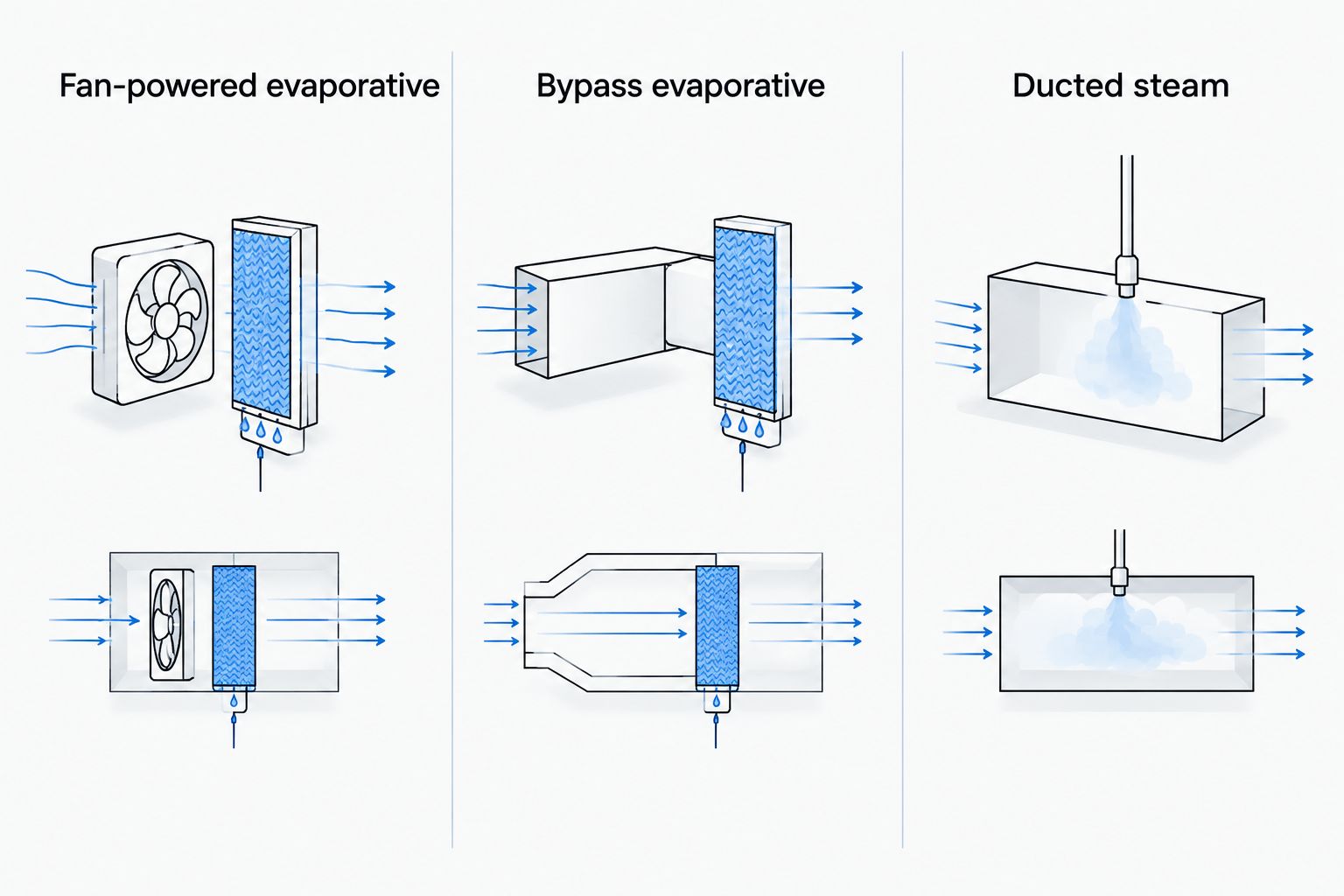
| 1. Fan-powered evaporative | Compatible forced-air homes without a suitable bypass route | A built-in fan moves air through a wet evaporative panel | Requires electrical power, mounting clearance, and suitable operating conditions |
| 2. Bypass evaporative | Furnace-connected installations with space for bypass ductwork | Uses HVAC airflow and a pressure difference across the bypass route | Depends on duct layout and available system runtime |
| 3. Ducted steam | Homes needing moisture production independent of furnace heat | Generates steam rather than relying on evaporation from heated air | Requires more involved electrical, water, drainage, and control planning |
Fan-powered and bypass equipment both use evaporation. Steam equipment actively boils water, but a ducted steam system still needs appropriate airflow to distribute that moisture safely.
1. Fan-powered evaporative: best for avoiding bypass ductwork
A fan-powered evaporative humidifier moves air through a water-wetted panel using its own fan. In a compatible forced-air installation, that arrangement avoids the separate bypass connection used by a bypass humidifier.
This is the default 2026 shortlist option when you have central ductwork, suitable mounting space, and enough operating time for evaporation. It is not automatically the right choice for every furnace or heat pump; the equipment's installation instructions determine acceptable mounting and controls.
Fan-powered evaporative pros
- A built-in fan moves air through the evaporative panel.
- No separate bypass duct is required by this design.
- The evaporative panel provides a defined service component.
- Humidity controls can regulate moisture delivery when correctly installed.
Fan-powered evaporative cons
- The fan requires electrical power and adds a moving component.
- Evaporation depends on air conditions and operating time.
- The cabinet needs clearance for installation and panel access.
Best for: A homeowner with compatible forced-air equipment who lacks a practical bypass route.
Ask the installer how the selected unit behaves when the furnace is not producing heat. Do not assume that a built-in fan makes an evaporative humidifier equivalent to steam equipment.
Also check the service position. A cabinet installed against another appliance or a wall can turn routine panel replacement into an avoidable access problem. Have the installer demonstrate how the panel is removed before the installation is finished.
Verdict: Buy a fan-powered evaporative humidifier when HVAC compatibility and service access are confirmed; skip it when limited runtime leaves moisture demand unmet.
2. Bypass evaporative: best for a furnace-connected installation
A bypass evaporative humidifier uses a duct connection and a pressure difference within the HVAC system to move air across a wet panel. The system's airflow performs the air-moving work rather than a dedicated humidifier fan.
Choose this design when your furnace and duct arrangement provide a suitable bypass route. Its suitability depends on the complete installation, not just whether there is an empty patch of sheet metal beside the furnace.
Bypass evaporative pros
- Uses the HVAC system's airflow rather than a dedicated humidifier fan.
- Provides a straightforward evaporative operating principle.
- Uses a replaceable panel in common panel-based designs.
- Fits furnace-connected applications with suitable duct routing.
Bypass evaporative cons
- Requires space for a bypass connection between appropriate duct locations.
- Moisture delivery depends on available airflow and operating conditions.
- Panels, water distribution, and drains still require maintenance.
Best for: A homeowner whose furnace layout supports a proper bypass installation and whose humidity needs fit evaporative operation.
For your 2026 furnace-and-humidifier decision, assess both systems together. Our guide to gas furnace brands for Illinois winters covers the heating-equipment side; humidifier selection still requires a separate compatibility check.
Ask whether the selected design includes a seasonal damper and what position it needs during cooling operation. Follow that model's instructions rather than copying advice intended for a different bypass unit.
Do not dismiss this category because it has fewer active components. Equally, do not choose it solely for simplicity if the duct route is awkward or the available operating time is inadequate.
Verdict: Buy a bypass evaporative humidifier when the furnace layout supports it; skip it when bypass routing or operating conditions are unsuitable.
3. Ducted steam: best for limited heating runtime
A ducted steam humidifier boils water and introduces steam into the air-distribution system. Steam production does not depend on heat from the furnace, although safe distribution still depends on appropriate blower operation and installation.
This makes steam the relevant category when an evaporative system's dependence on air temperature and runtime does not fit the home. The installation requires coordinated electrical, water, drainage, and HVAC controls.
Ducted steam pros
- Produces moisture independently of furnace heat.
- Separates steam generation from evaporative-panel operation.
- Can support humidity demand during limited heating runtime when correctly configured.
- Allows controlled moisture delivery through a compatible duct system.
Ducted steam cons
- Electrical requirements need verification before equipment selection.
- Water chemistry affects servicing and, for some designs, operation.
- Steam distribution requires proper placement and condensation management.
Best for: A homeowner whose compatible ducted system needs humidity production that does not rely on furnace heat.
Steam is not a shortcut around poor duct design. The installer must follow the equipment's requirements for steam dispersion, clearances, airflow, and control placement. Steam introduced into an unsuitable location can condense rather than distribute as intended.
Ask whether the selected equipment uses electrodes or electric heating elements. That distinction affects water requirements and maintenance; instructions for one design should not be applied to another.
Before approving a 2026 steam installation, confirm how the blower starts on a humidity call and how the system prevents steam production without adequate airflow.
Verdict: Buy ducted steam when independent moisture generation solves a documented operating need; skip it when a suitable evaporative installation already meets that need.
How the ranking works
The ranking uses HVAC compatibility, moisture delivery, controls, water requirements, service access, and condensation protection. Fan-powered evaporative equipment is the default shortlist for compatible forced-air homes without a practical bypass route; bypass and steam each solve a different installation problem.
This is a design-based comparison, not a laboratory test or a model reliability ranking. A correctly selected lower-ranked design is a better choice than a higher-ranked design installed in the wrong application.
What to check before installation
Give your installer a description of the problem, not just a preferred equipment name. Record humidity readings in the rooms you use, note window condensation, and explain whether dryness persists while the heating system runs.
Use this checklist for your 2026 appointment:
- Room readings: Log indoor relative humidity over 24 hours, including a heating period. Treat this as a starting observation, not a complete sizing calculation.
- HVAC equipment: Identify the furnace or heat pump and whether the home has central ductwork, multiple zones, or ductless rooms.
- Water supply: Confirm the connection location and discuss water treatment before selecting equipment.
- Drainage: Identify an acceptable drain arrangement under the equipment instructions and applicable local requirements.
- Electrical supply: Verify the selected unit's requirements rather than assuming a nearby connection is suitable.
- Service access: Check that panels, cylinders, valves, and drains remain reachable.
GSHA Services, LTD provides indoor air quality installation and repair alongside HVAC services. Request an assessment that connects the humidity complaint to the heating system, duct layout, and installation requirements.
Request an indoor air quality assessment
Discuss whole-house humidifier compatibility for your Woodstock or Lake Bluff home.
Which whole-house humidifier should you choose?
Choose fan-powered evaporative equipment first when your forced-air system supports it and a bypass route is impractical. Choose bypass equipment when the furnace layout and operating conditions suit a simpler airflow-driven installation.
Choose ducted steam when independent moisture generation addresses a specific need. Do not select steam merely because it sounds more capable; additional installation requirements still need a reason.
For a home without central ductwork, stop before buying a conventional duct-mounted humidifier. Ask for a system-specific assessment instead of assuming that the same recommendation applies to radiators, baseboard heating, or ductless indoor units.
A good recommendation explains both the equipment choice and the operating limits. You should know what setting to adjust, what condensation warning to watch for, and which maintenance tasks belong to you.
FAQ
What’s the best whole-house humidifier for dry winter air in 2026?
A fan-powered evaporative humidifier is a strong starting choice for a compatible forced-air home without a practical bypass route. Choose bypass equipment when the duct layout supports it, or ducted steam when moisture production must be independent of furnace heat.
Is a steam humidifier better than a bypass humidifier?
Steam is better suited to situations that need moisture generation independent of furnace heat. A bypass humidifier is the more direct fit when suitable HVAC airflow, operating conditions, and bypass routing already exist.
What humidity should I set in winter?
Use a setting that avoids condensation on windows and other cold surfaces. The EPA recommends indoor relative humidity below 60%, ideally 30% to 50%, but cold-weather conditions can require a lower setting.
Can I install a whole-house humidifier with a heat pump?
Installation depends on the heat pump, duct system, humidifier design, and controls. Have the installer verify compatibility and operating conditions rather than applying a furnace-based recommendation unchanged.
Does a whole-house humidifier need softened water?
Water requirements depend on the selected humidifier’s design. Follow the manufacturer’s water-quality instructions, especially for steam equipment, rather than assuming softened water suits every unit.
How much does whole-house humidifier installation cost?
Request a quote for the selected equipment and the actual installation work. Duct alterations, electrical connections, water supply, drainage, and controls determine the scope; compare those items rather than an equipment-only figure.
Who installs whole-house humidifiers in Woodstock and Lake Bluff?
GSHA Services, LTD provides indoor air quality installation and repair services in Woodstock, Lake Bluff, and surrounding areas. Ask for an assessment of HVAC compatibility, water connections, drainage, and humidity controls.
One last thing
A window can reveal an over-humidification problem before the room feels damp. If condensation appears after you raise the setting, lower it and check conditions; do not treat the humidity display as permission to keep adding moisture.
Keep the equipment instructions beside your maintenance record. The useful document is the one that states the exact panel or cylinder requirement, water instructions, and seasonal settings for your installed unit—not a generic recommendation for the category.
Related guides
- Water softeners for hard-water homes
- Whole-house water filtration systems
- Ductless mini-split brands for home additions


