
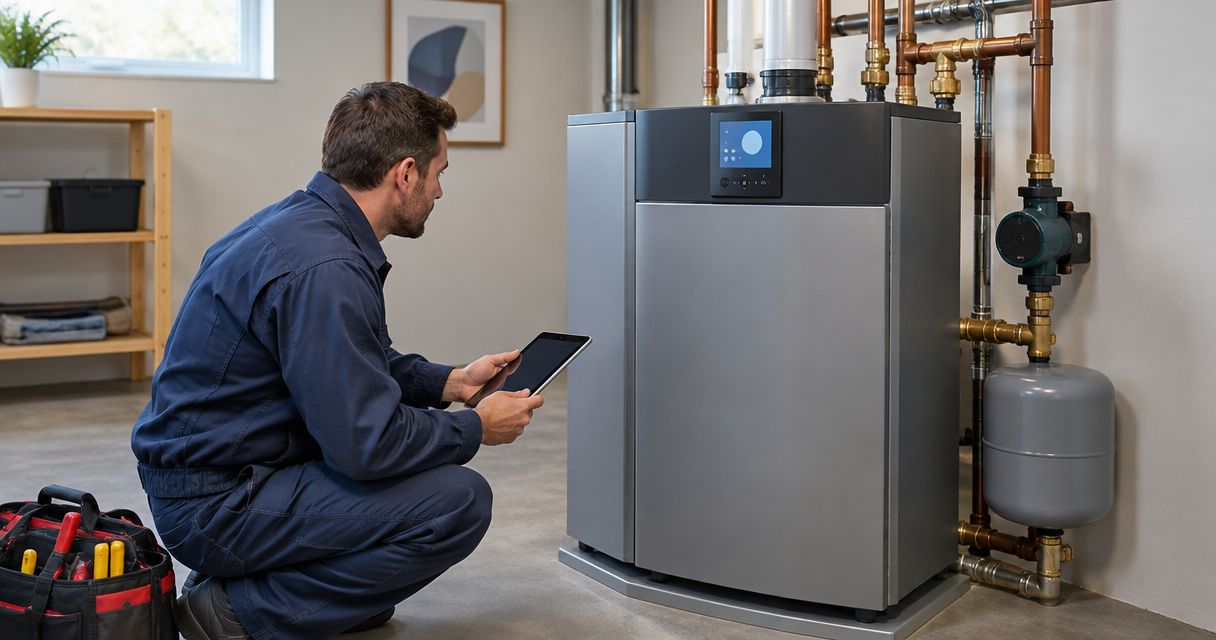
A Weil-McLain gas boiler requires a site-specific installed quote in 2026: the equipment model alone does not establish your replacement total. Your quote must also address removal, venting, piping, controls, permits, and startup—not just the boiler itself. Compare the complete installation scope before choosing an installer.
- A Weil-McLain gas boiler needs an installed quote covering equipment, piping, venting, removal, and startup.
- Match the replacement to your steam or hot-water system before comparing boiler models.
- GSHA Services provides local HVAC installation and repair in Woodstock, Lake Bluff, and surrounding areas.
- Compare boiler replacement scope and winter heating requirements, not equipment alone.
Why this matters
A boiler replacement connects new equipment to an existing heating system. The radiators, distribution piping, chimney, gas supply, and controls all affect the work. An equipment-only offer leaves those connections unresolved.
GSHA Services is best for homeowners seeking local HVAC installation and repair in Woodstock, Lake Bluff, and surrounding areas. You can review the services offered by GSHA Services while preparing your project requirements. For a 2026 replacement, ask each contractor to describe the same work so you can compare proposals without guessing what is included.
How much does a Weil-McLain gas boiler cost installed?
The installed total is the contractor’s written amount for a specified boiler and a defined installation scope. A model name, equipment listing, or verbal estimate does not tell you whether the proposal includes adapting your existing system.
Start with this breakdown. Every applicable item should appear in the proposal as included work, excluded work, or a clearly defined allowance.
| Installation component | What the written quote should identify | What to clarify |
|---|---|---|
| Boiler equipment | Exact model, fuel, heating output, and system type | Whether the selection matches the building’s heating needs |
| Removal | Disconnecting and removing the existing boiler | Disposal and any separate hazardous-material work |
| Venting | Approved exhaust route and combustion-air arrangement | Chimney work or a new exterior termination |
| Heating connections | Piping, valves, circulation equipment, and connections | Which existing components remain in service |
| Gas and electrical | Required supply connections and controls | Any modifications beyond reconnecting equipment |
| Permits and inspection | Required approvals and responsibility for arranging them | Whether associated work is included |
| Startup | Manufacturer-required checks and control setup | Written documentation and homeowner instruction |
A complete quote names the equipment and the work needed to make it operate correctly. Before accepting a 2026 proposal, resolve exclusions in writing rather than assuming the installer will handle them later.
Steam boiler replacement: match the existing distribution system
Best for: a home with a steam heating system that you intend to retain. A steam boiler replacement must account for the connected radiation and the piping arrangement required by the selected boiler’s installation instructions.
The advantage is retaining a compatible steam distribution system. The limitation is that the near-boiler piping is part of how the system operates; replacing the appliance without addressing incorrect piping does not resolve that underlying problem.
Ask the contractor to document the connected radiation and explain the proposed boiler selection. The proposal should also identify near-boiler piping work, water-level safety controls, and the startup checks required for that installation.
Do not compare a steam replacement directly with a hot-water replacement as though the appliances were interchangeable. They serve different distribution systems, and changing the system creates a different project.
Hot-water boiler replacement: evaluate the whole heating circuit
Best for: a home retaining compatible hot-water radiators, baseboards, or other hydronic emitters. A hot-water boiler heats circulating water rather than supplying steam to the distribution system.
The advantage is retaining suitable existing emitters and distribution piping. The limitation is that an older system can still need work on circulation, air removal, expansion control, valves, or zoning.
Have the contractor explain the building heat-loss calculation and the output selected to meet it. Simply matching the old boiler’s nameplate does not establish that the replacement is correctly sized.
Your 2026 proposal should distinguish between components being replaced and components being reused. Ask how the installer will assess retained parts and what happens if a problem appears during commissioning.
Condensing boiler installation: check temperature and venting requirements
Best for: a compatible hot-water system designed or adjusted to support condensing operation. A condensing boiler recovers additional heat from combustion exhaust when operating conditions allow water vapor in that exhaust to condense.
The benefit is additional heat recovery under suitable conditions. The trade-off is that the installation must address approved venting, combustion air, condensate handling, and the manufacturer’s water-quality and piping requirements.
Condensing performance depends partly on return-water temperature. An efficiency rating does not prove that your existing radiators and control settings will keep the boiler in condensing operation throughout the heating season.
Ask the installer to explain the proposed operating temperatures and how the emitters will heat the home under those conditions. Do not accept a promised reduction in fuel use without a stated basis.
Which replacement approach fits your home?
| Replacement approach | Best for | Main advantage | Main limitation |
|---|---|---|---|
| Steam boiler replacement | Retaining a steam distribution system | Preserves compatible existing radiation | Requires correct steam sizing and near-boiler piping |
| Noncondensing hot-water replacement | Retaining a compatible hydronic system | Keeps suitable distribution components in use | Existing chimney and system components still need evaluation |
| Condensing hot-water installation | Systems supporting appropriate operating temperatures | Recovers additional exhaust heat under suitable conditions | Adds venting, condensate, and operating-temperature considerations |
These are system approaches, not interchangeable equipment tiers. Establish which approach fits your building before comparing individual models.
Why the installation scope varies
The work changes with the building and the condition of its existing heating system. These factors explain why matching boiler brands alone does not produce comparable proposals:
- Heating system type. Steam and hot-water systems require different sizing methods, controls, and piping arrangements. The contractor must identify the system before selecting replacement equipment.
- Required heating output. Building heat loss matters for hot-water equipment selection; connected radiation matters for steam sizing. An existing nameplate is not a substitute for the appropriate assessment.
- Venting condition and route. The selected appliance must use an approved venting arrangement. A chimney assessment or a different termination route changes the work involved.
- Piping and component condition. Leaking valves, unsuitable near-boiler piping, circulation problems, and defective expansion equipment require attention separate from the appliance replacement.
- Access and removal. Basement access, stairs, clearance, and the existing equipment’s construction affect removal and placement. Suspected asbestos requires separate evaluation rather than ordinary demolition.
- Controls and hot water. Heating zones, thermostat connections, outdoor-reset controls, and an existing indirect water heater affect how the replacement integrates with the building.
Ask which of these factors the contractor has inspected. A proposal based only on photographs leaves concealed conditions and system measurements unresolved.
How do you compare installation quotes correctly?
Use the same project description for every contractor. Otherwise, a proposal that replaces only the appliance is not directly comparable with one that also corrects piping, replaces defective components, or changes the venting arrangement.
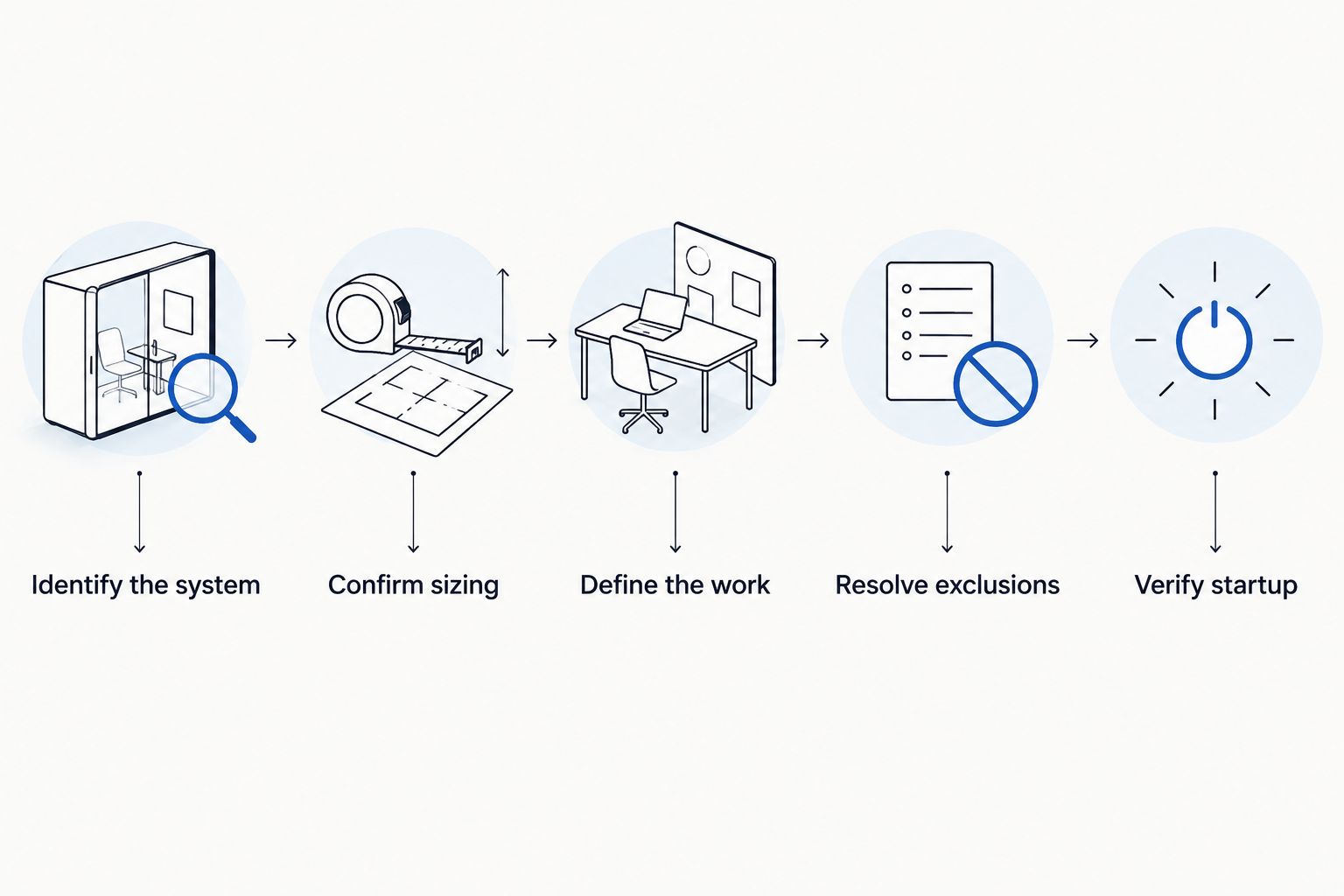
- Identify the system. Record whether the building uses steam or hot water, along with the existing boiler’s model and fuel. Photograph the equipment and surrounding connections without removing covers.
- Confirm the sizing basis. Ask for the assessment supporting the proposed output. The contractor should explain why the selected boiler fits the connected system and heating requirement.
- Define the work. Request equipment, removal, piping, venting, controls, permits, and startup as separate scope descriptions. Mark any retained components clearly.
- Resolve exclusions. Ask about chimney repairs, hazardous materials, electrical changes, concealed defects, and repairs to finished surfaces. Get the process for approving additional work in writing.
- Verify startup. Confirm that the installer will complete the manufacturer-required commissioning procedures, explain normal operation, and provide the equipment documentation.
The decision comes after these checks, not before them. Choose a proposal you can understand line by line.
For a local HVAC installation discussion, contact GSHA Services with your system type, existing equipment information, and a description of the heating problem. Do not send a model number alone when the question concerns a complete replacement.
What affects winter boiler operating costs?
Installation and operation are separate budgeting questions. Your winter boiler operating costs depend on fuel use and utility charges, while the replacement proposal describes equipment and installation work. A more efficient appliance does not establish a household’s actual seasonal fuel use by itself.
Weather, thermostat settings, building heat loss, system controls, and equipment condition all affect heating demand. For a condensing installation, operating temperatures also affect how much additional exhaust heat the boiler recovers.
Use your own heating bills when evaluating a 2026 replacement. Compare fuel consumption as well as the bill total, because utility rate changes can conceal or exaggerate changes in consumption.
Ask the contractor to separate equipment-efficiency statements from projected household savings. A savings estimate should state its assumptions about the existing equipment, heating demand, fuel charges, and control settings. Do not treat an efficiency rating as a guaranteed bill reduction.
Does a boiler replacement include domestic hot water?
A boiler replacement does not automatically include domestic hot-water equipment. A boiler can serve space heating alone or connect to a separate indirect water heater; the proposal must identify which arrangement applies to your home.
If you have an indirect tank, ask whether it remains in service and whether the proposed boiler and controls support it. If you have a separate gas water heater, replacing the boiler does not automatically mean replacing that appliance.
This distinction prevents you from comparing unlike scopes. Describe space heating and domestic hot water separately when requesting installation proposals.
Should you repair the existing boiler instead?
Repair deserves consideration when a qualified inspection identifies a repairable fault and finds the remaining equipment suitable for continued service. Replacement deserves consideration when the assessment identifies unsafe conditions, a failed major component, or system problems that the proposed repair would leave unresolved.
Ask for the diagnosis before choosing either path. A leaking valve, control fault, and damaged boiler section are different findings; the age of the equipment alone does not explain the repair required.
Request written descriptions of what each option fixes and what it leaves unchanged. Neither a repair nor a replacement should be presented as solving distribution problems that are outside its scope.
FAQ
Can I get an installed quote from a boiler model number alone?
A model number alone does not establish a complete installed quote. The contractor also needs to evaluate system type, sizing, access, piping, venting, controls, and required approvals.
Is a Weil-McLain gas boiler suitable for both steam and hot-water heating?
Select a boiler specifically approved for your heating system; steam and hot-water equipment are not interchangeable selections. Confirm the exact model’s intended application in its manufacturer documentation.
Will a new boiler work with my existing radiators?
Existing radiators require a compatibility and condition assessment before the replacement is selected. Steam radiation and hot-water emitters also require different sizing considerations.
Does a condensing boiler always reduce my heating bill?
A condensing boiler does not guarantee a specific reduction in your heating bill. Fuel use depends on heating demand, controls, operating temperatures, equipment condition, and how the system is installed.
Do I need a chimney inspection before replacing my boiler?
A chimney used for the proposed boiler’s venting needs an assessment for that application. The selected appliance’s installation instructions and applicable requirements determine the approved venting arrangement.
Can I install a gas boiler myself?
Gas boiler installation requires qualified work on combustion, fuel supply, venting, electrical connections, and safety controls. Use a qualified contractor and confirm the permit and inspection requirements that apply locally.
Does GSHA Services provide local HVAC services?
GSHA Services provides HVAC installation and repair to homeowners and businesses in Woodstock, Lake Bluff, Illinois, and surrounding areas. Discuss your existing heating system and proposed replacement requirements when requesting service.
One last thing
Do not discard the startup paperwork after a 2026 boiler replacement. Keep the exact model information, installation instructions, commissioning record, permit documentation, and written scope together. Those records give the next service technician a clearer starting point than a photograph of the boiler alone.
Before the installer leaves, ask how to recognize normal operation, where the emergency shutoff is located, and which maintenance instructions apply to your equipment. Do not adjust combustion settings or bypass a safety control yourself.
Related guides
- Best gas boiler brands for older homes
- How much does gas water heater installation cost?
- Tankless water heater installation in Illinois


