
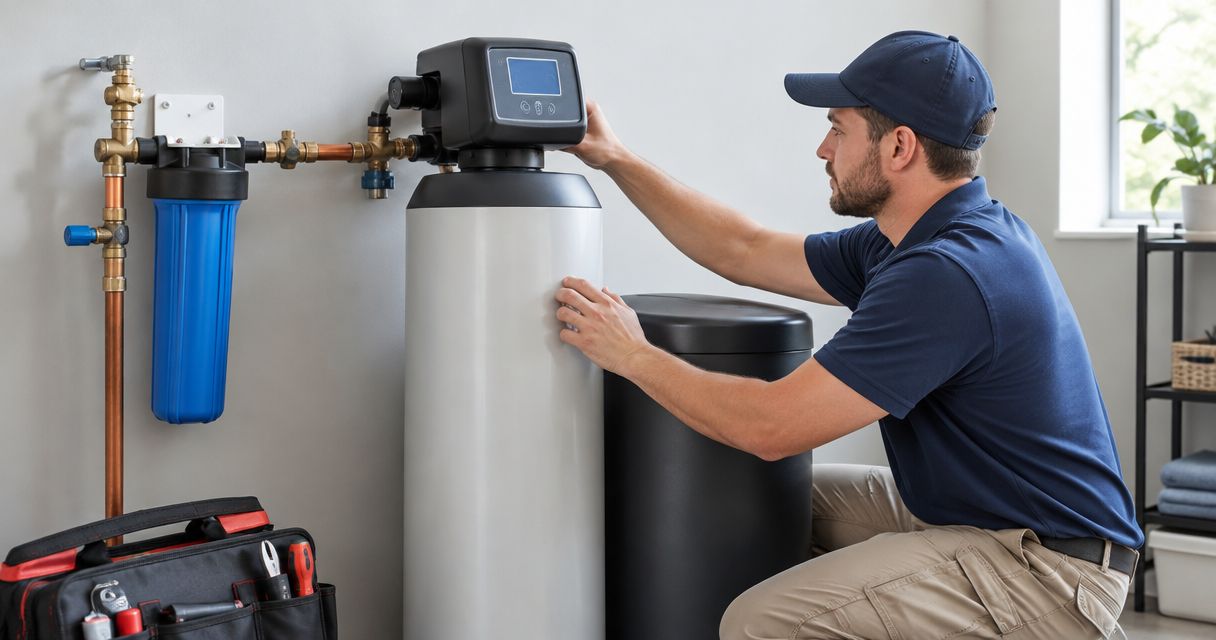
Your water softener installation cost depends on the equipment, existing plumbing, drain access, and work required to complete the installation, so a useful 2026 estimate must cover your specific home rather than the softener alone. Compare the installed scope and ongoing salt, water, and maintenance requirements before accepting a quote.
- Compare water softener installation cost by equipment, plumbing work, drainage, startup, and exclusions—not equipment alone.
- An existing softener connection does not prove that the drain, bypass, or electrical setup is suitable.
- Choose water softening for measured hardness; choose filtration for the contaminants a water test identifies.
- GSHA Services, LTD serves homeowners and businesses seeking local plumbing installation and repair in Woodstock and Lake Bluff.
Why this matters
An equipment-only quote and a completed-installation quote describe different purchases. If you compare their totals without checking the scope, you cannot tell whether the difference comes from equipment, plumbing changes, or omitted work.
Start with the water problem. A softener addresses hardness caused primarily by dissolved calcium and magnesium; it does not replace testing for other water-quality concerns. The guide to water softeners for hard-water homes is a useful next step when hardness is the problem you need to solve.
Buy treatment for a measured condition, not for a symptom alone. Spots, deposits, taste, and odor do not all point to the same treatment.
How much does a water softener installation cost?
A complete water softener installation quote should identify the equipment and the work needed to put it into service. For a 2026 comparison, require each contractor to separate the same categories so an omitted connection does not look like a saving.
| Quote component | What the written scope should identify | What to clarify |
|---|---|---|
| Equipment | Softener model, treatment capacity, control valve, and included components | Whether the selection follows your water test and household demand |
| Plumbing | Supply connections, isolation valves, bypass, and pipe changes | Whether existing connections will be reused or replaced |
| Drainage | Regeneration discharge route and required drain protection | Whether the proposed drain connection complies with local requirements |
| Electrical | Power requirements for the selected equipment | Whether a suitable receptacle exists and electrical work is included |
| Startup | Programming, regeneration setup, and operational checks | Whether the installer checks for leaks and explains operation |
| Removal and approvals | Existing equipment removal and applicable permits or inspections | Which tasks are included, excluded, or your responsibility |
Ask for exclusions in writing. A quote that leaves drain work or electrical work unresolved is not a complete basis for comparing the finished project.
Also separate installation from ownership. Salt-based equipment needs regenerant and uses water during regeneration; maintenance requirements depend on the selected unit and your water conditions. Those obligations belong in your decision even though they are not all installation charges.
Replacing an existing water softener
Best for: a home with a confirmed hardness problem and usable existing connections. Replacement lets the installer assess whether the existing location, supply piping, bypass, drain route, and power source suit the new equipment.
The advantage is the opportunity to reuse suitable infrastructure. The limitation is that old connections are not automatically acceptable: corroded valves, restricted drains, inaccessible bypasses, or mismatched fittings still need attention.
Ask the installer to identify what stays and what changes. Include removal of the old unit, handling of remaining salt or brine, and startup of the replacement in the written scope.
Do not select the replacement solely because it resembles the old unit. Household demand and water conditions should guide sizing, particularly if the previous system failed to provide satisfactory softening.
Installing a water softener for the first time
Best for: a home with measured hardness and no existing softening system. A first-time installation requires a plan for the treatment location, water connections, regeneration discharge, access, and any power the equipment requires.
Its advantage is that the layout can be designed around the selected equipment. Its limitation is the additional work needed when suitable connections are absent or distant.
Confirm which fixtures will receive softened water. The contractor should explain whether outdoor hose connections or other selected lines remain untreated and how the proposed plumbing arrangement achieves that result.
For a 2026 project, document the installation location before comparing proposals. Quotes based on different locations can include different pipe runs, drain arrangements, and access requirements even when the equipment appears similar.
Why water softener installation cost varies
These factors change the work involved. Have each contractor explain which apply to your property rather than accepting an unexplained allowance.
- Water conditions: Hardness testing guides softener selection and programming. Additional treatment needs require their own assessment rather than an assumption that the softener handles everything.
- Household demand: Equipment must accommodate water use and the flow needed when fixtures operate together. Bedroom count alone does not describe that demand.
- Existing plumbing: Pipe material, connection sizes, shutoff condition, bypass arrangements, and accessibility affect the installation work.
- Drain access: Regeneration discharge needs a suitable destination and a code-compliant connection. The installer must evaluate the route, not simply identify the nearest opening.
- Power and location: Equipment requirements, available receptacles, service access, and protection from freezing influence where the system belongs.
- Project scope: Removal, permits where required, inspections, startup, and additional treatment change what the contractor is being asked to deliver.
A lower total is not a better proposal when it leaves required work outside the agreement. Resolve scope differences before comparing the bottom line.
Water softener or whole-house filter: which do you need?
Water softening and filtration address different treatment goals. Choose between them using test results, and assess a combined system only when the water conditions justify both functions.
| Treatment option | Best for | Main benefit | Main limitation |
|---|---|---|---|
| Salt-based ion-exchange softener | Reducing dissolved hardness | Removes calcium and magnesium through ion exchange | Requires regenerant, regeneration water, and appropriate discharge arrangements |
| Whole-house filtration | Addressing a contaminant or condition the selected filter is designed to reduce | Targets a defined treatment need | A general filter is not automatically a hardness-removal system |
| Combined softening and filtration | Water with separate, confirmed treatment needs | Addresses hardness and another identified condition | Adds components and maintenance requirements that must be assessed separately |
A claim about scale control is not the same as a claim about hardness removal. If you are considering a salt-free conditioner, ask what it changes, what it does not remove, and what evidence supports its suitability for your water.
Keep that distinction in your 2026 quote comparison. Equipment described with different treatment claims is not interchangeable simply because each proposal uses the phrase water treatment.
How do you get a comparable installation quote?
Use the same information and requested scope for every contractor. This makes differences easier to evaluate without treating unlike projects as equivalent offers.
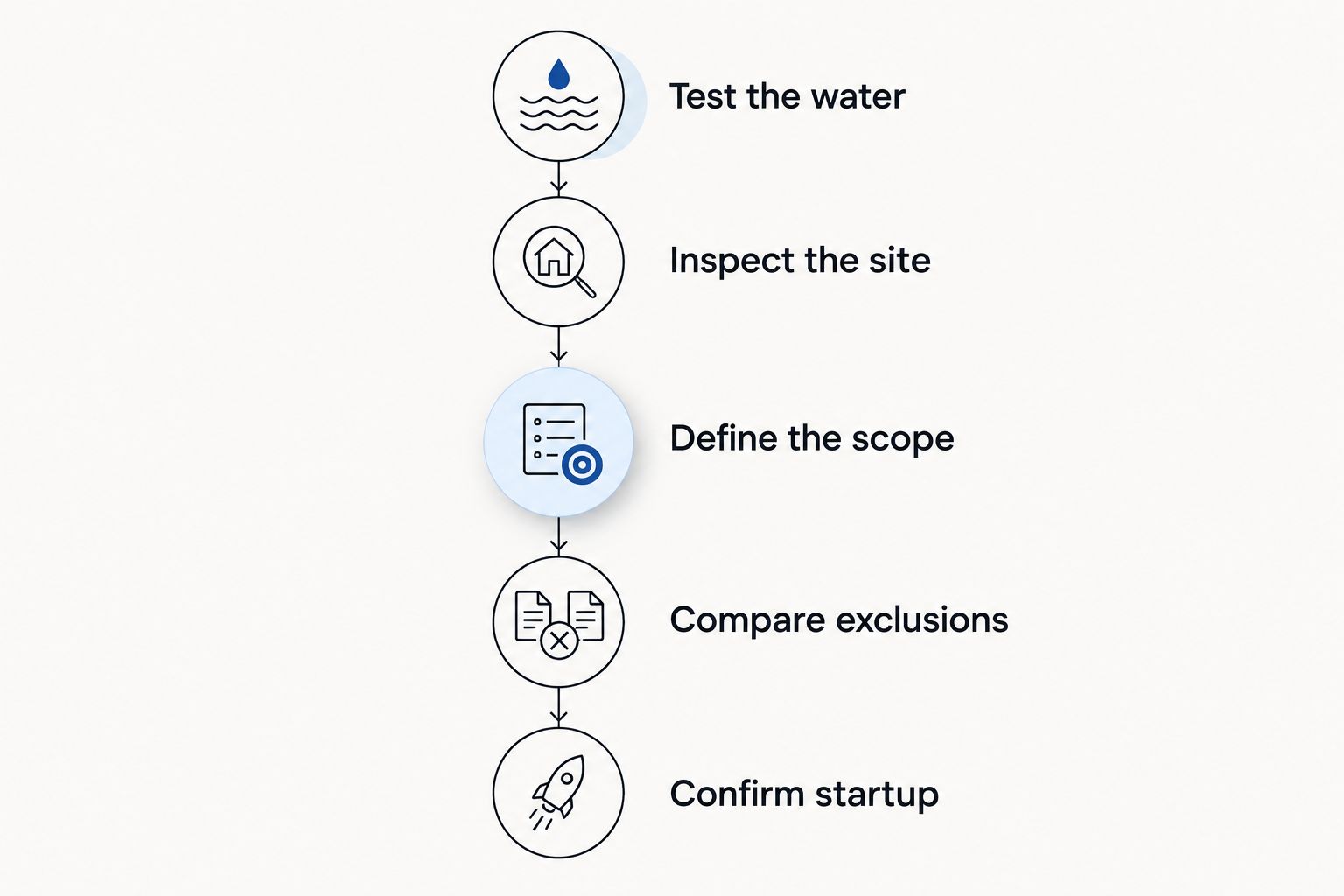
- Test the water. Obtain a hardness result and discuss other testing appropriate to your water source and concerns. Tell the contractor whether the property uses municipal water or a private well.
- Inspect the site. Show the proposed location, main water line, existing treatment equipment, nearby drain options, and available power. Photographs help describe access but do not replace a site assessment.
- Define the scope. Request the equipment identity, plumbing work, discharge arrangement, startup, removal, and applicable approval responsibilities in writing.
- Compare exclusions. Check who handles any separate electrical work, pipe repairs, drainage changes, or additional treatment. Resolve open items before authorizing installation.
- Confirm startup. Ask how the installer will program the unit, check operation, explain the bypass, and hand over maintenance instructions.
Keep the final scope with the equipment manual and water-test results. Those records help you distinguish an installation issue from a later change in settings, maintenance, or source-water conditions.
How does water hardness affect equipment selection?
Hardness is commonly reported in grains per gallon or milligrams per liter as calcium carbonate. One grain per gallon equals approximately 17.1 milligrams per liter as calcium carbonate. A result of 10 grains per gallon therefore equals approximately 171 milligrams per liter on that same basis.
Those are equivalent measurements, not different water conditions. Check the units before comparing test results or entering a hardness setting.
The setting should follow the equipment manufacturer's instructions and the actual water analysis. Other constituents can affect equipment selection and operation, so a hardness number alone is not a complete treatment design.
Do not mistake a softener's advertised capacity for proof that it suits your home. Ask the contractor to explain the relationship between measured hardness, usable capacity, regeneration settings, and expected household demand.
Is replacing a softener simpler than a first-time installation?
Replacing a softener is a more limited project when the existing connections are suitable for reuse. That advantage disappears when the old location, drainage, valves, or power arrangement needs correction.
Have the installer inspect those connections before you approve the replacement scope. Reusing a problematic connection carries the problem into the new installation.
Can you install a water softener yourself?
A do-it-yourself installation puts responsibility for plumbing connections, drainage, equipment setup, and applicable local requirements on you. It also requires you to recognize when electrical work or changes to the water system need a qualified professional.
Use professional help when the project involves unfamiliar pipe work, uncertain drain arrangements, or unresolved code questions. Equipment instructions are essential, but they do not replace local installation requirements.
What should a local service conversation cover?
GSHA Services, LTD is best suited to homeowners and businesses in Woodstock and Lake Bluff seeking local plumbing installation and repair. Describe the water concern and existing equipment first, then confirm whether the requested treatment work falls within the proposed service scope.
Bring the water-test report, equipment details, and photographs of the installation area to the conversation. You can contact the service team to discuss the plumbing work and next steps without treating a general inquiry as a finalized installation proposal.
For a 2026 project, ask for a written scope that separates treatment selection from the connections needed to install it. Confirm the specific work offered before making a decision.
FAQ
What’s included in water softener installation cost?
Water softener installation cost should cover the equipment and the agreed work needed to connect, configure, and check it. Confirm plumbing, drainage, power requirements, removal, startup, and applicable approval responsibilities in writing.
Is replacing a water softener the same as installing a new system?
Replacing a water softener is not the same scope as a first-time installation. Existing connections can be reused only when they suit the replacement equipment and meet applicable requirements.
Do I need a water test before choosing a softener?
Yes, use a water test to establish hardness before selecting and programming a softener. Discuss additional testing based on your water source and any separate water-quality concerns.
Does a whole-house water filter replace a softener?
A whole-house water filter does not automatically replace a softener. The filter must be assessed against its specific treatment claims, while a softener is selected to reduce dissolved hardness.
What ongoing maintenance does a salt-based softener need?
A salt-based softener needs regenerant replenishment and the maintenance specified for its equipment and water conditions. Ask for written instructions covering salt, settings, inspections, and any required cleaning.
Can a water softener use an existing drain connection?
An existing drain connection is usable only if it suits the equipment and complies with applicable requirements. Have the installer check the discharge route and required backflow protection rather than assuming the old arrangement is acceptable.
Who can I contact about local plumbing work in Woodstock or Lake Bluff?
GSHA Services, LTD provides plumbing installation and repair services to homeowners and businesses in Woodstock, Lake Bluff, and surrounding areas. Confirm the scope of your requested water-treatment project directly before arranging work.
One last thing
Ask the installer to show you the bypass before the job is considered complete. Knowing how to isolate the softener helps you respond to an equipment problem without guessing which valves to turn.
Make that demonstration part of your 2026 installation handover, alongside the settings, manual, and maintenance instructions. A finished installation includes knowing how to operate it.


