
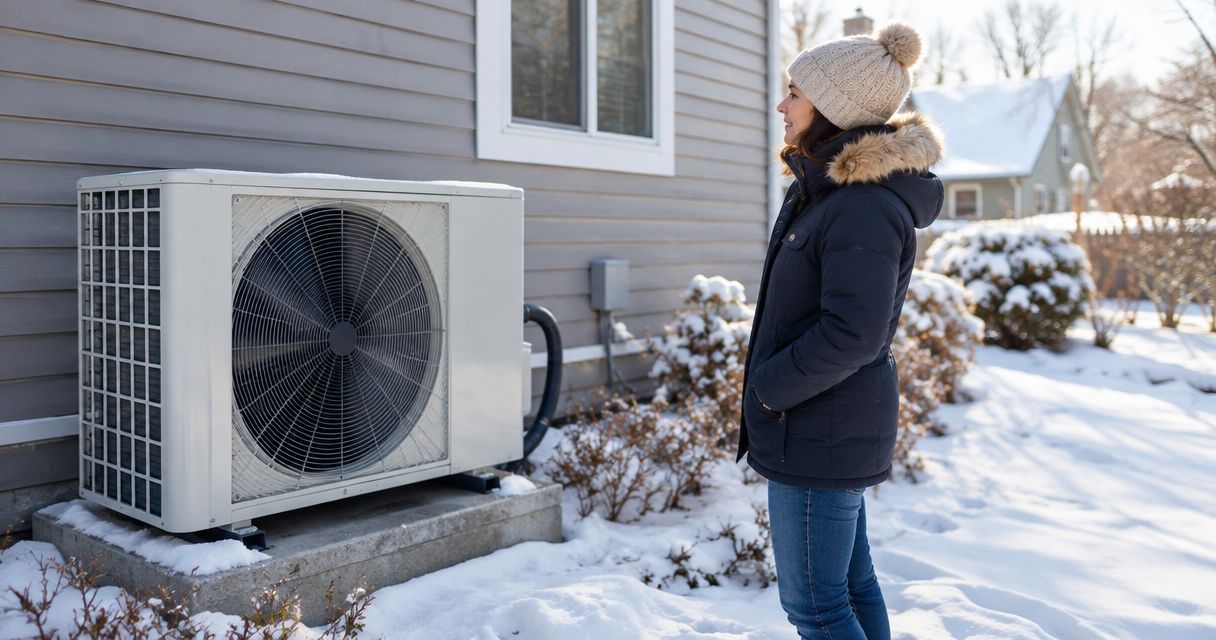
Yes—a properly selected and sized cold-climate heat pump can heat an Illinois home without a backup furnace, provided its heating output meets the home's heat loss at the local winter design temperature. No furnace does not necessarily mean no backup heat: an all-electric system can still need supplemental electric resistance heating during conditions the heat pump alone cannot cover.
- Can a heat pump work in Illinois winters without a furnace? Yes, when cold-weather output meets the home’s heating load.
- A cold-climate heat pump needs verified low-temperature capacity, not just a low operating-temperature claim.
- Electric auxiliary heat provides furnace-free backup but increases electricity demand when it runs.
- GSHA Services, LTD provides HVAC and electrical installation services for homeowners in Woodstock, Lake Bluff, and surrounding areas.
Why this matters
Removing a furnace changes more than the equipment that heats your house. It changes how the system covers extreme cold, how much electrical capacity it needs, and what happens during a defrost cycle.
For a 2026 replacement, start with a heating-load calculation and the proposed equipment's published performance data. The cold-climate heat pump guide is a useful next step when comparing equipment, but the final selection must match your house—not simply the equipment category.
Can a heat pump work in Illinois winters without a furnace?
Yes, if the installed system can meet the home's heating demand at the temperature used to design its heating system. A heat pump that operates in cold weather is not automatically a heat pump that delivers enough heat for your house in that weather.
Compare these arrangements before deciding whether to remove an existing furnace:
| Heating arrangement | Best for | Main advantage | Main limitation |
|---|---|---|---|
| Cold-climate heat pump alone | Homes whose calculated heating load stays within the selected system's cold-weather output | No furnace or resistance-heating backup required for the documented design conditions | Requires a verified capacity match and a plan for conditions beyond that design |
| Heat pump with electric auxiliary heat | Homeowners who want furnace-free heating with supplemental electric capacity | Covers a documented heating shortfall without a fuel-burning furnace | Auxiliary heat adds electrical demand and uses more electricity per unit of heat than heat-pump operation |
| Heat pump with a backup furnace | Homeowners who want a dual-fuel arrangement | Retains a separate fuel-burning heat source | Keeps furnace maintenance, fuel service, and more complex changeover controls |
The important comparison is available heating capacity versus calculated heat loss at the same outdoor temperature. Comparing a mild-weather equipment rating with a cold-weather building load does not answer the question.
In Woodstock, Lake Bluff, and surrounding communities, ask the installer to identify the local design temperature used in the proposal. An Illinois-wide rule does not replace a site-specific calculation.
Heat pump alone: no supplemental heat source
A heat-pump-only arrangement is appropriate when the selected equipment supplies the required heat throughout the documented design conditions. The proposal should identify the exact indoor and outdoor equipment combination and its heating output at the relevant temperatures.
The benefit is a heating system without a furnace or electric resistance backup. The trade-off is that there is no separate supplemental heat source to cover an output shortfall; equipment selection, distribution, and controls must be evaluated together.
Do not accept an oversized system as an automatic solution. Heating requirements and cooling requirements differ, so the selection must also account for summer operation and the equipment's ability to reduce output under lighter loads.
Choose heat-pump-only heating only after the capacity calculation supports it. A cold-climate label alone is not enough evidence to remove a working furnace.
Heat pump with electric auxiliary heat: furnace-free backup
Electric auxiliary heat supplies additional heat when the heat pump cannot meet demand or when the system's approved control sequence calls for it. In a compatible ducted system, electric heating elements can be installed in the air handler.
This arrangement answers an important distinction: you can eliminate the furnace without eliminating backup heat. It is still an all-electric system, but its electrical requirements must include the auxiliary heater—not just the outdoor unit.
Electric resistance heat does not provide the heat-moving efficiency of a working heat pump. Ask how the thermostat stages auxiliary heat, when it is permitted to run, and whether unnecessary activation can be avoided without sacrificing comfort or equipment protection.
For a 2026 installation, require the auxiliary-heater selection and electrical requirements in writing. A proposal that simply says backup included leaves the most important operating details unanswered.
Heat pump with a backup furnace: dual-fuel heating
A dual-fuel system pairs a heat pump with a furnace and uses compatible controls to select the heating source. It is an alternative to furnace-free heating, not a requirement for every Illinois home.
Keeping a furnace gives you a separate fuel-burning source for colder conditions. It also means maintaining that furnace and coordinating the equipment, thermostat, and changeover settings.
Keep the furnace when the documented design supports dual fuel—not because someone says every Illinois heat pump needs one. Likewise, do not remove the furnace solely because the outdoor unit's literature lists a very low operating temperature.
Ask whether the changeover setting is based on heating capacity, operating expense, or an equipment limitation. Those are different reasons and should not be treated as interchangeable.
Why furnace-free performance varies
The same heat pump does not produce the same result in every Illinois house. These factors determine whether a furnace-free arrangement fits your property:
- Building heat loss: Insulation, air leakage, windows, and exposed surfaces affect how much heat the home needs.
- Cold-weather output: Published capacity at low outdoor temperatures determines how much heat the selected system can supply.
- Heat distribution: Duct sizing, leakage, airflow, and room coverage affect whether heat reaches the spaces that need it.
- Defrost operation: Outdoor-coil frost removal temporarily changes operation and must be addressed in the equipment and control design.
- Electrical capacity: The heat pump, air handler, and any auxiliary heater must fit the home's electrical service and circuit requirements.
- Control settings: Thermostat compatibility, auxiliary-heat staging, and equipment lockouts affect which heating source runs.
A larger outdoor unit cannot correct every distribution problem. If a bedroom already receives inadequate airflow, replacing the heat source without checking the ducts leaves that underlying problem unresolved.
What should you check before removing the furnace?
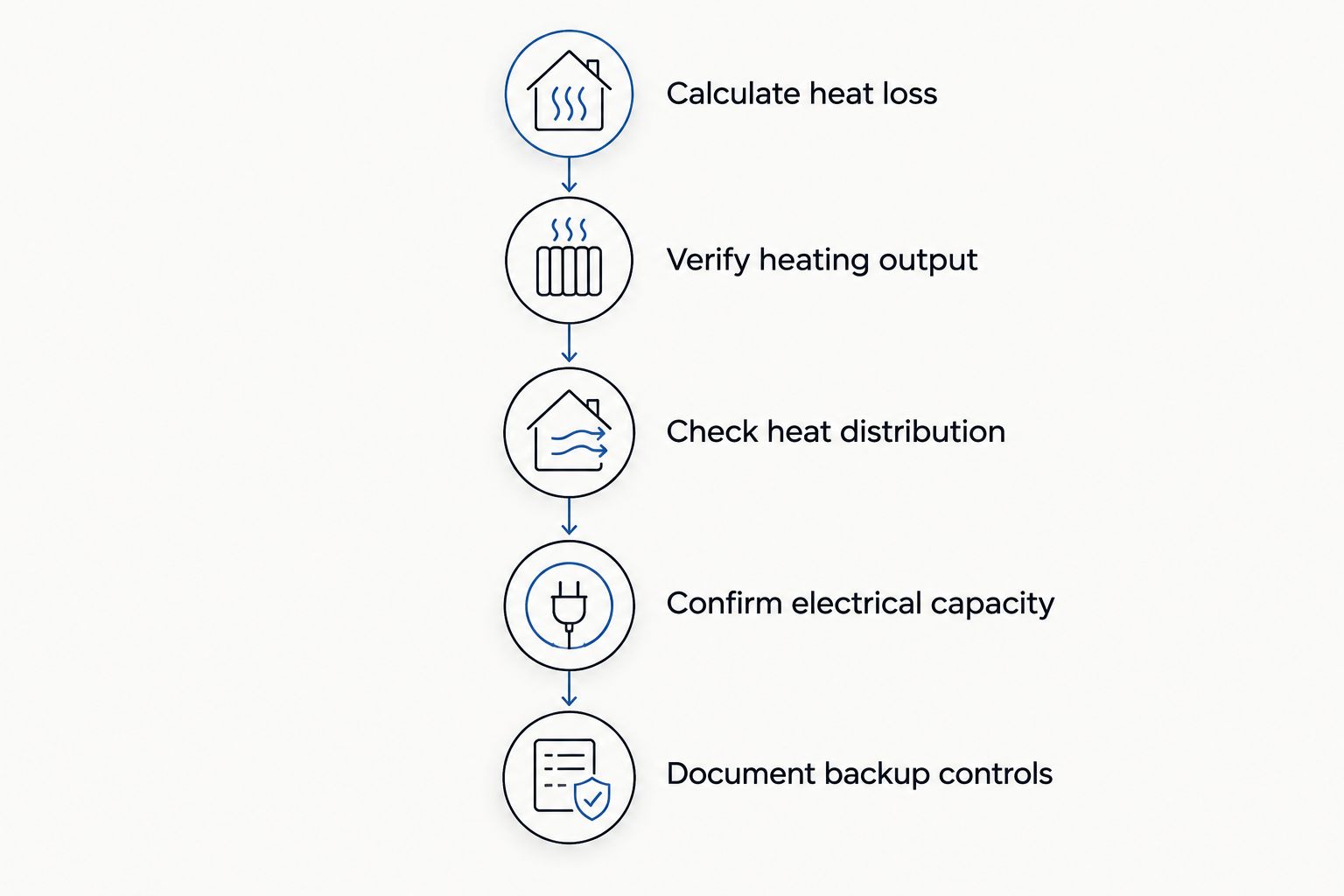
Use this sequence when reviewing a 2026 installation proposal. Each step should produce a specific answer rather than a general assurance that the equipment handles cold weather.
- Calculate heat loss. Request a room-by-room heating-load calculation, commonly performed using ACCA Manual J for residential work. Confirm the indoor and outdoor design conditions used.
- Verify heating output. Request manufacturer performance data for the exact equipment combination. Ask for output at 47°F, 17°F, and 5°F where published, plus data that addresses the local design temperature.
- Check heat distribution. Confirm duct airflow and delivery to individual rooms, or document indoor-unit coverage for a ductless design. A hallway temperature reading does not establish bedroom comfort.
- Confirm electrical capacity. Have the electrical requirements evaluated for the complete system, including supplemental heat where proposed. Available breaker spaces alone do not establish service capacity.
- Document backup controls. Identify whether supplemental heat is required, how defrost is handled, and when each heating source operates. Include the response to an equipment fault or conditions beyond the design assumptions.
The comparison temperatures are checkpoints, not a promise that every product publishes identical tables or maintains the same output. The decisive evidence is the selected system's capacity at the conditions your home must handle.
Keep the calculation, equipment data, and control plan together with the proposal. That record makes it possible to compare competing designs on the same basis instead of comparing equipment names alone.
What does the lowest operating temperature actually tell you?
A minimum operating temperature identifies an equipment operating limit under the manufacturer's stated conditions. It does not, by itself, establish the amount of heat available for your house at that temperature.
Capacity and efficiency are also different measurements. Heating capacity describes heat output, commonly reported in Btu/h; efficiency describes the relationship between energy input and useful heating output.
For your 2026 comparison, ask for both. A system can remain operational while its output is below the building's heating demand, which is exactly when a backup strategy becomes important.
Ask how much heat the system delivers, not just how cold it can run. That question separates a documented furnace-free design from a temperature claim with no building-load comparison.
Will a ductless heat pump heat every room?
A ductless heat pump can provide furnace-free heating when its capacity and indoor-unit layout cover the home's room-by-room loads. One indoor unit in an open living space does not establish that closed bedrooms, bathrooms, or separated floors receive enough heat.
Ask how the design handles doors that remain closed and rooms far from an indoor unit. For multi-zone equipment, request performance information for the actual indoor-unit combination rather than assuming every indoor unit receives its full listed output simultaneously.
A ducted system also needs room-level review. The difference is how heat travels through the home—not whether distribution matters.
Does a heat pump need backup during a power outage?
A heat pump needs electricity to operate, so removing the furnace does not create outage protection. A conventional forced-air gas furnace also normally needs electricity for its blower and controls.
Supplemental electric heat is heating backup, not backup power. If outage heating is a priority, evaluate the proposed heating system as part of a separate backup-power design, including starting requirements and any auxiliary-heater load.
Do not assume an existing generator can support a replacement heating system. The connected equipment and electrical demand need a fresh review.
When should you request a local installation assessment?
Request an assessment before authorizing furnace removal, especially when the project also changes the air handler, ducts, thermostat, or electrical circuits. These decisions belong in one coordinated installation plan.
GSHA Services, LTD is best for Woodstock and Lake Bluff homeowners seeking local HVAC and electrical installation services. Its stated service scope includes both trades; the recommendation to keep or remove a furnace still needs to follow the property's heating and electrical requirements.
Use the contact page to discuss the project with GSHA Services, LTD. Ask for the load calculation, low-temperature capacity comparison, electrical assessment, and proposed supplemental-heat arrangement.
Plan your furnace-free heating installation
Discuss heating capacity, electrical requirements, and supplemental heat for your Illinois home.
FAQ
Can a heat pump work in Illinois winters without a furnace?
Yes, a properly selected cold-climate heat pump can heat an Illinois home without a furnace when its output meets the calculated heating demand. Some furnace-free installations still require electric auxiliary heat.
Do I need electric heat strips if I remove my furnace?
Electric heat strips are not automatically required in every furnace-free design. Their need depends on the capacity comparison, equipment requirements, defrost strategy, and planned response to a heating shortfall.
Is a heat pump that runs at 5°F enough for my house?
Operation at 5°F does not establish that a heat pump produces enough heat for your house. Compare its published output at the relevant outdoor temperature with your home’s calculated heating load.
Is dual fuel better than an all-electric heat pump?
Dual fuel is not automatically better than an all-electric heat pump. It retains a furnace as another heating source, while an all-electric arrangement avoids that fuel-burning appliance but needs adequate electrical capacity.
Will my electrical panel need an upgrade for a heat pump?
An electrical-panel upgrade is not automatic. The decision requires an assessment of the existing service, connected loads, circuits, and proposed equipment, including auxiliary heat.
Can a ductless mini-split replace my furnace?
A ductless mini-split system can replace a furnace when its heating capacity and indoor-unit layout cover the home’s heating loads. Verify coverage for closed rooms and separated spaces before removing the existing system.
Who can help plan a furnace-free heating installation near Woodstock?
GSHA Services, LTD provides HVAC and electrical installation services in Woodstock, Lake Bluff, and surrounding areas. Ask for a property-specific heating and electrical assessment before choosing a furnace-free arrangement.
One last thing
Before signing a 2026 proposal, ask the installer to show the outdoor temperature where the home's heating demand and the heat pump's available output meet. This is the thermal balance point; below it, the design needs another way to cover any shortfall.
That answer is more useful than a general claim that a heat pump works in Illinois. Remove the furnace only when the written design explains how every required room stays heated.


