
A whole-house humidifier is worth it in an Illinois winter when measured indoor humidity stays low throughout your home and you want moisture control beyond a single room. It also adds maintenance, water use, and sometimes electrical work; if your windows already collect condensation, adding humidity is the wrong first move.
- Is a whole house humidifier worth it? Yes for persistent, house-wide winter dryness—not for rooms with condensation.
- The EPA recommends indoor relative humidity below 60%, ideally between 30% and 50%; cold windows can require lower settings.
- GSHA Services provides HVAC and indoor air quality installation and repair in Woodstock, Lake Bluff, and surrounding areas.
- Choose equipment around your ductwork, heating system, water supply, and maintenance requirements—not square footage alone.
Is a whole house humidifier worth it in Illinois winters?
Yes, if dryness affects several rooms, measurements confirm the problem, and your home can tolerate added moisture without condensation. A central humidifier addresses moisture through the HVAC system rather than requiring you to refill separate room units.
Start with compatibility, not equipment shopping. The guide to connecting an Aprilaire humidifier to your furnace explains the connection considerations behind a furnace-mounted installation; the correct arrangement still depends on the equipment involved.
Use this comparison to decide whether central humidification fits your situation:
| Approach | Best for | Main advantage | Main limitation |
|---|---|---|---|
| Whole-house humidifier | Measured dryness across several rooms | Central moisture control without carrying room tanks | Requires installation, servicing, and moisture-limit controls |
| Portable humidifier | A bedroom or another isolated dry space | Treats the room where you need help | Requires refilling and cleaning; coverage is local |
| No added humidification | Homes already comfortable or showing condensation | Avoids unnecessary equipment and moisture | Does not address confirmed low indoor humidity |
A whole-house unit is not automatically the better choice because your home is large. If only your bedroom feels dry, a portable unit offers a more targeted approach. If multiple occupied rooms consistently read low, central humidification becomes a stronger fit.
Why this matters during an Illinois winter
Cold outdoor air contains less water vapor than warmer air at the same relative humidity. When that air enters your home and warms up, its relative humidity drops unless moisture is added. Heating does not need to remove water from the air for winter dryness to develop.
That distinction matters. Replacing a furnace does not, by itself, correct a dry-air problem caused by outdoor air entering the building. A humidifier adds moisture, while air sealing addresses uncontrolled air movement; these are different jobs.
For your 2026 winter comfort plan, separate comfort, building moisture, and equipment performance. A room that feels uncomfortable does not prove that the entire house needs humidification, and condensation is evidence that more moisture is not the answer at that surface.
What indoor humidity should you aim for?
The U.S. Environmental Protection Agency's A Brief Guide to Mold, Moisture and Your Home recommends keeping indoor relative humidity below 60%, ideally between 30% and 50%. That is general indoor moisture guidance, not permission to hold every Illinois home at the upper end throughout winter.
Your windows and other cold surfaces set an additional limit. Water condenses when a surface falls below the surrounding air's dew point, so an indoor reading within the general guidance range does not rule out condensation on cold glass.
Use the lowest humidity setting that improves comfort without creating moisture on windows or other cold surfaces. As outdoor temperatures fall, your home can require a lower setting. An outdoor-temperature-responsive control helps manage that adjustment, but it does not repair poor windows or hidden moisture problems.
For a 2026 humidity check, record:
- Indoor relative humidity in the rooms you use most.
- Whether the heating system is operating when you take the reading.
- Outdoor conditions when condensation appears.
- Moisture on glass, sills, exterior-wall corners, or nearby finishes.
- Whether discomfort affects one room or the whole house.
Compare readings under similar conditions. A sensor beside a shower, supply register, or humidifier outlet does not represent the rest of your home.
Which humidifier type fits your heating system?
Whole-house humidifiers do not all move moisture the same way. The installation must match the heating equipment, available duct space, water supply, drainage requirements, and controls.
The following are equipment categories, not recommendations for a particular model. Confirm the selected unit's installation manual before deciding what your system supports.
| Humidifier type | Best for | How it works | Main advantage | Main limitation |
|---|---|---|---|---|
| Bypass evaporative | Compatible ducted systems with space for a bypass connection | HVAC airflow passes through a wetted media panel | Uses existing system airflow | Output depends on operating conditions and the required air path |
| Fan-powered evaporative | Compatible ducted systems where a dedicated fan suits the layout | A built-in fan moves air through wetted media | Does not rely on a bypass duct arrangement | Adds a fan and still needs media and water-system maintenance |
| Steam | Installations needing steam-based moisture delivery | Electrically generated steam enters a compatible distribution system | Generates moisture without relying on evaporation from warm furnace air | Adds electrical requirements and steam-generator maintenance |
Bypass evaporative humidifiers
A bypass humidifier is a candidate when the duct arrangement supports the required connections and pressure difference. It needs a suitable installation location, an approved water connection, and any drainage specified by the manufacturer.
Its limitation is operating dependence. Airflow, water conditions, and heating operation affect evaporation, so selecting a unit by house size alone leaves out important variables.
Fan-powered evaporative humidifiers
A fan-powered humidifier moves air through its wetted media with a built-in fan. That changes the installation layout, but it does not eliminate the need to check airflow, service access, or controls.
Its advantage is a different air-moving arrangement. Its drawback is additional equipment to maintain alongside the media panel and water components.
Steam humidifiers
Steam equipment generates water vapor electrically. Some installations support humidity calls beyond an active heating cycle, provided the blower and controls are configured correctly.
That flexibility comes with additional installation and maintenance requirements. Electrical supply, water quality, steam distribution, and service access all belong in the decision—not just the desire for more humidity.
Why the value of a whole-house humidifier varies
The same equipment category can be useful in one house and unnecessary in another. These factors determine whether the installation solves your actual problem:
- Extent of dryness. Several consistently dry rooms support a central solution; an isolated room supports a local approach.
- Air leakage. Uncontrolled outdoor air entering the house increases the moisture needed to maintain an indoor setting.
- Heating and airflow. Ductwork, blower operation, and heating cycles affect how compatible equipment distributes moisture.
- Window and wall temperatures. Cold surfaces restrict how much humidity you can add without condensation.
- Water quality. Mineral deposits affect service needs for wetted media and steam-generating components.
- Maintenance access. A unit that is difficult to inspect or service creates an avoidable ownership burden.
Do not choose a larger humidifier to compensate for unexplained air leakage or wet windows. First identify whether you have a moisture deficit, an airflow problem, or a cold-surface problem. More output is not a substitute for that diagnosis.
How do you decide before scheduling installation?
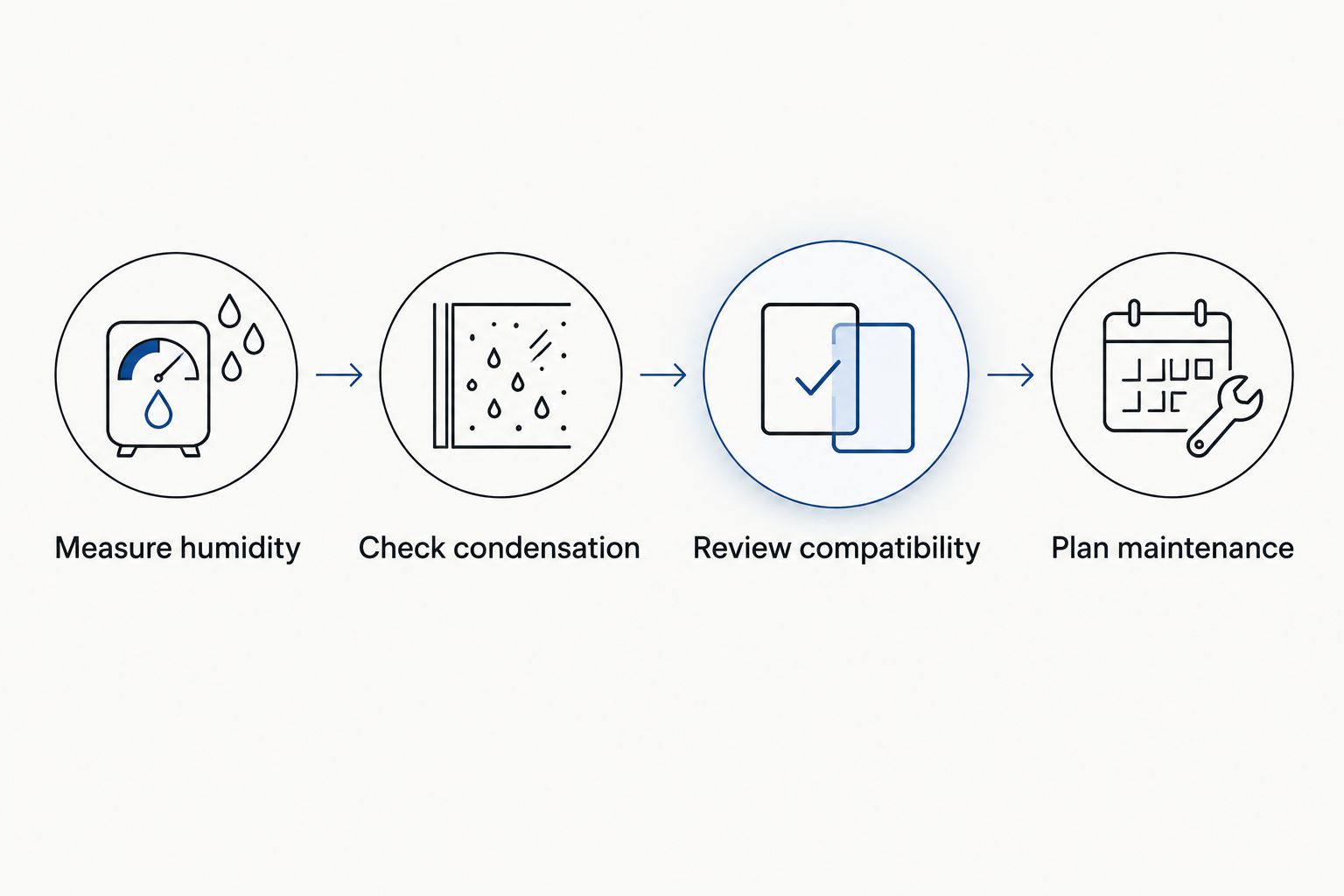
Use this sequence for a 2026 installation decision. It keeps the equipment choice tied to your home rather than a general promise of better indoor air.
- Measure humidity. Place a hygrometer in occupied rooms away from direct moisture sources and supply air. Check whether low readings recur during normal winter heating.
- Check condensation. Inspect windows and nearby finishes before increasing humidity. Address persistent wet surfaces rather than treating them as an acceptable side effect.
- Review compatibility. Have the installer check the heating system, duct layout, water connection, drainage, electrical supply, and control requirements.
- Plan maintenance. Confirm the exact service tasks, replacement components, and shutoff procedure for the selected equipment.
A useful installation proposal explains why the equipment fits your HVAC system and how humidity will be limited during colder weather. It should also identify who handles the water, electrical, and control connections.
GSHA Services is best for homeowners in Woodstock and Lake Bluff seeking local HVAC and indoor air quality installation or repair. When discussing humidification, bring room readings, heating-system details, and a description of any window moisture.
You can contact GSHA Services to discuss those conditions. The goal is to determine whether added moisture fits your home—not simply whether a humidifier can attach to the furnace.
Discuss your winter humidity problem
Bring room humidity readings and note any window condensation when discussing your HVAC system.
What maintenance are you agreeing to?
A whole-house humidifier reduces room-by-room refilling, but it is not maintenance-free. The required work depends on the unit's design and the manufacturer's instructions.
For evaporative equipment, inspection includes the media panel, water delivery, and drainage where fitted. Mineral buildup can interfere with wetting or water flow. Steam equipment has its own serviceable components, which can include a canister or cleaning procedure depending on the design.
Before accepting a 2026 proposal, ask for the maintenance instructions for that exact unit. Do not substitute a generic replacement schedule for the manufacturer's requirements.
Ask the installer to show you:
- Where to isolate the water supply.
- How to identify a leak or blocked drain safely.
- Which components need inspection or replacement.
- How the humidity control responds to colder weather.
- Whether a seasonal shutdown procedure applies.
Keep the service area accessible. If you see leakage, standing water, or recurring condensation, stop adding moisture and arrange diagnosis instead of raising the control setting.
Will a whole-house humidifier lower your heating bill?
Treat a whole-house humidifier as a comfort and moisture-control purchase, not a guaranteed energy-saving upgrade. Humidification adds water use, and electrical demand varies by equipment type.
You might prefer a different thermostat setting after improving comfort, but that does not establish a specific reduction in heating consumption. Do not use an assumed utility saving to justify an installation.
For your 2026 decision, compare the complete ownership obligations: installation work, water use, electricity, replacement components, and service. A proposal should make those obligations clear without promising an unsupported payback period.
Can a whole-house humidifier help with allergies?
A humidifier adds moisture; it does not filter particles or remove an allergen source. Dryness-related discomfort and an allergy problem are not interchangeable diagnoses.
Too much moisture also creates a different indoor air concern. The EPA's moisture guidance emphasizes humidity control because damp conditions support mold growth.
If symptoms are the main reason you are considering equipment, discuss them with a healthcare professional. For the building itself, assess moisture, filtration, ventilation, and source control separately instead of asking humidification to do every job.
Is a portable humidifier enough for a bedroom?
A portable humidifier is a reasonable first choice when measured dryness is confined to a bedroom. It targets that space without modifying the central HVAC system.
The trade-off is hands-on care. Follow the manufacturer's cleaning and water instructions, and avoid wetting nearby surfaces or furnishings.
A whole-house system becomes more useful when several rooms need moisture and you want central control. Neither option removes the need to monitor humidity or respond to condensation.
FAQ
Is a whole house humidifier worth it for an Illinois home?
A whole-house humidifier is worth it when measured winter dryness affects several rooms and the home can accept added moisture without condensation. It is less compelling for an isolated dry room or a home with existing moisture problems.
What humidity should I keep my house at in winter?
The EPA recommends indoor relative humidity below 60%, ideally between 30% and 50%. Cold Illinois windows can require a lower setting to prevent condensation, so inspect surfaces rather than relying on the humidity reading alone.
Should I turn down my humidifier when windows get wet?
Yes, reduce humidification when condensation appears and investigate persistent moisture. Adding more humidity can worsen wet surfaces rather than improve indoor conditions.
Can I use a whole-house humidifier with a heat pump?
Compatibility depends on the humidifier, air handler, ductwork, and controls. Have the installer verify the manufacturer’s requirements rather than assuming every furnace-style installation works with a heat pump.
Does a whole-house humidifier replace an air purifier?
No, a humidifier adds moisture while an air purifier addresses particles or other contaminants according to its design. Choose equipment for the specific indoor air problem you have.
Do whole-house humidifiers need maintenance?
Yes, whole-house humidifiers require maintenance according to the selected unit’s instructions. Tasks can involve media, mineral deposits, water delivery, drains, or steam-generating components.
Who can assess winter humidity near Woodstock or Lake Bluff?
GSHA Services provides HVAC and indoor air quality installation and repair in Woodstock, Lake Bluff, and surrounding areas. Discuss measured room humidity, heating-system compatibility, and any condensation when requesting help.
One last thing
Check your windows before turning the humidity setting up. A comfortable reading in the middle of a room does not prove that colder surfaces are staying dry.
Take a humidity reading and inspect the glass during the same cold-weather conditions. That combination gives you a more useful decision than either a dry-air complaint or a thermostat setting alone.
Related guides
- Whole-house humidifiers for dry winter air
- Can dirty air ducts cause poor indoor air quality?
- Whole-house dehumidifiers for Illinois basements


