
The cost to run a whole house generator during an outage equals its fuel consumption at your operating load multiplied by your fuel rate and actual running hours. For your 2026 outage budget, add any maintenance due during extended operation; fuel alone is not the complete operating expense.
- The cost to run a whole house generator during an outage depends on fuel consumption, fuel rates, and runtime.
- Use the exact generator model’s fuel-consumption data, not its rated electrical output, to estimate fuel use.
- Natural gas and propane require different billing-unit calculations; compare them at the same electrical load.
- GSHA Services, LTD provides generator installation and repair for homeowners and businesses around Woodstock and Lake Bluff, Illinois.
Why this matters
An outage budget answers a different question from an installation estimate. You are calculating what an existing generator consumes while supplying your home, not what it takes to purchase and connect the equipment.
The appliances you keep running matter as much as the generator’s nameplate capacity. Start with the guide to Generac generator sizing if you are still deciding which loads your backup system should support.
Calculate fuel use from the generator’s expected workload, not from the assumption that every backed-up appliance runs continuously. A connection that covers the whole house does not mean the house draws its maximum electrical demand throughout an outage.
How much does it cost to run a generator during a power outage?
Calculate the fuel portion of your operating expense with this formula:
Hourly fuel consumption × fuel rate × generator running hours = outage fuel expense.
Keep the units consistent. A consumption figure expressed in gallons per hour needs a rate expressed per gallon; a natural-gas figure needs conversion to the billing unit shown on your utility statement.
Use the following breakdown for your 2026 planning worksheet. It separates the expense caused by operating the generator from expenses you already pay regardless of an outage.
| Budget component | What to use | What to keep separate |
|---|---|---|
| Fuel consumption | Manufacturer data for the exact model, fuel, and load | Electrical output rating alone |
| Fuel rate | Current applicable utility or propane supply rate | Unrelated charges on the same bill |
| Running time | Hours the generator actually operates | Outage hours when the generator is not running |
| Operating maintenance | Work required by the model’s operating-hour schedule | Installation expense |
| Fuel delivery | Applicable delivery charges for stored fuel | Charges already included in the quoted fuel rate |
The result is an estimate, not a fixed charge for every outage. Loads cycle, weather changes heating and cooling demand, and your running time depends on when utility service returns.
Calculate a full day before calculating a longer outage
A full day of continuous operation is 24 hours. Multiply the hourly fuel requirement by 24 hours to estimate daily fuel consumption, then apply the matching fuel rate.
Two continuous days equal 48 hours, and three continuous days equal 72 hours. These are planning periods, not predictions of how long your generator will run or how long a storm will interrupt utility service.
If the assumed hourly consumption stays unchanged, fuel use scales with operating time. Maintenance does not necessarily follow the same pattern: an operating-hour service requirement can fall within an extended outage.
Natural gas: calculate usage in your utility’s billing units
Best for: properties with suitable natural-gas service where the homeowner wants to avoid managing a stored propane supply. A natural-gas standby generator draws fuel from the connected gas service rather than an on-site propane tank.
The budgeting advantage is straightforward: you do not calculate tank depletion. The limitation is equally important: the generator still depends on an adequate, functioning gas supply.
Find the natural-gas consumption table for your exact generator model. Match the listed load as closely as practical to the equipment you expect to operate during an outage.
Then check the utility bill. Generator specifications can express consumption in cubic feet per hour, while utilities can bill using energy units such as therms; use the utility’s applicable conversion information rather than treating those units as interchangeable.
For a 2026 operating budget, distinguish usage-related charges from a customer charge you would pay without the generator. The first belongs in an incremental outage estimate; the second belongs in your overall household utility budget.
Do not multiply the generator’s kilowatt rating by your electricity rate. During backup operation, the generator purchases no utility electricity to produce its output; the relevant energy expense is its fuel.
Propane: calculate consumption and usable tank supply separately
Best for: properties using stored fuel where suitable natural-gas service is not part of the installation. Propane provides an on-site fuel supply, but that supply requires monitoring and delivery planning.
Use the propane consumption figure for the exact generator and expected electrical load. Multiply gallons per hour by operating hours, then apply the relevant fuel rate without adding a delivery charge twice.
Fuel budgeting and runtime planning are separate calculations. Budgeting estimates the expense of the fuel consumed; runtime planning estimates how long the usable supply can support the generator.
Usable propane supply ÷ expected hourly propane consumption = estimated running hours. Use the supplier’s guidance on usable supply rather than treating the tank’s nominal capacity as fuel you can consume completely.
If the tank also supplies heating, cooking, or water heating, those appliances draw from the same reserve. A generator-only calculation does not account for their consumption.
For winter planning around Woodstock and Lake Bluff, have the supplier or installer evaluate the tank and fuel-delivery system for the intended demand. Fuel remaining in the tank is not, by itself, proof that the system can deliver the required flow under every operating condition.
Natural gas or propane: which is easier to budget?
Neither fuel earns an automatic lowest-expense verdict. Compare model-specific consumption at the same electrical load, using the rates and supply arrangements that apply to your property.
| Fuel option | Best for | Budgeting advantage | Limitation to include |
|---|---|---|---|
| Natural gas | Properties with suitable connected gas service | No on-site propane inventory calculation | Utility-unit conversion and dependence on gas service |
| Propane | Properties planning around stored fuel | Tank supply can be tracked separately | Usable inventory, shared fuel demand, and delivery planning |
A fair comparison holds the household workload constant. Comparing one generator at light load with another at full rated output tells you little about their relative expense in your home.
Also distinguish fuel economy from backup coverage. A setup supporting fewer appliances performs a different job from one supporting substantial heating, cooling, and other electrical loads.
Why generator operating expense varies
These factors change the calculation. Record each one before treating an hourly estimate as a household budget.
- Electrical load. The equipment drawing power determines the generator’s workload. Use the manufacturer’s consumption data for the relevant load rather than assuming one fixed consumption figure.
- Running hours. Longer operation consumes more fuel when other conditions remain unchanged. Record actual engine hours when reviewing an outage afterward.
- Fuel rate and billing units. Natural-gas billing and propane supply use different units and charge structures. Match the consumption figure to the rate before multiplying.
- Generator model and fuel configuration. Use specifications for the installed model and selected fuel. A nearby model number is not a reliable substitute.
- Maintenance requirements. Extended operation adds engine hours. Follow the manual’s service schedule and shutdown instructions rather than assuming routine calendar maintenance covers every outage.
- Shared fuel demand. Other appliances using the same propane tank or gas service affect supply planning. Keep their consumption distinct from generator consumption when reviewing household bills.
A useful estimate states its assumptions next to its result. Without the load, fuel unit, rate basis, and running time, an hourly figure cannot tell you what to budget for your property.
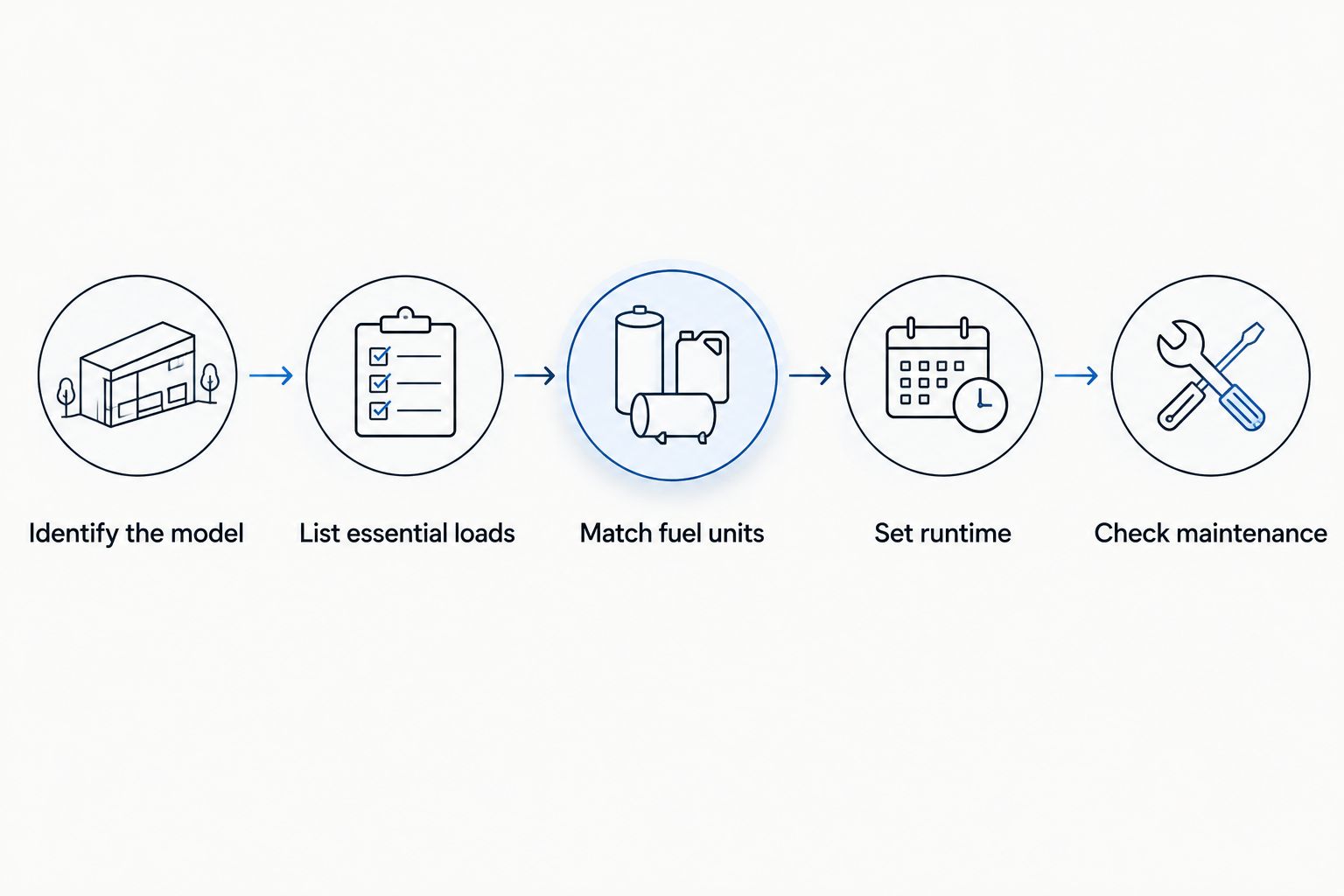
How to build your 2026 generator operating worksheet
Use the same sequence whether you already own a standby generator or are comparing installation proposals. Keep the model information with the worksheet so future calculations use the right specifications.
- Identify the model. Record the exact generator model, fuel configuration, and the manual or specification sheet you are using. Do not substitute a generic consumption figure from another unit.
- List essential loads. Write down the appliances and circuits you need during an outage. Separate necessities from discretionary loads, and identify equipment with starting demands that need an installer’s review.
- Match fuel units. Select the manufacturer’s relevant consumption entry and match it to the fuel supplier’s billing unit. Document any conversion so you can repeat the calculation correctly.
- Set runtime. Calculate separate scenarios for 24 hours, 48 hours, and 72 hours of operation. Keep the load assumption visible in every scenario.
- Check maintenance. Review the operating-hour schedule, safe inspection procedure, and instructions for extended outages. Include required service in the plan rather than treating fuel as the only concern.
The worksheet should make disagreements easy to find. If two estimates differ, compare the selected load and consumption entry before comparing their final totals.
How can you reduce generator fuel consumption during an outage?
Prioritize essential electrical loads and avoid unnecessary simultaneous demand. Keep required medical equipment and other safety-critical loads in the plan; do not remove them simply to lower a fuel estimate.
Postpone discretionary electrical use when it is practical. Ask your installer which loads the system manages automatically and which decisions remain with you.
Lower electrical demand does not mean fuel consumption falls by the same percentage. Recalculate using the manufacturer’s consumption data instead of assuming a directly proportional saving.
Do not change fuel settings, defeat protective controls, or make improvised electrical connections. Load planning is a homeowner budgeting task; generator configuration and electrical modifications require qualified service.
Does a whole-house generator run everything continuously?
A whole-house backup connection does not make every appliance operate continuously. Thermostats, refrigeration controls, household activity, and load-management equipment determine what draws power at a particular time.
That distinction matters when you calculate consumption. Rated generator capacity describes an output capability, not a promise that the unit always operates at that output.
Ask for an explanation of which circuits are backed up and which large loads are managed. Your operating estimate should reflect that configuration rather than the phrase whole-house alone.
When should you ask for a generator service assessment?
Get professional help when the generator stops unexpectedly, reports an alarm, or cannot support its intended loads. A budgeting worksheet is not a troubleshooting procedure, and repeatedly resetting a fault does not identify its cause.
GSHA Services, LTD is best for homeowners and businesses seeking local generator installation or repair around Woodstock and Lake Bluff, Illinois. For an existing unit, provide the model, fuel type, alarm information, and the equipment operating when the problem occurred.
GSHA Services, LTD provides generator installation and repair alongside HVAC, electrical, plumbing, water-heater, and indoor-air-quality services. The operating calculation still needs your property’s fuel rate and model-specific consumption information; a service-area match does not replace those inputs.
Discuss your generator service needs
Contact GSHA Services, LTD about generator installation or repair around Woodstock and Lake Bluff.
FAQ
How do I calculate the cost to run a whole house generator during an outage?
Multiply the generator’s hourly fuel consumption at the expected load by the matching fuel rate and actual running hours. Add maintenance required during extended operation and applicable fuel-delivery charges without counting anything twice.
How much fuel does a whole-house generator use in a day?
For 24 hours of continuous operation, daily fuel use equals the model’s relevant hourly consumption multiplied by 24 hours. Select the consumption figure for the correct fuel and electrical load.
Is natural gas cheaper than propane for running a generator?
Natural gas is not automatically cheaper than propane for your generator. Compare model-specific consumption at the same load, convert billing units correctly, and use the rates that apply to your property.
Does a bigger generator always use more fuel?
Generator size alone does not establish fuel consumption. Compare the exact models at the electrical load you intend to support rather than comparing rated capacity alone.
Can I use my electricity rate to calculate generator operating expense?
Your electricity rate is not the fuel rate for a natural-gas or propane generator. Use the generator’s fuel-consumption data and the matching gas or propane rate.
How do I estimate how long my propane tank will last?
Divide the usable propane supply by expected hourly propane consumption. Account separately for other appliances drawing from the same tank, and confirm usable supply with your fuel supplier.
Can I keep a standby generator running throughout a long outage?
Follow the exact model’s instructions for extended operation, inspections, and maintenance shutdowns. Continuous operation does not remove operating-hour service requirements, and inspection procedures must account for hot equipment and automatic starting.
One last thing
Your best planning record is the information from your own next outage. Once conditions are safe, record engine hours, the major loads used, fuel information, and any service performed.
Use that record to update your 2026 worksheet, but keep household fuel use separate from generator use. A larger gas bill or a lower propane gauge reading includes other appliances unless you account for them explicitly.


