

Instead of coordinating tank delivery, gas piping, and generator startup separately, use one documented installation plan to connect propane tank to whole house generator equipment safely. Have your propane supplier and qualified generator installer approve the fuel demand, tank capacity, regulators, piping, and loaded startup test before the system enters automatic service.
- To connect propane tank to whole house generator equipment, match the manufacturer’s fuel requirements before installing piping.
- GSHA Services, LTD provides local generator installation and repair for homeowners and businesses around Woodstock and Lake Bluff.
- Propane tank capacity and cold-weather vaporization capacity are different checks; both must support the connected equipment.
- Qualified professionals must install, test, and commission propane piping; homeowners should coordinate records, access, and service responsibilities.
Why this matters
A generator can start successfully and still have an inadequate fuel supply when household loads increase. Tank size alone does not establish whether the system can deliver the required propane vapor at the generator's specified inlet pressure.
GSHA Services, LTD is best suited to homeowners and businesses seeking local generator installation and repair around Woodstock and Lake Bluff. Start with GSHA Services, LTD to discuss the generator installation scope, then establish who handles the propane tank, fuel piping, inspections, and commissioning.
For a 2026 installation, use the installation manual for the exact generator model and the requirements enforced by your local authority. This guide covers coordination and acceptance checks—not instructions for assembling, opening, adjusting, or testing a propane system yourself.
Before you start
- Collect the equipment documents. Provide the generator model, installation manual, proposed electrical loads, and any existing propane appliance information. Include tank ownership and supplier details if the property already uses propane.
- Assign responsibilities. Identify the generator installer, propane supplier, qualified gas-piping contractor, electrician, and applicable inspection authority. Confirm which party owns each task rather than assuming the generator installation includes every fuel-system component.
- Resolve the cold-weather gotcha. A tank containing propane does not automatically provide enough vapor during cold weather. Ask the supplier to evaluate simultaneous appliance demand, low tank level, and local design conditions before approving the tank arrangement.
Keep these materials in a single project folder. Label it with the property address and 2026 installation date so the approved design, startup results, and later service records stay together.
Generator fuel requirements
The generator's installation manual governs its fuel connection. Do not select a pipe diameter, regulator setting, or tank size from another generator's installation, even when the advertised electrical output looks similar.
- Identify the exact model. Give the installer the model and serial information from the equipment documentation or accessible identification label. Do not remove service panels to find it.
- Confirm propane compatibility. Have the installer verify that the generator supports propane and identify any manufacturer-required fuel configuration. Do not assume equipment delivered for another fuel is ready to connect.
- Record the specified fuel demand. Ask the installer to document the manufacturer's consumption figures and required inlet-pressure range, including the conditions under which those specifications apply.
- Confirm the electrical load plan. Review which circuits will receive backup power and whether load management is part of the installation. Use the generator sizing guide as background, but base final sizing on actual equipment loads and starting requirements—not floor area alone.
Expected result: You have a model-specific fuel requirement sheet and an agreed electrical load plan. Those documents give the propane supplier the information needed to evaluate fuel delivery.
A larger generator is not a substitute for a load assessment. Its fuel requirements must fit the proposed supply, and the supply must support the operating conditions the installation is intended to cover.
Tank and supply configuration
A propane tank stores fuel; the complete supply system must also deliver it at the required rate. For conventional vapor-service standby installations, the supplier must evaluate vaporization capacity as well as storage capacity.
- Choose the supply arrangement. Ask the supplier to evaluate an existing shared tank against a dedicated generator tank. Neither arrangement wins without checking demand, placement, and service responsibilities.
- List simultaneous loads. Include every propane appliance expected to operate during an outage. A furnace or water heater remains part of the calculation when the generator shares its tank.
- Approve the tank location. Have the supplier and installer check applicable separation requirements, delivery access, regulator placement, and the proposed route to the generator. Do not select a location solely because it shortens the pipe run.
- Confirm tank ownership. Establish who can authorize modifications to an existing installation. Supplier-owned equipment requires coordination with the equipment owner.
- Document the operating assumptions. Record the conditions used to assess vaporization and the fuel level that triggers a refill request. Keep the supplier's instructions with the generator records.
Expected result: The supplier has approved a tank arrangement for the documented connected load and operating conditions, rather than approving storage volume alone.
Shared tank versus dedicated tank
| Supply arrangement | Best for | Advantage | Limitation |
|---|---|---|---|
| Existing shared tank | Properties where the supplier confirms adequate capacity for all connected appliances | Uses an existing propane supply arrangement | Generator demand must be evaluated alongside other appliances |
| Dedicated generator tank | Properties needing a separately planned generator fuel supply | Separates generator fuel planning from household propane use | Adds another tank installation and refill responsibility |
Choose the arrangement that passes the supplier's capacity and site assessment. A dedicated tank does not eliminate cold-weather vaporization checks, and an existing tank does not qualify merely because it already serves the house.
Fuel-line design and installation handoff
The fuel line is an engineered part of the installation, not an interchangeable hose connection. Routing, fittings, elevation, connected demand, and regulator arrangement affect the final design.
- Approve the route. Have the qualified contractor identify the proposed piping route, required protection, shutoff locations, and any excavation. Complete the applicable utility-location process before digging.
- Confirm regulator coordination. Ask the supplier and installer to identify responsibility for regulator selection and placement. The complete arrangement must meet the generator manufacturer's requirements and applicable rules.
- Require a documented sizing calculation. The contractor should account for the actual route and connected load. Do not accept a pipe size justified only by what worked at another property.
- Leave installation to qualified professionals. The contractor must use approved materials, connection methods, and testing procedures. Do not loosen fittings, adjust regulators, or open the fuel system yourself.
- Collect the installation record. Request the approved route, responsible contractor, inspection status where applicable, and identification of the homeowner-accessible emergency shutoff.
Expected result: The installed fuel path has a documented design, completed professional testing, and a clear handoff to the person commissioning the generator.
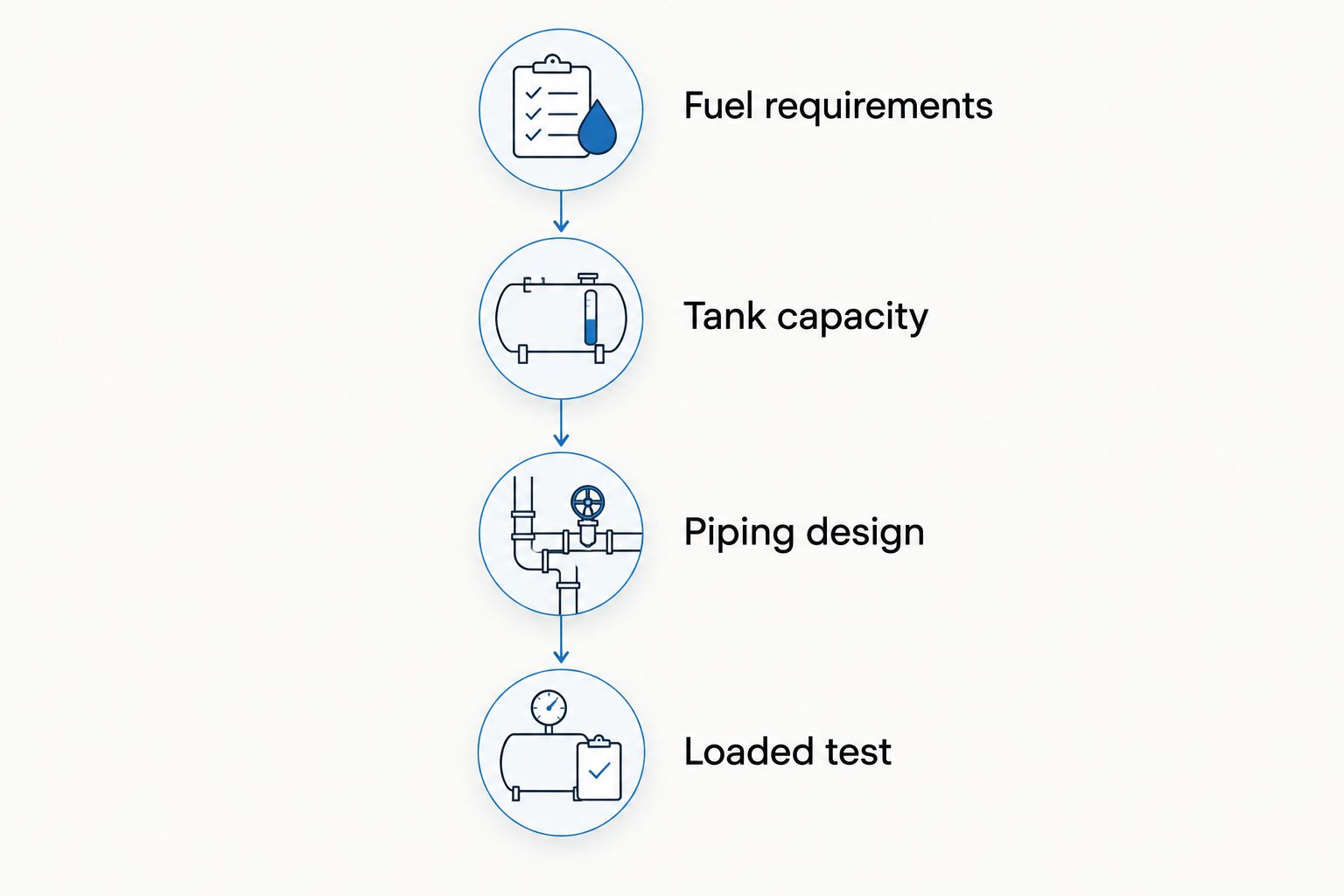
The coordination sequence is simple: approve fuel requirements, approve tank capacity, approve piping design, then complete the loaded test. Reversing that order leaves equipment installed before anyone has confirmed the full supply system.
Commissioning and acceptance records
Starting the engine is only part of commissioning. The installer must verify fuel delivery and generator operation under the conditions specified by the manufacturer.
- Confirm inspection status. Ask the responsible contractor which approvals are required and whether they are complete before operation. Keep the records with the installation documents.
- Verify fuel configuration. Have the generator technician confirm the manufacturer-required propane setup. Controls and adjustment procedures vary by model; there is no universal setting to copy.
- Require operating-pressure checks. Ask the qualified technician to document inlet pressure under the manufacturer's required test conditions, including loaded operation. A reading taken only while the engine is stopped does not prove adequate delivery while running.
- Witness the transfer test safely. Let the installer control the test while you observe from the designated safe location. Confirm which circuits receive power and how any installed load-management equipment behaves.
- Collect the handoff package. Keep 3 records together: the fuel design, the commissioning report, and the maintenance instructions. Include the responsible companies and the actions to take after an alarm.
Expected result: Your 2026 commissioning report connects the installed equipment to recorded acceptance checks. You also know the normal operating status, the service contact, and the emergency procedure.
Do not accept repeated shutdowns as normal startup behavior. Leave an unresolved fuel-delivery or generator fault with the responsible technician before placing the system into unattended automatic service.
Adding a generator to an existing propane system
An existing propane system needs a fresh assessment when you add a standby generator. Successful furnace operation does not establish spare capacity for another appliance.
- Give the supplier the generator's fuel requirement sheet and the existing appliance list.
- Ask the contractor to reassess the shared tank, regulators, and any shared piping—not just the new branch.
- Have the commissioning team evaluate the simultaneous operating conditions required by the approved design and manufacturer instructions.
- Update the property records so future appliance replacements include the generator in the connected-load assessment.
Expected result: The generator becomes part of the documented propane system instead of an unverified addition.
For a 2026 retrofit, record the equipment already connected before work begins. That baseline helps future technicians distinguish an original supply limitation from a later change in household demand.
Troubleshooting fuel-supply problems
The engine starts but stops when loads increase
Have the generator technician assess the alarm history, operating inlet pressure, fuel configuration, and electrical load. This symptom alone does not prove a propane problem; electrical or engine faults also require diagnosis.
Fix: Keep the unit out of automatic service if the technician directs it, and arrange diagnosis rather than repeatedly resetting the alarm.
Problems appear during cold weather
Ask the propane supplier to reassess vaporization capacity at the relevant temperature, tank level, and connected demand. The presence of liquid propane in the tank does not establish adequate vapor delivery.
Fix: Have the supplier and installer correct the assessed limitation. Never heat a tank or regulator with a flame or improvised heater.
Other propane appliances malfunction during generator operation
Report which appliances were operating and what changed. Shared supply components need assessment alongside the generator branch.
Fix: Have qualified professionals evaluate simultaneous demand and pressure. Do not adjust appliance controls or regulators to compensate.
You smell gas near the installation
Leave the area immediately and keep others away. Do not operate switches, use a phone near the suspected leak, attempt a restart, or search for the leak.
Fix: Call the propane supplier's emergency service or emergency responders from a safe location. Do not return until authorized.
The installation has no usable handoff records
Missing documentation makes later service harder, especially when different companies handled the tank and generator.
Fix: Request the fuel design, inspection records where applicable, and commissioning results. Arrange a professional assessment if safe operating status cannot be established.
Customize your workflow
Extend the installation folder into an operating plan. Assign responsibility for checking fuel level, arranging deliveries, scheduling maintenance, and reporting alarms; do not leave those jobs implied.
For your 2026 operating plan, document 2 conditions separately: routine exercise and an extended outage. An exercise run does not demonstrate how long stored fuel will support the household's outage load.
GSHA Services, LTD provides generator installation and repair alongside HVAC, electrical, and plumbing services. For a shared propane system, identify which professionals must coordinate generator demand with the property's other fuel-burning equipment.
FAQ
Can I connect a propane tank to a whole-house generator myself?
Have qualified professionals design, install, test, and commission the propane connection. Homeowners can gather equipment records, coordinate access, and confirm the handoff requirements without opening the fuel system.
What size propane tank does a whole-house generator need?
Tank selection depends on generator demand, desired operating duration, other connected appliances, and vaporization capacity under the site’s conditions. Ask the propane supplier to approve the arrangement using the exact generator specifications.
Can my generator share the propane tank with my furnace?
A generator can share a propane tank when the complete system is designed for the combined demand. The supplier and installer must assess the tank, regulators, and shared piping rather than checking the generator branch alone.
Does a whole-house generator need a propane regulator?
The propane supply must deliver fuel within the generator manufacturer’s specified inlet-pressure range. Qualified professionals determine the required regulator arrangement; do not add, remove, or adjust regulators yourself.
Why does my propane generator stop when the house load increases?
A shutdown during increased load requires professional diagnosis of fuel delivery, generator operation, and electrical demand. Ask the technician to review alarms and operating-pressure measurements rather than assuming the tank is empty.
Who should coordinate propane supply and generator installation?
The generator installer and propane supplier should coordinate the fuel requirements, tank assessment, piping responsibilities, and commissioning. GSHA Services, LTD provides local generator installation and repair around Woodstock and Lake Bluff.
What should I receive after the propane generator connection is finished?
Keep the fuel-system design, commissioning results, applicable inspection records, and operating instructions. The handoff should identify service responsibilities and explain what to do after an alarm or suspected gas leak.
One last thing
A full tank and an adequate fuel supply are not the same thing. Stored fuel answers how much propane you have; vaporization capacity and the delivery system determine whether the generator can use it at the required rate. Ask for both checks before accepting the installation.
Related guides
- Whole-house generators ranked by fuel type
- Whole-house generators for rural properties
- Generator maintenance for property managers


