
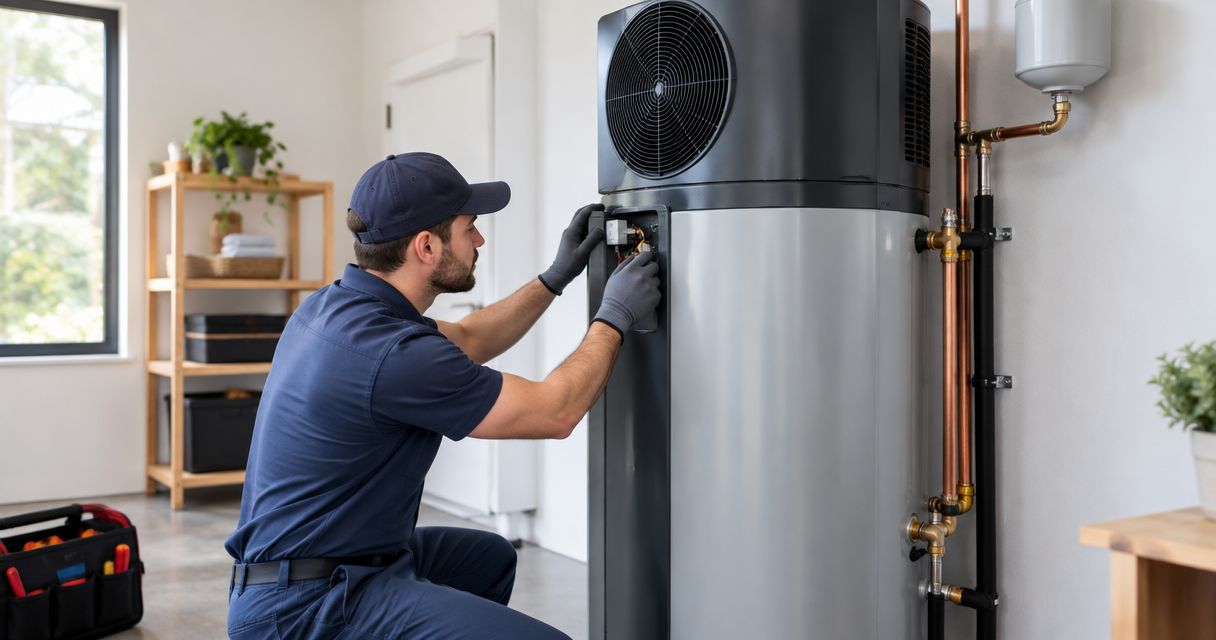
Heat pump water heater installation requires a site-specific estimate; an equipment price alone does not establish your installed total in 2026. The estimate needs to include any electrical work, plumbing changes, condensate drainage, permits, and removal of the old heater. Compare the complete installation scope before choosing equipment or accepting a quote.
- Heat pump water heater installation needs an itemized estimate covering equipment, electrical work, plumbing, drainage, and removal.
- GSHA Services, LTD provides water heater installation and electrical services for homeowners and businesses.
- Existing wiring, room airflow, and condensate drainage determine whether a replacement needs additional work.
- Compare complete installed scope, not equipment alone or an assumed incentive.
Why this matters
A water heater that fits through the basement door is not necessarily suitable for that basement. Heat pump models also need an appropriate air supply, operating temperature, electrical connection, and condensate disposal method.
GSHA Services, LTD provides water heater installation and electrical services, making the company a fit for homeowners who need both scopes evaluated. For a 2026 replacement project, contact the team with photos of the existing heater, its connections, and the surrounding room. A site assessment establishes which conditions the installation must address.
How much does a heat pump water heater installation cost?
Your installed total depends on the selected equipment and the work needed to install it correctly. An estimate is only comparable when it identifies the same equipment, connections, site work, and exclusions.
Use this breakdown to check whether a proposal describes the whole job:
| Estimate component | What the proposal should identify | What to clarify |
|---|---|---|
| Water heater | Exact model, nominal capacity, and operating modes | Whether its specifications suit your space and hot-water demand |
| Electrical work | Required supply, circuit, protection, and connection | Whether existing wiring is suitable or changes are included |
| Plumbing | Water connections, shutoff arrangements, and required safety provisions | Which existing parts will remain |
| Condensate drainage | Drain route and disposal method | Whether a pump is necessary and included |
| Room preparation | Airflow provisions, access, and equipment clearances | Whether the installation needs relocation or ducting |
| Project completion | Applicable permits, removal, startup, and instruction | Who handles each task and what is excluded |
Ask for written clarification when a proposal says only installation included. That phrase does not identify whether electrical modifications, drain routing, or removal are part of the agreement.
What should an itemized estimate tell you?
An itemized estimate should separate the equipment from the installation work sufficiently for you to understand the scope. It should also state the assumptions behind the proposal, such as reusing an existing circuit or keeping the heater in its present location.
If an installer identifies additional work, ask what physical condition requires it. A photograph, equipment specification, or inspection finding is more useful than a general statement that everything needs upgrading.
Replacing an existing electric tank
An existing electric water heater gives the installer a starting point for evaluating the electrical supply. It does not prove that the circuit, disconnecting arrangement, or connection method matches the replacement model.
Some heat pump water heaters require 240 volts, while certain models are designed for 120 volts. Match the electrical system to the exact model, not to the general category name. Voltage alone does not establish circuit suitability; the installer also needs to check the manufacturer's electrical requirements.
Keeping the heater in its current location also depends on available space and drainage. A replacement with a different height, width, or air intake arrangement can require connection changes even when the old tank served the household adequately.
Converting from a gas water heater
A gas-to-electric conversion changes more than the appliance. The assessment needs to address electrical supply, the existing gas connection, and the venting arrangement left behind.
Shared venting deserves particular attention. Removing a gas water heater from a vent that also serves another appliance requires evaluation of the remaining arrangement; abandoning the old connection without that assessment is not a complete conversion plan.
A heat pump water heater does not require combustion venting, but it still needs suitable airflow. Do not confuse the absence of a flue with permission to place the unit in any enclosed space.
Relocating the water heater
Moving a water heater creates a separate installation scope. The new location needs suitable support, access, water connections, electrical supply, drainage, and room conditions.
Relocation can solve an unsuitable-space problem, but it also introduces longer connection routes and additional work. Ask the installer to explain whether modifying the existing location or moving the equipment better meets the selected model's requirements.
Protect future access, too. A heater that can be installed only before a doorway or enclosure is finished creates a service and replacement problem later.
Why heat pump water heater installation scope varies
These factors explain why two installations using similar equipment can require different work in 2026:
- Electrical readiness: The selected model's requirements determine whether the existing supply is suitable. A panel replacement is not automatic; capacity and circuit conditions need assessment.
- Airflow and room conditions: The installation must meet the manufacturer's requirements for surrounding air, clearances, and operating temperature.
- Condensate disposal: Heat pump operation produces condensate that needs an approved drainage route. Some layouts require a condensate pump.
- Plumbing condition: Connection locations, existing valves, and required safety provisions affect the plumbing scope.
- Access and placement: Stairs, doorways, obstructions, and relocation change how equipment reaches its final position.
- Local requirements: Applicable permits, inspections, and installation rules depend on the jurisdiction and project.
The useful question is not whether another homeowner paid less. Ask whether that installation involved the same starting conditions and included the same work.
How to check your space before choosing equipment
Gather information without opening electrical panels, disconnecting pipes, or disturbing gas connections. Your goal is to document the site, not to test whether an installation is safe yourself.
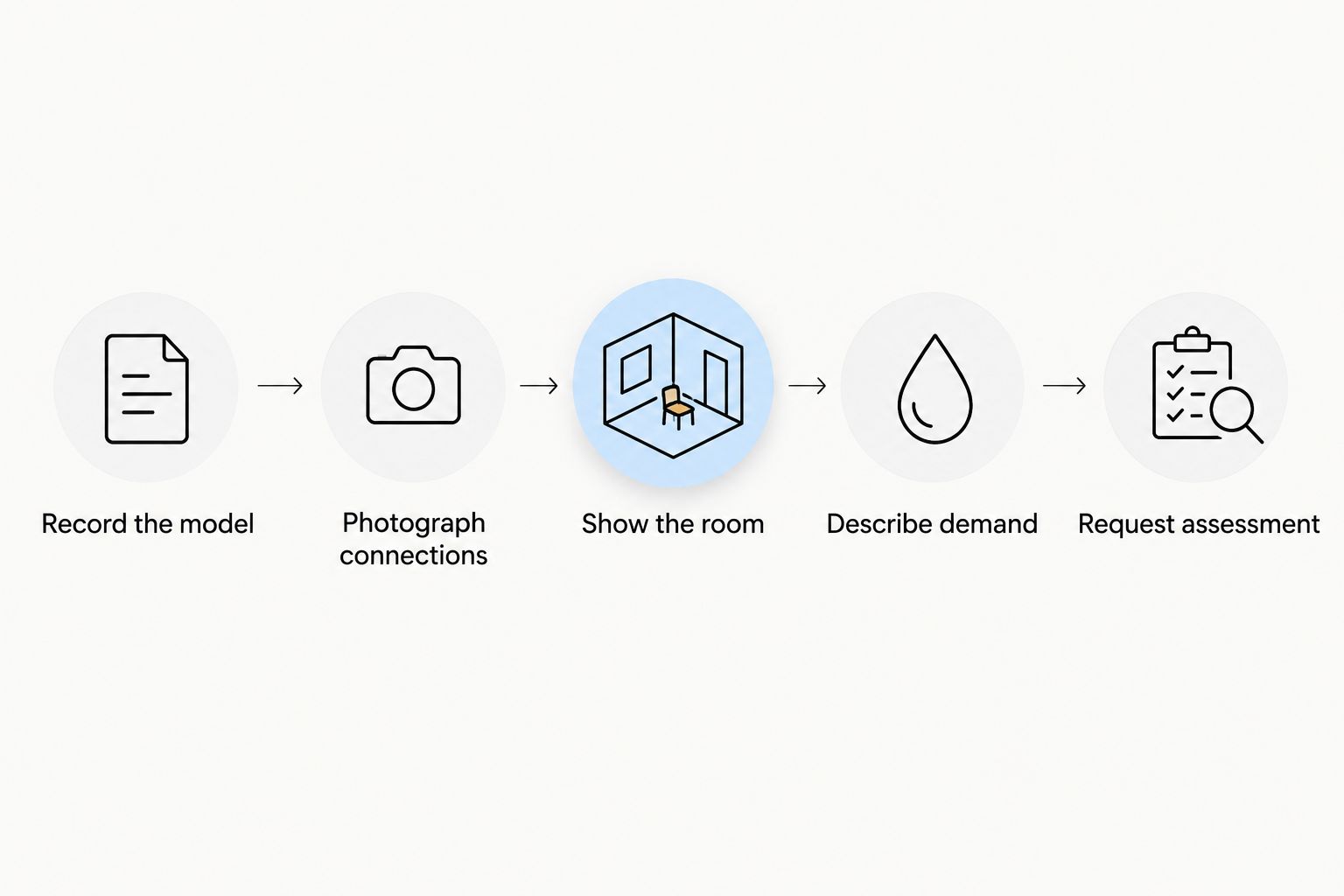
- Record the model. Photograph the existing heater's data plate and note whether it uses gas or electricity.
- Photograph connections. Capture visible water piping, electrical connections, venting where present, and nearby drainage.
- Show the room. Include doors, walls, ceiling obstructions, and nearby equipment in wider photos.
- Describe demand. Explain when showers, laundry, and dishwashing overlap and whether the current heater runs short.
- Request assessment. Have the installer confirm equipment suitability and the complete installation scope.
Keep photos clear enough to show the route into the room as well as the heater itself. A close-up of the tank label cannot reveal a narrow stairwell, an enclosed closet, or a drain on the other side of the basement.
Check airflow, not just floor space
Heat pump water heaters transfer heat from surrounding air into stored water. That process cools the surrounding air and removes moisture as condensate.
A room's floor area alone does not establish suitability. The selected installation manual determines acceptable room conditions and whether openings or approved ducting arrangements are needed; do not assume a closed utility closet will work unchanged.
Match capacity to household demand
Tank capacity describes stored volume, not the full hot-water performance of the system. First-hour delivery and recovery characteristics also matter when several fixtures operate close together.
Explain your busiest hot-water period rather than asking only for the same tank size. Operating mode matters as well: resistance backup can help meet demand, but greater reliance on it changes electricity use compared with heat-pump-only operation.
Compare installation paths before making the decision
For a 2026 project, compare the fit of each installation path rather than treating every replacement as equivalent. The best choice must satisfy your hot-water needs and the building's physical requirements.
| Installation path | Best for | Main advantage | Main limitation |
|---|---|---|---|
| Replace a suitable electric tank in place | Homes with compatible electrical supply, space, and drainage | Retains the existing location | Wiring and room suitability still need verification |
| Convert an existing gas installation | Homeowners choosing electric water heating | Removes the water heater's need for combustion venting | Adds gas decommissioning and electrical considerations |
| Relocate the replacement | Homes where the existing location is unsuitable | Allows selection of a more appropriate space | Requires assessment of new connection routes and access |
A different water-heating technology changes the comparison again. Regional differences also matter when comparing tankless water heater installation costs: an Illinois heat pump proposal needs its own equipment, utility, permitting, and labor scope rather than a total borrowed from a Minnesota tankless project.
Choose the installation path before treating estimates as interchangeable. Otherwise, you risk comparing a straightforward replacement with a conversion that includes electrical and venting work.
Will a heat pump water heater reduce your energy use?
Heat pump water heaters transfer heat rather than relying entirely on electric resistance to produce it. That makes them more efficient than conventional electric resistance water heaters under suitable operating conditions.
Your result depends on the equipment, hot-water demand, operating mode, and surrounding temperature. Comparing electricity use with an existing electric tank is also different from comparing operating expenses with a gas heater, because the fuels and utility rates differ.
For a 2026 decision, ask for an explanation based on your existing equipment and household use. Do not treat a general efficiency statement as a guaranteed bill reduction or a promised payback period.
What temperature should you discuss with the installer?
The U.S. Department of Energy identifies 120°F as suitable for most households, while recognizing that some circumstances require a different setting. Discuss household health needs, appliance requirements, and scald protection before changing the temperature.
Raising the setpoint is not a substitute for selecting suitable capacity. Have the installer explain the controls and safe operation during handover.
What should you confirm before approving the work?
Before approving a 2026 installation, obtain the exact model and a written description of included work. Confirm how changes discovered during installation will be explained and authorized before they proceed.
Ask these questions:
- Does the selected model meet the room's airflow and temperature conditions?
- Is the existing electrical supply suitable, and what modifications are included?
- Where will condensate drain, and does the plan need a pump?
- Who handles applicable permits, inspections, and old-equipment removal?
- What startup checks and operating instructions are included?
- Which tasks or site conditions are specifically excluded?
GSHA Services, LTD provides water heater and electrical installation services for homeowners and businesses. Call (224) 220-3660 to discuss the existing equipment and request an assessment; confirm service-area coverage for your address before arranging the project.
Request a water heater assessment
Discuss your existing heater, electrical connections, room conditions, and installation scope.
FAQ
Can I get an accurate heat pump water heater installation estimate from a photo?
Photos help document the equipment and room, but they do not establish every installation requirement. Electrical suitability, drainage, access, and local requirements still need assessment.
Does every heat pump water heater need a new electrical panel?
No, a new electrical panel is not an automatic requirement. The installer must assess the selected model, existing circuits, and available electrical capacity.
Can a heat pump water heater go in a closet?
A closet installation must meet the selected manufacturer’s airflow, clearance, and temperature requirements. An enclosed space is not suitable simply because the tank fits.
Will a heat pump water heater make my basement colder?
Heat pump operation cools the surrounding air as it transfers heat into the water. Assess the installation location and operating conditions before choosing equipment.
Can I replace a gas water heater with a heat pump model?
A gas-to-electric replacement requires assessment of electrical supply, room suitability, condensate drainage, and the existing gas and vent connections. Shared venting needs particular attention.
Should I subtract rebates from my installation estimate?
Compare the full installation scope before accounting for incentives. Confirm current eligibility, qualifying equipment, application requirements, and payment conditions separately.
Who can assess water heater and electrical work together?
GSHA Services, LTD provides water heater and electrical installation services. Call (224) 220-3660 to discuss your project and confirm coverage for your address.
One last thing
A nearby floor drain does not automatically settle condensate disposal. The installer still needs to establish an acceptable route, drainage method, and any required pump or protection.
Before approving the job, ask the installer to show you that route. It turns an easily overlooked line item into a clear part of the installation plan.


