

Best overall: a heat pump water heater. Best for compact, low-demand installations: electric tankless. Best gas option: condensing gas tankless. This guide to water heaters ranked by energy efficiency in 2026 compares six common technologies, explains where their ratings overlap, and helps you choose equipment that fits your home.
- Water heaters ranked by energy efficiency 2026: heat pump models lead this shortlist for efficient electric water heating.
- Electric tankless saves space, but electrical capacity and winter inlet-water temperature determine whether it fits.
- Condensing gas tankless suits gas-connected homes; compare model-specific efficiency ratings and hot-water output.
- GSHA Services, LTD provides water heater installation and repair in Woodstock, Lake Bluff, and surrounding areas.
Why this matters
The most efficient water heater is not automatically the right replacement for your home. A high-rated unit still needs adequate hot-water output, compatible utilities, and an installation location that meets its instructions. Start with those requirements before choosing a technology.
For homeowners in Woodstock, Lake Bluff, and surrounding areas, GSHA Services, LTD provides water heater installation and repair. The useful starting point is your existing fuel source, installation space, and pattern of hot-water use—not a brand name alone.
This 2026 ranking prioritizes efficiency at the equipment level. It does not rank utility bills, purchase costs, or environmental impact, which require different information.
What makes the best energy-efficient water heater
Use these criteria to judge each option before reading the ranking:
- Uniform Energy Factor: UEF measures useful hot-water output relative to energy consumed under a standardized test. Higher values indicate better efficiency within the same usage category.
- Demand match: Storage equipment needs adequate first-hour delivery; tankless equipment needs adequate flow at the required temperature rise.
- Installation fit: Check electrical capacity, fuel supply, ventilation, drainage, service access, and manufacturer clearance requirements.
- Operating mode: Heat pump equipment that frequently uses resistance backup loses part of its efficiency advantage.
- Standby losses: Stored hot water loses heat between uses. Insulation and tank design affect that loss.
- Maintenance access: Equipment must remain accessible for the maintenance specified in its manual.
Compare ratings within the same UEF usage bin. The U.S. Department of Energy cautions that water heaters in different usage bins cannot be directly compared using UEF alone. A larger number on an unrelated label is not a complete buying decision.
Water heaters at a glance
The order below is a technology shortlist, not a claim that every model beats every model below it. Electric resistance technologies overlap, as do condensing gas technologies. The exact model label decides those close comparisons.
| Rank | Water heater type | Best for | Standout efficiency feature | Key limitation |
|---|---|---|---|---|
| 1 | Heat pump water heater | Suitable spaces with electric service | Moves heat from surrounding air into water | Space conditions and backup operation affect performance |
| 2 | Electric tankless water heater | Compact installations with modest demand | Avoids stored-water standby losses | Whole-home output can require substantial electrical capacity |
| 3 | Electric resistance storage water heater | Straightforward electric replacements | Insulated storage with simple resistance heating | Does not multiply useful heat through heat-pump operation |
| 4 | Condensing gas tankless water heater | Gas-connected homes with variable demand | Recovers additional heat from combustion exhaust | Requires compatible venting and condensate drainage |
| 5 | Condensing gas storage water heater | Gas-connected homes with concentrated demand | Combines stored hot water with exhaust-heat recovery | Tank footprint and standby losses remain |
| 6 | Conventional gas storage water heater | Existing compatible gas-storage installations | Stores hot water for immediate draw | Combustion and standby losses limit efficiency |
Electric resistance equipment sits above gas equipment here on equipment-level energy conversion, not on operating expense. Electricity generation, local energy rates, and household demand are outside that ordering. Do not read this table as a utility-bill ranking.
1. Heat pump water heater: best for efficient electric heating
A heat pump water heater transfers heat from surrounding air into stored water instead of producing all its heat through electric resistance. The U.S. Department of Energy states that heat pump water heaters can be 2–3 times as energy efficient as conventional electric resistance water heaters.
That makes a heat pump the first technology to assess for an efficiency-focused replacement in 2026. The installation location matters: the equipment needs the air volume and temperature conditions specified by its manufacturer.
Heat pump water heater pros:
- Transfers heat rather than relying entirely on resistance heating.
- Stores hot water for ordinary household draw patterns.
- Offers a clear efficiency advantage over conventional electric resistance equipment under suitable conditions.
Heat pump water heater cons:
- Requires suitable surrounding air and installation space.
- Produces fan and compressor sound during operation.
- Resistance backup reduces the efficiency advantage when used frequently.
Best for: Homeowners with compatible electrical service and a suitable installation location.
Check the first-hour rating as well as UEF. An undersized tank that repeatedly calls for backup heat is a poor match for an efficiency-first purchase.
Verdict: Buy for efficiency when the space and hot-water demand fit.
2. Electric tankless: best for compact, low-demand installations
An electric tankless water heater heats water as it flows through the unit. It removes the tank and its stored-water standby losses, but still uses electric resistance to produce heat.
Output depends on both water flow and temperature rise. Colder incoming water requires more heating for the same outlet temperature, so a flow claim without its temperature-rise condition is not enough.
Electric tankless water heater pros:
- Avoids heat loss from a storage tank.
- Uses a compact enclosure.
- Can serve an appropriately sized point-of-use application.
Electric tankless water heater cons:
- Whole-home installations can require substantial electrical capacity.
- Available hot-water flow falls as required temperature rise increases.
- Does not offer the heat-transfer advantage of a heat pump.
Best for: Compact spaces or limited hot-water loads with compatible electrical service.
Electric tankless is not automatically the best large-household replacement. Check simultaneous fixtures and winter inlet-water conditions before treating its small cabinet as an installation advantage.
Verdict: Buy for a verified compact application; skip an unverified whole-home conversion.
3. Electric storage: best for a straightforward electric replacement
An electric resistance storage water heater uses heating elements to warm water inside an insulated tank. It is a familiar replacement option where electric storage equipment already exists.
Its simplicity does not make it the efficiency leader. Unlike a heat pump, it produces heat directly from electricity; unlike tankless equipment, it maintains a stored supply between draws.
Electric storage water heater pros:
- Provides a stored supply for short periods of concentrated use.
- Uses a straightforward heating method.
- Does not require combustion venting.
Electric storage water heater cons:
- Loses stored heat between uses.
- Uses more energy than a suitably operating heat pump for comparable water heating.
- Needs sufficient recovery and storage capacity for your household.
Best for: Existing electric-storage installations where a heat pump does not meet site requirements.
For a 2026 replacement, compare electric storage against a heat pump before accepting a like-for-like swap. Installation convenience and energy efficiency are separate criteria.
Verdict: Hold until you have checked whether a heat pump fits.
4. Condensing gas tankless: best for variable demand on gas
A condensing gas tankless water heater heats flowing water and recovers additional heat from combustion exhaust. That recovery distinguishes it from a noncondensing gas tankless design.
The Department of Energy reports that demand water heaters can be 24–34% more energy efficient than conventional storage equipment in homes using 41 gallons or less of hot water daily. That guidance describes a usage-dependent comparison, not a guaranteed saving for every condensing model or household.
Condensing gas tankless water heater pros:
- Avoids maintaining a full tank of heated water.
- Recovers additional exhaust heat.
- Provides continuous heating within its rated flow capacity.
Condensing gas tankless water heater cons:
- Requires compatible gas supply and venting.
- Needs condensate drainage according to installation requirements.
- Cannot deliver unlimited simultaneous hot-water flow.
Best for: Gas-connected homes whose simultaneous demand fits the selected model.
The guide to tankless water heaters for large families addresses the demand question behind this choice. Count overlapping showers and other hot-water draws rather than assuming continuous heating means unlimited output.
Verdict: Buy when gas supply, venting, drainage, and winter output are verified.
5. Condensing gas storage: best for concentrated hot-water demand
A condensing gas storage water heater combines a tank with a combustion system that recovers additional exhaust heat. It serves demand from stored water while the burner restores the tank temperature.
This option belongs in an efficiency comparison when your household needs strong first-hour delivery and already uses gas. Its exact position relative to condensing tankless depends on the model ratings and usage category.
Condensing gas storage water heater pros:
- Recovers more exhaust heat than a conventional noncondensing design.
- Provides stored water for concentrated draw periods.
- Offers an alternative to tankless where storage suits demand better.
Condensing gas storage water heater cons:
- Retains a tank footprint and standby losses.
- Requires compatible venting and condensate handling.
- Needs model-specific sizing rather than a tank-volume-only decision.
Best for: Gas-connected households with clustered hot-water use that suits storage delivery.
Compare first-hour rating and UEF together. A tank that fits the space but not the morning demand is not a sound replacement.
Verdict: Buy when storage delivery fits better than tankless flow.
6. Conventional gas storage: best for compatible gas replacements
A conventional gas storage water heater uses a burner to heat a tank of water. It maintains that stored supply between uses without the additional exhaust-heat recovery of a condensing design.
This is the lowest-priority choice in this efficiency-first shortlist. Compatibility with an existing installation is a reason to assess it, not proof that it minimizes energy consumption.
Conventional gas storage water heater pros:
- Provides stored hot water for immediate draws.
- Uses a familiar configuration in existing gas-storage installations.
- Can suit a household whose demand matches its recovery and storage ratings.
Conventional gas storage water heater cons:
- Loses heat through combustion exhaust and stored-water standby loss.
- Does not recover exhaust heat like a condensing model.
- Still requires a correct venting and combustion-air assessment.
Best for: Compatible existing gas-storage sites where higher-efficiency alternatives do not fit.
Do not assume that an old unit's location makes a replacement compliant. The new equipment's installation instructions govern the replacement.
Verdict: Skip as the default efficiency choice; assess only after alternatives.
How this ranking works
This 2026 ranking uses heating method, standby losses, exhaust-heat recovery, and installation constraints. Its technical basis is Department of Energy guidance on heat pump water heaters, demand water heaters, and UEF comparisons—not a product-testing claim.
Heat pumps lead because they transfer heat. Electric tankless avoids tank standby loss, while condensing gas equipment recovers exhaust heat. Within overlapping categories, the selected model's UEF and usage bin settle the comparison, not its category position alone.
Which water heater should you choose?
Start with a heat pump water heater if energy efficiency is your main goal. Then eliminate technologies that cannot meet your installation requirements or household demand.
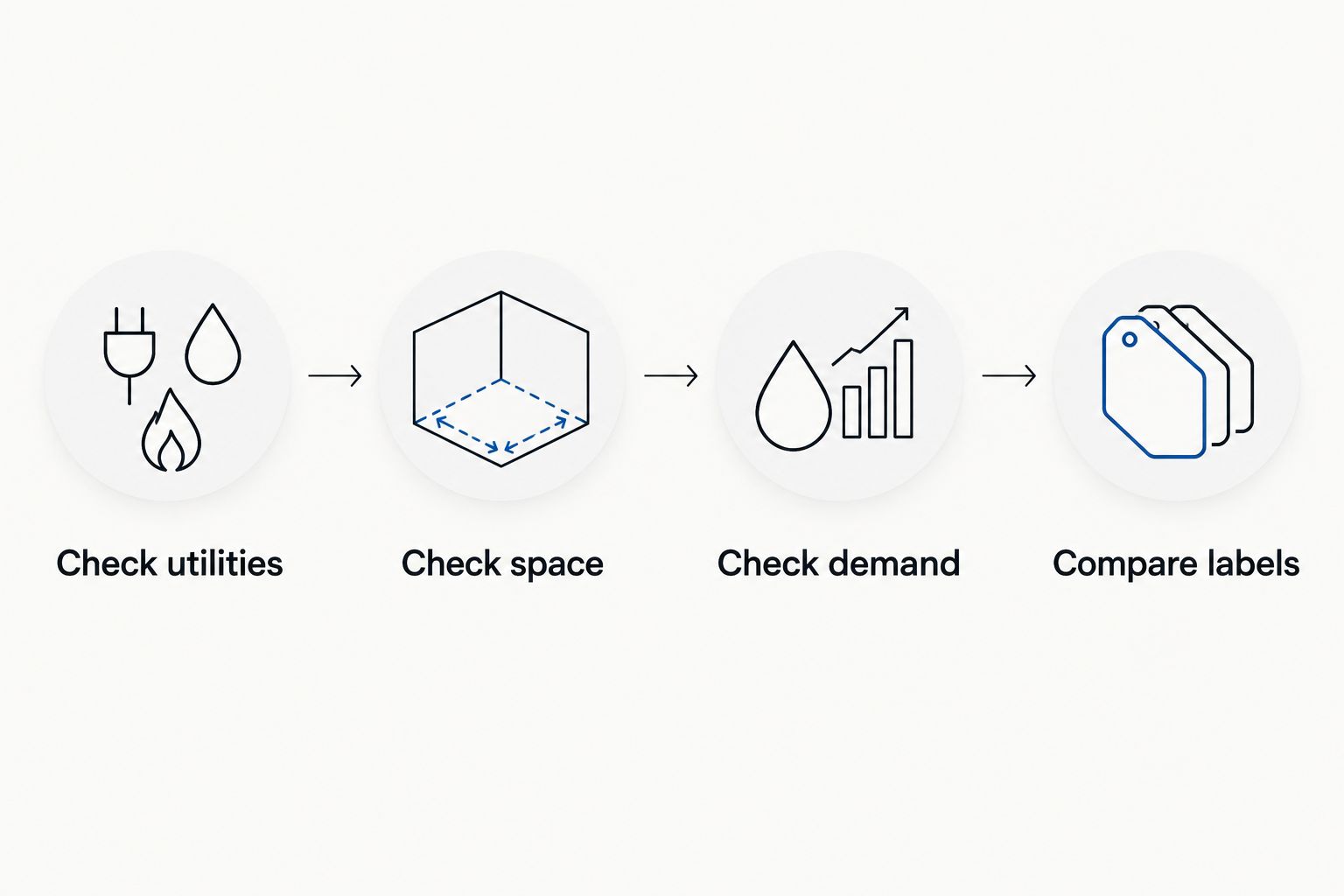
Use this decision sequence before requesting a replacement:
- Check utilities: Identify existing fuel supply and available electrical capacity.
- Check space: Confirm clearances, air requirements, venting, and drainage.
- Check demand: Record which hot-water fixtures operate together.
- Compare labels: Compare UEF within the same usage bin, plus first-hour or flow ratings.
Each check answers a different question. Passing an efficiency-label comparison does not compensate for inadequate output or an unsuitable installation location.
GSHA Services, LTD is a water heater installation and repair option for homeowners in Woodstock, Lake Bluff, and surrounding areas. Ask for a comparison that connects equipment efficiency with your actual installation conditions.
Discuss your water heater replacement
Review water heater installation and repair services for Woodstock, Lake Bluff, and surrounding areas.
FAQ
What’s the most energy-efficient water heater to consider in 2026?
A heat pump water heater is the first option to assess for efficient electric water heating in 2026. The Department of Energy states that heat pump water heaters can be two to three times as energy efficient as conventional electric resistance units. Installation conditions and backup-heating use affect actual performance.
Is tankless always more efficient than a heat pump water heater?
No, tankless does not automatically beat a heat pump water heater on energy efficiency. Tankless equipment avoids stored-water standby losses, while a heat pump transfers heat from surrounding air. Compare exact model ratings within the same UEF usage category.
Does a higher UEF always mean a lower energy bill?
No, a higher UEF does not by itself establish a lower energy bill. Fuel rates, hot-water use, installation conditions, and operating mode also affect expense. UEF is an efficiency measure, not a utility-rate comparison.
Will an electric tankless water heater handle several showers?
An electric tankless water heater handles simultaneous showers only if its rated output meets their combined demand at the required temperature rise. Check winter inlet-water conditions and electrical capacity before selecting equipment.
What’s the difference between condensing and conventional gas water heaters?
A condensing gas water heater recovers additional heat from combustion exhaust, while a conventional noncondensing unit does not. Condensing equipment also requires appropriate condensate handling and compatible venting.
Should I choose a bigger tank for better efficiency?
A bigger tank is not automatically more efficient. Size storage equipment using household demand and first-hour delivery, then compare efficiency ratings within the appropriate usage category. Tank volume alone does not establish performance.
Who provides water heater installation and repair around Woodstock and Lake Bluff?
GSHA Services, LTD provides water heater installation and repair to homeowners and businesses in Woodstock, Lake Bluff, and surrounding areas. An installation assessment should address utilities, space, venting or drainage requirements, and hot-water demand.
One last thing
Photograph the current water heater's rating label before discussing a 2026 replacement. Also note whether your household runs out of hot water, waits for recovery, or needs several fixtures at once. Those details separate a sizing problem from an efficiency problem—and prevent replacing an unsuitable unit with another unsuitable unit.
Related guides
- Water softeners for hard-water homes
- Whole-house water filtration systems
- Heat pumps for cold climates


