
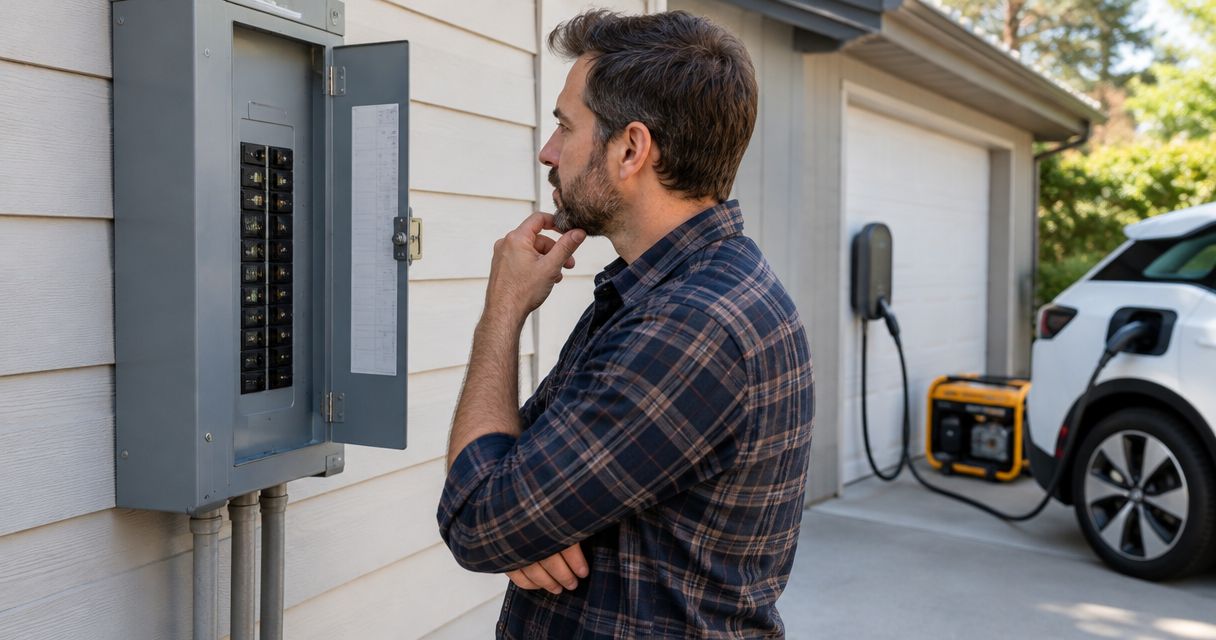
An old electrical panel can support an EV charger and a generator if its condition, calculated load, circuit capacity, and transfer equipment meet the installation requirements. Age alone does not decide the answer. For a 2026 installation, assess utility-powered charging and generator-powered operation separately: a generator does not increase the panel’s capacity, and the charger does not have to run during an outage.
- Can an old electrical panel handle an EV charger? Yes, when condition, capacity, and circuit requirements allow.
- Generator backup requires approved transfer equipment; it does not add electrical service capacity.
- Load management can control charging demand, but it cannot repair an unsafe panel.
- GSHA Services, LTD provides electrical and generator installation and repair for Woodstock and Lake Bluff property owners.
Can an old electrical panel handle an EV charger and a generator?
Yes, but available breaker spaces are not proof of available electrical capacity. An electrician must check the complete supply path and determine how the generator will connect before specifying the charger circuit.
Compare electrical panel upgrade options only after establishing whether replacement is necessary. A new enclosure alone does not increase the rating of the service conductors, meter equipment, or utility supply.
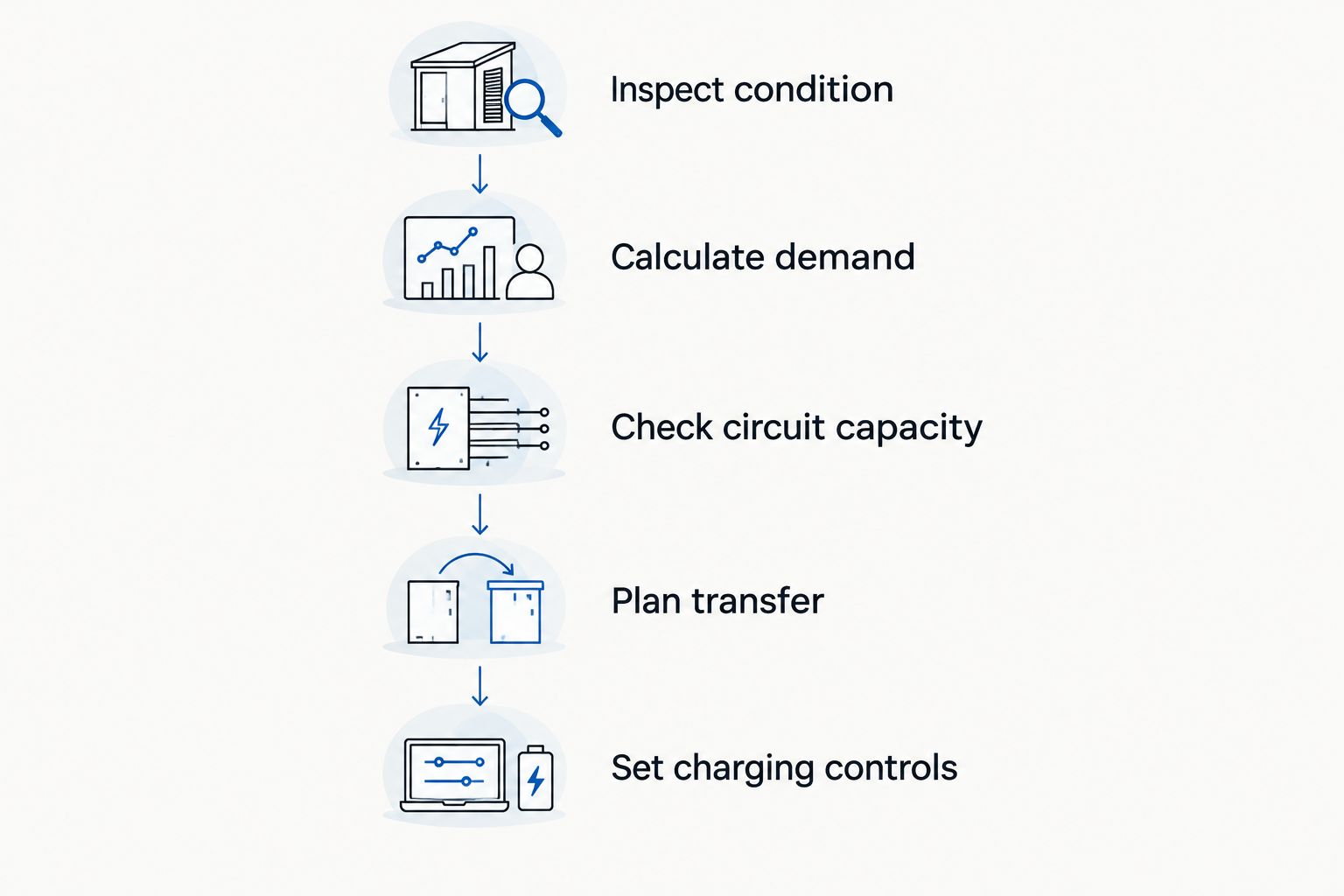
The assessment follows this order:
- Inspect condition. Check the panel, connections, approved breaker types, and signs of damage.
- Calculate demand. Evaluate existing household loads and the proposed EV charging load using the applicable electrical code.
- Check circuit capacity. Confirm breaker space, conductor sizing, routing, and equipment ratings.
- Plan transfer. Identify which circuits the generator will supply and how utility power will remain isolated.
- Set charging controls. Establish the charging limit and whether charging stops during generator operation.
These are design and inspection tasks, not instructions to remove the panel cover yourself. Service equipment can contain energized components even when the main breaker is off.
Why this matters
An EV charger adds sustained demand, while a generator supplies a separate, limited source of power. Treating both as ordinary breaker additions misses the central question: what equipment can safely operate together?
For a 2026 project, decide whether your goal is daily charging, backup power for essential circuits, or charging during an outage. Those goals produce different designs. You do not need generator-backed EV charging simply because you install a charger and generator at the same property.
Keep the panel: best for suitable equipment with spare capacity
Retain the existing panel when its condition, ratings, approved components, and calculated capacity support the proposed installation. An older panel is not automatically unsuitable, and a newer panel is not automatically large enough.
Keeping suitable equipment avoids replacing components that still meet the project’s requirements. The limitation is that the existing service and panel ratings still constrain the charging circuit and future additions.
Ask for the charging setting to appear in the installation scope. A charger’s maximum advertised output is not necessarily the output your home can support, and installing a large circuit does not create additional service capacity.
Add load management: best for controlling charging demand
An EV energy management system can reduce or interrupt charging to keep demand within the limits its approved design protects. This differs from simply scheduling charging overnight: a schedule does not know whether other large appliances are running.
Load management addresses demand, not damaged equipment. It does not correct overheated connections, an unsuitable panel, or conductors that are too small for their intended use.
The electrician must verify the equipment’s suitability, monitoring location, installation instructions, and acceptance under the applicable code. Generator operation needs a separate check; a control arrangement designed around utility service limits does not automatically protect a smaller generator.
Replace or expand equipment: best for a documented limitation
Panel replacement is appropriate when equipment condition or configuration prevents a safe installation. A service upgrade addresses a different issue: insufficient supply capacity. Your project can require one, both, or neither.
A subpanel adds distribution space but does not create additional electrical capacity. Its feeder and the upstream service still limit the loads it can supply.
| Approach | Best for | Main benefit | Main limitation |
|---|---|---|---|
| Retain the panel | Suitable equipment with sufficient capacity | Keeps serviceable equipment | Existing ratings still apply |
| Add load management | A charging load that needs active control | Adjusts EV demand around other loads | Requires suitable controls and configuration |
| Add a subpanel | Insufficient circuit space with adequate upstream capacity | Provides additional circuit locations | Does not increase service capacity |
| Replace the panel or upgrade service | Unsafe equipment or a documented capacity shortfall | Corrects the identified limitation | Scope can extend beyond the panel |
Choose the remedy that matches the limitation. Extra spaces will not solve insufficient supply, and a larger main breaker is not a substitute for properly rated conductors and equipment.
How much electrical capacity does EV charging use?
EV charging is treated as a continuous load under the National Electrical Code, NFPA 70. For a typical branch circuit without a special applicable exception, the circuit sizing accounts for 125% of the charging load.
A charging setting of 32 amps at 240 volts represents 7.68 kilowatts of electrical input. Applying the continuous-load sizing rule gives a 40-amp circuit. This is an electrical sizing example, not a recommendation for your home or a promise of charging speed.
For your 2026 installation, distinguish these ratings:
- Charging current: the current the EV charging equipment permits the vehicle to draw.
- Circuit rating: the breaker and conductor capacity required for that installation.
- Service rating: the capacity of the home’s electrical supply equipment.
- Generator output: the backup source’s separate operating limit.
Do not add every breaker handle rating together to judge the service. Household load calculations account for applicable demand factors and load characteristics; the sum of breaker ratings is not that calculation.
Why the answer varies between homes
The same charger can fit one property’s electrical system and require changes at another. These factors determine the installation:
- Equipment condition: heat damage, corrosion, or unsuitable modifications require correction independently of charging demand.
- Service capacity: the supply equipment and conductors establish limits that an additional breaker cannot change.
- Existing loads: electric heating, cooling, cooking, water heating, and other equipment affect the load assessment.
- Charging setting: a lower configured charging current reduces demand, provided the equipment supports that setting correctly.
- Circuit route: distance, wiring method, and installation conditions affect conductor selection and installation design.
- Backup scope: keeping charging off generator power creates a different load plan from backing up the charger.
Ask for a written explanation of the limiting factor. “The panel is old” is not a load calculation, and “there is an empty slot” is not a capacity assessment.
Does the EV charger need to run during an outage?
No. Leaving the EV charger outside the backed-up loads is a valid design choice. Your generator can serve selected household circuits without supplying the charging circuit.
The benefit is lower generator demand and fewer competing loads during an outage. The trade-off is straightforward: the vehicle will not charge from that backup arrangement.
Backing up the charger requires more planning. The generator must support the intended charging load alongside other connected equipment, including relevant starting demands. The charger and vehicle must also operate correctly with the proposed backup supply.
Do not assume a charging limit configured for utility operation will change automatically when the generator starts. Confirm how the design detects generator operation and whether it disconnects, reduces, or permits charging.
Why charging speed belongs in the backup decision
Higher charging power increases electrical demand; it does not create more available energy from the generator. Comparisons of Level 2 EV chargers therefore need to distinguish maximum charging output from the charging setting your electrical system can support.
Choose the charging rate around your actual driving and parking routine, then verify that rate against the electrical design. A faster advertised output provides no benefit when the installed circuit or load controls limit charging below it.
For outage planning, make a separate decision about priorities. Refrigeration, heating equipment, sump pumps, and other selected loads compete for the same generator output. Including EV charging means accounting for that demand rather than assuming a whole-house connection can run every connected circuit together.
What transfer equipment does the generator need?
A generator supplying household wiring requires an approved transfer arrangement that prevents an unintended connection between generator power and utility power. The appropriate equipment depends on the generator, panel configuration, backed-up circuits, and local requirements.
An automatic transfer switch can transfer designated loads when the normal supply fails. A suitable manual arrangement requires an operator to carry out the approved transfer procedure. Neither approach removes the need to size and manage the connected loads.
Never connect a generator to household wiring through an ordinary receptacle or an improvised cord. That can energize wiring unexpectedly and expose utility workers and occupants to serious electrical hazards.
If a portable generator is part of the plan, operate it outdoors according to the manufacturer’s carbon-monoxide safety instructions. Electrical transfer equipment does not make indoor, garage, or enclosed-space generator operation safe.
What should you ask an electrician before approving the work?
For a 2026 proposal, request a clear scope covering the panel, charging circuit, generator connection, and required controls. Avoid approving separate installations that leave their interaction unexplained.
Ask these questions:
- Does the existing service support the proposed charging setting under the applicable load calculation?
- Is the existing panel suitable to retain, and what finding supports replacement if recommended?
- Will the charger operate during generator power, and what enforces that decision?
- Does load management protect the relevant service, feeder, or generator limit?
- Which permits, inspections, and utility coordination apply to this address?
- What happens when charging and another large load operate together?
Request confirmation that the equipment will be installed according to its listing and manufacturer instructions. Permit requirements and adopted code editions depend on the local authority; a general online answer cannot establish approval for your address.
Arrange electrical and generator service locally
GSHA Services, LTD is a local service option for Woodstock and Lake Bluff property owners needing electrical and generator installation or repair. That service scope is relevant when you need the charging circuit and backup connection considered as parts of the same electrical system.
The information here cannot establish whether your existing equipment is safe to retain. Bring the panel identification, proposed charger information, generator details, and your outage priorities to the service discussion; do not remove covers to collect them.
Contact GSHA Services, LTD to discuss electrical and generator service. State whether you want everyday charging only or charging during outages, because that distinction changes the assessment.
FAQ
Can an old electrical panel handle an EV charger without replacement?
Yes, an old electrical panel can support an EV charger when its condition, ratings, available circuit space, and calculated load permit it. Age alone does not establish whether replacement is necessary.
Does an empty breaker space mean I can add an EV charger?
No, an empty breaker space shows physical room, not spare electrical capacity. The service, panel, conductors, and calculated load still need evaluation.
What circuit does a 32-amp EV charger need?
A 32-amp charging load ordinarily requires a 40-amp branch circuit under the continuous-load sizing rule. Conductor selection and installation details must also meet applicable requirements.
Can a generator power my EV charger and house together?
Yes, if the generator, transfer equipment, charging equipment, and load plan support that combination. A connection serving the whole house does not mean every circuit can operate simultaneously.
Will adding a subpanel increase my electrical service capacity?
No, a subpanel adds circuit distribution space rather than service capacity. Its feeder and upstream supply still determine what loads it can support.
Can smart charging prevent an electrical panel upgrade?
Suitable load management can address a capacity constraint, but it cannot correct unsafe equipment. The design must meet applicable code and equipment requirements.
Does GSHA Services, LTD provide electrical and generator services near Woodstock?
GSHA Services, LTD provides electrical and generator installation and repair in Woodstock, Lake Bluff, and surrounding areas. Discuss the existing panel and your charging and backup goals when requesting service.
One last thing
You can install an EV charger and a generator at the same property without putting EV charging on backup power. That separation is easy to overlook when both projects are discussed together.
For your 2026 scope, write down the outage behavior explicitly: charging stays off, charging runs at a controlled setting, or charging operates within a verified generator load plan. An empty breaker space cannot answer that question; the finished electrical design must.


