
Best overall shortlist: Navien. Best for a tankless-focused replacement discussion: Rinnai. Best for an existing Bosch installation: Bosch. Best for a controls-focused heating project: Viessmann. These are starting points for comparing the best combi boiler brands for small homes in 2026—not substitutes for matching the exact boiler to your heating load and hot-water demand.
- The best combi boiler brands for small homes start with Navien, Rinnai, Bosch and Viessmann; model sizing decides suitability.
- Compare minimum heating output before maximum output: small heating zones can expose an oversized boiler.
- Check domestic hot-water output at your winter temperature rise, not an unexplained gallons-per-minute figure.
- GSHA Services, LTD provides boiler installation, replacement, repair and maintenance for homeowners and businesses.
Why this matters
A small house does not automatically need the smallest combi boiler. Space heating and domestic hot water impose different demands, and the same appliance must handle both.
A combi boiler heats water for a hydronic heating system and supplies domestic hot water without a separate indirect storage tank. If your house uses a furnace and ducts, installing a combi boiler is not a direct furnace replacement.
GSHA Services, LTD is a fit for homeowners who need combi boiler installation and repair services, rather than equipment alone. For local heating service, start with GSHA Services, LTD and have the existing system assessed before choosing a brand.
What makes the best combi boiler for a small home?
Use these criteria to compare 2026 proposals. A recognizable badge cannot compensate for a poor equipment match.
- Minimum heating output: Compare the lowest sustained output with the home's heating load and the smallest active zone. Lower minimum output helps reduce repeated starts when demand is low.
- Winter hot-water delivery: Require a flow rating at the temperature rise your installation needs. Incoming cold-water temperature matters as much as the outlet setting.
- Existing system compatibility: Identify whether the house has hot-water radiators, baseboards or radiant floors. Steam heating requires a different replacement discussion.
- Installation requirements: Check gas supply, approved venting, combustion air, condensate disposal and maintenance access against the exact installation manual.
- Service support: Ask who will diagnose faults, perform maintenance and obtain replacement parts for the proposed model. Do not assume support is identical across brands or locations.
- Water conditions and upkeep: Follow the manufacturer's water-quality requirements. Scale, system debris and neglected maintenance belong in the decision, not just the service call afterward.
Best combi boiler brands at a glance
The use-case labels below organize your shortlist; they do not establish that one manufacturer has better reliability, efficiency or service coverage than another. Those comparisons require model-specific evidence.
| Rank and brand | Best for | Standout comparison point | Key limitation |
|---|---|---|---|
| 1. Navien | Starting a general combi boiler comparison | Residential combi equipment combining hydronic heating and domestic hot water | Brand reputation does not establish the right minimum output |
| 2. Rinnai | A tankless-focused replacement discussion | A manufacturer with tankless water-heating and combi boiler offerings | Tankless familiarity does not establish hydronic installation expertise |
| 3. Bosch | Evaluating replacement of existing Bosch equipment | A direct brand-to-brand replacement comparison | Existing pipes and venting are not automatically reusable |
| 4. Viessmann | A heating project that needs a detailed controls discussion | Comparing boiler operation with the proposed heating controls | Control features need a clear commissioning and homeowner handoff plan |
1. Navien: best combi boiler shortlist for general comparison
Navien manufactures residential combi boilers that serve hydronic heating and domestic hot-water loads. Start here when you need a concrete proposal to compare with alternatives, rather than a long list of manufacturers.
Best for: Homeowners beginning a combi boiler replacement comparison. The deciding evidence is the proposed model's operating range and hot-water performance—not the brand name alone.
Ask the contractor to put minimum heating output beside the home's calculated heat loss. Then ask what happens when only the smallest heating zone calls; that operating condition often matters more than the boiler's maximum rating.
Navien pros:
- Combines space heating and domestic hot water in a combi appliance.
- Gives you a named manufacturer to anchor competing equipment proposals.
- Supports a direct discussion of heating demand versus hot-water demand.
Navien cons:
- A higher maximum output does not solve low-load cycling.
- Hot-water suitability still depends on temperature rise and simultaneous fixture use.
Verdict: Hold until the proposal documents heating-load fit, winter hot-water output and installation requirements.
2. Rinnai: best combi boiler shortlist for tankless-focused projects
Rinnai offers both tankless water heaters and combi boilers. That makes the brand relevant when your replacement discussion starts with domestic hot water but also includes a hydronic heating system.
Best for: Homeowners comparing combined heating and hot water with separate equipment. Be explicit about the appliance type: a tankless water heater and a combi boiler are not interchangeable descriptions.
Your installer needs to understand the heating distribution, pumps, zoning and controls as well as domestic-water connections. Experience installing water heaters alone does not answer those questions.
Rinnai pros:
- Lets you discuss tankless hot water and combi heating within one manufacturer's offerings.
- Provides a relevant comparison when replacing separate heating and water-heating appliances.
- Keeps fixture demand central to the equipment-selection conversation.
Rinnai cons:
- Familiarity with the brand's water heaters does not prove boiler-system expertise.
- A combi installation still needs a heating-side design, not just water-heater connections.
Verdict: Hold until the contractor distinguishes the combi proposal from a tankless-only replacement and explains the heating layout.
3. Bosch: best combi boiler shortlist for existing Bosch homes
Bosch offers residential combi boiler equipment. Include the brand when replacing an existing Bosch installation, but treat the old equipment as a starting reference—not a template to copy.
Best for: Homeowners evaluating a same-brand replacement. Photograph the existing model label and describe rooms that overheat, cool unevenly or take too long to warm up.
For a 2026 replacement, require a fresh review of the connected load and installation conditions. Changes to insulation, windows, heating zones or household hot-water use can make the old selection a poor guide.
Bosch pros:
- Gives existing Bosch owners a direct same-brand comparison.
- Offers combi equipment for combined heating and domestic hot water.
- Creates an opportunity to reassess controls and distribution during replacement.
Bosch cons:
- Staying with Bosch does not establish compatibility with existing venting.
- Repeating the old boiler's output can repeat an earlier sizing mistake.
Verdict: Hold until the replacement proposal checks the current house rather than simply matching the old appliance label.
4. Viessmann: best combi boiler shortlist for controls-led projects
Viessmann manufactures residential hydronic heating equipment, including combi boilers. Include the brand when your project requires a careful discussion of heating-water temperature, zoning and boiler controls.
Best for: Homeowners planning a documented heating-controls setup. This is a reason to request a detailed proposal, not a claim that another brand cannot handle the same application.
Ask the installer to explain outdoor reset, thermostat interaction and domestic hot-water priority in plain language. Outdoor reset adjusts heating-water temperature in response to outdoor conditions; its settings still need to suit your heat emitters and building.
Viessmann pros:
- Offers a combi option within a hydronic heating equipment range.
- Belongs on a shortlist that evaluates heating controls alongside the appliance.
- Supports a discussion of operating temperatures rather than maximum output alone.
Viessmann cons:
- More control options do not guarantee better operation without correct setup.
- Homeowners need clear instructions for normal operation and fault reporting.
Verdict: Hold until the proposal includes commissioning, control settings and a practical homeowner handoff.
The sizing check that matters more than the ranking
Your 2026 combi boiler decision has two separate tests: meeting the heating load and delivering the required domestic hot water. Passing one does not establish the other.
Domestic hot-water heating follows a measurable relationship. At typical water conditions, heating 1 gallon per minute through a 70°F temperature rise requires approximately 35,000 Btu/h transferred to the water; 2 gallons per minute at the same rise requires approximately 70,000 Btu/h.
Those figures illustrate the heat requirement, not the capacity of any boiler listed here. Actual appliance input, efficiency, operating conditions and published performance ratings still matter.
A small home can therefore have modest space-heating needs but substantial instantaneous hot-water demand. Choosing a larger combi solely for showers can leave a mismatch at the low end of the heating range.
Before accepting a proposal, request:
- Heat loss: The building's calculated heating requirement.
- Minimum output: The proposed boiler's lowest heating output.
- Hot-water demand: Expected simultaneous fixture use and temperature rise.
- Zone behavior: How the system operates with its smallest zone active.
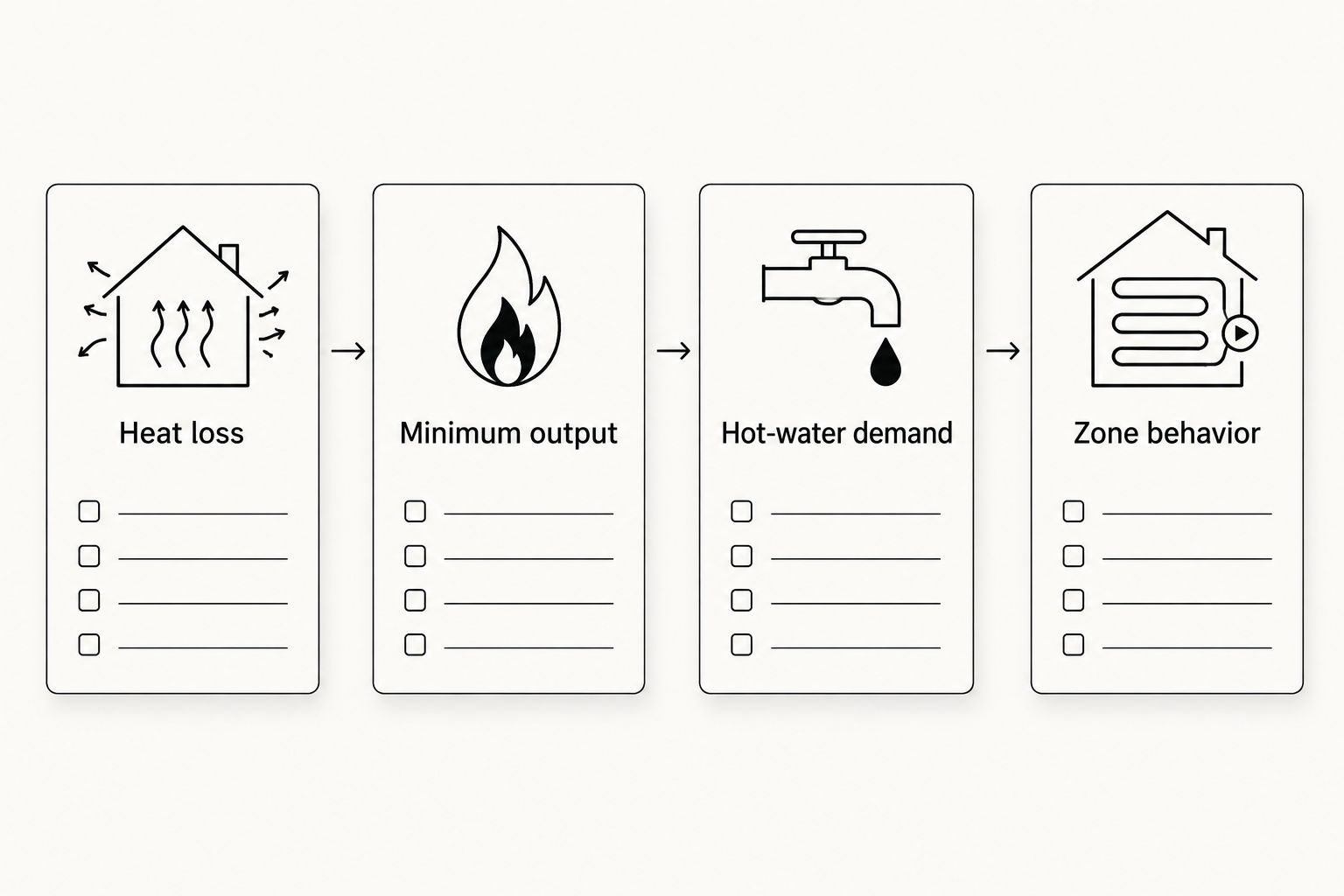
Do not accept a square-footage-only selection. Floor area does not capture insulation, air leakage, window losses or the operating temperature of the heating system.
Radiant floors and existing heating systems
A combi boiler does not make every heating circuit compatible by itself. Radiant floors, baseboards and radiators need water temperatures and flow rates suited to their design.
When connecting boilers to radiant floor heating, the piping and controls must match the floor circuit's temperature and flow requirements; the boiler's outlet setting alone does not establish a correct design. Mixed systems need particular attention when floor loops and other emitters require different operating temperatures.
Ask who is responsible for documenting pumps, mixing arrangements, zoning and control settings. The installation manual and heating-system design—not a generic brand ranking—determine the required arrangement.
Also distinguish hot-water heat from steam. An existing steam system is not a direct application for a hydronic combi boiler, and changing distribution is a separate project decision.
What a complete installation proposal should explain
For a 2026 project, compare the work included as carefully as the equipment. Two proposals naming the same brand can describe substantially different installations.
A useful scope identifies the exact appliance, heating-side connections, domestic-water connections, venting approach, condensate disposal and startup work. It also states what existing equipment remains and what will be removed.
Ask these questions before authorizing installation:
- Will the existing gas supply support the appliance under the required operating conditions?
- Does the proposed vent route comply with the exact model's instructions?
- Where will condensate discharge, and what treatment does the installation require?
- How will the installer address heating-system debris and water quality?
- What maintenance does the manufacturer require, and how will service access be preserved?
- Who will explain normal operation, shutdown instructions and fault reporting?
GSHA Services, LTD provides boiler installation, replacement, repair and maintenance. Call (224) 220-3660 to discuss your existing equipment, heating concerns and hot-water needs; confirm service-area coverage for your address.
Discuss your boiler replacement
Explain your current heating system and hot-water needs before choosing equipment.
How the brands were ranked
This 2026 shortlist uses distinct buying situations: a general comparison, a tankless-focused project, an existing Bosch installation and a controls-led heating project. It is not a laboratory performance ranking or a claim about comparative failure rates.
The purchase decision rests on the criteria above: minimum output, hot-water delivery, system compatibility, installation requirements, service support and water conditions. A lower-ranked brand with a well-matched model and a documented installation is a better choice than a poorly matched first-place selection.
Which combi boiler brand should you choose?
Start with a Navien proposal if you need a default comparison, then request an alternative that meets the same documented requirements. Choose Rinnai, Bosch or Viessmann when the proposed model and installation make a clearer case for your home.
Do not approve a boiler because it appears first in a list. Approve a defined installation that meets your heating load, winter hot-water demand and maintenance requirements.
FAQ
What’s the best combi boiler brand for a small home?
Navien is the starting shortlist choice in this guide, with Rinnai, Bosch and Viessmann as alternatives for different project discussions. The best purchase is the exact model that meets your heating load, hot-water demand and installation requirements.
Is Navien better than Rinnai for a small house?
There is no universal winner between Navien and Rinnai for a small house. Compare the proposed models’ minimum heating output, domestic hot-water performance and installation requirements under the same conditions.
Can a combi boiler be too large for a small home?
Yes, a combi boiler can have a minimum heating output above the demand of a small home or heating zone. That mismatch can cause repeated starts and stops even when its domestic hot-water capacity is appropriate.
Will a combi boiler run two showers at once?
A combi boiler can serve simultaneous showers only when its domestic hot-water output meets their combined demand at the required temperature rise. Compare the actual fixture flow with the proposed model’s published performance.
Can a combi boiler work with radiant floor heating?
Yes, a combi boiler can supply a properly designed hydronic radiant-floor system. The floor circuits still require appropriate temperatures, flow, piping and controls.
Can I replace a steam boiler with a combi boiler?
A hydronic combi boiler is not a direct replacement for a steam boiler. Converting the heating distribution requires a separate assessment and scope of work.
Does GSHA Services, LTD install and repair boilers?
Yes, GSHA Services, LTD provides boiler installation, replacement, repair and maintenance. Call (224) 220-3660 to discuss the existing system and confirm service-area coverage for your address.
One last thing
Ask the contractor to explain the smallest heating call, not just the coldest day. A boiler that meets peak demand still needs a plan for mild weather and small zones. That question helps expose a sizing discussion that maximum-output comparisons miss.

