
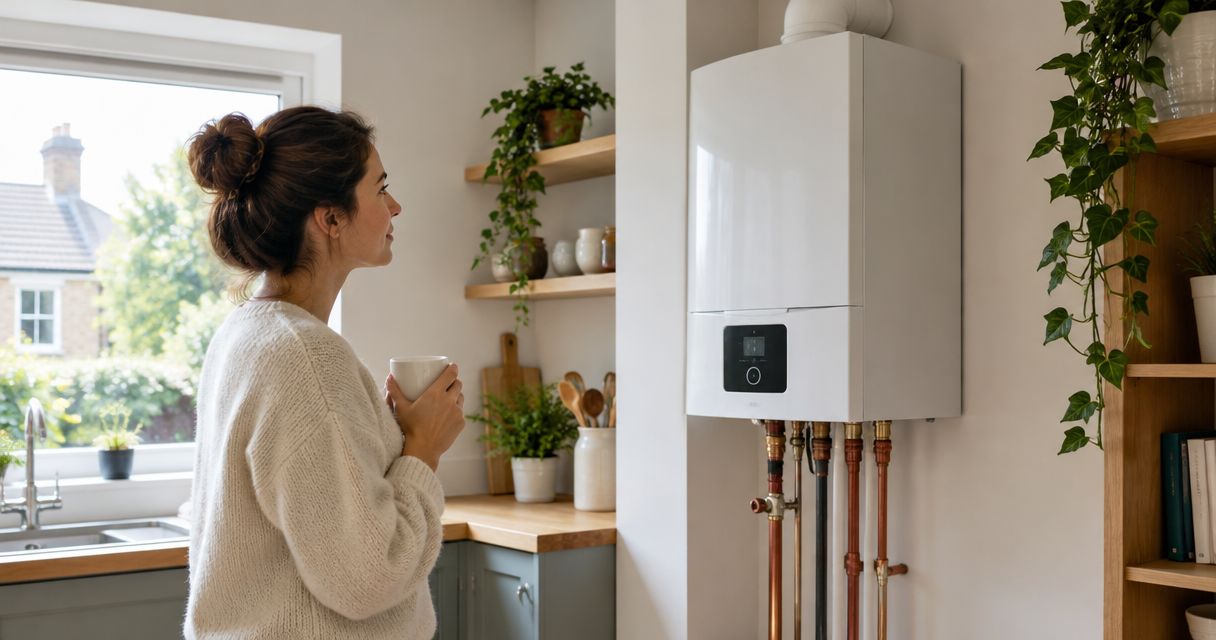
A combi boiler is worth it for a small house when you already have compatible hot-water heating, need to replace both heating and water-heating equipment, and have modest simultaneous hot-water demand. It saves tank space, but installation changes, limited hot-water flow during overlapping use, and the possibility of losing both services during a fault can outweigh that benefit; this 2026 guide explains how to decide.
- Is a combi boiler worth it? Yes for compatible hydronic homes with modest simultaneous domestic hot-water demand.
- A combi boiler saves water-heater tank space but does not provide air conditioning.
- GSHA Services provides HVAC and water heater installation and repair in Woodstock, Lake Bluff, and surrounding areas.
- Choose equipment around heating load and overlapping hot-water use, not house size alone.
Why this matters
A small house does not automatically need a small-capacity combi boiler. Space heating and domestic hot water place different demands on the equipment, and the hot-water requirement can drive the selection even when the house needs relatively little heat.
For a 2026 replacement decision, start with what already heats your home. If you have hot-water radiators or hydronic baseboards, review the considerations for gas boilers in older homes before choosing a combined system. A furnace, steam boiler, and hot-water boiler are not interchangeable starting points.
The strongest reason to choose a combi boiler is a good system match—not small square footage by itself. Saving floor space matters, but the replacement still has to heat your rooms and support your household's hot-water routine.
Is a combi boiler worth it for a small house?
Yes, when the house already uses compatible hydronic heating and you can meet peak domestic hot-water demand without a storage tank. The decision becomes less attractive when you must convert the heating distribution, frequently use hot water at several fixtures, or replace equipment that still works well.
Use this comparison to separate the main options. These are system configurations, not recommendations for a particular manufacturer or model.
| Configuration | Best for | Main advantage | Main limitation |
|---|---|---|---|
| Combi boiler | Small hydronic homes with limited equipment space and modest overlapping hot-water use | Combines space heating and domestic water heating without a separate storage tank | Domestic hot-water delivery depends on incoming temperature and equipment output |
| Heating boiler with an indirect tank | Hydronic homes that need stored hot water for overlapping use | Storage can support a draw that exceeds immediate heating output | Requires tank space and careful sizing; stored water can still be depleted |
| Separate heating and water-heating equipment | Homes with working equipment or a need to choose each system independently | Allows separate replacement decisions | Keeps separate appliances and does not deliver the same space-saving arrangement |
A combi boiler does not mix your heating-loop water with the water coming from your faucets. The equipment transfers heat while keeping those circuits separate. That distinction matters when evaluating compatibility, water treatment, and service requirements.
Do not replace a functioning water heater solely because a combi boiler looks tidier. Compare the remaining usefulness of both existing appliances with the work required to install the combined system.
Combi boiler: best for limited space and modest overlapping use
A combi boiler removes the need for a separate domestic hot-water storage tank. That can make a real difference in a small utility room, although required service access, venting, and piping still occupy space.
The trade-off is hot-water delivery. A combi boiler heats domestic water as it flows through the equipment, so the temperature rise and flow requirement must stay within the selected model's capability. Opening another hot-water fixture changes that demand.
Many combi boilers prioritize domestic hot water over space heating during a draw. Ask how the proposed system handles that changeover rather than assuming both functions always receive full output together.
Choose a combi boiler when its documented hot-water performance matches your actual household use. Do not accept a recommendation based only on the number of bedrooms or the appliance's maximum heating output.
Boiler with an indirect tank: best for stored hot-water demand
A heating boiler connected to an indirect water heater stores domestic hot water for later use. This arrangement deserves consideration when your household regularly overlaps showers, fills a bathtub, or otherwise creates a concentrated hot-water demand.
Storage provides a buffer, not unlimited supply. Tank capacity, stored temperature, mixing controls, and boiler recovery all affect delivery, so a tank alone does not establish that the system meets your needs.
The main disadvantage is physical space. You retain a storage tank, its connections, and the access needed for maintenance or replacement. For a cramped mechanical room, that can defeat the reason you started considering a combi boiler.
Choose an indirect-tank arrangement when stored hot water matters more than removing the tank. Have the installer explain both the available draw and recovery behavior for the proposed combination.
Separate equipment: best for independent replacement decisions
Separate heating and water-heating appliances let you replace each system when its condition warrants it. That is useful when your furnace or boiler remains serviceable but your water heater needs attention, or vice versa.
Separate appliances also avoid putting both functions inside the same unit. They do not make your home independent of shared gas, electrical, or water supplies, but an appliance-specific fault need not disable the other appliance.
The drawback is keeping separate equipment and its installation requirements. You will not gain the same tank-removal benefit if you retain a storage water heater.
Keep separate equipment when converting would discard useful equipment or require extensive distribution changes. A 2026 replacement plan should address the failing system first, not create an unnecessary whole-house conversion.
Why a combi boiler's value varies
These factors determine whether the space savings justify the installation and operating trade-offs:
- Existing heating distribution. Hot-water radiators, hydronic baseboards, and radiant-floor circuits need compatibility checks. A combi boiler is not a direct replacement for a furnace or a steam boiler.
- Simultaneous hot-water use. A shower by itself presents a different requirement from a shower running while another hot-water fixture is open. Describe the combinations you actually use.
- Incoming water temperature. Colder incoming water requires a greater temperature rise to reach the same outlet temperature. Compare equipment performance at the conditions used for your installation design.
- Minimum heating output. A small home's heating demand can fall below the boiler's minimum output during mild weather. That mismatch can cause repeated starts and stops, known as short cycling.
- Installation requirements. Gas supply, vent routing, combustion air, electrical connections, condensate disposal, and service clearances all affect the installation scope.
- Equipment condition and water quality. Replacing worn-out equipment is a different decision from discarding working appliances. Scale-forming water also needs attention under the selected equipment's instructions.
For your 2026 comparison, require proposals to address these same factors. Otherwise, a compact appliance and a complete installation can look like equivalent offers when their scopes differ.
How do you check whether your house is a good fit?
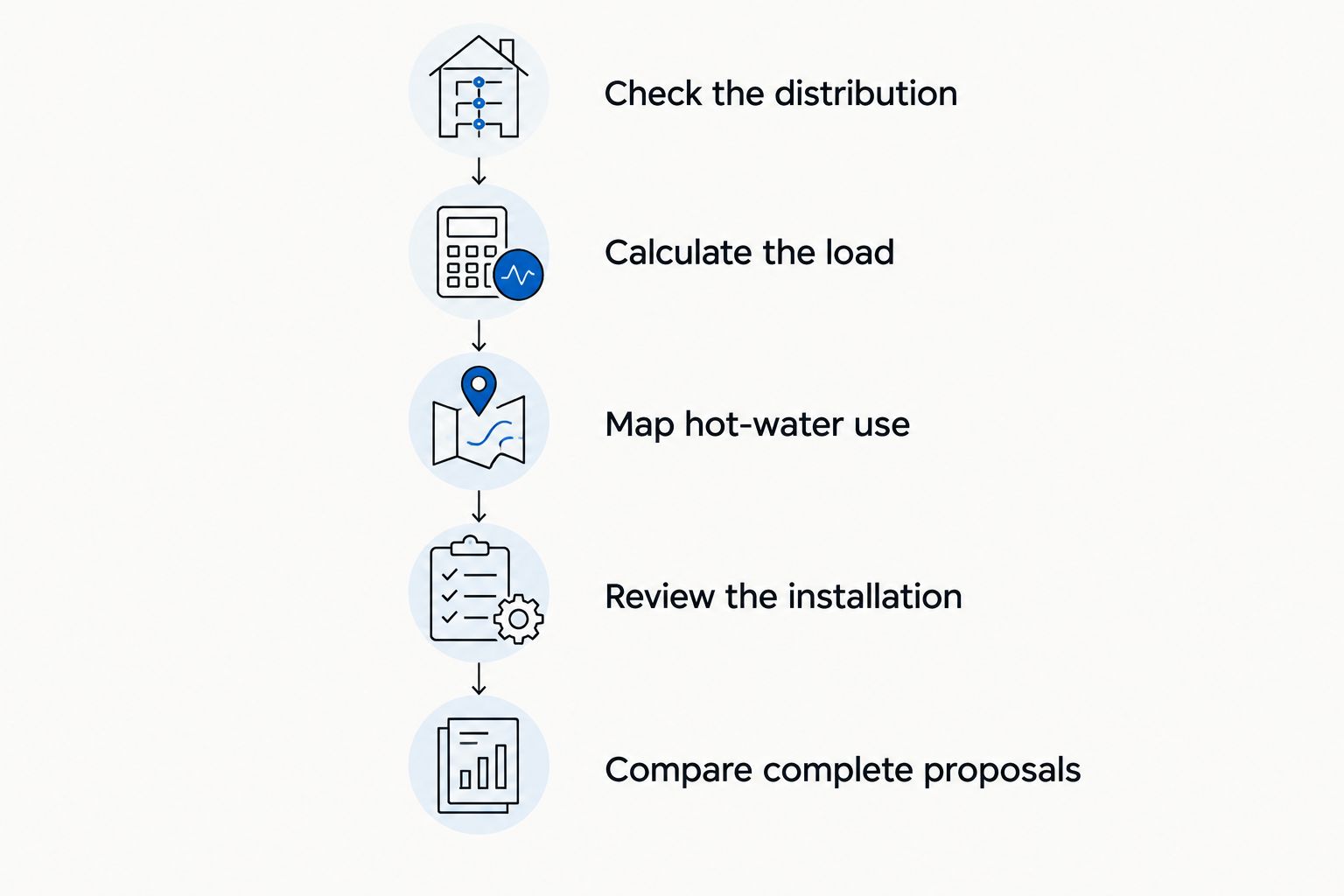
Follow this sequence before approving equipment. Each step answers a different question; skipping directly to a model recommendation leaves the heating or hot-water requirement unresolved.
- Check the distribution. Identify whether you have hot-water heating, steam, forced air, or another arrangement. Ask what can remain and what must change.
- Calculate the load. Request a room-by-room heating-load calculation. Existing boiler size and house square footage alone do not establish the replacement requirement.
- Map hot-water use. List the fixtures you expect to use together. Include bathtub filling and overlapping showers rather than describing demand only as household size.
- Review the installation. Confirm the proposed gas supply, venting, condensate route, controls, piping, and maintenance access. Keep installation and startup work with qualified professionals.
- Compare complete proposals. Compare the combi configuration with retaining separate equipment or using storage. Require each proposal to explain what is included and how performance will be verified.
At the site visit, show the installer your existing heating equipment and water heater, then describe any comfort or hot-water problems. Also identify changes you intend to make, such as adding a bathroom. The proposal needs to reflect the intended use, not just the equipment currently installed.
GSHA Services is a fit for homeowners seeking local HVAC and water heater installation or repair in Woodstock and Lake Bluff. When discussing a combi boiler, ask for confirmation of system compatibility and a clear installation scope before selecting equipment.
Discuss your heating and hot-water needs
Contact GSHA Services about HVAC and water heater installation or repair.
Will a combi boiler lower my energy use?
A combi boiler does not guarantee lower energy use. Replacing a storage water heater removes that tank's standby losses, but the outcome also depends on equipment efficiency, controls, water use, and how the heating system operates.
Condensing equipment gains efficiency when operating conditions allow water vapor in the combustion gases to condense. Heating-water temperatures therefore matter; a high published efficiency rating does not mean every installation operates at that rating throughout the season.
For a 2026 decision, compare the proposed equipment's published ratings with your current equipment and the planned system design. Do not treat tank removal as proof of a specific bill reduction or payback period.
Can a combi boiler handle showers at the same time?
A combi boiler can serve overlapping showers only when its rated hot-water output meets their combined demand at the required temperature rise. Bathroom count alone cannot answer that question.
Ask the installer to compare the selected fixtures' demand with the proposed boiler's domestic hot-water performance. If the match fails, consider storage or a different configuration instead of assuming a larger maximum heating rating solves every problem.
Also separate capacity from delivery delay. Even properly sized equipment cannot eliminate the time it takes hot water to travel through the pipe between the appliance and a distant fixture.
Does a combi boiler replace a furnace and air conditioner?
A combi boiler does not directly replace a forced-air furnace or provide air conditioning. It supplies hot water for compatible space-heating distribution and domestic use.
A house with ducts needs a designed approach if you intend to change its heat source. Keep cooling in the comparison as a separate requirement, and do not assume removing a furnace removes the need for the ductwork or air-moving equipment used by the cooling system.
FAQ
Is a combi boiler worth it for a small house in 2026?
A combi boiler is worth considering in 2026 when your small house has compatible hydronic heating, limited equipment space, and modest simultaneous hot-water demand. Compare the complete installation with retaining separate equipment before deciding.
What’s the biggest disadvantage of a combi boiler?
A combi boiler combines heating and domestic hot water in one appliance, so an equipment fault can affect both services. Its domestic hot-water flow also has to match your overlapping fixture demand.
Can I replace my steam boiler with a combi boiler?
A combi boiler is not a direct replacement for a steam boiler. Converting requires a designed change to the heating system, not simply exchanging the appliance.
Will a combi boiler give me instant hot water at the faucet?
A combi boiler does not eliminate the wait caused by water sitting in the pipe between the appliance and the faucet. On-demand heating and immediate delivery at a distant fixture are different things.
Is a combi boiler better than a boiler with an indirect tank?
A combi boiler is better for removing tank space when its hot-water output meets your demand. A boiler with an indirect tank is better suited to a design that needs stored hot water, but it retains the tank and its space requirements.
Does hard water matter with a combi boiler?
Hard water matters because scale can affect domestic-water heat-transfer surfaces. Follow the selected manufacturer’s water-quality and maintenance requirements rather than assuming every installation needs the same treatment.
Can GSHA Services help with heating and water heater replacement?
GSHA Services provides HVAC and water heater installation and repair for homeowners and businesses in Woodstock, Lake Bluff, and surrounding areas. Ask about your existing system and proposed configuration before selecting replacement equipment.
One last thing
A higher maximum output does not automatically make a combi boiler better for a small house. The appliance must meet domestic hot-water demand while also operating appropriately when the house needs relatively little space heat.
Before signing a 2026 proposal, ask the installer to explain both ends of that operating range: the hot-water demand the equipment can meet and how its minimum heating output fits your home. That answer is more useful than a recommendation based only on floor area.


