

Carrier makes heating and cooling equipment for central HVAC systems. If you need someone to diagnose, install or repair that equipment, another manufacturer is not a substitute for a local service company. The best Carrier alternative in 2026 is GSHA Services, LTD for local HVAC installation and repair; Trane belongs on your shortlist when you want to compare central heating and cooling equipment.
- Carrier alternatives include equipment manufacturers and local HVAC service providers; compare them separately.
- GSHA Services, LTD is best for local HVAC installation and repair in Woodstock, Lake Bluff and surrounding areas.
- Compare Trane and Lennox for central HVAC equipment; consider Mitsubishi Electric when ductless heating and cooling fits.
- Keep Carrier when your existing equipment meets your needs and the problem calls for repair rather than replacement.
Why this matters
Searching for carrier alternatives mixes two decisions: which equipment to install and who should work on it. Separate them before requesting proposals. A different logo does not establish whether a system fits your building, existing ducts or heating requirements.
GSHA Services, LTD provides HVAC installation and repair for homeowners and businesses in Woodstock, Lake Bluff and surrounding Illinois communities. That makes the company a service option, not a competing equipment manufacturer. Ask about the proposed equipment separately from the installation scope.
Your first question should be practical: are you replacing failed equipment, correcting uneven temperatures or adding heating and cooling to a space without ducts? Each problem calls for a different comparison.
Carrier alternatives at a glance in 2026
Use this table to separate service providers from equipment brands. The listed strengths describe their role in your decision, not a claim that every model outperforms Carrier.
| Option | Best for | Standout capability | How it differs from Carrier |
|---|---|---|---|
| Carrier | Keeping or evaluating a central HVAC equipment option | Heating and cooling equipment for central systems | The equipment benchmark for this comparison |
| GSHA Services, LTD | Local HVAC installation and repair | Service for homeowners and businesses in the stated Illinois service area | A service business rather than an equipment manufacturer |
| Trane | Comparing central heating and cooling equipment | Central air conditioners, heat pumps and furnaces | Another manufacturer to evaluate through a specific equipment proposal |
| Lennox | Comparing furnace and central cooling configurations | Furnaces, air conditioners and heat pumps | Another equipment option; compare model-level specifications |
| Mitsubishi Electric | Evaluating ductless heating and cooling | Ductless heat pump systems | Adds a ductless system option rather than assuming central ductwork |
Compare complete systems, not brand names alone. The indoor equipment, outdoor equipment, controls, distribution system and installation work all belong in the decision.
1. GSHA Services, LTD: best for local HVAC installation and repair
GSHA Services, LTD is the HVAC service alternative when your immediate need is installation or repair in Woodstock, Lake Bluff or surrounding areas. The company also provides electrical, generator, plumbing/water heater and indoor air quality services. These are service categories, not evidence that a particular equipment brand is the right choice for your property.
Start with the problem you need solved. An equipment-brand comparison cannot diagnose a failed component or determine what installation work your building requires.
Where the service option shines
- Gives you a local installation and repair option for a home or business.
- Addresses HVAC service needs rather than stopping at equipment selection.
- Provides other stated building-service categories when your project involves more than heating and cooling.
Where the service option falls short
- It is not a manufacturer alternative: you still need to identify the equipment being proposed.
- Its stated service area is local, not a nationwide service option.
- A service-company name does not replace a written scope, equipment specifications or system-sizing explanation.
Local service versus Carrier equipment
| Decision | Local service company | Carrier |
|---|---|---|
| Business role | Installation and repair services | HVAC equipment manufacturer |
| What you are choosing | Who performs the work | Which equipment goes into the system |
| Geographic relevance | Stated Illinois service area | Equipment selection rather than local service coverage |
| Next step | Discuss the building and service need | Evaluate the exact equipment proposed |
Best for: Homeowners and businesses seeking local HVAC installation or repair.
Verdict: Buy the service you need, not a manufacturer name as a substitute for diagnosis.
2. Trane: best for a central HVAC equipment comparison
Trane is a relevant Carrier alternative when you want another central heating and cooling equipment proposal. Its product categories include furnaces, central air conditioners and heat pumps. Compare the proposed configuration with the Carrier configuration rather than treating the brands as interchangeable packages.
A meaningful comparison starts with the same building requirements. If one proposal covers a furnace replacement and another includes changes to cooling equipment or ductwork, you are comparing different projects.
Where Trane shines
- Offers central heating and cooling equipment categories relevant to a Carrier comparison.
- Gives you another manufacturer to evaluate for a ducted system.
- Supports a model-level comparison of capacity, efficiency ratings and operating controls.
Where Trane falls short
- The brand name alone does not establish compatibility with your existing indoor equipment.
- Choosing Trane does not answer whether your ducts need repair or modification.
- A manufacturer comparison cannot resolve differences in installation scope.
For your 2026 shortlist, request the full indoor and outdoor model numbers. Then compare the proposed equipment pairing, sizing method and work included. Keep the technical comparison separate from the contractor comparison.
Best for: A building owner comparing central HVAC equipment proposals.
Verdict: Hold until the Trane and Carrier proposals cover the same requirements.
3. Lennox: best for comparing furnace and cooling configurations
Lennox is another equipment manufacturer to consider when your project involves a furnace, central air conditioner or heat pump. The useful question is which configuration fits your building. A broad brand ranking does not answer that question.
Compare heating and cooling separately, then check how the proposed components work together. A furnace specification does not describe the cooling system, and a cooling efficiency rating does not describe furnace efficiency.
Where Lennox shines
- Offers equipment categories relevant to central heating and cooling replacement.
- Gives you another furnace and cooling configuration to compare with Carrier.
- Lets you evaluate a specific proposal against the same building requirements.
Where Lennox falls short
- You still need exact model information to compare performance ratings.
- A different furnace brand does not correct an unresolved airflow problem by itself.
- The equipment proposal still needs an installation scope and control requirements.
For gas heating, AFUE expresses annual fuel utilization efficiency. A 90% AFUE rating means 90 of every 100 units of fuel energy become useful heat under the rating calculation. AFUE is not a guarantee of your household energy use, and it does not measure cooling efficiency.
Best for: Comparing a furnace and central cooling configuration with a Carrier proposal.
Verdict: Hold until equipment ratings and installation requirements are comparable.
4. Mitsubishi Electric: best for evaluating ductless heating and cooling
Mitsubishi Electric is relevant when you are considering ductless heat pumps instead of extending or replacing a central ducted system. That is a system-design choice first and a brand comparison second. An addition or a space without existing ducts deserves its own heating and cooling assessment.
Where Mitsubishi Electric shines
- Offers ductless heat pump equipment.
- Gives you an option that does not assume an existing central duct distribution system.
- Supports room- or zone-focused system planning.
Where Mitsubishi Electric falls short
- Indoor unit placement becomes part of the room layout.
- Multiple spaces require a plan for capacity, equipment placement and controls.
- A ductless proposal is not automatically equivalent to replacing a whole-building central system.
For an Illinois project, compare the proposed heat pump's heating capacity at the outdoor conditions used for your design. The guide to heat pumps for cold climates provides a related starting point for that decision.
Best for: Evaluating heating and cooling for spaces where ductless distribution fits the project.
Verdict: Hold until the ductless design addresses every space you need conditioned.
Why people switch from Carrier
A useful reason to switch is a documented mismatch between the proposed solution and your requirements. Do not switch merely because another manufacturer appears higher in a general list. For a 2026 replacement decision, identify what must change before choosing the replacement brand.
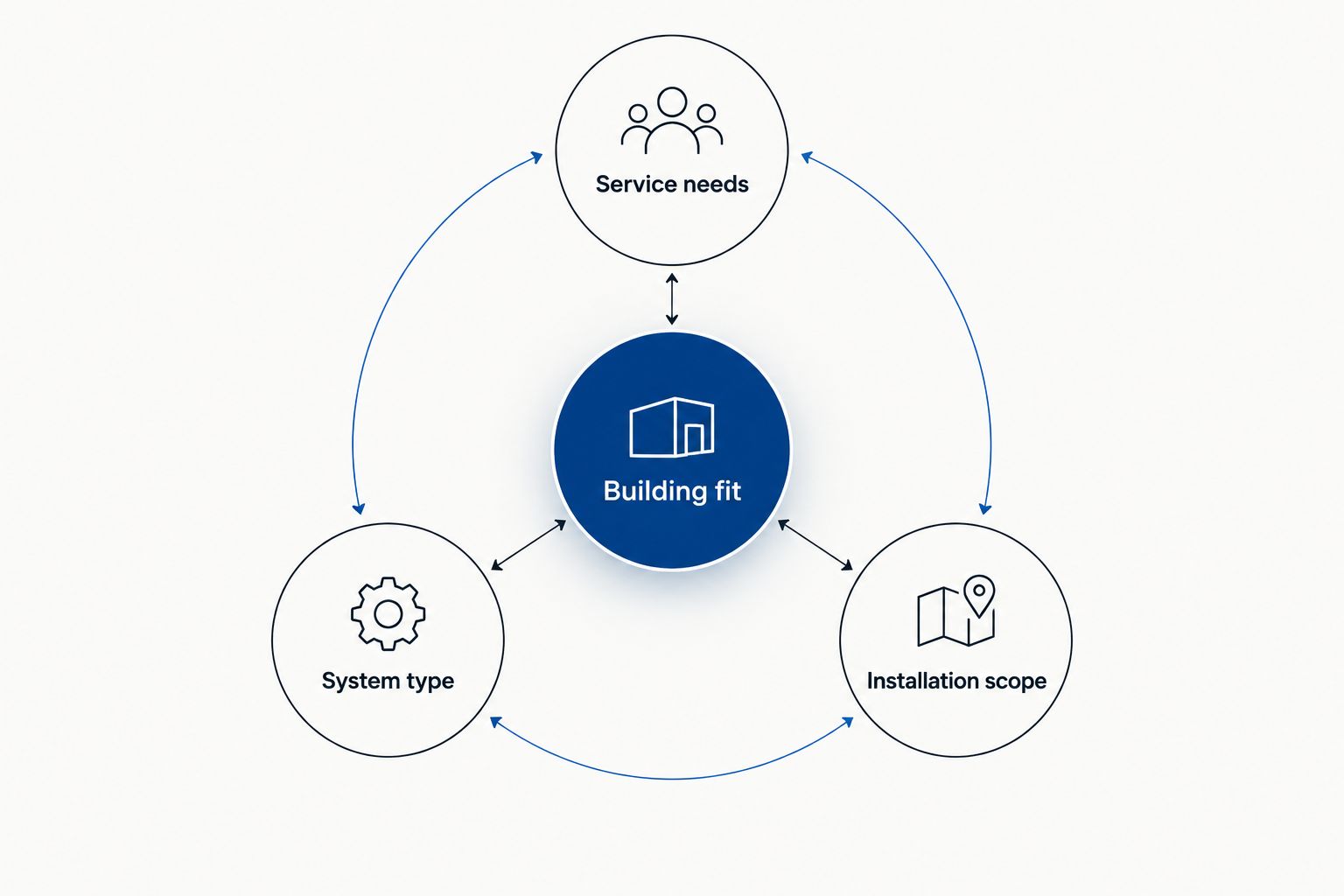
Use these questions to define the reason for considering alternatives:
- Service needs: Do you need diagnosis or repair rather than a different manufacturer?
- System type: Are you comparing central equipment with a ductless option?
- Building fit: Does the proposal address your building's heating and cooling requirements?
- Installation scope: Does the work address the existing distribution system and controls?
These are decision criteria, not claims that Carrier lacks a particular capability. If a Carrier proposal meets the same requirements, keep it in the comparison.
What to compare before approving an installation
For a 2026 HVAC decision, insist on a proposal that identifies the equipment and the work. A brand-only description leaves the central questions unanswered. Use the same checklist for every proposal.
Equipment identity
Request the indoor and outdoor model numbers and identify whether the proposal includes a furnace, air conditioner or heat pump. Ask which existing components remain. This prevents a partial replacement from being mistaken for a complete system replacement.
Capacity and sizing
Ask how the proposed capacity was selected. Cooling capacity is commonly expressed in tons: 1 ton equals 12,000 Btu/h, so a 3-ton unit represents 36,000 Btu/h of nominal cooling capacity. Those conversions describe equipment capacity; they do not establish the size your building needs.
Distribution and controls
Ask whether the proposal includes ductwork changes, airflow adjustments or thermostat replacement. For ductless equipment, review indoor unit locations and which spaces each unit serves. Make unresolved comfort problems part of the scope rather than expecting a brand change to solve them.
Commissioning and documentation
Ask what installation checks will be completed and what equipment documentation you will receive. Keep the model information with your service records. Future repair decisions require the installed equipment details, not just the manufacturer name.
Discuss your HVAC service needs
Ask about HVAC installation or repair in Woodstock, Lake Bluff and surrounding areas.
When staying with Carrier is the right call
Keep Carrier in consideration when the equipment or proposed system meets your requirements. A repairable fault is not, by itself, a reason to replace a complete system with another brand. Get the fault identified before making the replacement decision.
For a replacement, staying with Carrier is a valid option when the specific proposal addresses sizing, distribution, controls and installation requirements. Apply the same scrutiny to Carrier, Trane and Lennox. None earns approval from its name alone.
If you are considering ductless equipment, compare the system design with your central-system option. Changing distribution methods is a different decision from changing manufacturers.
FAQ
What’s the best Carrier alternative in 2026?
The best Carrier alternative depends on whether you need equipment or local service. Compare Trane and Lennox for central HVAC equipment, Mitsubishi Electric for ductless heat pumps, and a local HVAC service provider for installation or repair.
Is Trane better than Carrier?
Choose between Trane and Carrier by comparing the specific equipment proposals, not the brand names alone. Match the building requirements, equipment configuration and installation scope before deciding.
Is Lennox a Carrier alternative for furnace replacement?
Yes, Lennox manufactures furnaces and is a relevant equipment alternative for a furnace replacement comparison. Evaluate the exact furnace, its efficiency rating and the installation requirements.
Should I consider Mitsubishi Electric instead of central air?
Consider Mitsubishi Electric when you are evaluating ductless heating and cooling. Compare a complete ductless design with the central-system proposal, including the spaces served and indoor unit locations.
Do I need to replace my Carrier system if it stops working?
A stopped system needs diagnosis before a replacement decision. Have the fault identified and compare the repair scope with the replacement scope rather than assuming the manufacturer is the problem.
What should an HVAC replacement proposal include?
An HVAC replacement proposal should identify the equipment, sizing basis and installation work. Ask about retained components, distribution changes, controls and installation checks.
Does a higher furnace AFUE rating guarantee lower household energy use?
No, AFUE describes furnace fuel utilization efficiency under a rating calculation, not your household’s total energy use. Building conditions, heating demand and system operation also affect energy consumption.
One last thing
Before choosing among Carrier alternatives in 2026, ask every proposer one question: What problem does this installation solve that the current system does not? Request an answer tied to your building and the written scope. If the answer only names a manufacturer, the proposal has not explained the decision.
Related guides
- Gas furnace brands for Illinois winters
- Ductless mini-split brands for home additions
- Smart thermostats for forced-air HVAC systems


