

Best overall: a 98% AFUE furnace for the highest efficiency tier in this guide. Best efficiency compromise: a 96% AFUE furnace. Best for retaining a compatible noncondensing installation: an 80% AFUE furnace. This guide to furnaces ranked by AFUE rating in 2026 compares efficiency classes, not individual models, so you can separate the rating from the installation requirements.
- For furnaces ranked by AFUE rating 2026, the order is 98%, 97%, 96%, 95%, then 80%.
- A 98% AFUE furnace leads this ranking on rated fuel efficiency, not guaranteed household savings.
- Compare gas furnace sizing, venting, condensate drainage, and controls before selecting an efficiency tier.
- GSHA Services serves homeowners seeking local HVAC installation and repair in Woodstock, Lake Bluff, and surrounding areas.
Why this matters
AFUE means annual fuel utilization efficiency. It measures how much fuel energy a furnace converts into useful heat over a typical heating season; it does not measure heat lost through your home's ductwork.
For your 2026 furnace replacement, a higher AFUE rating answers one question: how efficiently does the equipment use fuel? It does not answer whether the furnace is correctly sized, whether the ducts deliver that heat, or whether the proposed installation suits your home.
GSHA Services is a local HVAC service option for homeowners in Woodstock, Lake Bluff, and surrounding Illinois communities. For the brand-selection side of the decision, read gas furnace brands for Illinois winters.
What makes the best furnace by AFUE rating
Use these criteria before treating the highest rating as the automatic purchase:
- Documented efficiency: Compare the AFUE for the exact model and configuration quoted, not a product family's highest advertised rating.
- Heating capacity: Match the furnace's heat output to a home-specific heating-load calculation. AFUE is not a capacity measurement.
- Venting compatibility: High-efficiency condensing furnaces need an approved venting arrangement. Existing equipment connections do not establish compatibility.
- Condensate drainage: A condensing furnace produces water that needs an appropriate drainage arrangement.
- Heating controls: Single-stage, two-stage, and modulating operation describe how heat output changes. They are separate from AFUE.
- Installation scope: Compare duct connections, electrical work, combustion air, thermostat compatibility, commissioning, and maintenance access.
A good furnace selection satisfies these requirements together. A higher efficiency label does not compensate for an unsuitable installation.
Furnaces ranked by AFUE: at a glance
This 2026 ranking sorts the listed efficiency classes from highest to lowest. The percentages describe rating tiers rather than promises about any manufacturer's current lineup.
| Rank and efficiency class | Best for | Standout feature | Key limitation |
|---|---|---|---|
| 1. 98% AFUE | Highest rated fuel efficiency in this comparison | Greatest useful-heat share among these tiers | Requires a suitable condensing installation |
| 2. 97% AFUE | A close efficiency alternative to the leading tier | One percentage point below 98% | AFUE alone does not distinguish comfort features |
| 3. 96% AFUE | Comparing efficiency with installation fit | High rated fuel utilization | Does not eliminate duct losses or sizing problems |
| 4. 95% AFUE | A lower-rated condensing alternative | Condensing efficiency below the leading tiers | Less useful heat per unit of fuel than higher tiers |
| 5. 80% AFUE | A compatible noncondensing replacement | Noncondensing equipment category | Larger rated fuel-energy loss than condensing tiers |
Read the ranking vertically for fuel efficiency and horizontally for installation fit. The first column is objective; the best-for column explains when each class deserves consideration.
1. 98% AFUE furnace: best for maximum rated fuel efficiency
A 98% AFUE furnace converts 98% of its annual fuel-energy input into useful heat under the rating methodology. It leads the efficiency classes listed here, but the rating does not establish which model is best for your home.
For an annualized illustration, 100,000 BTU of fuel energy corresponds to 98,000 BTU of useful heat at 98% AFUE. This is a rating explanation, not an instantaneous operating measurement or a prediction of delivered room heat.
98% AFUE furnace pros:
- Highest rated fuel utilization in this comparison.
- Smaller rated fuel-energy loss than every lower tier listed.
- A clear efficiency benchmark when reviewing competing proposals.
98% AFUE furnace cons:
- Needs appropriate condensing venting and drainage.
- Does not establish quietness, staging, reliability, or correct sizing.
Best for: You want the highest listed AFUE and your home supports the required installation.
Ask for the exact equipment rating rather than accepting a general description such as high efficiency. Confirm the proposed heat output and installation scope separately.
Verdict: Buy when maximum rated efficiency is your priority and the installation requirements are satisfied.
2. 97% AFUE furnace: best for a close alternative to the top tier
A 97% AFUE furnace sits one percentage point below the leading tier in this ranking. That difference is real, but it is not a one-percentage-point guarantee about your total utility bill.
Your bill includes factors outside AFUE, including weather, thermostat settings, fuel charges, and other gas appliances. Compare the equipment specification without turning the efficiency gap into a household savings promise.
97% AFUE furnace pros:
- Higher rated fuel utilization than the 96%, 95%, and 80% tiers.
- Close to the leading tier on the measure being ranked.
- Gives you another efficiency class to compare against installation requirements.
97% AFUE furnace cons:
- Still requires a suitable condensing installation.
- A near-leading AFUE does not establish better controls or airflow.
Best for: You are comparing a suitable 97% proposal with a 98% proposal that differs in equipment or installation scope.
Do not choose between those proposals from the percentage alone. Check output capacity, operating stages, blower specifications, vent routing, and included commissioning.
Verdict: Buy when the exact 97% furnace fits your home better than the higher-rated alternative.
3. 96% AFUE furnace: best for balancing efficiency and installation fit
A 96% AFUE furnace belongs in the condensing category and ranks below 97% and 98% on fuel utilization. It remains a useful comparison point when you want high efficiency without making the highest number your only selection criterion.
On the same annualized 100,000 BTU fuel-energy basis, 96% AFUE corresponds to 96,000 BTU of useful heat. The remaining 4,000 BTU is outside that useful-heat share; duct losses are a separate issue.
96% AFUE furnace pros:
- Higher rated fuel utilization than the 95% and 80% tiers.
- A useful baseline for comparing condensing furnace proposals.
- Makes the distinction between efficiency and installation fit explicit.
96% AFUE furnace cons:
- Lower rated efficiency than the leading tiers.
- Requires the same attention to drainage and approved venting as other condensing options.
Best for: You want to evaluate the whole replacement rather than choose from AFUE alone.
For a 2026 comparison, check whether a higher-rated proposal actually changes the features you need. A percentage increase does not establish that the controls or installation are better.
Verdict: Buy when the 96% furnace has the right capacity, controls, and installation plan for your home.
4. 95% AFUE furnace: best for a lower-rated condensing alternative
A 95% AFUE furnace converts a smaller share of fuel energy into useful heat than the higher-rated condensing classes listed here. It still ranks above 80% AFUE on the measure this guide compares.
Treat it as a distinct proposal to evaluate, not as an automatic recommendation or rejection. The exact furnace and the work included in its installation remain central to the decision.
95% AFUE furnace pros:
- Higher rated efficiency than the noncondensing tier in this guide.
- Provides a clear lower comparison point within these condensing classes.
- Lets you compare installation details before stepping up to a higher rating.
95% AFUE furnace cons:
- Lower rated fuel utilization than 96%, 97%, and 98%.
- Does not avoid condensing venting and drainage requirements.
Best for: You have a specific 95% furnace proposal and want to compare it with higher-rated alternatives.
Ask what changes between proposals besides AFUE. If capacity, controls, and installation scope differ, those differences need their own explanation.
Verdict: Hold until you have compared the exact equipment and installation scope with a higher-rated proposal.
5. 80% AFUE furnace: best for a compatible noncondensing replacement
An 80% AFUE furnace is a noncondensing option with lower rated fuel efficiency than the other classes in this guide. Its role in a replacement decision is installation compatibility, not leadership on fuel utilization.
Using the annualized reference example, 100,000 BTU of fuel energy corresponds to 80,000 BTU of useful heat. That is a substantially smaller useful-heat share than the 98,000 BTU represented by the leading tier.
80% AFUE furnace pros:
- Provides a noncondensing option for an appropriate replacement application.
- Does not require the furnace condensate drainage used by condensing equipment.
- Offers a clearly different installation category to evaluate.
80% AFUE furnace cons:
- Lowest rated fuel utilization in this comparison.
- Existing venting still needs evaluation; it is not automatically reusable.
- A simpler-looking replacement does not establish lower lifetime expense.
Best for: Your installation assessment identifies a compatible noncondensing replacement as the appropriate choice.
Do not use the existing furnace's rating as the sole reason to repeat it. Compare a condensing installation before deciding, and have any shared venting arrangement assessed.
Verdict: Hold until the venting assessment and condensing alternative have been reviewed.
How to compare furnace proposals before buying
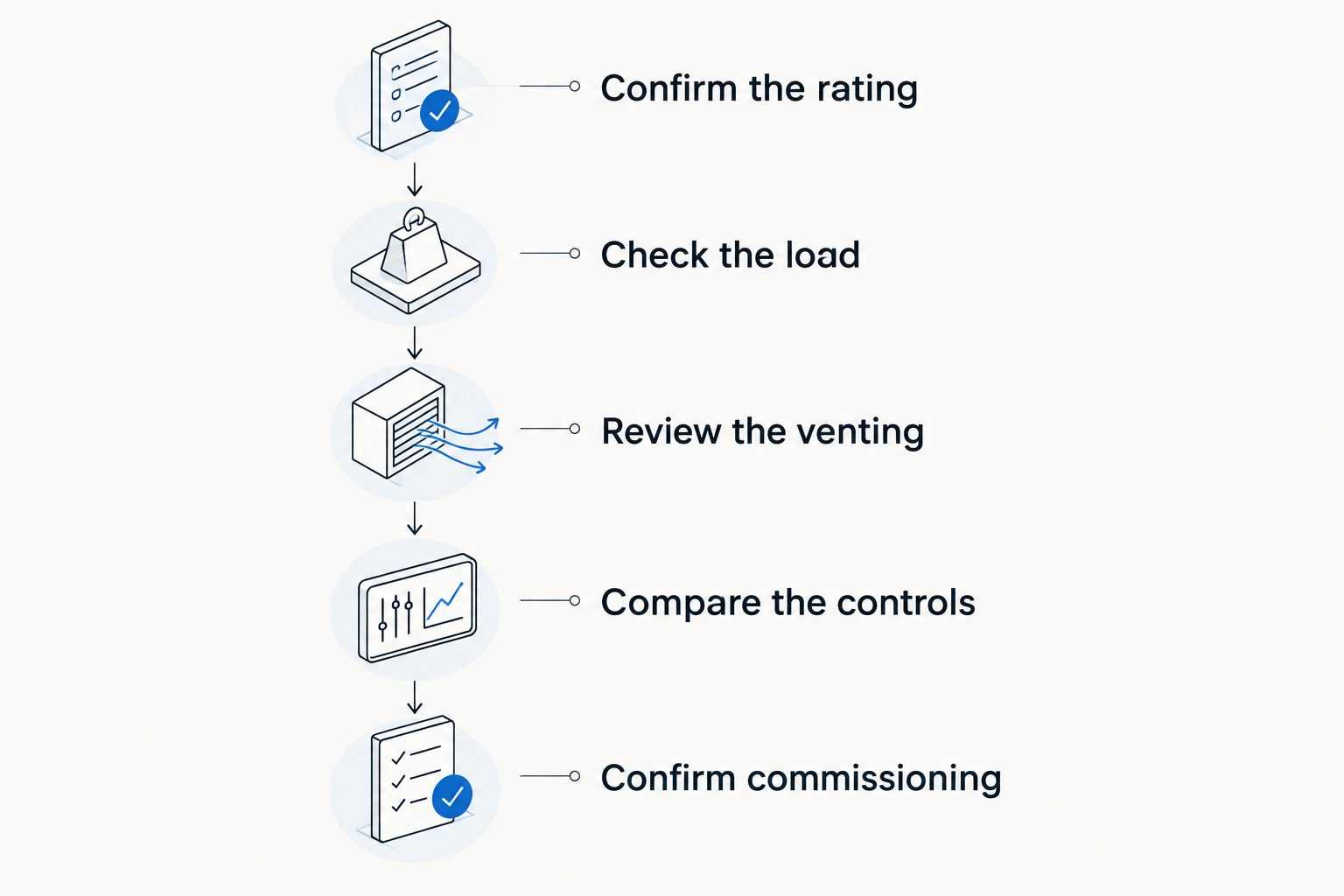
Use this sequence to turn the 2026 efficiency ranking into a replacement decision. Keep the equipment selection and the installation assessment together.
Confirm the rating
Get the exact model identifier, AFUE, and rated heating output on the proposal. An efficiency figure without an equipment identity is not enough to compare furnaces.
Check the load
Request a home-specific heating-load calculation. Repeating the old furnace's capacity does not establish that the new furnace is correctly sized.
Review the venting
Identify the approved exhaust route, combustion-air arrangement, and condensate requirements. If another appliance shares the existing vent, include that appliance in the assessment.
Compare the controls
Check operating stages, thermostat requirements, and blower operation. AFUE describes fuel utilization, not how the furnace adjusts its output or distributes air.
Confirm commissioning
Ask what startup checks the installation includes. Airflow, temperature rise, combustion setup, and safe operation need attention beyond the rating label.
For homeowners in Woodstock, Lake Bluff, and surrounding areas, GSHA Services provides HVAC installation and repair. Discuss the home's heating requirements before choosing a furnace from its efficiency label alone.
Discuss your furnace replacement
Review HVAC installation needs for your home in Woodstock, Lake Bluff, or surrounding areas.
How the efficiency classes are ranked
The ranking uses one dimension: AFUE, in descending order. Installation requirements and use-case labels explain the trade-offs; they do not change the numerical order.
This is not a model-level reliability ranking, a contractor rating, or a record of hands-on testing. For a 2026 purchase, verify the exact furnace specification and compare proposals with the same installation scope.
Which furnace efficiency should you choose?
Start with a 96% AFUE condensing proposal as a comparison point, then evaluate higher-rated alternatives against the same requirements. If maximum rated fuel efficiency is your priority, 98% leads the classes in this guide.
Choose an 80% noncondensing furnace only after reviewing installation compatibility and the condensing alternative. GSHA Services can be considered for local HVAC installation and repair; the equipment decision still starts with your home's heating requirements.
FAQ
What’s the best furnace AFUE rating in this 2026 ranking?
98% AFUE is the highest rating among the furnace efficiency classes compared here. It leads on rated fuel utilization, but correct sizing and installation remain separate requirements.
Is a 98% AFUE furnace better than a 96% furnace?
A 98% AFUE furnace has higher rated fuel efficiency than a 96% AFUE furnace. That does not establish better reliability, comfort, controls, or installation fit.
What does an 80% AFUE furnace rating mean?
An 80% AFUE rating means 80% of annual fuel-energy input becomes useful heat under the rating methodology. AFUE does not account for heat lost through your home’s ductwork.
Does a higher AFUE mean a smaller heating bill?
A higher AFUE means less fuel is needed for the same useful furnace heat under comparable conditions. Your actual bill also depends on weather, settings, fuel charges, installation, and other fuel use.
Do high-efficiency furnaces need a drain?
Condensing furnaces need an appropriate condensate drainage arrangement. The installation must also follow the exact equipment’s venting and drainage instructions.
Is a two-stage furnace always more efficient?
Two-stage operation does not establish a furnace’s AFUE rating. Staging describes changes in heat output; compare the documented AFUE separately.
Can I reuse my old furnace vent?
Reuse depends on the replacement furnace’s requirements and the existing vent’s suitability. Have the vent assessed, including any other appliance connected to it, before selecting the replacement.
One last thing
Ask for output capacity, not just input capacity. Two furnaces with the same fuel-input rating but different AFUE ratings do not have the same useful-heat relationship. For your 2026 replacement, confirm the manufacturer's rated heating output instead of using AFUE as a shortcut for sizing.
Related guides
- Smart thermostats for forced-air HVAC systems
- Heat pumps for cold climates
- Whole-house humidifiers for dry winter air


