
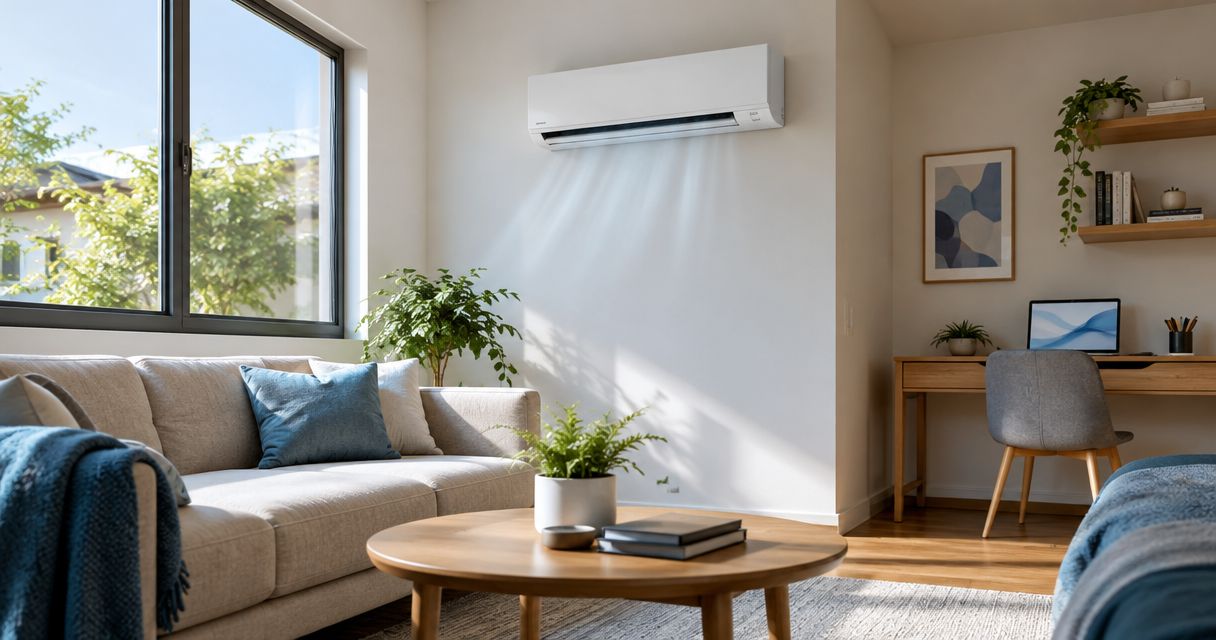
Ductless AC is worth it for a single-room home addition when extending your existing ductwork is impractical or you want independent temperature control. The trade-off is a separate indoor unit, outdoor equipment, and maintenance; if the addition also needs winter heat, evaluate a ductless heat pump rather than cooling-only equipment.
- Is ductless AC worth it? Yes, when a home addition needs independent cooling without new ductwork.
- A ductless mini-split needs correct sizing, a condensate drain, electrical service, and accessible equipment.
- Compare a duct extension before choosing ductless; existing system capacity determines whether that alternative makes sense.
- GSHA Services provides HVAC installation and repair for homeowners in Woodstock, Lake Bluff, and surrounding areas.
Is ductless AC worth it for a single-room home addition?
Choose ductless when the addition needs its own temperature setting and your existing HVAC system cannot serve it properly without substantial changes. Do not choose it solely because the room is small. The room’s heating and cooling requirements, connection to the house, and equipment placement determine whether it fits.
For homeowners planning an addition in 2026, GSHA Services provides HVAC and electrical installation and repair services in Woodstock, Lake Bluff, and surrounding areas. Treat the cooling decision and electrical requirements as parts of the same project.
| Approach | Best for | Main advantage | Main drawback |
|---|---|---|---|
| Single-zone ductless system | An addition needing independent temperature control | Conditions the room without extending supply and return ducts | Requires indoor and outdoor equipment, drainage, and electrical work |
| Extend existing ductwork | An addition the existing system can support | Uses the home’s existing central equipment | Requires verified capacity, duct design, and an adequate return-air path |
| Window AC | Seasonal cooling where a suitable window exists | Avoids permanent refrigerant piping between separate units | Occupies a window and does not provide a complete year-round heating solution |
These are alternatives, not an automatic ranking. A properly designed duct extension can be the right answer; a ductless system becomes more compelling when the addition’s comfort needs differ from the rest of the house.
Why this matters
An addition changes the home’s heating and cooling load. Connecting a new room to an existing supply duct does not establish that the system has enough capacity or that air can circulate correctly.
A room can also need cooling when the central thermostat is satisfied elsewhere. Independent control addresses that mismatch, but it does not correct poor insulation, air leakage, or excessive solar heat through windows.
For a 2026 addition, settle the HVAC approach before closing walls and ceilings. Equipment placement, electrical routing, and the condensate drain are easier to coordinate while the construction details remain accessible.
Single-zone ductless AC: 1 indoor unit
A typical single-zone ductless arrangement pairs 1 indoor unit with 1 outdoor unit to serve the addition. Refrigerant piping, wiring, and a condensate drain connect the installation; you do not need to extend the home’s air-distribution ducts into the room.
Best for: an enclosed addition that needs cooling independently of the central thermostat. A bedroom, office, or other room with a different occupancy schedule can benefit from that separation.
The indoor unit still needs an appropriate location. Its airflow must reach the occupied area, and furniture, curtains, or room partitions must not obstruct it. A location chosen only to hide the equipment can undermine comfort.
The drawback is visible equipment and a separate maintenance responsibility. You also need a workable route outside and a safe way to remove condensate. Choose this arrangement only after those details appear in the installation plan.
Ductless heat pump: 2 operating modes
A ductless heat pump provides 2 operating modes: heating and cooling. That makes it a different decision from buying equipment solely to address a hot room in summer.
Best for: a year-round addition needing both heating and cooling. In Illinois, the heating assessment must include the selected equipment’s output at the outdoor temperatures used for the home’s heating design—not just its advertised nominal capacity.
The benefit is room-level heating and cooling from the same system. The limitation is that heating performance depends on the equipment and outdoor conditions, so a cooling match does not automatically establish a winter heating match.
If the addition will rely on the heat pump through winter, review heat pumps for cold climates before selecting equipment. Ask whether the proposed model meets the room’s calculated heating load and what supplemental heat, if any, the design requires.
Why ductless value varies between additions
The same equipment approach does not produce the same result in every addition. These factors determine whether independent ductless conditioning solves the actual problem:
- Existing system capacity. A duct extension is a meaningful alternative only when the existing equipment and distribution system can support the addition.
- Room construction. Insulation, air sealing, windows, orientation, and ceiling height affect the heating and cooling load. Floor area alone is not enough.
- Room use. A regularly occupied office or bedroom has different control needs from a room used occasionally. Match the system to how you will use the space.
- Installation route. Indoor and outdoor placement, refrigerant piping, electrical routing, and drainage all affect the work required.
- Heating requirements. Summer cooling and year-round conditioning are different scopes. Confirm which job the proposed equipment must perform.
- Maintenance access. Filters, coils, drains, and outdoor equipment need access. A concealed location is not useful if routine service becomes difficult.
These factors also explain why a blanket savings claim is unhelpful. Independent operation and avoiding new ducts are practical benefits; neither establishes a household-specific energy reduction or financial payback.
What should you check before approving installation?
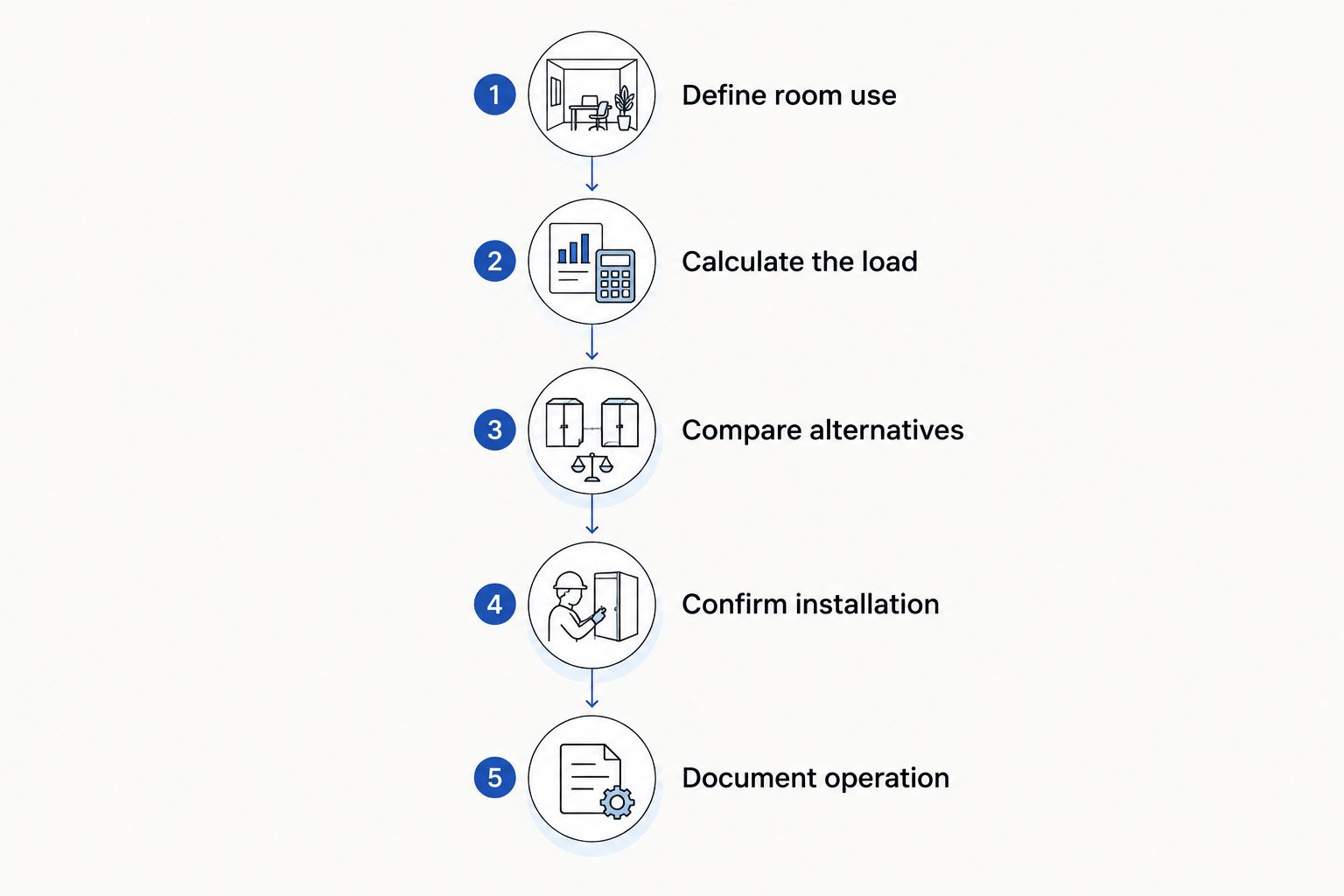
Use this sequence to review a 2026 proposal. Approve the design, not just the equipment name. Each step should resolve a specific question about how the addition will operate.
Define room use
Tell the contractor whether the addition is a bedroom, office, seasonal room, or another occupied space. Identify when you use it and whether you expect heating, cooling, or both.
Include door position in that discussion. A system selected for an enclosed room should not be assumed to condition adjacent spaces through an open doorway.
Calculate the load
Request a room-specific heating and cooling load calculation. The calculation should account for the addition’s construction and exposure rather than selecting equipment from square footage alone.
Oversizing is not extra protection. Equipment that cannot reduce output sufficiently for a small load can cycle instead of operating steadily, which can affect comfort and moisture removal.
Compare alternatives
Ask whether extending the central system is technically suitable. The answer should address equipment capacity, supply airflow, return airflow, and control—not simply whether a duct can reach the room.
If the addition is used only seasonally, compare that requirement with a window AC where appropriate. Its limitations can be acceptable for occasional cooling without making it equivalent to a permanent year-round system.
Confirm installation
Identify the indoor unit location, outdoor unit location, piping route, electrical requirements, and condensate discharge point. Review these details before construction conceals the available routes.
Ask how the outdoor unit will remain accessible and how its placement accounts for snow and drainage. Follow the selected manufacturer’s installation requirements rather than assuming every location works.
Document operation
Have the proposal identify the controls and explain how you will switch modes, adjust temperature, and maintain filters. Confirm that any proposed smart thermostat or adapter is compatible with the selected equipment.
Keep the equipment documentation and installation information together. A clear handover makes future maintenance and troubleshooting easier.
A useful proposal connects each equipment choice to the room it will serve. If the documentation lists a model but leaves drainage, electrical work, or heating performance unresolved, request those details before approving the work.
GSHA Services is best suited to homeowners seeking local HVAC installation and repair in Woodstock, Lake Bluff, and surrounding areas. For an addition, request an assessment that addresses both the room’s conditioning needs and the electrical work involved.
Discuss your addition’s HVAC needs
Review heating, cooling, and electrical requirements for your home addition.
When is ductless the wrong choice?
Ductless is a poor fit when the installation cannot provide suitable airflow, drainage, outdoor placement, or service access. Those are design requirements, not finishing details to solve after equipment arrives.
It also deserves reconsideration when the existing central system can serve the addition correctly and independent control offers little benefit. Compare the complete installation scope instead of assuming that avoiding ducts always makes ductless preferable.
Do not use new cooling equipment to cover up an unfinished building-envelope problem. If the addition has significant air leakage or inadequate insulation, address those defects as part of the construction plan. The HVAC system must be sized for the intended finished room.
A final limitation is ventilation. A typical ductless indoor unit recirculates room air; installing it does not, by itself, establish an outdoor-air ventilation solution. Discuss ventilation separately where the addition’s design requires it.
Can ductless AC cool the addition with the door closed?
A properly designed single-zone ductless system can cool the addition with its door closed. That independence is a central reason to choose it, provided the indoor unit is inside the room and the equipment matches the calculated load.
Do not assume the same unit will cool other enclosed rooms. Doorways, partitions, and airflow paths limit how effectively conditioned air reaches spaces beyond the installation room.
Is extending existing ductwork better than ductless?
Extending existing ductwork is better when the central system has sufficient capacity and the addition can receive balanced airflow. Ductless is the stronger fit when separate control matters or a suitable duct route is impractical.
For a 2026 project, ask for both approaches to be assessed against the same room requirements. Compare heating, cooling, controls, electrical work, and installation details—not equipment alone.
Will ductless AC lower the whole home’s energy use?
Ductless AC does not guarantee lower whole-home energy use. It adds conditioning to a space, and the effect depends on what it replaces, how you operate it, the room’s load, and the selected equipment.
If the addition was previously unconditioned, you are adding a new comfort service. Evaluate that improvement honestly instead of treating every ductless installation as an energy-saving replacement.
FAQ
Is ductless AC worth it for just one room?
Ductless AC is worth considering for one room when you need independent cooling and extending existing ducts is impractical. Confirm the room’s load, electrical requirements, drainage, and equipment placement before choosing it.
Can a ductless mini-split heat a home addition in Illinois?
A ductless heat pump can heat a home addition when its heating output meets the room’s design load at the relevant outdoor temperature. Confirm the selected model’s cold-weather performance and whether supplemental heat is required.
Should I buy a bigger mini-split for extra cooling?
Choose a mini-split from a room-specific load calculation, not an assumption that bigger is better. An oversized system can cycle when its minimum output exceeds the room’s needs.
Does a ductless system bring fresh air into the addition?
A typical ductless system recirculates indoor air rather than supplying outdoor ventilation air. Assess the addition’s ventilation requirements separately.
Does every ductless installation need an electrical panel upgrade?
A ductless installation does not automatically require a panel upgrade. An electrical assessment must establish whether the existing service, panel, and proposed circuit can support the selected equipment.
Can I use my existing smart thermostat with a mini-split?
You can use an existing smart thermostat only when the selected ductless equipment supports a compatible control arrangement. Verify the exact equipment and adapter requirements before installation.
What maintenance does a single-room ductless system need?
A single-room ductless system needs filter care and inspection of components including coils, condensate drainage, and outdoor equipment. Follow the selected manufacturer’s maintenance instructions and keep service access clear.
One last thing
Decide where the condensate will go before deciding where the indoor unit looks best. Cooling removes moisture from room air, and that water needs a reliable discharge route. A location that complicates drainage can introduce a condensate pump and another component requiring attention.
For your 2026 addition, put the drain route on the installation plan alongside the electrical and refrigerant routes. Ask GSHA Services to address those details during the HVAC assessment, while you can still change the layout rather than work around finished walls.
Related guides
- Ductless mini-split brands for home additions
- Connecting a smart thermostat to a ductless mini-split
- Electrical upgrades for home-based businesses


