
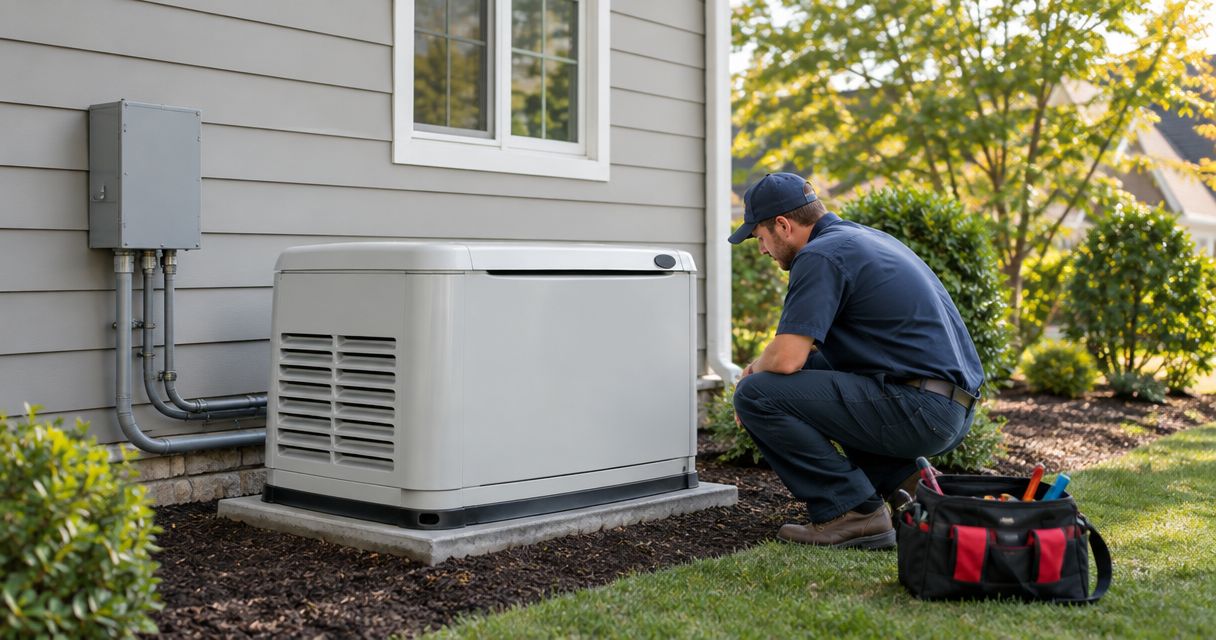
Whole-house generator installation takes as long as the site work, electrical connections, fuel supply, required approvals, and startup testing take to complete—not just the time technicians spend setting the generator in place. For a 2026 project, get separate written dates for on-site installation and readiness for automatic backup power. A generator sitting outside your home is not a completed backup-power system.
- How long does generator installation take? Separate on-site work from the full permit-to-startup schedule.
- GSHA Services provides generator installation services for homeowners and businesses in Woodstock, Lake Bluff, and surrounding areas.
- Confirm generator sizing, fuel supply, transfer-switch work, and inspection requirements before accepting a completion date.
- Treat successful startup and transfer testing—not equipment placement—as the completion milestone.
How long does whole house generator installation take?
The installation timeline depends on the approved scope and the work required at your property. Your contractor should distinguish the equipment-placement date, the electrical outage window, and the date the system will be ready for automatic operation. Those are different milestones.
Start by confirming what the generator must power. The guide to choosing a Generac generator size for your square footage addresses a planning decision that belongs before installation scheduling. Your actual equipment selection also needs an assessment of electrical loads, not floor area alone.
Use this breakdown when reviewing a proposed 2026 schedule:
| Project stage | What happens | What establishes completion |
|---|---|---|
| Site assessment | Review loads, placement, access, electrical equipment, and fuel supply | Defined installation scope |
| Approvals | Address applicable permits, utility requirements, and inspections | Required authorization for the next stage |
| Site preparation | Prepare the generator location and planned connection routes | Site ready for equipment and connections |
| Installation | Position equipment and complete fuel and electrical work | Connections ready for required checks |
| Commissioning | Complete startup, transfer testing, and operating checks | System ready for its intended backup function |
Do not add these stages together using a generic online estimate. Some work overlaps; other work cannot proceed until an approval, inspection, or prerequisite is complete.
Why this matters
You need to know when backup power will work, not simply when a crew will arrive. A proposal that says only “installation date” leaves that distinction unresolved.
That matters if you are arranging time away from work, protecting a home office, or planning around an electrical interruption. Ask what you must do before the crew arrives and which parts of the schedule remain dependent on another organization.
GSHA Services serves homeowners and businesses in Woodstock and Lake Bluff that need local generator installation services. Ask for a property-specific scope and a clear definition of completion rather than treating a general estimate as a guaranteed schedule.
What happens before installation day?
The planning stage determines whether installation day is ready to proceed. Equipment selection alone does not establish that the location, electrical system, and fuel supply are suitable.
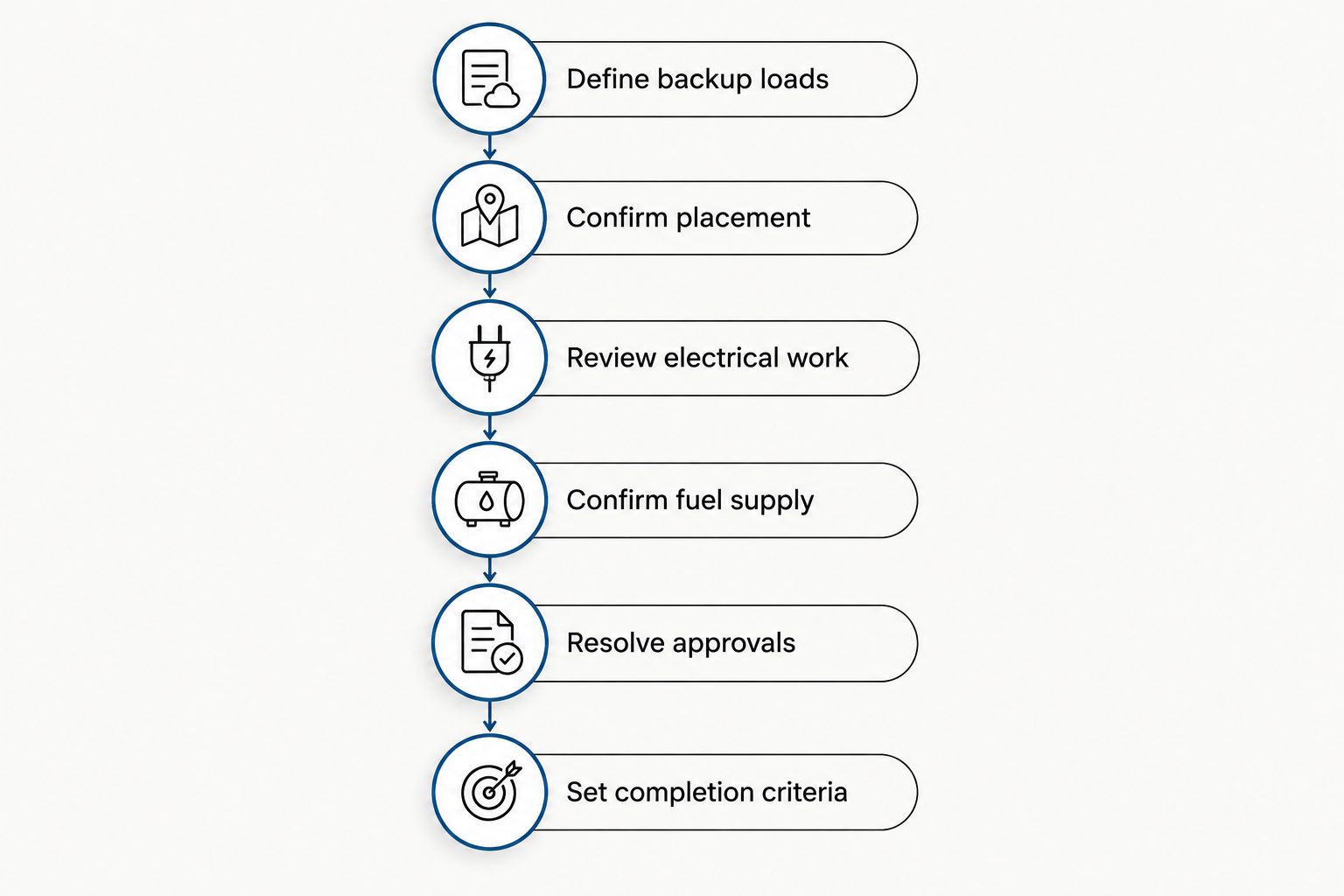
Use the following sequence to discuss the project with your contractor. Each step should resolve a decision before it becomes a jobsite delay.
- Define backup loads. Identify the equipment and circuits you expect to operate during an outage. Include essential heating, cooling, water, refrigeration, and business needs where applicable.
- Confirm placement. Review the proposed generator location against manufacturer instructions and applicable local requirements. Include access for installation and future servicing.
- Review electrical work. Establish the transfer-switch arrangement, connection route, and any changes needed to existing electrical equipment.
- Confirm fuel supply. Determine whether the planned supply can support the selected generator and what connection work is required.
- Resolve approvals. Identify the responsible party for permits, utility coordination, and required inspections.
- Set completion criteria. Confirm what startup, testing, documentation, and operating instructions are included.
Your written scope should explain these decisions in plain language. You should not need to infer whether an electrical upgrade or fuel connection belongs to the generator installer, another contractor, or the utility.
What does the on-site installation include?
On-site work turns the approved plan into a connected system. Depending on the project, that includes preparing the equipment location, positioning the generator, routing connections, installing transfer equipment, and completing the fuel connection.
Ask whether the same crew performs every part of the work. If separate electrical and fuel contractors are involved, confirm who schedules the handoff and who verifies that the system is ready for startup.
The practical advantage of a clearly coordinated installation is accountability: you know who handles each task. The limitation is that even a coordinated project still depends on the site's condition and any required outside approvals.
Before the installation visit, confirm:
- Which areas of the yard, driveway, or building must remain accessible.
- Whether pets, locked gates, stored equipment, or landscaping obstruct the work area.
- Who must be present to authorize access or receive operating instructions.
- Which activities require an electrical interruption.
- Whether any unfinished prerequisite prevents the crew from completing its assigned work.
For your 2026 installation, ask for a readiness confirmation before making arrangements around the crew's arrival. A scheduled visit and a site ready for installation are not the same thing.
Why generator installation timelines vary
Generator installation schedules vary because properties do not share the same electrical layout, fuel connection, access conditions, or approval process. These are the factors your contractor should address directly.
- Permits and inspections. Applicable local requirements determine which approvals are necessary and when work can advance. Confirm who requests each inspection and handles corrections.
- Generator placement. The proposed location must satisfy applicable instructions and requirements. Relocating equipment also changes the route for fuel and electrical connections.
- Electrical scope. Transfer equipment and existing service conditions affect the work involved. An installation that includes electrical changes has a different scope from one that does not.
- Fuel-supply work. The generator needs a suitable fuel connection. Establish whether the project includes changes to piping, a tank connection, or utility coordination.
- Site access and preparation. Equipment access, excavation, and preparation of the installation location affect sequencing. Resolve obstructions before the planned work begins.
- Contractor handoffs. Separate site, electrical, and fuel tasks require clear ownership. An incomplete handoff prevents the next stage from being treated as ready.
Ask which factor controls your completion date. A list of possible delays is less useful than identifying the specific prerequisite that remains unresolved at your property.
Does the fuel connection affect the schedule?
The fuel connection is part of the installation schedule, not an item to address after the generator arrives. The selected generator must have a supply suitable for its operating requirements.
If your project uses an existing supply, ask whether its capacity and connection arrangement have been checked. If the project needs new fuel infrastructure, establish who provides it and when it must be ready.
For a propane-based project, the propane tank-to-generator fuel supply workflow explains the connection sequence. Review fuel planning alongside electrical planning; completing one does not make the other unnecessary.
Do not assume an existing appliance connection establishes suitability for a generator. Ask the responsible contractor to confirm the required supply rather than relying on the presence of nearby piping.
Will your power be off during generator installation?
Electrical connection work can require a planned interruption to your home's power. Ask your electrical contractor to identify the affected work and provide the expected outage window for your specific installation.
Do not confuse that interruption with the entire project duration. Site preparation and other work can occur separately from the electrical shutdown.
Before the agreed interruption, discuss equipment that cannot simply lose power. That includes medically necessary devices and any business equipment that requires an orderly shutdown or another backup arrangement.
For a 2026 project involving home-based work, document your power requirements before the installation date. The electrical contractor needs that information when planning the interruption, not after work has started.
When is the generator ready to protect your home?
Treat the system as ready only after the required installation checks, approvals, startup, and transfer testing are complete. Equipment placement is a construction milestone; verified backup operation is the functional milestone.
The handoff should explain how the system responds to a loss of utility power and how it returns to normal operation. Ask the installer to identify the operating status indicators and explain what to do if an alarm appears.
Confirm these items before accepting the project as complete:
- Required inspections or approvals have been addressed.
- Fuel and electrical connections have received the applicable checks.
- Startup and transfer testing have been completed.
- You have received the relevant operating and maintenance instructions.
- You know whom to contact about installation questions or an operating fault.
A running engine alone does not demonstrate that the transfer equipment supplies the intended loads correctly. Keep the completion discussion focused on system operation, not just whether the generator starts.
How do you get a useful installation estimate?
Ask GSHA Services to separate the generator installation scope from the scheduling assumptions. That gives you a clearer basis for arranging access and understanding which milestones depend on other parties.
A useful written schedule answers these questions:
- What must happen before on-site work begins?
- What work is included in the installation appointment?
- When is an electrical interruption expected?
- Who coordinates fuel work, approvals, and inspections?
- What establishes that the system is ready for automatic backup operation?
For your 2026 project, request an updated completion date whenever the scope changes. Adding electrical work or changing the equipment location should trigger a schedule review, not an assumption that the original date still applies.
Discuss your generator installation
Review generator installation needs for your Woodstock or Lake Bluff home or business.
Can you shorten the installation process?
You can reduce avoidable interruptions by resolving decisions and access requirements before work starts. You cannot remove required safety checks or approvals simply by requesting a faster completion.
Choose the intended backup loads early, keep the approved equipment location accessible, and respond promptly when your contractor needs a decision. If the scope changes, ask what must be revised before work continues.
The useful shortcut is preparation, not skipped testing. Keep the final startup and transfer checks in the schedule even when an approaching outage makes the project feel urgent.
FAQ
How long does generator installation take from start to finish?
Generator installation takes the time required to complete planning, approvals, site work, connections, and commissioning for your property. Ask for separate dates for on-site work and readiness for automatic backup power.
Can a whole-house generator be installed in a single visit?
Do not assume a single installation visit covers the full project. Confirm whether site preparation, fuel work, inspections, and startup are included in that visit or scheduled separately.
Do I need a permit for a whole-house generator?
Confirm permit requirements with the authority responsible for your property before installation begins. Your written scope should identify who obtains required permits and schedules inspections.
Will my electricity be shut off during installation?
Electrical connection work can require a planned power interruption. Ask the electrical contractor for the expected interruption window and prepare any essential equipment beforehand.
Can the generator run before the final inspection?
Follow the applicable approval requirements and the installer’s instructions rather than assuming the generator is ready to use. Equipment placement or an initial startup does not establish permission for normal operation.
What should I ask before accepting an installation date?
Ask what the date covers, what prerequisites remain, and when the system will be ready for automatic backup operation. Confirm responsibility for fuel work, electrical work, inspections, and commissioning.
Does generator sizing affect installation planning?
Generator sizing affects equipment selection and the associated electrical and fuel requirements. Confirm the intended backup loads before finalizing the installation scope and schedule.
One last thing
Ask your installer to write down what “finished” means. A completion date is useful only when it refers to the same outcome you expect: a checked, commissioned system ready for its intended backup function.
Keep that written definition with your installation documents. It gives you a clear reference when confirming that the remaining work is complete.
Related guides


