
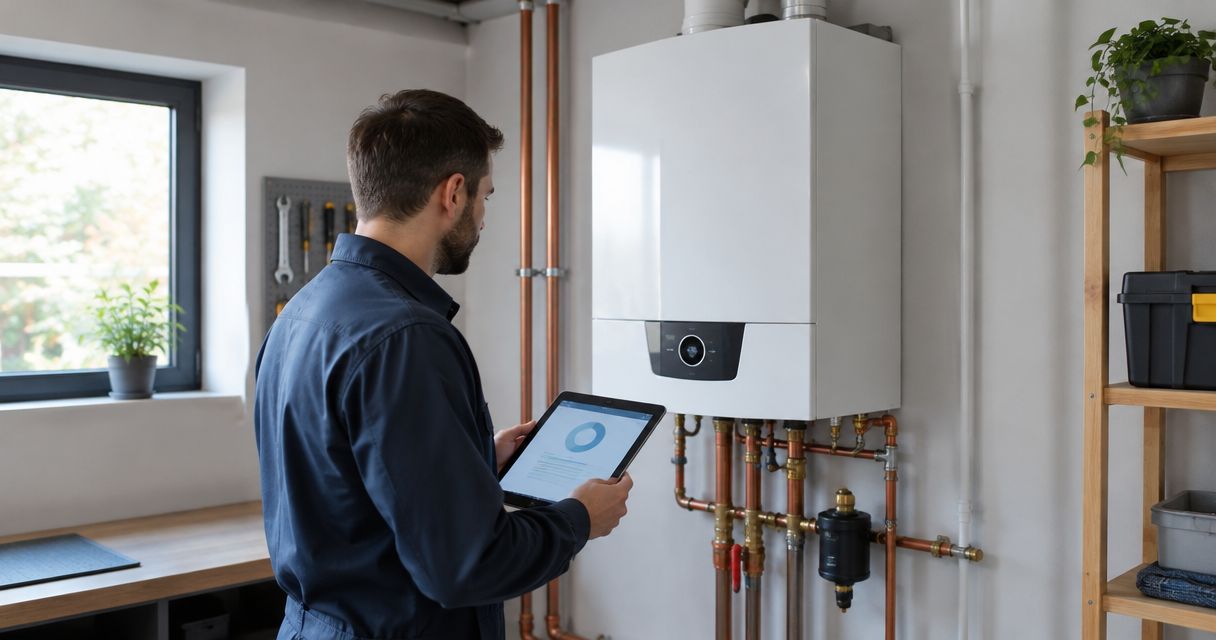
A Peerless boiler installation in 2026 requires a property-specific quote covering the selected boiler, labor, and work needed to connect it safely to your heating system. Compare the complete installed scope, not the equipment alone: venting changes, piping repairs, controls, permits, and removal can sit outside an equipment-only proposal.
- A Peerless boiler installation needs a written, property-specific quote—not an equipment-only estimate.
- Compare boiler sizing, venting, piping, controls, removal, and startup before choosing an installer.
- GSHA Services provides local HVAC installation and repair for homeowners and businesses around Woodstock and Lake Bluff.
- Higher AFUE describes fuel efficiency; it does not establish your installation requirements or heating savings.
How much does a Peerless boiler installation cost?
The useful figure is the total for your specified installation, with exclusions identified in writing. A brand name alone does not establish that total. The exact model, heating requirements, existing distribution system, and installation conditions determine what belongs in the proposal.
For your 2026 comparison, ask each contractor to quote the same work. A proposal that includes venting replacement and system repairs is not equivalent to one that covers only the boiler and its immediate connections.
If you are still comparing equipment, review gas boiler brands for older homes before requesting competing proposals. Then bring the discussion back to the exact model and installation scope rather than brand rankings alone.
| Proposal component | What the written quote should identify | What to question |
|---|---|---|
| Boiler equipment | Exact model, fuel, heating application, and rated output | A brand name without a model |
| Installation labor | Removal, placement, connections, and startup responsibilities | Unspecified additional labor |
| Venting and combustion air | Existing components retained and changes required | Assumptions that existing venting is suitable |
| Heating-system connections | Piping, valves, pumps, and controls included | Unexplained reuse of deteriorated components |
| Electrical connections | Wiring and control changes included | Electrical work excluded without explanation |
| Permits and inspections | Who arranges them and what the proposal includes | Responsibility left undefined |
| Completion | Testing, cleanup, operating instructions, and disposal | No stated completion standard |
Treat this table as a scope checklist, not a requirement to replace every component. Replace what the installation requires; retain suitable components only after their condition and compatibility are checked.
Why this matters
Boiler replacement connects new equipment to an existing building. That building brings its own piping, heat emitters, fuel supply, controls, and venting conditions. Those connections matter as much as the name on the boiler.
An incomplete quote leaves you comparing different jobs. You need to know whether a contractor has included necessary corrective work, deliberately excluded it, or left it for a later decision.
For a 2026 replacement, separate three decisions: whether replacement is necessary, which equipment suits the heating system, and what installation work that equipment requires. Combining those decisions into a single unexplained total makes the proposal harder to evaluate.
Existing-system replacement: check what stays
A replacement that retains compatible piping, controls, and distribution equipment has a narrower scope than a project that changes the heating arrangement. That does not mean every existing component should remain. Condition and compatibility come first.
Best for: a property whose existing heating distribution can remain in service after inspection. The advantage is a clearly bounded project; the limitation is that retaining equipment does not correct unrelated distribution problems.
Ask the contractor to identify retained components by function. For example, the proposal should distinguish existing zone controls from new boiler controls and explain how they will work together.
Do not accept “reuse existing” as the entire explanation. You need to know what was evaluated, what remains your responsibility, and what happens if a retained component fails during startup.
Installation with system changes: define each change
A project that changes venting, reorganizes piping, replaces control arrangements, or adds domestic hot-water integration needs a more detailed scope. Each change should have a stated purpose tied to the selected equipment or the building's needs.
Best for: a property where inspection identifies compatibility problems or where the owner is deliberately changing system functions. The advantage is addressing those requirements within the replacement project; the drawback is more work to coordinate and approve.
Avoid accepting an upgrade merely because it appears beside the new boiler on a proposal. Ask what problem it solves and whether it is required, recommended, or optional.
| Installation approach | Best for | Main advantage | Main limitation |
|---|---|---|---|
| Retain suitable existing connections | A compatible system in serviceable condition | Keeps the replacement scope focused | Existing distribution problems remain unless addressed |
| Include necessary system changes | A system with identified compatibility or condition issues | Addresses documented installation requirements | Requires more detailed planning and coordination |
Neither approach wins automatically. Choose the scope that matches the inspection findings, not the proposal with the shortest equipment list.
Why Peerless boiler installation requirements vary
The following factors explain why two properties can require different work even when both owners request a Peerless boiler:
- Heating application. Steam and hot-water systems have different sizing and installation requirements. Confirm the application before comparing equipment.
- Building heat loss. For hot-water heating, insulation, windows, air leakage, and building dimensions affect the heating requirement. Floor area alone does not describe all of them.
- Existing system condition. Deteriorated piping, leaking valves, or unsuitable controls create work beyond placing a new boiler.
- Venting and combustion air. The selected appliance's installation instructions govern acceptable arrangements. Existing venting is not automatically reusable.
- Access and removal. Stairs, narrow openings, and the boiler's location affect how equipment can be removed and installed safely.
- Added functions. Changes to zoning, controls, or domestic hot-water production expand the project beyond a basic heating-equipment replacement.
Ask which factors apply to your property. A contractor should be able to connect each proposed change to an observed condition or an installation requirement.
How to get a comparable installation quote
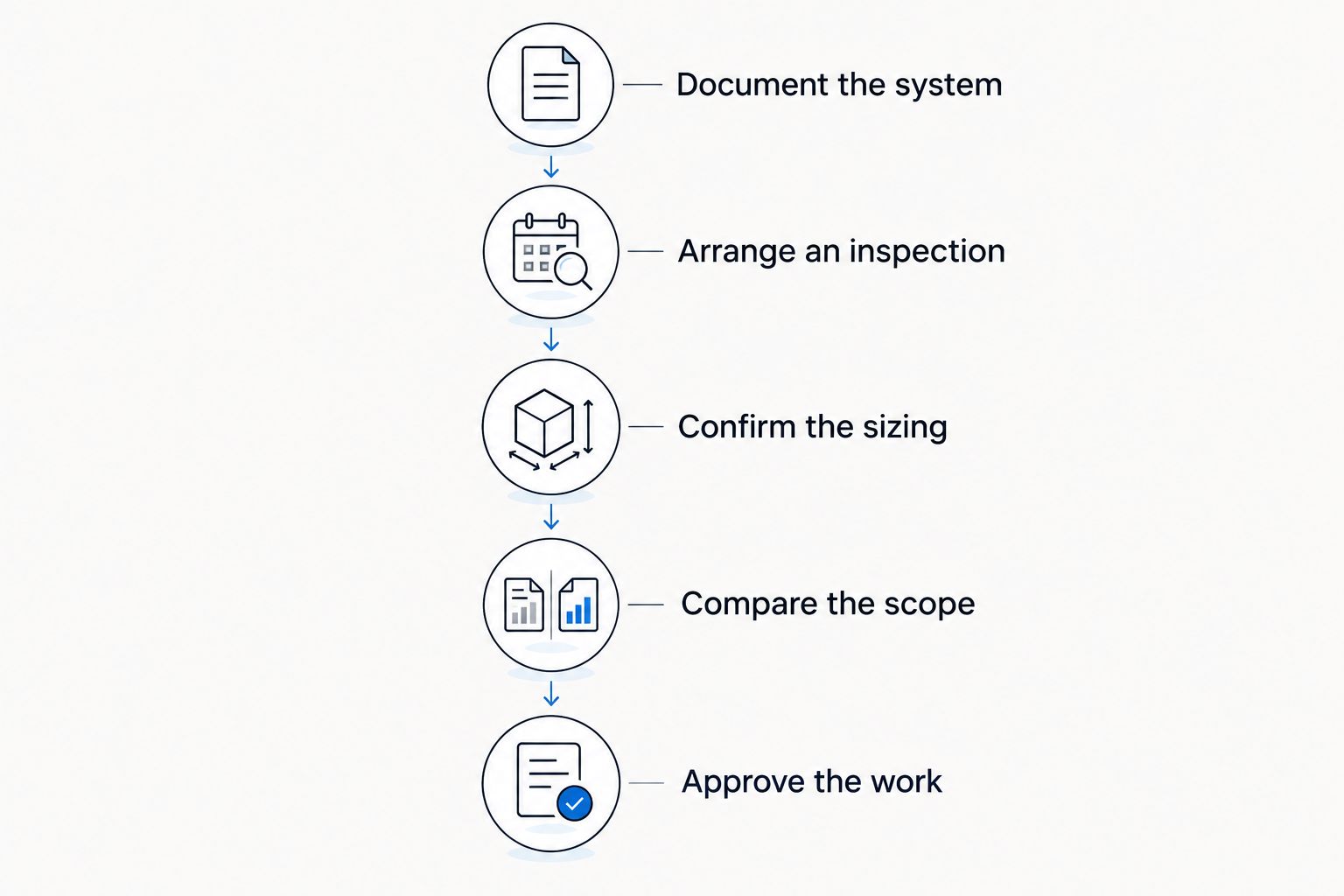
Use the same sequence with every contractor. It keeps equipment selection, required work, and optional improvements separate.
- Document the system. Gather the existing boiler's nameplate information, note whether the system uses steam or hot water, and list comfort or operating problems.
- Arrange an inspection. Have the contractor examine the installation location, distribution connections, venting, controls, and relevant fuel and electrical connections.
- Confirm the sizing. Ask how the proposed capacity was selected. Do not assume the existing boiler's capacity is the correct replacement target.
- Compare the scope. Match equipment, retained components, required changes, exclusions, permits, disposal, and startup across proposals.
- Approve the work. Resolve unclear items in writing before authorizing installation, including how additional work requires your approval.
Photographs help explain the current arrangement, but they do not replace an inspection. Keep a written list of rooms that heat unevenly, recurring leaks, unusual noises, and control problems so those concerns are not lost in an equipment discussion.
GSHA Services is best for homeowners and businesses around Woodstock and Lake Bluff seeking local HVAC installation and repair. Use the contact page to discuss your heating project and the information needed for an assessment.
Discuss your boiler installation
Contact GSHA Services about your heating project in Woodstock, Lake Bluff, or surrounding areas.
Does a higher-efficiency boiler settle the decision?
No. Annual fuel utilization efficiency, or AFUE, describes a boiler's annual fuel-conversion efficiency under standardized conditions. It does not establish the condition of your piping, the quality of the installation, or your property's heating demand.
For illustration, 90% AFUE represents 90 Btu of useful heat per 100 Btu of fuel input on the rating basis. This is an explanation of the metric, not a rating for an unspecified Peerless model or a prediction of your utility bill.
Higher efficiency offers a fuel-use advantage when comparing otherwise appropriate equipment under the rating conditions. The limitation is that the rating alone does not describe installation changes, distribution losses, operating conditions, or maintenance requirements.
For a 2026 proposal, request the exact model's published efficiency information and installation requirements together. Then ask the contractor to explain the practical differences for your property without turning the AFUE difference into an unsupported savings promise.
Can you size a replacement from the old boiler's label?
The old boiler's label is a reference, not a sizing calculation. A previous installation does not prove that its capacity matches the building's current requirements.
For a hot-water system, ask for the building heat-loss basis used to select capacity. For a steam system, ask how the connected radiation and applicable sizing requirements were evaluated. These are different applications, so the explanation should match your system.
Do not request a larger boiler simply to address a cold room. Air in a hot-water circuit, control settings, distribution issues, or other faults need diagnosis before equipment capacity becomes the proposed solution.
Can you keep your existing radiators and piping?
Existing radiators and piping can remain when their condition and compatibility support the new installation. Replacing a boiler does not automatically require replacing every heat emitter or pipe.
The benefit is retaining serviceable equipment. The limitation is that a new boiler does not repair leaks, remove every distribution restriction, or correct an unsuitable control arrangement by itself.
Ask the installer to separate boiler work from distribution repairs on the proposal. That distinction lets you see which problems the project will address and which remain outside its scope.
Should you repair the boiler instead of replacing it?
Choose between repair and replacement after the fault and equipment condition are assessed. A repair addresses an identified problem; replacement changes the heating equipment and requires a broader installation review.
Repair keeps serviceable equipment in use but does not eliminate unrelated deterioration. Replacement allows equipment selection and installation changes, but it also introduces removal, connection, and commissioning work that a targeted repair does not involve.
For your 2026 decision, request a clear diagnosis before comparing the alternatives. Ask what the repair resolves, what known problems remain, and whether replacement is being recommended for safety, condition, compatibility, or another documented reason.
FAQ
How do I get an accurate Peerless boiler installation quote?
Get a property-specific inspection and a written proposal naming the exact Peerless boiler model and installation scope. Compare removal, connections, venting, controls, permits, and startup rather than equipment alone.
Does a Peerless boiler quote include removing the old boiler?
Removal is included only when the written proposal says so. Ask whether the scope covers disconnecting, moving, and disposing of the old equipment, along with cleanup.
Can I replace a boiler without replacing my radiators?
You can retain radiators when their condition and compatibility support the replacement installation. The installer should identify any distribution repairs separately from the boiler replacement.
Is a higher-AFUE boiler always the right choice?
A higher AFUE rating alone does not establish the right boiler for your property. Compare suitable equipment alongside its venting requirements, system compatibility, controls, and maintenance needs.
Should the replacement boiler match the old boiler’s capacity?
The replacement should match the system’s assessed requirements, not automatically copy the old boiler’s capacity. Ask for the sizing basis appropriate to your steam or hot-water system.
Do I need a permit to replace a boiler in Illinois?
Confirm permit and inspection requirements with the authority responsible for your property’s location. The proposal should state who obtains required permits and arranges inspections.
Can GSHA Services help with a local heating project?
GSHA Services provides HVAC installation and repair for homeowners and businesses in Woodstock, Lake Bluff, and surrounding areas. Contact the company to discuss your heating system and project requirements.
One last thing
Put the existing heating problem in the written scope, not just the new boiler model. If your main complaint is an upstairs room that stays cold, a proposal that only names replacement equipment does not explain whether that complaint will be resolved.
Before approving your 2026 installation, ask the contractor to state which existing problems the work addresses. That sentence is often more useful than another page of equipment features.
Related guides
- Best gas furnace brands for Illinois winters
- How much does gas water heater installation cost?
- Water heaters ranked by energy efficiency


