

Best overall for a ducted installation: AprilAire E100. Best for a separately controlled basement zone: Santa Fe Ultra98. Best for tight equipment spaces: Santa Fe Compact70. For the best whole house dehumidifiers for basements 2026, choose by airflow layout and moisture load—not the largest capacity label.
- For best whole house dehumidifiers for basements 2026, AprilAire E100 is the default shortlist for ducted installations.
- Santa Fe Ultra98 suits a separately controlled basement zone; Santa Fe Compact70 suits tight equipment spaces.
- A portable dehumidifier treats a room, not an entire house through its ductwork.
- Fix water entry before selecting equipment, and provide a dependable condensate drain.
Why this matters
A damp Illinois basement does not automatically need a larger air conditioner. Dehumidification removes moisture independently of a cooling demand, which matters when the basement feels damp but does not need more cooling. Standing water, foundation seepage, and plumbing leaks need repairs—not a larger dehumidifier.
GSHA Services, LTD provides indoor air quality installation and repair services to homeowners and businesses in Woodstock, Lake Bluff, and surrounding areas. Start with GSHA Services, LTD when you need an assessment of the basement, existing HVAC system, and installation requirements.
For a 2026 equipment decision, separate the moisture problem from the distribution problem. A capable dehumidifier still needs a clear air path to reach enclosed rooms, plus a drain that removes the collected water without routine bucket emptying.
What makes the best whole house dehumidifier?
Use these criteria before comparing models. They determine whether the installation works in your basement rather than just looking suitable on a product sheet.
- Moisture control: Select equipment for the actual moisture load, basement temperature, and desired relative humidity. Floor area alone is not a sizing calculation.
- Air distribution: Decide whether the unit will connect to HVAC ducts, use dedicated ducts, or circulate air within an open basement.
- Drainage: Identify a suitable condensate destination and whether gravity drainage is practical. Pumped drainage adds equipment that also needs attention.
- Installation clearance: Allow room for duct connections, filter access, service work, and removal of the unit—not just its cabinet.
- Controls and maintenance: Choose an accessible humidity control and a layout that lets you clean the filter and inspect the drain.
EPA moisture-control guidance recommends keeping indoor relative humidity below 60%, ideally between 30% and 50%. Those are humidity guidelines, not a promise that one model will maintain them in every building. For this 2026 shortlist, the equipment choice follows the installation layout first.
Whole house dehumidifiers at a glance
These recommendations rank installation fit, not laboratory performance. A model's current installation manual governs duct connections, operating conditions, clearances, and controls.
| Option | Best for | Standout feature | Key limitation |
|---|---|---|---|
| AprilAire E100 | Integration with a forced-air HVAC system | Whole-house dehumidifier suited to ducted installation | Requires an appropriate duct and control design |
| Santa Fe Ultra98 | A separately controlled basement zone | Ductable equipment for a dedicated dehumidification layout | Separate-zone treatment needs planned airflow between rooms |
| Santa Fe Compact70 | Tight basement equipment spaces | Compact equipment format | A small cabinet does not eliminate service-clearance requirements |
| Portable room dehumidifier | One accessible basement room | Room-level moisture removal without HVAC duct connections | Not a substitute for whole-house air distribution |
The first three options are whole-house or basement-system candidates. The portable option is included as a limited-scope alternative, not as an equivalent whole-house system. Do not compare them solely by the moisture-removal figure printed on the carton.
1. AprilAire E100: best for forced-air HVAC integration
The AprilAire E100 is a whole-house dehumidifier that belongs on your shortlist when you want a ducted installation. It removes moisture from circulated air and sends that air back through the designed distribution path. Its value here is the system approach, not a claim that every basement needs this model.
Best for: A home with forced-air HVAC where the contractor can design suitable dehumidifier connections and controls.
AprilAire E100 pros
- Supports a ducted approach rather than relying on air moving around one open room.
- Provides dedicated moisture removal instead of making the cooling thermostat responsible for humidity control.
- Allows the installation discussion to include the basement and the rest of the home's air distribution.
AprilAire E100 cons
- Duct connections, control settings, and blower operation need coordinated design.
- The equipment needs a permanent drainage arrangement and accessible maintenance space.
- Whole-house distribution does not solve foundation leaks or isolate every moisture source.
Ask the installer where the unit draws air, where it delivers dry air, and how that airflow behaves when the HVAC blower is off. An answer such as “it connects to the furnace” is not enough. You need a layout that explains how moisture reaches the dehumidifier and how treated air reaches the rooms you want to control.
For a 2026 replacement or renovation, also check whether the intended equipment location leaves room to remove the filter. A cabinet that fits but cannot be maintained is the wrong installation.
Verdict: Buy the AprilAire E100 when the sizing, duct layout, and drainage support a forced-air installation; hold until those details are settled.
2. Santa Fe Ultra98: best for a separate basement zone
The Santa Fe Ultra98 is a ductable dehumidifier suited to a dedicated basement dehumidification layout. This recommendation is for homeowners who want to control the basement as its own zone rather than assume the upstairs cooling system will manage it. The installation still needs return and discharge paths that serve the actual rooms.
Best for: A basement needing a dedicated humidity-control layout, including a home where central HVAC distribution is not the chosen approach.
Santa Fe Ultra98 pros
- Supports dedicated ducting for a planned basement air circuit.
- Separates the moisture-control decision from the upstairs thermostat's cooling demand.
- Gives the installer an option for positioning equipment away from the primary occupied area.
Santa Fe Ultra98 cons
- Enclosed rooms need deliberate air pathways; a basement-zone label does not guarantee coverage.
- Dedicated ducts require space and installation work.
- Humidity control remains dependent on drainage, maintenance, and controlling incoming moisture.
Before choosing the Santa Fe Ultra98, map the basement's finished rooms, utility area, storage spaces, and doors. Identify where the dampness occurs and which doors normally stay closed. That layout is more useful than treating the basement as one rectangle on a floor plan.
A dedicated basement system also needs a sensible control location. A sensor beside the discharge is not representative of every room. Ask the installer how the selected control arrangement measures the zone you actually want to manage.
Verdict: Buy the Santa Fe Ultra98 for a planned basement-zone installation; hold if the proposal does not explain airflow between rooms.
3. Santa Fe Compact70: best for tight equipment spaces
The Santa Fe Compact70 is a compact dehumidifier option for installations where equipment space is a deciding constraint. It deserves consideration when a larger cabinet would make placement or service access difficult. Compact size is a placement advantage, not evidence that the unit matches your home's moisture load.
Best for: A basement installation with restricted equipment space and a moisture load that fits the selected model's operating requirements.
Santa Fe Compact70 pros
- Offers a compact cabinet format for constrained installation areas.
- Provides a dedicated dehumidification option rather than depending on cooling alone.
- Can be considered within a planned basement airflow arrangement.
Santa Fe Compact70 cons
- Cabinet size does not include all the space needed for connections and maintenance.
- Choosing primarily for fit risks overlooking moisture-removal requirements.
- A tucked-away installation still needs safe access to the filter, controls, and drain.
Measure the entire installation envelope before selecting the Santa Fe Compact70. Include the air connections, drain routing, and the space needed for a technician to work. Do not turn an inaccessible corner into the equipment location just because the cabinet fits there.
The right compact installation keeps routine maintenance straightforward. If changing the filter requires moving stored furniture or disconnecting equipment, reconsider the location before approving the job.
Verdict: Buy the Santa Fe Compact70 when restricted space and the calculated moisture load both support it; skip a fit-only selection.
4. Portable room dehumidifier: best for a limited basement area
A portable room dehumidifier draws air from the room around it and collects the removed moisture in a reservoir or sends it through an approved drain connection. It is a different category from a ducted whole-house installation. Include it in your decision only when the problem is genuinely limited to an accessible room or open area.
Best for: A limited basement area where you do not need whole-house distribution.
Portable room dehumidifier pros
- Does not require connections to the home's HVAC ductwork.
- Keeps room-level humidity control separate from the cooling thermostat.
- Allows placement near the area being treated, subject to the manufacturer's clearance requirements.
Portable room dehumidifier cons
- Closed doors and separate rooms limit the air it treats.
- Reservoir operation requires emptying; continuous drainage still needs a suitable route.
- Placement in an occupied room brings the equipment's sound and heat into that room.
Do not choose a portable unit because its label looks comparable to a whole-house model. Capacity ratings do not describe how air moves through your home. If the goal is several finished rooms or connected living areas, solve the distribution question first.
Verdict: Buy a portable room dehumidifier for a limited room-level problem; skip it as a substitute for a designed whole-house system.
Match the equipment to the basement layout
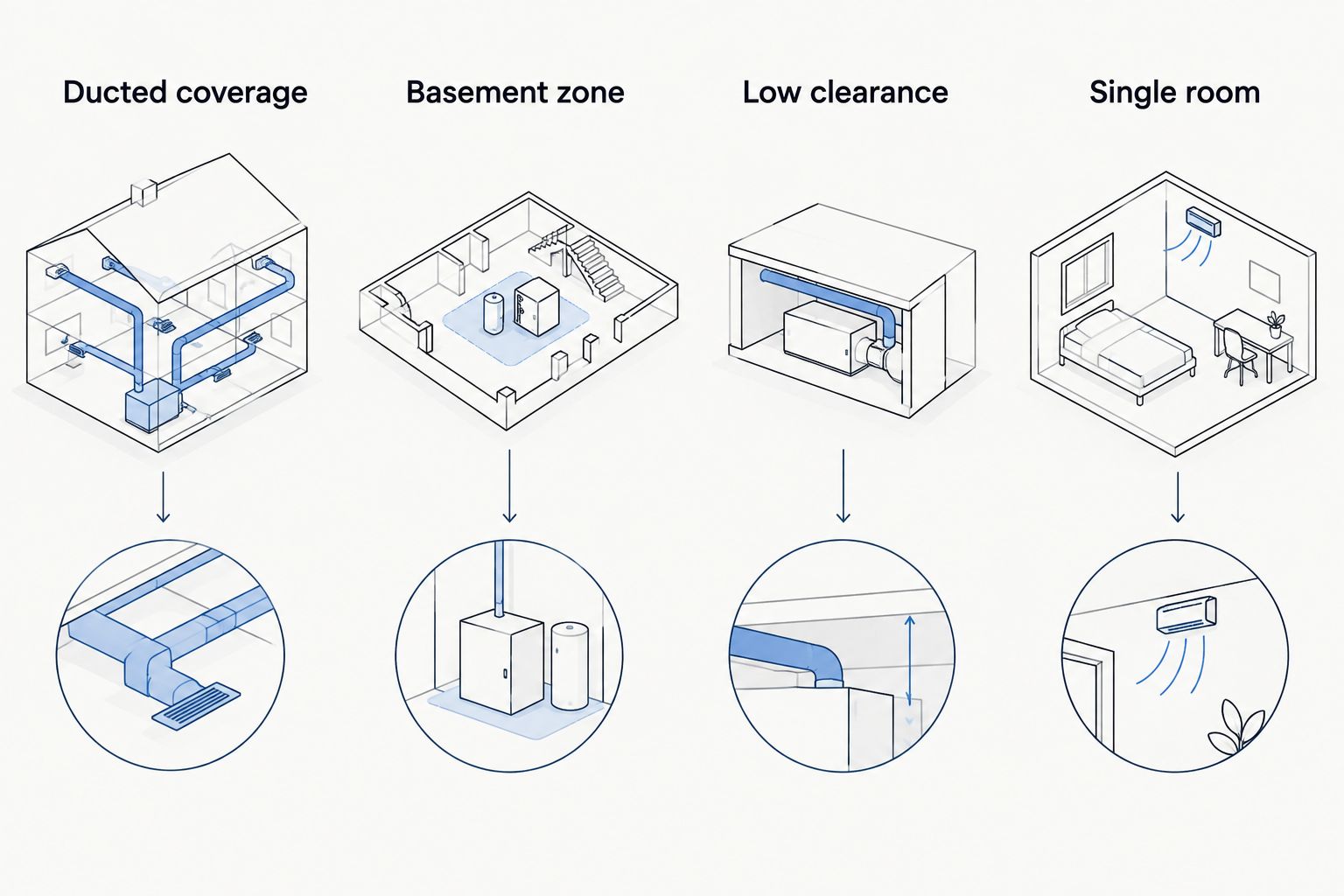
Use the four installation categories to narrow your request before discussing a specific model:
- Ducted coverage: Start with the AprilAire E100 when existing forced-air distribution is part of the proposed design.
- Basement zone: Consider the Santa Fe Ultra98 when the basement needs its own planned air circuit.
- Low clearance: Consider the Santa Fe Compact70 when equipment space restricts placement.
- Single room: Consider a portable unit when the scope does not require whole-house treatment.
These categories describe the recommendation, not exclusive capabilities. More than one model can fit a project; the installation manual and sizing assessment decide the final selection.
What to check before installation
Give the installer a useful description of the problem, not just a request for a brand. Record where dampness occurs, whether it follows rain, and whether the basement contains visible water. Explain how you use the rooms and which doors remain closed.
Then get the following details into the proposed scope:
- Water entry: Identify leaks or seepage that require separate repairs.
- Air path: Specify the intended return and discharge locations.
- Drain route: Explain where condensate goes and whether a pump is needed.
- Service access: Confirm how the filter and drain will be inspected.
- Control location: Identify where humidity is measured and adjusted.
GSHA Services, LTD is the service option for homeowners who need indoor air quality installation and repair in Woodstock, Lake Bluff, and surrounding areas. A clear installation scope is more useful than a model recommendation without airflow and drainage details.
Discuss your basement humidity
Review indoor air quality service options for your home and existing HVAC system.
How these recommendations are ranked
This 2026 shortlist ranks equipment by installation use case: forced-air integration, dedicated basement zoning, restricted equipment space, and room-only treatment. It does not claim measured performance differences or a universal winner. The final choice depends on the current manufacturer's instructions and the home's moisture-control requirements.
Which dehumidifier should you choose?
Start with the AprilAire E100 for a ducted whole-house project. Choose the Santa Fe Ultra98 when a separate basement-zone layout better matches the home, or the Santa Fe Compact70 when installation space is the controlling constraint. Keep portable equipment for a genuinely limited treatment area.
For a 2026 installation, ask GSHA Services, LTD about indoor air quality service before committing to equipment. Approve the model only after the proposal addresses moisture sources, airflow, drainage, controls, and maintenance access.
FAQ
What’s the best whole house dehumidifier for an Illinois basement?
AprilAire E100 is the default shortlist for a ducted whole-house installation. Santa Fe Ultra98 suits a separately planned basement zone, while Santa Fe Compact70 deserves consideration when equipment space is restricted.
Is a whole house dehumidifier better than a portable one?
A whole-house installation is the better fit when you need planned air distribution across multiple areas. A portable dehumidifier is appropriate for a limited room-level problem, not a replacement for ducted coverage.
What humidity should I aim for in my basement?
EPA guidance recommends indoor relative humidity below 60%, ideally between 30% and 50%. Choose a practical control setting within that guidance and address leaks or seepage separately.
Can a dehumidifier fix water coming through basement walls?
No, a dehumidifier does not repair water entry through basement walls. Correct the source of seepage or leakage before relying on equipment to control airborne moisture.
Does a whole house dehumidifier need a drain?
A permanently installed dehumidifier needs an appropriate condensate drainage arrangement. The installation must account for the drain destination, routing, and any required condensate pump.
Can I choose a dehumidifier by basement square footage alone?
No, basement square footage alone does not establish the moisture load or distribution requirements. Temperature, moisture sources, room layout, and the manufacturer’s operating requirements also affect selection.
Who can help with basement indoor air quality near Woodstock?
GSHA Services, LTD provides indoor air quality installation and repair services in Woodstock, Lake Bluff, and surrounding areas. Ask about the basement’s moisture sources, equipment layout, and existing HVAC system.
One last thing
A filter you cannot reach becomes a maintenance problem. Before approving the equipment location, ask the installer to show how the filter comes out and how the condensate drain is inspected. That simple check catches an installation problem before the ducts are connected.
Related guides
- Whole-house air purifiers for allergies
- Smart thermostats for forced-air HVAC systems
- Whole-house humidifiers for dry winter air


