
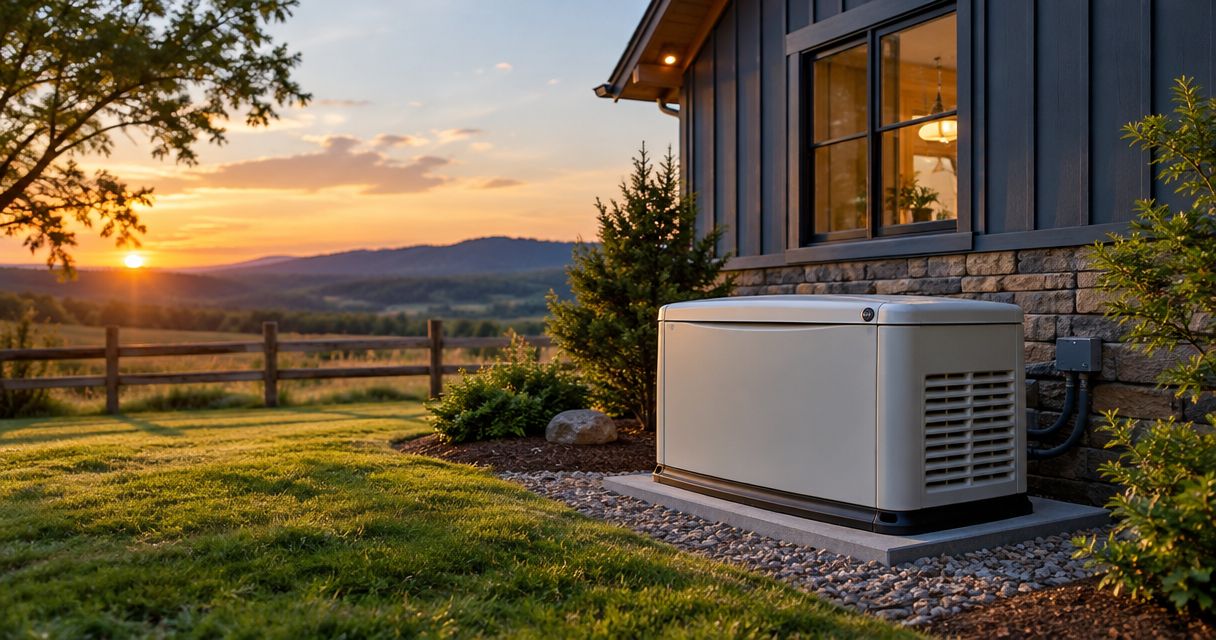
Whole house generators for rural properties are permanently installed backup systems that supply selected circuits or the home's electrical load during an outage, with the aim of keeping essential equipment operating. Rural planning must account for private wells, fuel delivery, detached buildings, and access for service—not just the house's square footage.
- Whole house generators for rural properties need load calculations that include well pumps, heating equipment, and detached buildings.
- Choose standby generator fuel around the property’s actual supply and delivery access, not convenience alone.
- Automatic transfer does not mean every appliance can run together; capacity and load management determine coverage.
- GSHA Services provides generator installation and repair for homeowners near Woodstock and Lake Bluff, Illinois.
Why whole-house generators matter for rural properties
A rural outage can interrupt more than lighting and refrigeration. If your property uses an electric well pump, losing electricity also interrupts pumped water unless another supply arrangement exists. A fuel-burning heating system can still need electricity for its controls, blower, or circulator.
Your 2026 backup plan should start with those dependencies. Identify what stops working without electricity, what damage or disruption follows, and which loads can wait. Treat a workshop, livestock building, or detached garage as a separate load decision rather than assuming it belongs in the house calculation.
GSHA Services is best for rural homeowners near Woodstock and Lake Bluff who need generator installation or repair. GSHA Services also provides HVAC, electrical, plumbing, water heater, and indoor air quality services. That service scope is relevant when your backup plan involves heating, electrical distribution, and water equipment; it does not establish which generator your property needs.
How to plan rural standby power in 2026
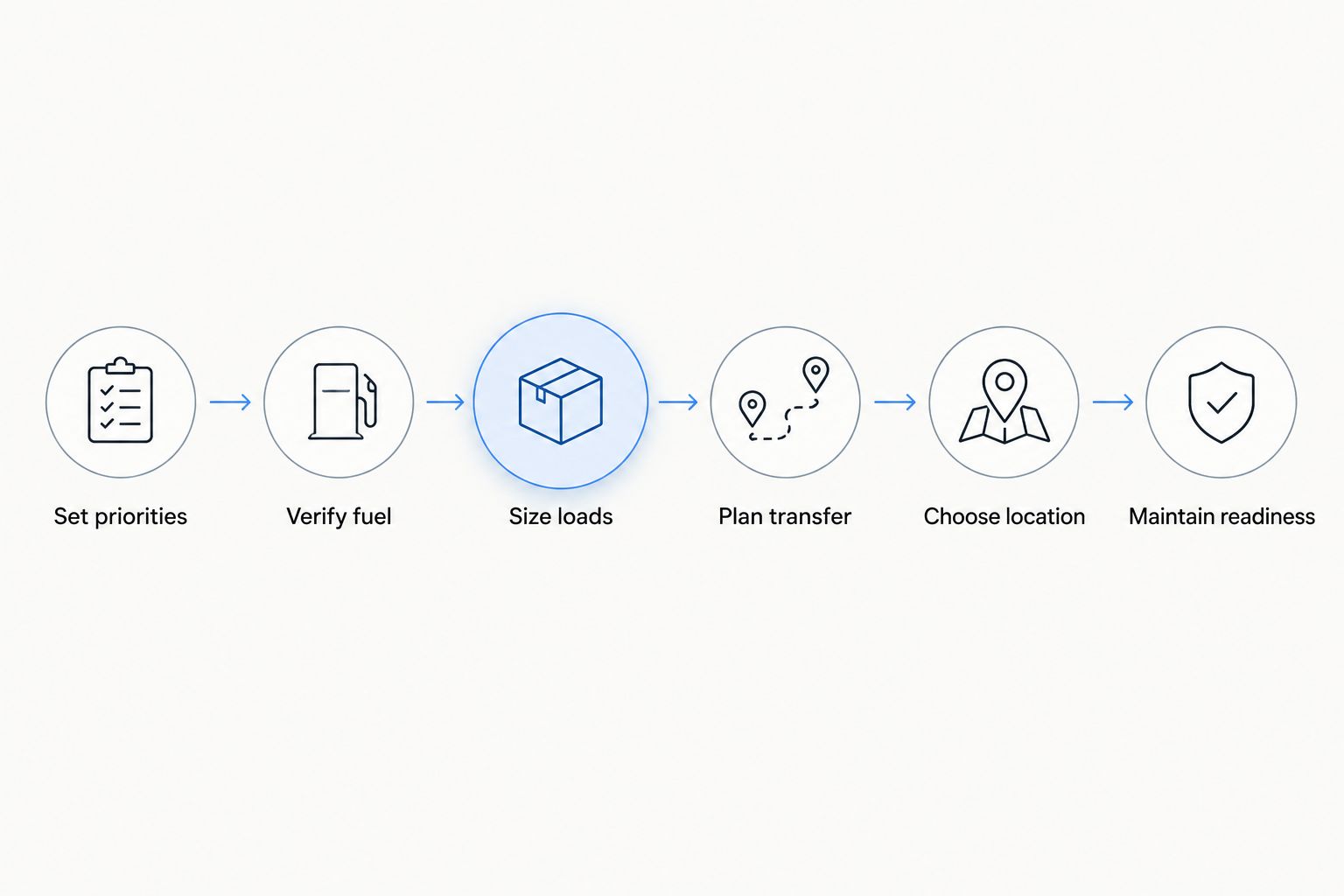
Use this sequence: Set priorities, Verify fuel, Size loads, Plan transfer, Choose location, and Maintain readiness. You can assemble the property information yourself before requesting professional design and installation.
Set priorities
Walk through the property with a notebook and record every system you want available during an outage. Begin with water, heat, refrigeration, sewage handling where applicable, and essential lighting. Then separate comfort loads from equipment whose interruption creates an immediate problem.
Define whole-house coverage in writing. The phrase does not tell you whether an electric range, air conditioner, water heater, and well pump can operate together. A circuit list makes that promise specific and gives you a basis for comparing proposals.
If someone depends on powered medical equipment, follow the equipment provider's backup instructions. A standby generator has a startup and transfer interval; it is not an uninterrupted power supply.
- Essential systems: List water, heating controls, refrigeration, and necessary lighting.
- Comfort loads: Identify cooling, cooking, and other loads you can temporarily defer.
- Detached buildings: Record each building's purpose and essential equipment.
- Special dependencies: Document medical equipment, sewage pumps, and freeze-sensitive plumbing.
Verify fuel
Start with the fuel infrastructure already present at the property. Confirm whether natural gas service exists or whether propane storage and delivery are practical. Do not choose a generator first and assume the existing fuel supply can support it.
For a 2026 installation, ask the fuel supplier and installer to evaluate generator demand alongside heating and other connected appliances. An existing propane tank does not prove that its capacity, regulator, piping, or cold-weather vaporization characteristics suit the proposed generator.
Propane avoids dependence on a utility gas connection, but stored fuel needs a replenishment plan. Natural gas avoids on-site refilling, but requires available service and adequate supply. Neither choice removes the need for a property-specific fuel assessment.
- Confirm the fuel source before requesting a specific generator model.
- Identify every appliance sharing the proposed fuel supply.
- Ask who evaluates piping, pressure, regulators, and storage requirements.
- Discuss winter delivery access and how you will track stored fuel.
- Request fuel-consumption information for the exact model and operating load.
Size loads
Collect equipment nameplate information and photographs without opening electrical enclosures. Your installer needs running demand and motor-starting requirements, especially for well pumps, air conditioners, and other motor-driven equipment. Square footage is background information, not a load calculation.
A larger generator is not a substitute for a documented sizing calculation. Generator output is commonly expressed in kilowatts: 1 kilowatt equals 1,000 watts. That rating must be considered alongside starting demand, fuel-specific output, and which loads operate simultaneously.
For a typical 120/240-volt residential electrical system, compatibility involves more than total wattage. Detached agricultural or commercial equipment can have different service requirements. Have the electrician verify the actual supply and equipment rather than assuming every rural building matches the house.
Use the generator sizing guide as preparation for a site assessment, not as permission to select capacity from floor area alone. Ask for a 2026 proposal that states both the supported circuits and any automatic load restrictions.
- Photograph accessible equipment labels and record model information.
- Include well pumps, sump pumps, heating equipment, and water treatment controls.
- Identify motors that might start while other major loads are running.
- Separate household loads from workshop and outbuilding requirements.
- Request the sizing assumptions and load-management sequence in writing.
Plan transfer
An automatic transfer switch changes the electrical supply from utility power to generator power after an outage and returns it when utility service is restored. Proper transfer equipment also prevents the generator from energizing utility wiring through an unintended connection.
Start by locating your utility meter, service disconnect, and electrical panels from accessible positions. Do not remove covers. Give the installer a simple sketch showing the house and detached buildings, then ask which equipment the proposed transfer arrangement actually serves.
A rural property can have separate services or separately supplied buildings. A generator connected to the house does not automatically protect every building on the land. GSHA Services generator installation planning should begin with a clearly defined coverage request; ask for the final electrical scope before approving equipment.
- Identify the panels and buildings you expect to receive backup power.
- Ask whether separate utility services affect the proposed arrangement.
- Confirm which loads transfer automatically and which are excluded.
- Request an explanation of load-shedding controls and restoration order.
- Leave transfer equipment installation and wiring to qualified professionals.
Choose location
Walk the property and note windows, doors, air intakes, drainage, snow accumulation, fuel equipment, and service access. A generator needs a location that satisfies its installation instructions and applicable local requirements. Open land alone does not make a placement safe.
Have the installer determine clearances, the mounting arrangement, and routing for electrical and fuel connections. Avoid choosing a distant location solely to reduce sound: additional routing and access requirements still need assessment. For 2026 planning, include the snow and drainage conditions the installer cannot see during a dry-weather visit.
Portable-generator rules are different from standby-generator installation requirements. Operate a portable generator outdoors at least 20 feet from the home, with exhaust directed away from buildings and openings. Never run one in a garage, barn, or enclosed porch, even with doors open.
- Mark doors, windows, vents, and other building openings on your sketch.
- Identify low areas, runoff paths, and places where snow collects.
- Keep required service access part of the placement decision.
- Ask how exhaust, sound, and neighboring buildings affect the location.
- Confirm local approvals and manufacturer requirements before site work begins.
Maintain readiness
Start with the maintenance schedule for the exact generator and keep the manual where another responsible person can find it. Record inspections, service, faults, and fuel deliveries. Calendar reminders help, but operating hours and the manufacturer's instructions also determine service needs.
Arrange professional commissioning that checks the installed system, not just whether the engine starts. Ask how transfer operation and intended loads will be verified. Establish what normal operation looks like so an alarm or failed exercise does not become a surprise during an outage.
GSHA Services provides generator repair as well as installation. Confirm maintenance scope and service arrangements directly rather than assuming either is included with installation. A successful exercise cycle does not, by itself, prove that every intended load has been tested under transfer.
- Follow the model-specific inspection and maintenance instructions.
- Record the model, serial number, fuel source, and service contact.
- Learn how to read alarms without opening energized equipment.
- Keep access clear without blocking ventilation or required clearances.
- Ask what commissioning tested and retain the results.
Compare backup options for your rural property
Choose the arrangement that matches your required loads and your willingness to operate equipment manually. These are system options, not interchangeable products. In 2026, a useful proposal should explain what each arrangement powers, what it excludes, and what you must do during an outage.
| Option | Best for | Main advantage | Key limitation |
|---|---|---|---|
| Natural-gas standby generator | Properties with suitable utility gas service | Automatic backup without on-site fuel refilling | Requires confirmed gas capacity and an acceptable installation location |
| Propane standby generator | Properties without suitable natural gas service | Automatic backup using stored fuel | Storage, cold-weather fuel delivery, and replenishment need planning |
| Standby generator with load management | Homes where selected major loads can pause | Controls which loads operate together | Whole-house connection does not mean unrestricted simultaneous use |
| Selected-circuit standby system | Owners prioritizing essential household systems | Defines backup coverage around named circuits | Excluded equipment remains without generator power |
| Portable generator with approved transfer equipment | Owners prepared for manual outage operation | Provides backup without a permanently installed engine | Requires safe outdoor operation, fuel handling, and manual setup |
Choose automatic standby power when automatic operation is a requirement. Choose selected-circuit coverage when you can clearly exclude nonessential loads. A portable setup serves a different operating model; it is not an unattended substitute for a permanently installed standby system.
Plan your generator installation
Discuss generator installation or repair for your Woodstock or Lake Bluff property.
Common mistakes rural property owners make
Assuming acreage determines generator size
Land area does not establish electrical demand. A smaller home with an electric well, electric heat, and workshop equipment needs a different assessment from a larger home with fewer electrical loads. Give the installer equipment information and operating priorities, not just acreage and floor area.
Treating an existing propane tank as approved capacity
A tank that serves heating equipment does not automatically support a generator at the same time. Ask for a fuel-system assessment that includes combined demand and winter conditions. Keep the supplier involved before the generator location and piping route are finalized.
Leaving out the water system
Include the well pump and any electrically powered controls or treatment equipment required for your intended water service. Identify sewage handling separately. Backing up a kitchen circuit does not restore water or wastewater equipment connected elsewhere.
Assuming detached buildings transfer with the house
A barn or workshop can sit outside the proposed backup arrangement. Ask the electrician to identify its supply path and confirm whether it is included. If it is excluded, decide how you will protect any essential equipment inside it.
Accepting an undefined whole-house proposal
A proposal that names only a generator leaves important questions unanswered. Require the transfer arrangement, covered loads, fuel scope, site work, approvals, and commissioning scope. Compare those details before comparing equipment names; two proposals can describe very different coverage.
FAQ
What’s the best whole-house generator setup for a rural property?
The best setup is the one sized for your documented loads and supported by a suitable fuel supply. Choose automatic standby operation when you need power restored without manual generator setup, and define any load-management restrictions before installation.
Can a whole-house generator run my private well?
A whole-house generator can power a well pump when the system is designed for the pump’s electrical requirements and starting demand. The pump must also be connected within the generator’s approved backup arrangement.
Is propane better than natural gas for a rural generator?
Propane is a practical choice where suitable natural gas service is unavailable. Natural gas avoids on-site refilling, while propane requires storage and replenishment; both need a fuel-system assessment for the selected generator.
Will one generator power my house and barn?
One generator can serve both only when the electrical design, capacity, and transfer arrangement support both buildings. A house installation does not automatically include a barn, workshop, or separate utility service.
Can I size a generator from my home’s square footage?
Square footage alone is not enough to size a generator. Use equipment loads, motor-starting requirements, simultaneous demand, and the intended load-management arrangement to establish capacity.
Does a standby generator provide uninterrupted power?
A standby generator does not provide uninterrupted power because startup and transfer take time. Equipment that cannot tolerate an interruption needs its own appropriate backup arrangement, following the equipment provider’s instructions.
Can I put a portable generator inside an open barn?
Do not operate a portable generator inside a barn, even with doors open. Run it outdoors at least 20 feet from the home, direct exhaust away from buildings and openings, and follow the manufacturer’s safety instructions.
One last thing
Write an acceptance checklist before signing the installation proposal. Ask which loads the commissioning process will verify, how the well pump will be included, and how any load-management controls will be demonstrated. Keep the agreed checklist with your 2026 installation records.
The useful question is not simply whether the generator starts. It is whether the completed backup system supplies the equipment you agreed to protect, within its documented limits.
Related guides
- Whole-house generators ranked by fuel type
- Portable generators for home backup
- Generators ranked by noise level


