
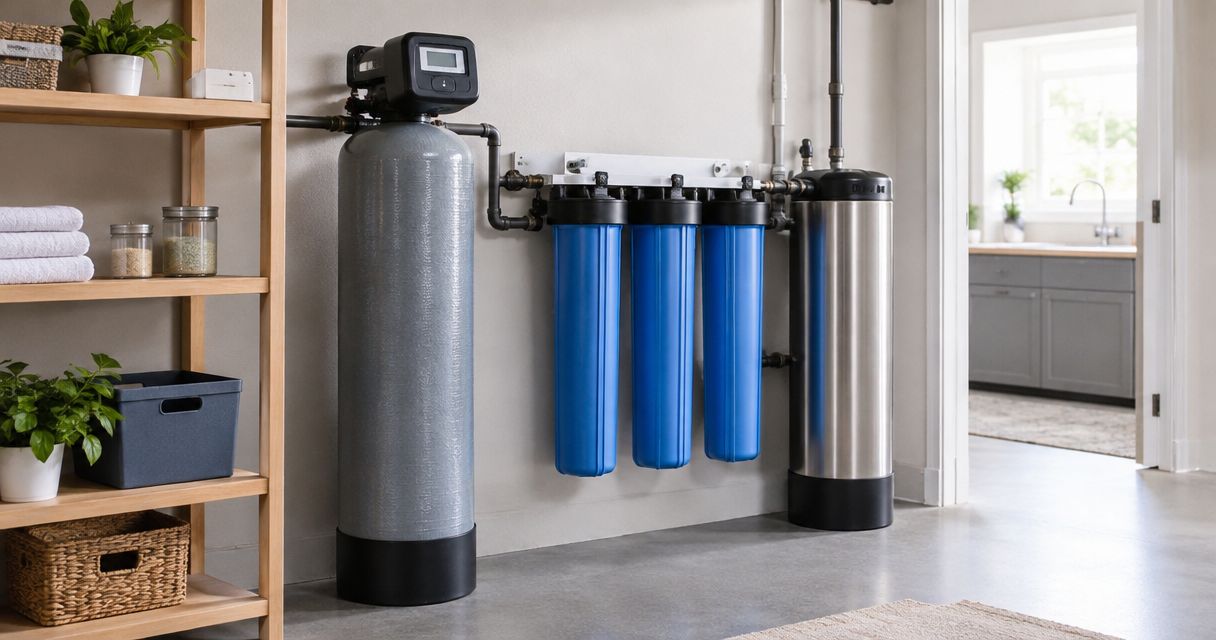
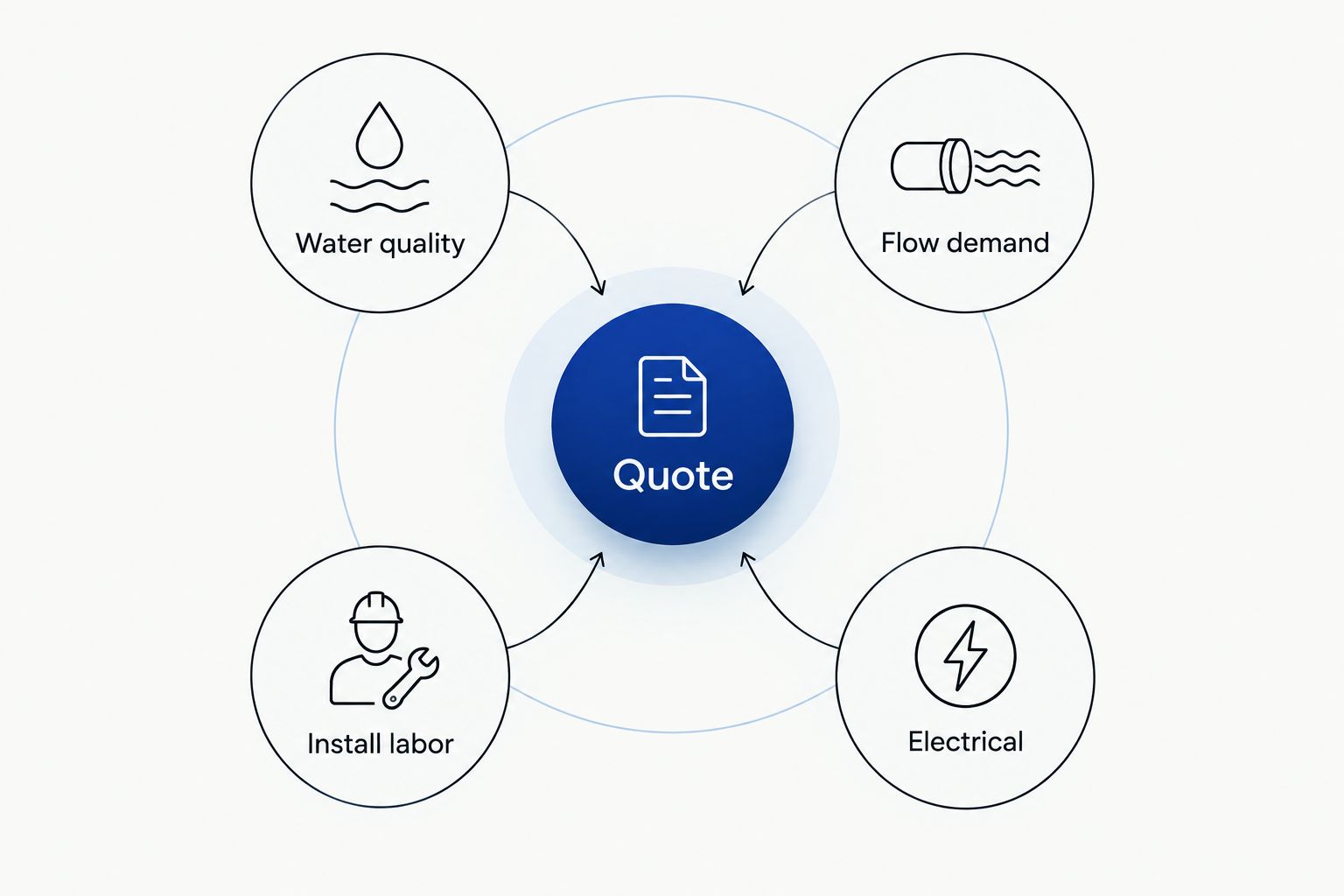
Whole house water filtration system cost in 2026 is set by four things: filter type, home water demand, water quality, and install labor. The type you pick moves the quote more than any other choice, and the ranking from cheapest to most expensive is stable even when dollar figures shift.
- Whole house water filtration system cost in 2026 ranks by type: sediment and carbon lowest, UV and iron filters mid, reverse osmosis highest.
- Install labor and a drain for backwashing add more to the quote than most buyers expect.
- Test your water first. Buying the wrong filter type is the costliest mistake.
- Get quotes that itemize equipment, bypass plumbing, drain work, and electrical.
Why this matters
A whole house filter treats every tap, shower, and appliance line. That makes it a plumbing project, not a countertop purchase. Two homes can buy the same filter and pay very different totals because of pipe size, basement layout, and where the main shutoff sits.
This page does not hard-code dollar amounts. Equipment prices, local labor rates, and promotions change through 2026, and a stale number misleads you. What holds steady is the cost order between system types and the factors that push a quote up or down. Use that order to judge any estimate you receive.
Short answer: what ranks cheapest and costliest
Sediment and basic carbon systems cost the least. Whole-house reverse osmosis costs the most. Everything else lands between, depending on how much plumbing and electrical work it needs.
Whole house filtration cost by type
The table ranks each type by total installed cost tier. "Lowest" to "Highest" is relative across the types listed, not a dollar figure.
| System type | What it removes | Installed cost tier | Install complexity | Best for |
|---|---|---|---|---|
| Sediment pre-filter | Sand, silt, rust particles (often rated near 5 micron) | Lowest | Low: cartridge housing on the main line | Well water or older pipes shedding debris |
| Carbon (granular activated) | Chlorine, taste, odor, some chemicals | Low to mid | Low to mid: tank, often with a backwash drain | City water with chlorine taste |
| Catalytic carbon or KDF blend | Chloramine, chlorine, some metals | Mid | Mid | Municipal water treated with chloramine |
| Salt-based softener (ion exchange) | Hardness minerals: calcium and magnesium | Mid | Mid: drain, power, brine tank | Hard water scale on fixtures and heaters |
| UV disinfection | Bacteria and viruses (standard dose: 40 mJ/cm²) | Mid | Mid: needs an electrical outlet and a pre-filter | Private wells with microbial risk |
| Iron and sulfur filter (oxidizing) | Iron, manganese, hydrogen sulfide | Mid to high | Mid to high: larger tank, air or chemical feed | Rotten-egg smell and rust staining |
| Multi-stage combination | Sediment, chlorine, and hardness in one setup | High | High: several tanks and a bigger footprint | Homes with more than one water problem |
| Whole-house reverse osmosis | Dissolved solids, broad contaminant range | Highest | Highest: storage tank, booster pump, drain | Severe contamination that nothing else fixes |
High and low: where the money goes
Sediment filtration leads on low cost. It is a housing and a cartridge on the main line, and a plumber finishes it quickly. Whole-house reverse osmosis trails at the other end. It needs a storage tank, a pump to restore pressure, and a drain line, and it sends a share of incoming water down the drain.
The middle of the table is where most homes land. Carbon, softeners, and UV all need real plumbing work, but none needs the tank-and-pump setup that reverse osmosis requires.
Verdict: if your water is municipal and your complaint is taste, carbon wins on cost. If it is a private well, budget for sediment plus UV before anything else.
Methodology and limits
The cost tiers reflect how much equipment and labor each system type generally requires, based on standard plumbing practice for whole-house installs. They are relative rankings, not a survey of local quotes. The limitation: this page cannot tell you your price. Pipe size, water pressure, and your layout change the total, and only an on-site estimate captures them.
The four cost drivers behind every quote
1. Water quality
Your water test decides the system. A softener does nothing for chlorine taste, and carbon does nothing for hardness. Pay for a lab or utility report before you buy equipment. A wrong-type purchase is a full loss, not a partial one.
2. Home size and flow demand
More bathrooms and bigger families mean higher flow rates. Undersized tanks restrict pressure and wear out faster. Larger tanks and wider housings cost more up front and fail less often.
3. Install labor and plumbing
Most systems need a bypass valve, new shutoffs, and fittings at the main line. Backwashing carbon, iron, and softener tanks also need a nearby drain. If your main line sits far from a drain, the extra pipe runs add to labor.
4. Electrical and ongoing costs
UV units, softeners with control heads, and reverse osmosis pumps need power. A missing outlet near the install spot means an electrician. Then there are the recurring costs: cartridges, salt, UV lamps, and membranes. The cheapest system to buy is not always the cheapest to own.
Cost by water problem
Match the fix to the symptom and you avoid paying for treatment you do not need.
- Chlorine taste and odor: carbon or catalytic carbon. Lower-cost tier.
- White scale on fixtures, spotty dishes: a softener. Mid tier. Compare options in best water softeners for hard water homes.
- Sand, rust flecks, cloudy water: sediment pre-filter. Lowest tier.
- Rotten-egg smell or orange staining: an iron and sulfur filter. Mid to high tier.
- Private well with microbial risk: UV plus a sediment pre-filter. Mid tier.
- Several problems at once: a multi-stage setup. High tier, but cheaper than patching one issue at a time with separate installs.
Water heater and softener interactions
Hard water shortens the life of a water heater, so a softener often pays back through the heater. If you are replacing a heater in 2026, price the filtration work in the same visit and compare against average tankless vs tank water heater installation cost. Doing both jobs together saves a second trip charge and lets one plumber match the fittings.
Tankless units are less forgiving of scale. If you choose one, treat hardness first.
How to use these benchmarks
- Test before you shop. The test result narrows eight types down to one or two, and that cuts the quote range more than negotiating does.
- Ask for an itemized quote. It should separate equipment, bypass plumbing, drain work, electrical, and permits if your town requires them. A single lump sum hides where the money goes.
- Compare five-year ownership, not install price. Add cartridge, salt, lamp, and membrane replacement to the equipment price in 2026 terms.
- Size to your flow. Count bathrooms and peak simultaneous use, then ask the installer to show the flow rating.
For a ranked look at specific systems, read best whole house water filtration systems. For how an installer builds an itemized estimate on another big home project, see how much AC installation costs.
Get an on-site estimate
Plumbing quotes depend on your pipes and layout. Ask GSHA Services.
What each type gets wrong
Honest pros and cons matter more than a price tier.
- Sediment: cheap and simple, but it removes nothing dissolved. It protects other equipment rather than treating water on its own. Buy as a first stage.
- Carbon: fixes taste and smell, but loses effectiveness as the media saturates. Replacement timing matters. Buy for city water.
- Softener: stops scale, but adds sodium and needs salt refills and a drain. It is not a drinking-water purifier. Buy for hard water.
- UV: treats microbes with no chemicals, but does nothing for minerals or chemicals and needs clear water to work. Hold until you test the well.
- Iron and sulfur filter: clears staining and odor, but needs regular maintenance and a larger footprint. Buy if you have the symptoms.
- Reverse osmosis at the whole-house scale: broadest removal, highest cost, most waste water, and pressure issues without a pump. Skip unless testing shows a problem nothing else solves.
FAQ
What is the cheapest whole house water filtration system?
A sediment pre-filter is the cheapest whole house system to buy and install. It removes particles like sand and rust but not dissolved chemicals or minerals.
What is the most expensive type of whole house water filter?
Whole-house reverse osmosis is the most expensive type. It needs a storage tank, a booster pump, and a drain line, which raises both equipment and labor cost.
Does whole house water filtration cost more for well water?
Well water usually costs more to treat because it often needs sediment filtration plus UV, and sometimes an iron filter. City water commonly needs only carbon.
Is installation included in the cost of a whole house water filter?
Not always. Many equipment prices exclude labor, bypass plumbing, drain work, and electrical. Ask for an itemized quote that lists each one.
Is a water softener the same as a whole house water filter?
No. A softener removes hardness minerals through ion exchange. A filter removes particles, chlorine, or other contaminants. Many homes need both.
How do I know which whole house filter I need?
Test your water first. A lab or utility report shows hardness, chlorine, iron, and microbial risk, and each result points to a specific system type.
Do whole house filters have ongoing costs?
Yes. Expect cartridges, salt, UV lamps, or membranes depending on type. Include these when you compare total ownership cost in 2026.
One last thing
The most expensive line item is often not equipment. It is relocating plumbing because the main shutoff or drain sits in the wrong place. Before you order anything in 2026, have a plumber look at the install spot and confirm the drain, outlet, and clearance. That single visit settles the quote better than any online calculator. GSHA Services handles plumbing for homes in Woodstock, Lake Bluff, and surrounding Illinois areas; start from the GSHA Services home page to reach the team.


