

Home-based business electrical planning is the assessment of household and work equipment with the aim of supporting safe, reliable business operations. In 2026, electrical panel upgrades for home-based businesses are justified by the existing equipment’s condition and a professional load assessment—not simply by adding a desk, printer, or business license.
- Electrical panel upgrades for home-based businesses require a load assessment, not a guess based on empty breaker spaces.
- GSHA Services provides electrical installation and repair for homeowners and businesses in Woodstock, Lake Bluff, and surrounding areas.
- A dedicated circuit addresses a shared-circuit problem; a panel replacement does not automatically increase utility service capacity.
- Plan surge protection and backup power separately: neither substitutes for adequate wiring and circuit capacity.
Why electrical planning matters for home-based businesses
Your business equipment shares an electrical system with household heating, cooling, cooking, and laundry. A printer that works during a quiet afternoon does not establish that its circuit can support the same equipment while other connected appliances run.
Start with the equipment and circuits, then decide whether the panel needs replacement. That sequence keeps a branch-circuit problem from becoming an unnecessary whole-house project.
For your 2026 project, separate three questions: Is the existing equipment safe? Can the electrical system support the calculated load? Will a power interruption stop essential business tasks? Each question requires a different remedy.
The electrical panel upgrade brands guide covers equipment selection. Choose the project scope before comparing brands; a name on the enclosure does not establish the capacity your business needs.
Plan your business electrical upgrades
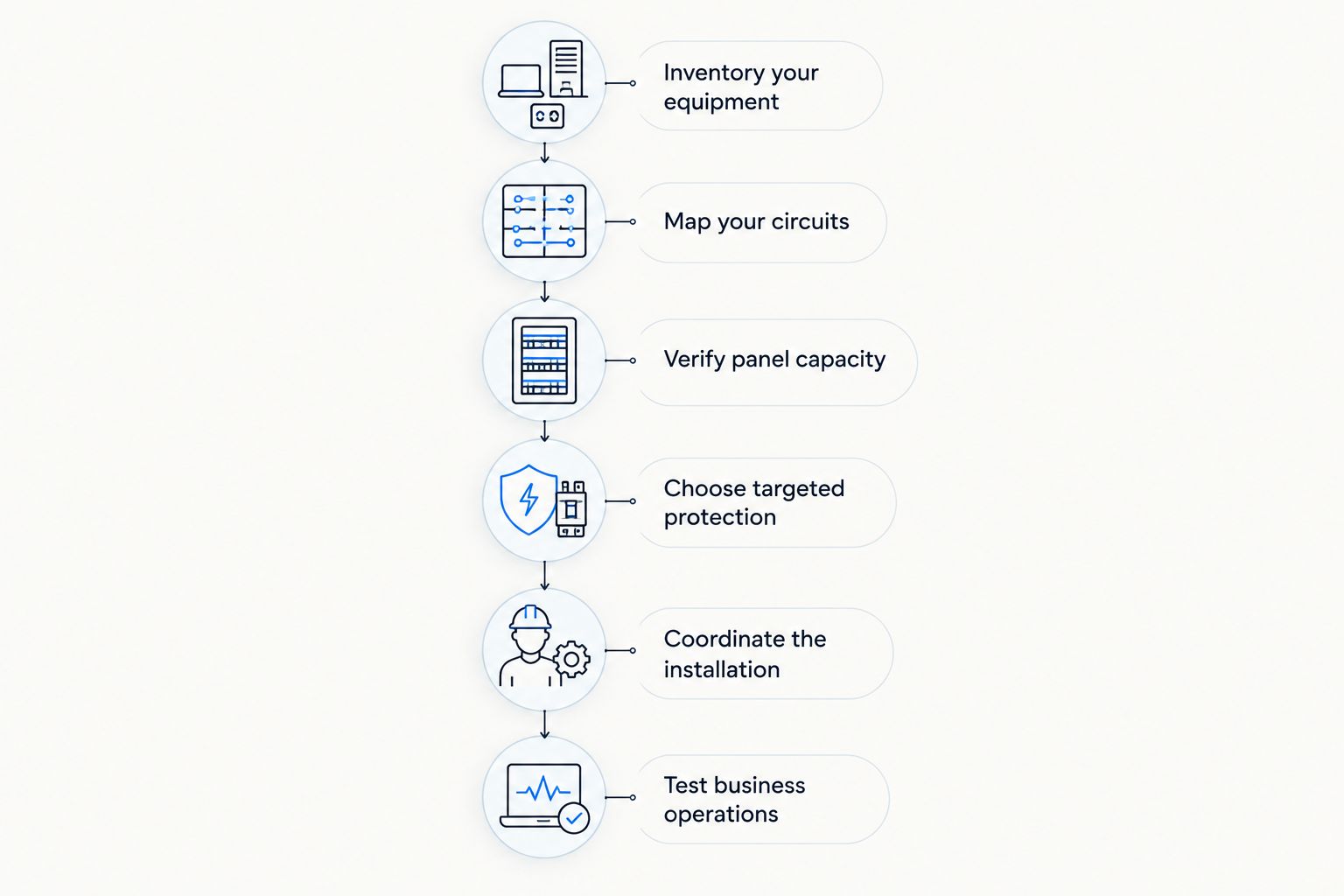
Inventory your equipment
Start manually with an equipment list. Record the devices you use now, the equipment you intend to add, and which machines operate together. Include household appliances rather than treating your office as a separate building.
Copy electrical ratings from equipment labels or manufacturer documentation. A laptop’s power adapter, a laser printer, and a workshop machine impose different demands; counting plugs treats them as equivalent when they are not.
Typical residential equipment uses 120 volts or 240 volts. Record the actual requirement instead of assuming that an available receptacle is suitable. A 15-amp circuit marking also does not mean every connected device can draw its maximum current simultaneously.
Keep operating requirements separate from business priorities. A device can consume little power yet be essential to keeping your business connected.
- List computers, monitors, printers, networking equipment, and task lighting.
- Include heaters, cooling equipment, tools, and other substantial loads.
- Record voltage, amperage or wattage, and manufacturer circuit requirements.
- Mark equipment that operates simultaneously.
- Identify equipment that must remain powered during an interruption.
Map your circuits
Use existing breaker labels and observations to create a preliminary circuit map. Mark which outlets lose power together only when you can check safely without interrupting essential equipment. Do not remove the panel cover or touch internal components.
A room is not necessarily a circuit. Your desk outlets can share a circuit with another room, and outlets in the same workspace can belong to different circuits. A power strip adds connection points, not electrical capacity.
For a 2026 office expansion, document symptoms before requesting a particular repair. Note what was operating when a breaker tripped, whether the problem repeats, and whether it affects one circuit or several.
Stop using affected equipment when you notice burning odors, sparking, damaged outlets, or unusual heat. Leave electrical diagnosis to a qualified electrician; repeated resetting is not troubleshooting.
- Copy visible breaker labels without opening the panel enclosure.
- Note shared outlets serving business and household equipment.
- Record trips and the equipment operating at the time.
- Photograph accessible equipment labels and outlet locations.
- Keep the panel area accessible and clear of business storage.
Verify panel capacity
Your equipment list and circuit map are the manual starting point. An electrician then evaluates the panel, service equipment, existing circuits, and calculated load. This is where professional assessment replaces assumptions about what a larger panel would accomplish.
GSHA Services is best for home-based business owners in Woodstock and Lake Bluff who need local electrical installation or repair. Request an electrical assessment through GSHA Services and explain both your current equipment and planned additions.
Ask the electrician to distinguish a panel replacement, a subpanel installation, and a service upgrade. A subpanel provides a distribution point for circuits; it does not create additional service capacity. Likewise, a panel with more breaker positions does not automatically permit a larger electrical load.
The service provider’s limitation matters: electrical installation and repair do not replace utility approval or local permit review where required.
- Request a load calculation covering household and business equipment.
- Ask whether the concern is condition, circuit space, capacity, or several issues.
- Have the electrician verify equipment compatibility and panel labeling.
- Confirm whether utility coordination is part of the proposed scope.
- Request a written explanation of why replacement is necessary.
Choose targeted protection
Choose the remedy that addresses the diagnosed problem. A dedicated circuit can separate business equipment from unrelated household loads. Additional properly installed receptacles can reduce dependence on extension cords. Neither measure repairs defective equipment elsewhere in the system.
Surge protection, ground-fault protection, and arc-fault protection serve different purposes. Ask which protections apply to the installation under locally adopted requirements; do not assume that a surge-protected power strip addresses shock or arcing hazards.
An uninterruptible power supply can support compatible electronics during a brief interruption, within its ratings. It is not a substitute for a correctly designed branch circuit or a generator sized for larger loads.
Choose targeted work when the assessment supports it; replace the panel when its condition or the project requires it.
- Separate circuit capacity from the number of available outlets.
- Specify dedicated circuits where equipment requirements or the design call for them.
- Ask about required ground-fault and arc-fault protection.
- Review surge protection for the electrical system and sensitive equipment.
- Match backup equipment to the devices it must support.
Coordinate the installation
Before approving your 2026 installation, get the work sequence in writing. Identify who handles permits, who contacts the utility if needed, and which tasks require electrical shutdown. Confirm the applicable requirements with the local authority rather than assuming neighboring Illinois communities follow identical procedures.
Tell the installer what cannot lose power without preparation: scheduled client calls, network equipment, payment devices, or active production work. Plan a controlled shutdown and save work before the scheduled interruption.
A useful scope distinguishes the assessment, circuit work, panel work, utility work, and inspection. It also states what is excluded. That prevents a proposal for panel replacement from being mistaken for a complete office rewiring project.
- Confirm permit and inspection responsibilities.
- Ask which areas and equipment will lose power.
- Schedule work around business commitments and household needs.
- Back up files and shut down sensitive equipment properly.
- Confirm access, restoration, labeling, and cleanup responsibilities.
Test business operations
After installation, verify the business setup with the electrician’s instructions and approved circuit arrangement. Do not deliberately overload circuits to test them. Operate equipment normally and report any recurring trips, unusual heat, odors, or unexpected shutdowns.
Check more than whether the lights turn on. Confirm that business outlets are identified, circuit labels make sense, and you understand any protective-device test procedures. Keep equipment instructions and installation records together.
Use the following sequence for later expansions as well. New equipment changes the planning question even when the previous installation worked correctly.
- Confirm the completed work matches the written scope.
- Obtain inspection documentation where applicable.
- Check circuit labels against the workspace layout.
- Record the electrician’s operating and testing instructions.
- Update the equipment inventory before adding substantial loads.
Compare electrical upgrade options
The best option depends on the diagnosed limitation, not the size of your business. A desk-based operation and a home workshop need different assessments because their equipment differs—not because one business is more legitimate than the other.
Use this comparison to discuss scope with your electrician. The options can be combined, but each needs a specific reason.
| Option | Best for | Main benefit | Key limitation |
|---|---|---|---|
| Circuit mapping and load assessment | Owners defining a project | Establishes existing conditions and planned demand | Identifies problems but does not repair them |
| Dedicated circuit and receptacle work | Equipment sharing unsuitable existing circuits | Separates loads and provides appropriate connections | Does not increase total service capacity |
| Subpanel installation | Workspaces needing additional circuit distribution | Provides a separate location for branch circuits | Requires adequate upstream capacity and suitable feeder wiring |
| Panel replacement | Equipment condition or panel limitations requiring replacement | Replaces the existing distribution equipment | Does not automatically increase utility service capacity |
| Service upgrade | Properties whose assessed demand exceeds existing service capacity | Increases service capacity when properly designed and coordinated | Involves broader work and utility coordination |
| Uninterruptible power supply | Compatible computers and networking equipment | Supports continuity or controlled shutdown within its ratings | Limited runtime and equipment capacity |
| Generator installation | Selected essential circuits or broader backup needs | Supplies designated loads during utility outages | Requires load planning, safe transfer equipment, and maintenance |
GSHA Services provides electrical and generator installation and repair. Confirm the specific proposed scope rather than treating either service as a guarantee that every business device will remain powered.
Common mistakes home-based business owners make
Ordering a larger panel before checking the circuits
A printer sharing a circuit with other substantial loads calls for investigation, not an automatic service upgrade. Ask what causes the problem and which proposed work corrects it. Empty breaker spaces and a panel’s labeled rating cannot answer that question alone.
Treating extension cords as permanent office wiring
A workspace that depends on cords across doorways or multiple interconnected power strips needs a better connection plan. Have the electrician assess receptacle locations and circuit loading. Adding outlets without checking the supplying circuit does not establish that more equipment can run safely.
Ignoring household loads during business planning
Your business does not have exclusive use of the home’s electrical capacity. Include heating and cooling equipment, cooking appliances, laundry, vehicle charging, and planned household additions. Otherwise, the project starts with an incomplete picture of demand.
Buying backup power without defining essential work
Backing up networking equipment is a different task from operating a workshop or the entire house. Identify the business functions you need first, then specify compatible backup equipment. Never connect a portable generator through a wall receptacle; use properly designed transfer arrangements installed by a qualified professional.
Scheduling installation without a shutdown plan
A planned electrical interruption still disrupts calls, files, equipment, and household routines. For a 2026 project, assign responsibility for saving work, shutting down devices, and restarting them after restoration. Confirm the expected work sequence with the installer rather than promising clients uninterrupted operation.
FAQ
Do I need a panel upgrade to run a business from home?
Running a business from home does not automatically require a panel upgrade. An electrician should assess equipment condition, circuit requirements, and household-plus-business demand before recommending replacement or a service upgrade.
Is a dedicated circuit better than replacing my electrical panel?
A dedicated circuit is the better fit when the diagnosed problem is an unsuitable shared circuit and the existing system can support the added circuit. Panel replacement addresses different issues, including equipment condition and panel limitations.
Will a subpanel give my home office more electrical capacity?
A subpanel does not increase the capacity of the existing electrical service. It distributes power to additional circuits and requires adequate upstream capacity and properly sized wiring.
Why does my breaker trip when I use my business equipment?
A tripping breaker requires diagnosis because overloads, faults, and equipment problems need different remedies. Record what was operating, stop using equipment showing damage or unusual heat, and do not repeatedly reset the breaker.
Can a surge protector keep my business running during an outage?
A surge protector does not supply backup power. A suitably rated uninterruptible power supply or properly installed generator serves a different function and must match the equipment you intend to support.
Who handles permits for a home business electrical upgrade in Illinois?
Confirm permit and inspection responsibilities with your installer and the local authority before work starts. The project scope and locally adopted requirements determine what approvals are necessary.
Who provides electrical services for home businesses in Woodstock and Lake Bluff?
GSHA Services provides electrical installation and repair for homeowners and businesses in Woodstock, Lake Bluff, and surrounding areas. Request an assessment covering both business equipment and household loads before selecting an upgrade.
One last thing
An unused breaker position is space, not proof of spare electrical capacity. Before buying equipment for your 2026 business expansion, give the electrician its electrical requirements and intended operating schedule. That information is more useful than a photograph of empty panel slots.
Related guides
- Best home EV charger brands
- Best Generac generator size for your square footage
- Best ductless mini-split brands for home additions


