
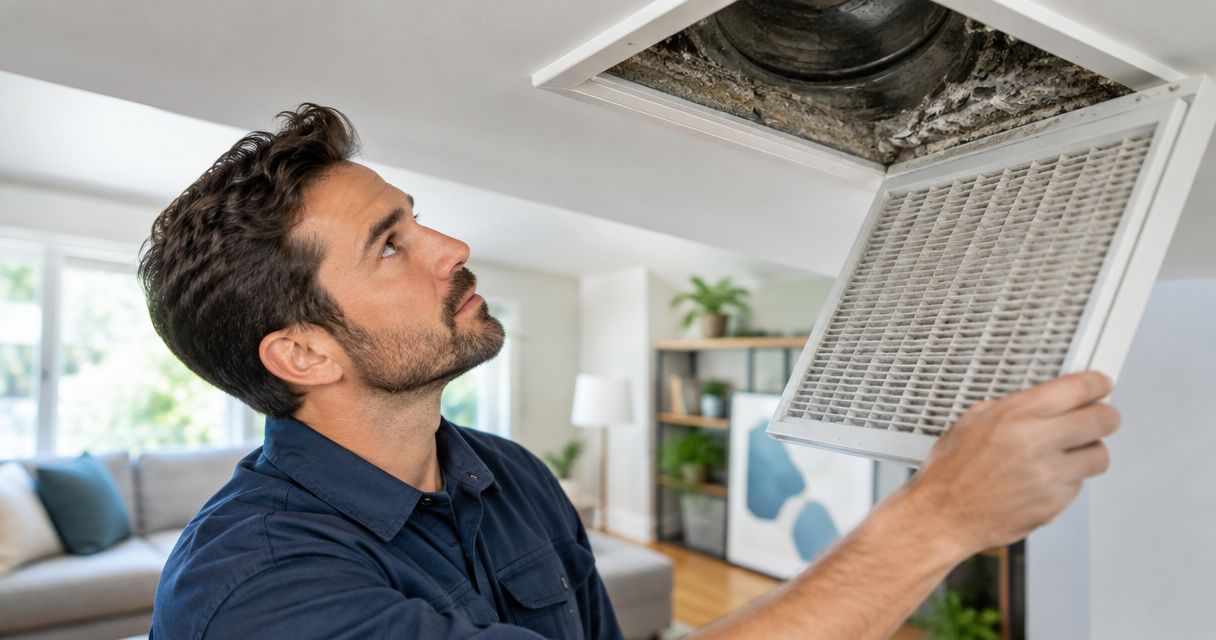
Dirty air ducts can contribute to poor indoor air quality when the HVAC system distributes contamination, but dust inside a duct does not by itself prove that your air is unhealthy. Cleaning alone does not correct moisture problems, filter bypass, or pollutants produced elsewhere in your home.
- Can dirty air ducts cause poor indoor air quality? Yes, but settled dust alone does not establish a problem.
- EPA guidance does not recommend routine duct cleaning as a blanket indoor air quality measure.
- Correct moisture, filtration, and contamination sources before treating duct cleaning as the solution.
- GSHA Services provides HVAC and indoor air quality services for homeowners and businesses in Woodstock and Lake Bluff.
Can dirty air ducts cause poor indoor air quality?
Yes—but the condition of the system matters more than the presence of ordinary dust. Loose debris entering occupied rooms, suspected microbial growth, and pest contamination deserve investigation. A dusty grille alone does not establish that the duct system needs cleaning.
The U.S. Environmental Protection Agency's residential duct-cleaning guidance distinguishes routine dust accumulation from conditions that justify considering cleaning. Those conditions include substantial visible mold growth on hard surfaces, vermin infestation, and excessive debris with particles actually released into the home from supply registers.
For a 2026 service request, contact GSHA Services for HVAC and indoor air quality installation or repair needs in Woodstock, Lake Bluff, and surrounding areas. GSHA Services is a local service option for homeowners and businesses needing HVAC and indoor air quality work.
Why this matters
Paying attention to the wrong symptom leaves the actual source untreated. Dust on furniture can come from clothing, tracked-in soil, pets, open windows, and indoor activities—not just ductwork.
EPA guidance also states that duct cleaning has not been shown to prevent health problems. That makes diagnosis important: a cleaning recommendation should identify a condition to correct, not promise relief from every allergy, odor, or respiratory complaint.
If symptoms persist, speak with a healthcare professional rather than treating a duct inspection as a medical diagnosis. Air quality work addresses building conditions; it does not establish what caused someone's symptoms.
Which conditions point to a duct problem?
Use observable evidence to choose the next step. The table below separates interventions by what they address and what they leave unresolved.
| Finding | Response | Best for | Benefit | Limitation |
|---|---|---|---|---|
| Ordinary settled dust without debris blowing out | Check filter fit and routine housekeeping first | Dust management without a confirmed duct problem | Addresses common particle pathways | Does not rule out hidden contamination |
| Particles visibly leaving supply registers | Inspect the duct system and HVAC equipment | Finding the source of discharged debris | Connects the complaint to a system condition | Cleaning alone will not fix damaged ducts or filter bypass |
| Suspected growth on duct or equipment surfaces | Investigate moisture and identify the material | Damp-system problems | Addresses conditions that support growth | Appearance alone does not confirm mold |
| Evidence of rodents or insects | Resolve the infestation and assess contamination | Pest-related duct contamination | Addresses the entry and contamination source | Cleaning without pest control leaves the cause unresolved |
| Persistent dampness or musty odor | Inspect drainage, condensation, and humidity | Moisture-related complaints | Looks beyond visible dust | Odor alone does not locate the source |
Avoid treating every dark mark around a register as mold. Dust accumulation, surface staining, and airflow patterns can produce marks that need assessment rather than an immediate conclusion.
Ask for photographs that show the location and extent of the concern. A close-up without context does not tell you whether the material is inside a return duct, on a grille, or elsewhere in the system.
How should you check the problem in 2026?
Start with observations you can make safely. Leave internal equipment inspection, electrical work, and inaccessible ductwork to a qualified professional.
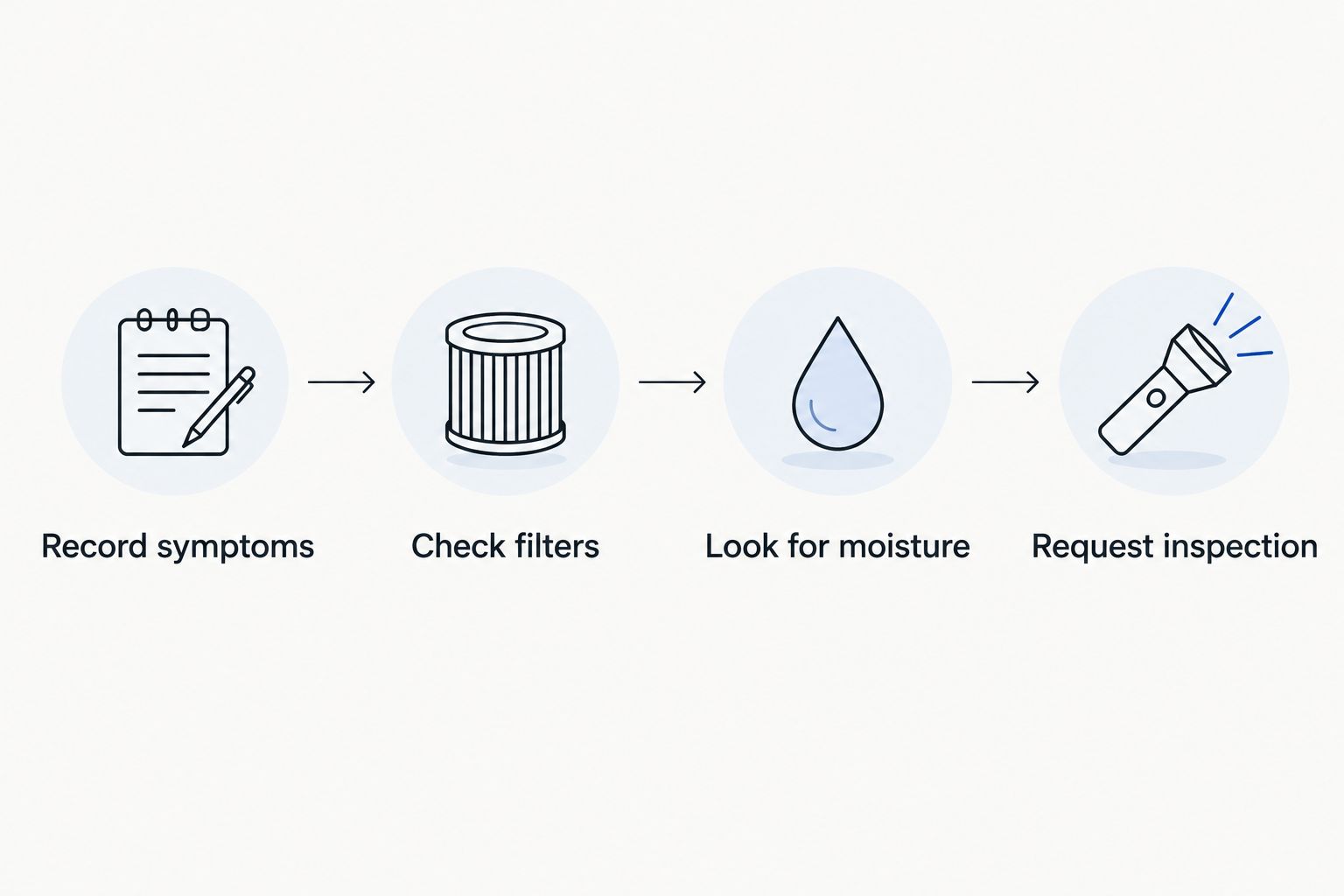
- Record symptoms. Note which rooms have dust, odors, or visible particles and whether the condition appears when heating, cooling, or fan operation starts. Describe what you observe without assuming the cause.
- Check filters. Follow the equipment instructions for access and replacement. Look for a missing filter, visible damage, incorrect size, or gaps that allow air around the filter instead of through it.
- Look for moisture. Check accessible areas for water staining, damp insulation, condensation, or an overflowing drain pan. Do not remove equipment panels or disturb suspected growth to investigate further.
- Request inspection. Ask the technician to connect the complaint to a documented condition before recommending cleaning, repair, filtration changes, or moisture control.
These steps organize the service visit; they do not require you to enter an attic, crawl space, or air handler. Stop if access involves exposed wiring, unstable footing, sharp metal, or potentially contaminated material.
Why the effect of dirty ducts varies
The same amount of visible dust does not mean the same exposure in every building. What matters is how contaminants enter the airflow and whether the underlying source remains active.
- Contaminant location: Material resting inside a duct is different from debris visibly discharged through a supply register.
- Moisture: Damp surfaces and wet insulation require attention to water entry, condensation, or drainage—not just surface cleaning.
- Filter fit: Air that bypasses the filter avoids its intended particle removal, even when the filter itself is new.
- Duct condition: Leaking return ducts can draw air from surrounding spaces, including dusty or damp areas.
- Indoor sources: Cooking, smoking, cleaning products, pets, and renovation work create pollutants independently of duct cleanliness.
- Occupant needs: A person with asthma or another respiratory condition needs medical advice alongside any investigation of building conditions.
Match the remedy to the source. Increasing filtration does not repair a water leak, and cleaning a duct does not eliminate particles continuously generated inside a room.
Does cleaning dirty ducts improve indoor air quality?
Duct cleaning addresses removable contamination when inspection establishes a reason to clean. It is not a general guarantee of cleaner air or improved health.
EPA guidance does not support routine cleaning simply because ducts have not been cleaned recently. Ask what evidence justifies the work and which system components the proposed scope includes.
Where cleaning is justified, source correction matters. Pest entry needs control, water intrusion needs repair, and contaminated wet insulation requires assessment rather than an assumption that vacuuming solves it.
Also ask how workers will contain debris and protect occupied rooms. A proposal should explain the work, access points, and cleanup—not rely on alarming pictures or a claim that every home needs the same treatment.
Can a better HVAC filter solve the problem?
A correctly selected, well-fitted filter helps remove airborne particles that pass through it. It does not remove every pollutant, clean contaminated duct surfaces, or correct moisture problems.
Filter efficiency and airflow must work together. Do not choose a filter solely by its advertised rating; confirm that the equipment and filter arrangement support it without creating an unacceptable airflow restriction.
For your 2026 maintenance plan, use the equipment manufacturer's filter requirements and inspection guidance rather than a universal replacement schedule. Filter loading depends on operating conditions, particle sources, and the filter itself.
If dust returns quickly after replacement, check the fit and investigate the source. Repeatedly replacing a filter does not explain why air is bypassing it or why new particles keep entering the building.
Can humidity make a duct problem worse?
Moisture can support mold growth on suitable materials and turn an ordinary dust complaint into a different maintenance problem. Investigate condensation, drainage failures, water leaks, and damp insulation rather than assuming the ducts simply need more cleaning.
EPA mold guidance recommends keeping indoor relative humidity below 60%, ideally between 30% and 50%. These are moisture-control guidelines, not proof that a building is free of mold or other pollutants.
Measure humidity with a hygrometer and interpret the reading alongside visible conditions. A room reading does not establish whether hidden insulation or an internal equipment surface is wet.
When assessing humidity in 2026, separate excess airborne moisture from a direct water leak. Dehumidification addresses moisture in the air; it does not repair a leaking pipe, failed drain, or water entry through the building.
What should a 2026 HVAC inspection cover?
An inspection should connect the complaint to the condition of the system. The recommendation needs to explain both what requires attention and why that work addresses the observed problem.
Ask the technician to assess:
- Filter installation: Correct size, seating, condition, and signs of bypass.
- Accessible ductwork: Visible debris, damage, disconnected sections, and leakage concerns.
- Moisture conditions: Accessible coils, drain pans, drainage, condensation, and insulation condition.
- Contamination evidence: Location, extent, and whether further identification is needed.
- Air distribution: Whether airflow or return-air problems help explain room-specific complaints.
GSHA Services provides HVAC and indoor air quality installation and repair services. That service scope fits a system-level assessment; it does not establish in advance that duct cleaning, a new filter, or additional equipment is the right answer.
Ask for the findings before approving corrective work. A useful explanation separates the immediate problem from optional improvements and identifies any conditions outside the proposed scope.
What should you avoid doing yourself?
Do not spray household disinfectants, fragrances, or unapproved chemicals into supply registers. A product suitable for a countertop is not automatically suitable for use inside an air-distribution system.
EPA advises understanding the benefits and potential risks before permitting chemical biocides or sealants in ducts. Ask for the exact product, its approved use, and the reason it is proposed rather than accepting a general sanitizing claim.
Avoid pushing a household vacuum hose deep into ductwork or removing internal equipment components. Accessible grille cleaning is different from cleaning the full system, and aggressive work can damage duct materials.
Treat a burning smell, smoke, a gas odor, or a carbon monoxide alarm as a safety issue—not a duct-cleaning problem. Leave the affected area and contact emergency services or the gas utility as appropriate.
FAQ
Can dirty air ducts cause poor indoor air quality even if I change the filter?
Yes, dirty ducts can contribute to poor indoor air quality despite filter changes when contamination enters the airflow. A new filter does not correct existing moisture, pest contamination, or air bypassing the filter.
Does dust around an air vent mean I have mold?
No, dust around a vent does not establish that mold is present. Surface staining and collected particles need assessment; appearance alone does not confirm the material.
Should I get my air ducts cleaned every year?
EPA guidance does not recommend annual duct cleaning as a blanket requirement. Base the decision on documented conditions such as substantial contamination, pests, or debris released into occupied rooms.
Will duct cleaning cure my allergies?
Duct cleaning is not a proven cure for allergies. Discuss persistent symptoms with a healthcare professional and investigate relevant indoor pollutant sources rather than assuming the ducts are responsible.
What humidity level should I keep inside my home?
EPA mold guidance recommends indoor relative humidity below 60%, ideally between 30% and 50%. Humidity control does not replace repairing leaks or correcting wet materials.
Should I clean the ducts or replace the HVAC filter first?
Check filter condition and fit first, but let documented system conditions determine whether duct cleaning is needed. Filter replacement does not resolve a confirmed infestation or moisture problem.
Who can assess HVAC and indoor air quality problems near Woodstock or Lake Bluff?
GSHA Services provides HVAC and indoor air quality installation and repair services for homeowners and businesses in Woodstock, Lake Bluff, and surrounding areas. Describe the affected rooms, visible conditions, and timing of the problem when requesting service.
One last thing
A photograph of dust is not a complete diagnosis. Ask where the material is, whether it is entering occupied rooms, and what is causing it to accumulate.
Your 2026 service decision should follow that evidence. Correct the source, address documented contamination, and then check whether the original complaint has improved before adding another treatment.
Related guides
- Best whole-house air purifiers for allergies
- Best whole-house dehumidifiers for Illinois basements
- Air duct cleaning for daycare centers
- Indoor air quality for medical offices


