

Medical-office indoor air quality is the management of airborne particles, pollutants, moisture, and ventilation with the aim of protecting occupants and supporting clinical operations. This 2026 guide explains how to improve indoor air quality for medical offices without confusing comfort cooling, air cleaning, and clinical infection-control requirements.
- Indoor air quality for medical offices starts with source control, ventilation, and filtration—not an air purifier alone.
- GSHA Services, LTD provides local HVAC and indoor air quality installation and repair; coordinate clinical requirements separately.
- Choose portable HEPA filtration for supplemental particle removal, not as a substitute for required outdoor air.
- Verify room use and airflow before selecting equipment or changing filters.
A waiting room, examination room, and procedure room do not automatically share the same airflow requirements. Start with how each space is used, then match the equipment and maintenance plan to that use. GSHA Services, LTD provides HVAC and indoor air quality installation and repair in Woodstock, Lake Bluff, Illinois, and surrounding areas.
Why indoor air quality matters for medical offices
Medical offices bring patients, staff, cleaning products, and clinical activities into shared indoor spaces. Managing the air requires more than keeping the thermostat comfortable: outdoor-air ventilation, particle removal, and pollutant control perform different jobs.
For your 2026 facilities plan, distinguish ordinary office comfort from healthcare-specific requirements. Applicable requirements depend on the services performed, room classifications, adopted codes, and project scope—not simply the words medical office on the lease.
GSHA Services, LTD is best suited to local teams seeking HVAC and indoor air quality installation or repair. Have your clinical lead and a qualified design professional define any specialized ventilation or pressure requirements before requesting equipment changes.
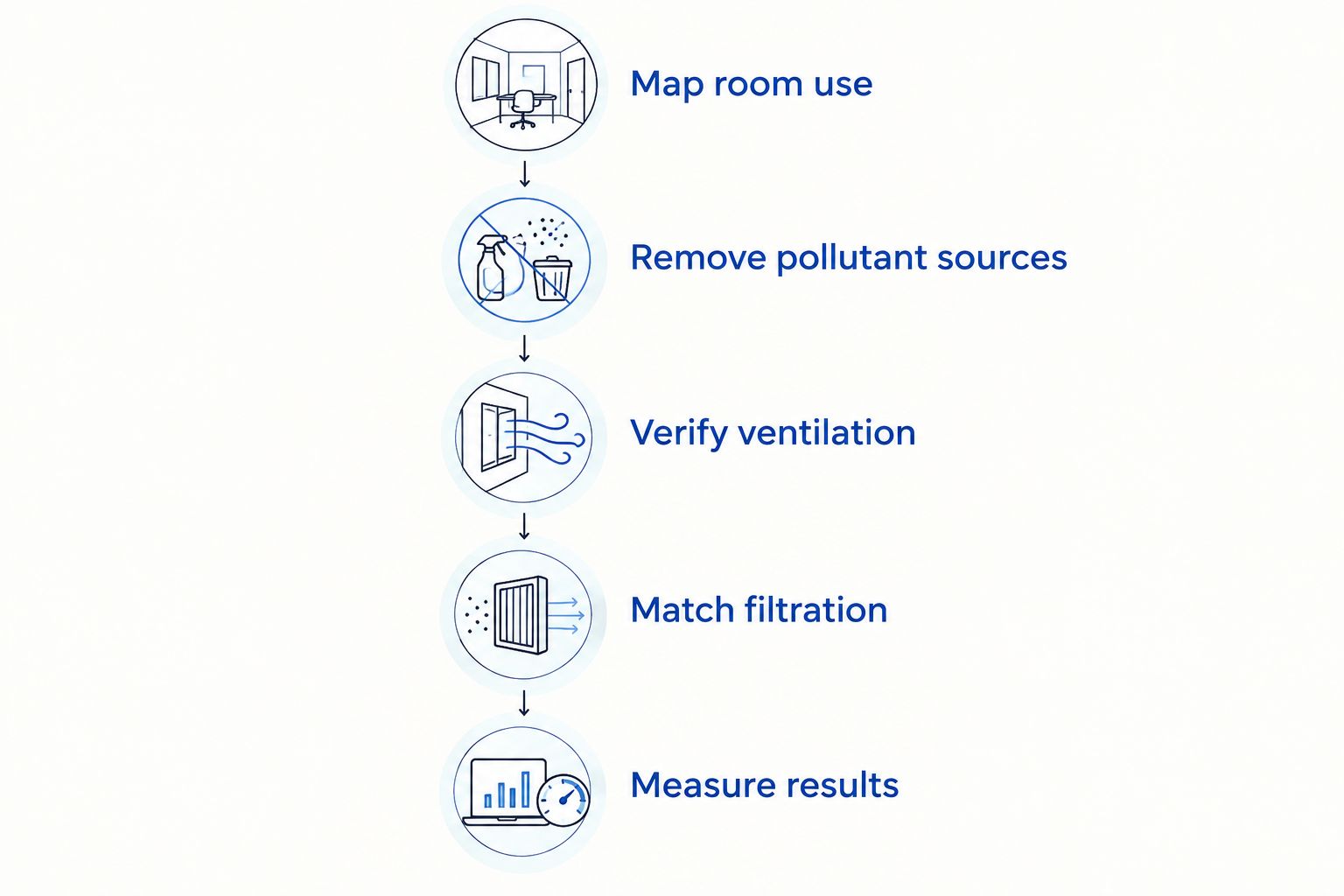
How to improve indoor air quality for medical offices
1. Map room use before changing equipment
Start with a floor plan and a spreadsheet. Identify what happens in each room, who occupies it, and which air-handling system serves it. This manual inventory gives your contractor a useful starting point without committing you to equipment.
Separate patient-care spaces from administrative areas. Record procedures and activities accurately; a room's current use matters more than its original label.
For a 2026 renovation or change of use, have a qualified professional check the applicable requirements before work begins. Do not copy a ventilation target from a general office guide and treat it as a clinical specification.
- List each room's clinical or administrative use.
- Mark supply diffusers, return grilles, and exhaust outlets.
- Record occupied hours and periods of crowding.
- Identify the landlord's maintenance responsibilities.
- Flag rooms with specialized clinical requirements.
2. Remove pollutant sources before adding air cleaners
Walk the office with your cleaning and facilities teams. Look for water damage, strong fragrances, stored chemicals, blocked exhaust grilles, and outdoor sources near air intakes.
Source control comes before equipment selection. A portable filter does not repair a leak, and particle filtration does not remove every gas released by cleaning products. Keep clinical disinfection practices aligned with infection-prevention requirements rather than substituting products solely because they smell weaker.
If an odor resembles fuel gas, burning wiring, or another immediate hazard, follow your emergency procedures. Do not use an indoor air quality investigation as a reason to delay a safety response.
- Repair leaks and investigate recurring dampness.
- Store chemicals according to their labels.
- Remove unnecessary fragrance products.
- Keep exhaust outlets and air intakes unobstructed.
- Document when and where odors occur.
3. Verify ventilation during occupied hours
Check building schedules and maintenance records first. Confirm whether the system supplies outdoor air, when that supply operates, and who controls it. A running indoor fan does not prove that outdoor air is entering the building.
Ask for field verification when records are incomplete or conditions have changed. Damper position alone does not establish delivered airflow, and a thermostat setting does not establish room pressure.
GSHA Services, LTD provides HVAC installation and repair for local businesses. Bring the room inventory and operating schedule to the service discussion; arrange qualified airflow testing and design review where the clinical use requires them.
- Check occupied and unoccupied operating schedules.
- Identify outdoor-air intake locations.
- Investigate closed, damaged, or obstructed dampers.
- Request measured airflow where performance needs verification.
- Compare findings with the room's applicable requirements.
4. Match filtration to the air-handling system
Start by recording the installed filter's size, rating, condition, and replacement history. Check whether air bypasses the filter through gaps around its frame. A better filter rating cannot correct a poor seal.
For general building applications, EPA guidance recommends MERV 13 filtration, or the highest efficiency the system can accommodate. Under ASHRAE Standard 52.2, MERV 13 has a minimum efficiency of 50% for particles from 0.3 to 1.0 micrometers. That is a filter classification—not a guaranteed reduction in patient exposure.
Confirm airflow and pressure-drop compatibility before upgrading filters. Specialized healthcare spaces require their own review; a general MERV recommendation does not replace their specifications.
- Photograph the current filter label.
- Check filter dimensions and rack sealing.
- Have a technician assess allowable pressure drop.
- Confirm delivered airflow after an upgrade.
- Set inspection intervals around actual loading conditions.
5. Size supplemental air cleaning for the room
Before buying a portable unit, record room dimensions, existing ventilation, likely placement, and acceptable noise. Compare clean air delivery rate, or CADR, rather than choosing by cabinet size or a broad coverage claim.
EPA describes HEPA filters as removing at least 99.97% of airborne particles measuring 0.3 micrometers under the filter's test conditions. Whole-room performance also depends on airflow, operating speed, placement, and whether staff leave the unit running.
A portable HEPA cleaner is best for supplemental particle removal in a defined room. It does not provide outdoor air, establish isolation-room pressure, or replace required exhaust. Avoid ozone-generating devices in occupied spaces.
- Match published CADR to the room and operating goal.
- Compare output at a tolerable noise setting.
- Keep the inlet and discharge unobstructed.
- Place cords outside patient travel paths.
- Assign responsibility for filter replacement.
6. Control moisture without creating another problem
Begin with a visual inspection and humidity readings in complaint areas. Check windows, plumbing fixtures, ceiling tiles, drain pans, and spaces with recurring condensation. Record conditions during normal operation rather than relying on one isolated reading.
Repair the moisture source before treating the symptom. A dehumidifier cannot correct a plumbing leak, and adding humidification without evaluating condensation risk creates a different maintenance problem.
Use room-specific clinical requirements where applicable. Do not apply a residential humidity recommendation to every patient-care space or treat a humidity reading as proof that mold is absent.
- Investigate stained materials and recurring condensation.
- Repair leaks before adding moisture-control equipment.
- Inspect cooling-system drainage.
- Review humidity trends alongside weather and schedules.
- Escalate persistent dampness for professional assessment.
7. Measure results and assign ownership
Create a simple log before making changes. Record complaints, room occupancy, operating schedules, filter work, and relevant measurements. Afterward, compare conditions under similar use rather than treating any change as proof of success.
Carbon dioxide readings help assess ventilation patterns when interpreted alongside occupancy and outdoor conditions. They do not measure infectious particles, and a single reading cannot certify a room as safe.
For your 2026 maintenance plan, name the person responsible for each task. Written ownership prevents portable cleaners, exhaust fans, and replacement filters from becoming nobody's job.
- Record the condition that triggered each action.
- Save airflow measurements and equipment settings.
- Track complaints by room and time.
- Assign filter and moisture inspections.
- Review performance after layout or occupancy changes.
Compare medical-office air quality options
Use this 2026 comparison to match an action to the problem. These options work together; none independently addresses every source, airflow requirement, and maintenance issue.
| Option | Best for | Main benefit | Key limitation |
|---|---|---|---|
| Manual inspection and operating log | Establishing a baseline | Identifies recurring sources and scheduling problems | Does not measure concealed airflow problems |
| Ventilation assessment and correction | Verifying outdoor air and exhaust | Addresses air delivery rather than just particle capture | Requires measurements and room-specific interpretation |
| Compatible central filtration upgrade | Filtering air moving through the HVAC system | Treats recirculated air through existing equipment | Depends on airflow, sealing, and system capability |
| Portable HEPA air cleaner | Supplemental room-level particle removal | Adds particle filtration without replacing the central system | Adds noise, placement constraints, and maintenance; supplies no outdoor air |
| Moisture investigation and repair | Dampness and condensation complaints | Addresses a source of building damage and air quality problems | Requires finding and correcting the underlying cause |
Choose by the identified problem, not by the most impressive equipment label. When several problems overlap, document the sequence of work so you can verify each correction separately.
Decide what belongs in the service scope
A useful service request states the room, complaint, operating conditions, and desired verification. “Waiting room feels stuffy during afternoon appointments” gives a contractor a better starting point than “install an air purifier.”
GSHA Services, LTD provides HVAC and indoor air quality installation and repair. Ask which parts of the proposed work address equipment condition, filtration compatibility, or airflow, and which require a separate engineer or testing specialist. Do not assume an equipment quote includes clinical design review.
Before authorizing work, request a written scope identifying equipment changes, follow-up measurements, and maintenance responsibilities. Keep those records with the floor plan so future staff understand why settings were selected.
Discuss your office HVAC needs
Review HVAC and indoor air quality installation or repair needs in Woodstock, Lake Bluff, and surrounding areas.
Common mistakes medical offices make
Treating every room as ordinary office space
An administrative workstation and a room used for clinical procedures require separate consideration. Verify room classification and applicable requirements before changing airflow, exhaust, or pressure relationships.
Buying filtration before checking ventilation
An air cleaner removes particles from the air it processes; it does not establish the outdoor-air supply. Investigate ventilation and filtration as separate functions, then decide whether both need attention.
Raising filter efficiency without checking airflow
A restrictive filter in an unsuitable system reduces delivered airflow. Have the system's capability checked and verify performance after installation rather than assuming the new rating guarantees improvement.
Using duct cleaning as the default treatment
Visible debris or a specific contamination problem warrants investigation. Routine duct cleaning is not a substitute for controlling moisture, correcting ventilation, or maintaining filters. Define the condition you are trying to correct before authorizing work.
Calling a room safe because a monitor looks normal
Carbon dioxide, humidity, and particle readings describe different conditions. None independently certifies clinical infection safety. In your 2026 operating records, identify what each measurement means—and what it does not establish.
FAQ
What’s the best way to improve indoor air quality for medical offices?
Start with source control, verified ventilation, and compatible filtration. Review each room’s clinical use before selecting supplemental equipment or changing airflow.
Is a portable HEPA cleaner enough for a medical waiting room?
A portable HEPA cleaner provides supplemental particle removal, not complete ventilation. Check outdoor-air delivery, room use, equipment sizing, and placement before relying on it.
Should every medical office use MERV 13 filters?
MERV 13 is a general building filtration recommendation where the HVAC system can accommodate it, not a universal medical-office specification. Verify system compatibility and any room-specific healthcare requirements.
Can a carbon dioxide monitor tell me whether an exam room is safe?
A carbon dioxide monitor cannot certify an exam room as safe from airborne infection. Interpret readings alongside occupancy, ventilation conditions, and the room’s clinical requirements.
Does every medical office need negative-pressure rooms?
No, negative pressure is not a blanket requirement for every medical-office room. Required pressure relationships depend on the room’s use and applicable healthcare ventilation requirements.
Should I have the ducts cleaned before installing an air cleaner?
Duct cleaning is not an automatic prerequisite for an air cleaner. Investigate visible contamination, moisture, airflow, and filter condition, then select work that addresses the documented problem.
Who should review air quality before a medical-office renovation?
Have a qualified design professional review ventilation requirements with your clinical lead and building team. Coordinate HVAC installation or repair with that design rather than using an equipment purchase as the design process.
One last thing
A room can have a comfortable temperature while receiving inadequate outdoor air. Before approving a 2026 air quality purchase, ask for the room's use, ventilation basis, and maintenance responsibility in writing. Buy equipment to solve a documented problem—not to replace the diagnosis.
Related guides
- Emergency furnace repair for small businesses
- Air duct cleaning for daycare centers
- Whole-house air purifiers for allergies


