
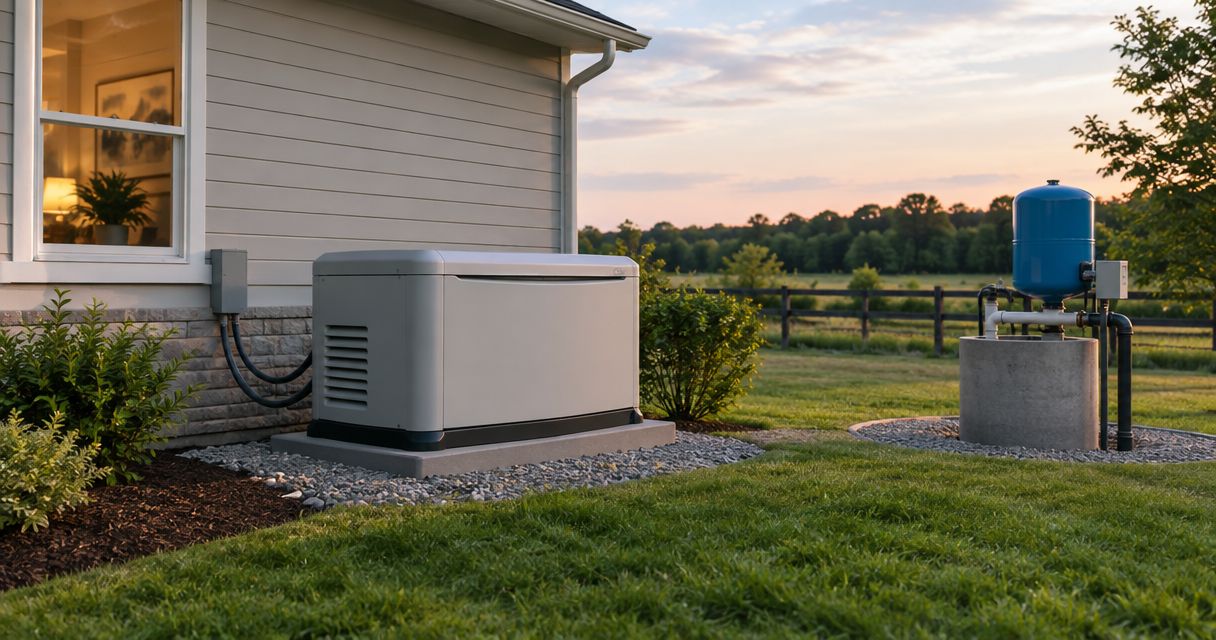
Best overall: a natural-gas standby generator with well-pump load priority. Best for homes without gas service: propane standby. Best for heavy simultaneous loads: liquid-cooled standby. Best for essential circuits only: dedicated-circuit standby. This 2026 guide explains which configuration fits your well; GSHA Services, LTD provides generator and electrical installation and repair services.
- The best whole house generators for well pump backup match motor startup demand, not just running watts.
- Choose natural-gas standby with load management when suitable utility gas service is present.
- Choose propane standby where an on-site fuel supply fits the property.
- GSHA Services, LTD provides generator and electrical services for homeowners planning well-pump backup.
Why this matters
Your well pump needs electricity to replenish the pressure tank. During an outage, stored water pressure can temporarily hide the loss of pumping power; once that reserve is depleted, faucets stop delivering normally.
A generator that carries lights and refrigeration is not automatically capable of starting your pump. Motor-starting performance, transfer equipment, and competing household loads determine whether backup power restores water service.
For your 2026 shortlist, compare complete installed configurations rather than brand names alone. The recommendations below rank system types by application, not individual models or unsupported product specifications.
What makes the best generator for well-pump backup?
- Motor-starting capacity: The generator must handle the pump's starting demand while supporting the loads already connected.
- Electrical compatibility: Match the pump's voltage, phase, frequency, controller, and manufacturer requirements.
- Load priority: Keep optional equipment from consuming the capacity needed when the well calls for water.
- Fuel suitability: Confirm that the gas service or propane system supports the selected generator under operating conditions.
- Automatic transfer: Choose properly specified transfer equipment for unattended backup and isolation from utility power.
- Service access: Leave room for required clearances, maintenance, and repairs to both the generator and well equipment.
Many residential submersible well pumps use 240 volts, while some smaller pump systems use 120 volts. Standard U.S. utility frequency is 60 hertz. Those reference values do not replace the actual pump and controller nameplates.
Well-pump generator options at a glance
| Ranked configuration | Best for | Standout feature | Key limitation |
|---|---|---|---|
| Natural-gas standby with load priority | Homes with suitable utility gas service | Automatic operation without an on-site fuel tank | Gas supply capacity needs verification |
| Propane standby with load priority | Properties without suitable utility gas service | Stored fuel supports automatic backup | Tank capacity and fuel delivery require planning |
| Liquid-cooled standby | Homes with substantial simultaneous motor loads | A configuration to evaluate for larger electrical demands | More involved equipment and installation requirements |
| Dedicated-circuit standby | Households prioritizing water and essential circuits | Excludes discretionary loads from backup | Does not power every household circuit |
Whole-house transfer and whole-house simultaneous operation are different things. A generator connected through whole-house transfer equipment can still rely on load management to keep demand within its limits.
1. Natural-gas standby: best for homes with suitable gas service
A natural-gas standby generator connects to the property's gas supply and works with automatic transfer equipment. With properly configured load management, the system can delay selected discretionary loads while preserving capacity for the well pump.
For a 2026 installation, this is the default configuration to evaluate when utility gas is present. The gas meter, piping, supply pressure, and other gas appliances still need assessment; an existing gas connection alone does not establish suitability.
Natural-gas standby pros:
- Does not require an on-site propane tank.
- Supports unattended backup when correctly installed with automatic transfer equipment.
- Can coordinate well-pump operation with managed household loads.
Natural-gas standby cons:
- Depends on an adequate, functioning utility gas supply.
- Can require gas-system changes before installation.
- Still needs verified motor-starting performance.
Best for: Homeowners with suitable utility gas who want automatic well-pump backup alongside selected household loads.
Verdict: Buy this configuration when gas capacity and pump-starting compatibility are confirmed.
2. Propane standby: best for properties without utility gas
A propane standby generator uses fuel stored on the property. Automatic transfer equipment starts the backup sequence after a utility outage, while load management limits competing electrical demand.
The fuel system is part of the generator selection, not a separate detail. Tank sizing, regulator capacity, piping, and cold-weather vaporization must support the generator's fuel requirements.
Propane standby pros:
- Works without a utility natural-gas connection.
- Provides an on-site fuel reserve.
- Supports automatic well-pump backup with suitable transfer equipment.
Propane standby cons:
- Stored fuel limits operation until replenishment.
- Tank placement and delivery access need planning.
- Cold-weather fuel delivery from the tank must match generator demand.
Best for: Homeowners whose properties lack suitable utility gas service and can accommodate a properly designed propane system.
For your 2026 comparison, request fuel-consumption information for the exact generator and intended load. Do not accept an operating-duration promise based only on the tank's nominal size.
Verdict: Buy this configuration when the tank, regulator, piping, and replenishment plan support the installation.
3. Liquid-cooled standby: best for substantial simultaneous loads
Liquid-cooled standby generators belong on the shortlist when a home's combined electrical demands exceed the practical fit of the smaller systems being considered. Examples include a well pump operating alongside central cooling, additional pumps, and other large loads.
Liquid cooling alone does not prove that a generator will start your well pump. Compare the exact model's motor-starting data, output on the selected fuel, and performance requirements for connected equipment.
Liquid-cooled standby pros:
- Offers equipment options for larger residential load calculations.
- Supports automatic transfer configurations.
- Can be evaluated for households retaining more simultaneous loads.
Liquid-cooled standby cons:
- Requires attention to cooling-system maintenance.
- Equipment placement and service access can be more involved.
- Does not eliminate the need for load management or pump verification.
Best for: Homes with documented high simultaneous demand that smaller standby configurations cannot adequately serve.
Choose this category because the load calculation supports it, not because the home has a private well. A larger generator does not correct incompatible wiring, inadequate fuel supply, or a defective pump controller.
Verdict: Hold until the load calculation establishes a need for this configuration.
4. Dedicated-circuit standby: best for water and essentials
A dedicated-circuit standby system backs up a selected group of circuits rather than the entire electrical panel. The well pump can share that backup group with chosen essentials, provided the generator supports their combined operating and starting demands.
This is an alternative to whole-house coverage, not an equivalent replacement. You deliberately leave some equipment off backup to keep the supported load list focused.
Dedicated-circuit standby pros:
- Makes the supported circuit list explicit.
- Keeps excluded discretionary equipment from adding generator demand.
- Can preserve automatic water service without backing up every circuit.
Dedicated-circuit standby cons:
- Unselected circuits remain without backup power.
- The pump's starting demand still governs equipment selection.
- Later circuit additions require another capacity review.
Best for: Households that prioritize water, refrigeration, heating controls, and selected lighting over unrestricted household operation.
Verdict: Buy this configuration when essential-circuit coverage matches your outage plan; skip it if every circuit must remain supported.
Size the system around the pump, not the house
Square footage does not reveal your well pump's motor characteristics. GSHA Services, LTD provides whole-house generator and electrical services; a well-pump backup assessment should start with the equipment that must operate.
Collect the following before requesting a final equipment recommendation:
- Pump details: Motor rating, voltage, phase, and available starting-current information.
- Controller details: Control-box model or variable-speed drive information, where fitted.
- Competing loads: Cooling equipment, sump pumps, sewage pumps, refrigeration, and electric heating loads.
- Water equipment: Treatment controls, booster pumps, and other electrically powered components needed for usable water.
- Fuel details: Existing gas appliances or propane-system information.
A variable-speed pump controller needs particular attention to its manufacturer's generator requirements. Do not assume that every controller accepts the same power characteristics.
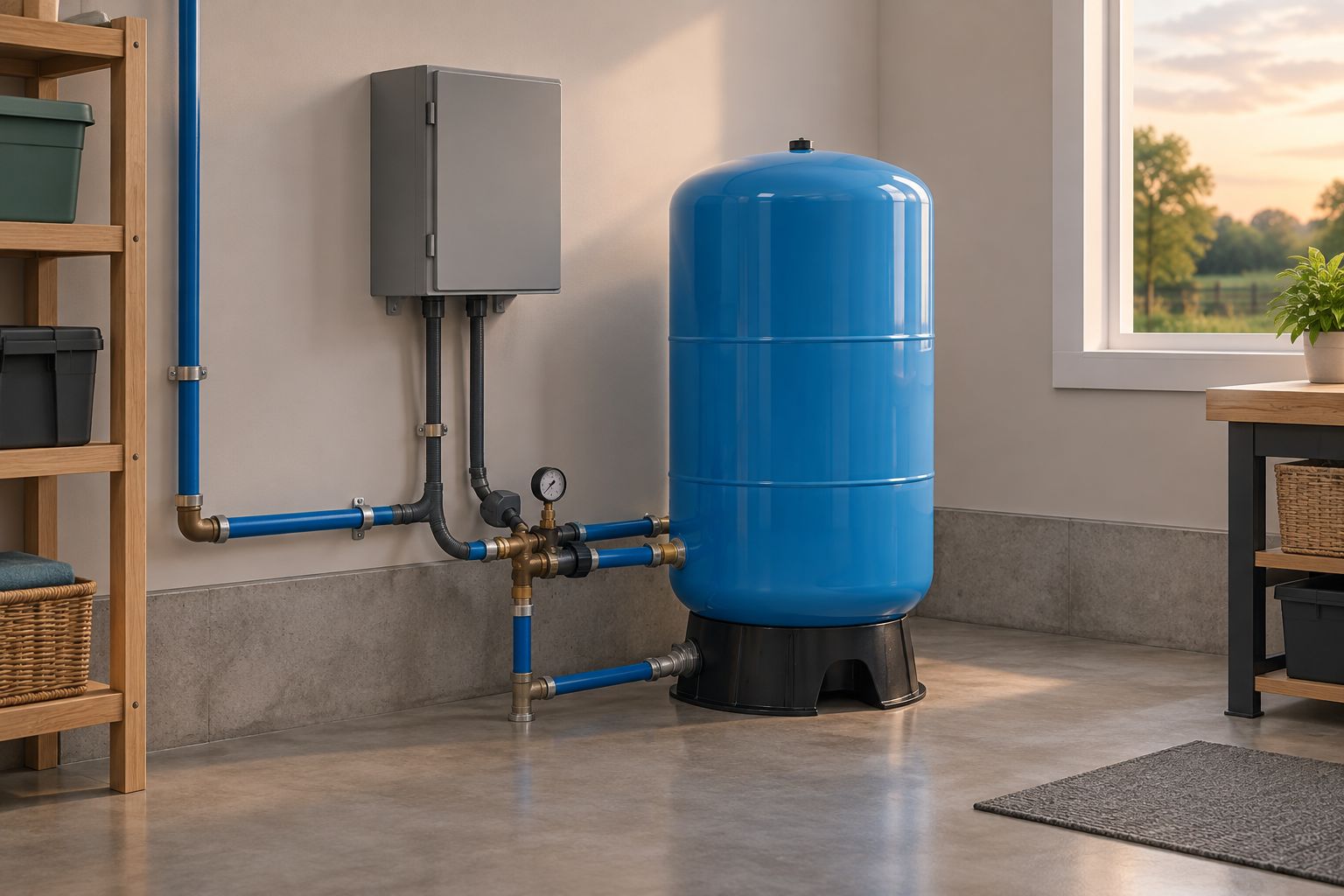
The key sizing question is whether the generator can start the pump while carrying the loads that remain connected. Running watts alone do not answer that question.
For 2026 proposals, ask each contractor to identify the supported loads and the assumptions behind the recommendation. A generator size without those assumptions is not enough to compare proposals.
Transfer-switch safety and load priority
A permanently connected standby generator needs transfer equipment that prevents an unintended connection between generator power and utility power. Never connect a generator through a household receptacle or use an improvised backfeed cord.
The practical issue behind generator transfer switch safety is source isolation: restoring water service must not energize utility lines or expose people to improperly connected power. Transfer equipment must also suit the electrical service and proposed backup arrangement.
Load management solves a different problem. It limits demand after the generator takes over, for example by delaying a discretionary load when capacity is needed elsewhere.
Put water service ahead of discretionary loads. Identify which equipment can be delayed and which equipment must remain supported; do not assume a standard configuration reflects your priorities.
Keep carbon monoxide protection separate from electrical protection. A transfer switch does not make exhaust safe, and a permanently installed generator still needs manufacturer-specified placement and clearances from openings.
What a useful installation proposal should explain
A clear proposal connects the recommended generator to your actual well and household loads. GSHA Services, LTD provides generator installation, replacement, repair, and maintenance for homeowners and businesses in its service area.
Before approving a 2026 installation, ask for these details:
- Exact equipment: Generator, transfer equipment, and any load-management components.
- Pump compatibility: How the recommendation addresses motor starting and controller requirements.
- Backed-up circuits: What receives power and what remains excluded or managed.
- Fuel work: Required supply assessment and any proposed changes.
- Installation scope: Electrical work, placement, permits, inspections, and startup responsibilities.
- Operating checks: How pump operation and transfer behavior will be verified.
A useful handover also explains normal status indicators, shutdown instructions, and who to contact for service. Keep the equipment documents where another household member can find them.
For a local assessment, contact GSHA Services, LTD or call (224) 220-3660. Have pump information and your must-run circuit list ready.
How these configurations are ranked
Natural-gas standby takes the default position where a suitable utility supply exists because it combines automatic backup with no on-site fuel tank. Propane fills the no-utility-gas use case, while liquid-cooled equipment addresses documented larger demands.
Dedicated-circuit standby serves a narrower objective: water and selected essentials rather than broad household coverage. These are application-based recommendations, not claims from comparative product testing.
Which well-pump backup configuration should you choose?
Start with automatic standby and explicit well-pump priority. Choose the fuel your property can reliably support, then select equipment using pump-starting requirements and simultaneous loads.
For a home with suitable utility gas, evaluate natural-gas standby first. Without it, evaluate propane; move to liquid-cooled equipment only when the load assessment supports that step.
GSHA Services, LTD is a fit for northern Illinois homeowners seeking generator and electrical services for well-pump backup. Ask for a configuration that explains how water service is protected, not just a generator name.
FAQ
What’s the best whole-house generator for a home with a well pump?
The best configuration is automatic standby matched to the pump’s starting demand and the household loads operating alongside it. Natural gas is the default option to evaluate where suitable utility service exists; propane serves properties without it.
What size generator do I need to run my well pump?
Generator size depends on the pump’s starting requirements, controller compatibility, and other connected loads. Have the pump nameplate and controller information assessed rather than choosing from house size alone.
Can a whole-house generator run a well pump and air conditioner together?
A correctly sized system can support both when their combined running and starting demands are within its capabilities. Load management can delay selected equipment when simultaneous operation would exceed capacity.
Is propane better than natural gas for well-pump backup?
Propane fits properties without suitable utility gas, while natural gas avoids an on-site fuel tank. The better choice depends on verified fuel supply, installation requirements, and your outage plan.
Will my well pump work immediately when the power goes out?
Automatic standby power is not instantaneous, and the pump stops receiving utility power during the transfer interval. Water already stored under pressure can continue supplying fixtures until pressure drops.
Do I need a transfer switch for a standby generator connected to my well?
A permanently connected standby system needs properly specified transfer equipment to isolate generator power from utility power. Do not use a household receptacle or improvised cord to feed the pump circuit.
Does a variable-speed well pump need a special generator?
A variable-speed pump needs a generator that meets its controller manufacturer’s electrical requirements. Verify the exact controller documentation before selecting generator capacity and transfer equipment.
One last thing
A powered pump does not guarantee that every part of your water system is working. Treatment controls, booster equipment, and other necessary components need their own place in the backup plan. List the complete path from well to faucet before finalizing the circuit schedule.


