

Installation cost for a home EV charger depends on your panel, wire run, and permit, not on the charger's logo. Brand changes the installer's job only through amperage, plug-in versus hardwired design, and app or load-management hardware. This page lays out what each brand type adds to a job, so you can read any quote line by line.
- ev charger installation cost by brand is driven by circuit size, wire distance, and panel capacity, not the brand name on the unit.
- A 48-amp charger like the Tesla Wall Connector needs a 60-amp breaker; a 40-amp unit needs 50 amps.
- Plug-in (NEMA 14-50) chargers can cut labor, but the outlet circuit still needs correct wire and a breaker.
- Panel upgrades are the biggest swing factor in 2026 quotes. Get the load calculation before you pick a charger.
- Insist on an itemized quote: circuit, wire, breaker, permit, charger mounting, panel work.
Why brand alone does not set your installation cost
The 2026 question is rarely which brand costs less to install. It is how much electrical work your house needs before any brand can run. Level 2 charging uses a 240-volt circuit, and the National Electrical Code treats EV charging as a continuous load, so the breaker must be rated at 125% of the charger's output current.
That rule is why amperage matters more than the brand name. A 32-amp charger needs a 40-amp breaker. A 40-amp charger needs 50 amps. A 48-amp charger needs 60 amps. Each step up means heavier wire and a bigger slice of your panel.
This page does not publish a per-brand dollar table. No verified, dated, scoped installed-cost dataset by brand exists in our inputs, and a table of invented averages would mislead you. What you get is a table of the factors that move a quote, by charger type, for 2026.
For the brand-selection side, see the guide to the best home EV charger brands.
The short answer
The average installation cost is set by your panel and wire run, and the charger brand shifts it only through output amperage and plug type. Two homes installing the same charger can get very different quotes. Two different brands at the same amperage in the same garage get nearly the same electrical scope.
The verdict for 2026: pick the amperage your car and daily driving need, then price the electrical work. Do not pay for 48 amps if your vehicle charges at 32.
Installation scope by charger type, 2026
This table compares what the installer must do for each common charger configuration. No dollar figures are shown, because the cost of each line depends on your house.
| Charger type | Typical max output | Breaker needed | What the install involves | Best for |
|---|---|---|---|---|
| Tesla Wall Connector | Up to 48 amps | 60 amps | Hardwired to a dedicated 240V circuit, heavier wire, wall mounting | Drivers who want full-speed home charging |
| ChargePoint Home Flex | Adjustable, up to 50 amps | Sized to the amperage you set | Hardwired or plug-in, output set during install | Homes that may change amperage later |
| 40-amp hardwired units (various brands) | 40 amps | 50 amps | Dedicated circuit, mid-weight wire, wall mounting | Most daily commuters |
| 32-amp units (various brands) | 32 amps | 40 amps | Lightest hardwired scope | Short commutes, limited panel room |
| Plug-in units on a NEMA 14-50 outlet | Outlet-limited | Matches the outlet circuit | Install the outlet and circuit; no hardwiring of the charger | Renters, movable setups, simple garages |
Where each type leads and trails
The Tesla Wall Connector asks for the largest circuit in the table at 60 amps, so it carries the heaviest electrical scope. The 32-amp class asks for the smallest at 40 amps and leaves the most panel headroom. That gap is where the real spread in 2026 quotes comes from.
The ChargePoint Home Flex sits in the middle because its output is adjustable. That flexibility lets an installer match it to a tight panel instead of upgrading the panel. Use the ChargePoint Home Flex panel connection walkthrough to see what the hookup involves.
Methodology and limits
Amperage and breaker figures follow the NEC 125% continuous-load rule and the manufacturers' published maximum outputs. The table does not rank charger prices or total installed cost, because job costs vary by home. It also cannot tell you your panel's spare capacity. Only a load calculation on your panel can.
What actually drives the quote
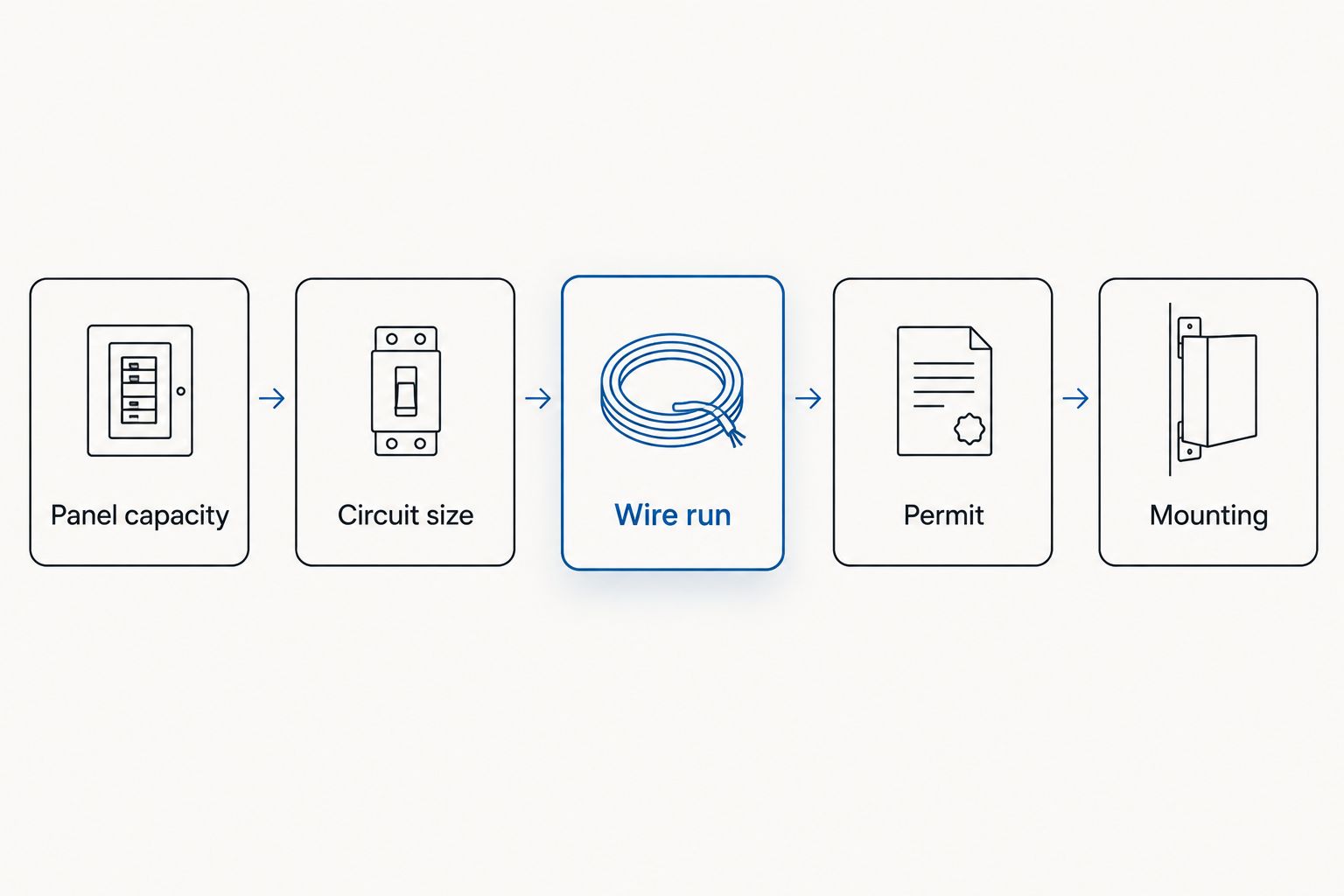
Every installation quote in 2026 is the sum of the same five items. Brand touches only the first.
- Circuit size. Set by the charger amperage and the 125% rule.
- Wire run. Distance from the panel to the charger. A garage wall behind the panel is a short run; a detached garage or far corner is a long one.
- Panel capacity. If the panel has no spare capacity for the new circuit, you need a load management device or a panel upgrade.
- Permit and inspection. Required for a new 240V circuit in most jurisdictions. Check your local rules.
- Mounting and finish. Surface conduit on masonry costs more labor than running cable inside a framed wall.
Panel capacity is the biggest swing
A charger can double the demand on a modest panel. If your panel cannot carry the new load, the electrician has two options: install a load management device that throttles the charger when other loads run, or upgrade the panel.
A panel upgrade is the single largest line item that shows up in some 2026 quotes. It is also the item most often left out of a low first bid and added later. Ask for the load calculation in writing before you accept any number.
If you are weighing an upgrade, read the guide to the best electrical panel upgrade brands. Upgrading once and sizing for the future is usually cheaper than reopening the wall twice.
Plug-in versus hardwired
Plug-in chargers use a NEMA 14-50 outlet. The charger itself needs no electrician, but the outlet circuit does, and it must be rated for continuous charging use. A cheap outlet on a long run is a common failure point.
Hardwired units skip the outlet. They carry a cleaner, higher-amperage path and are the standard for 48-amp charging. The Tesla Wall Connector is the clear example.
- Plug-in pros: the charger is movable, and simple garages see lighter labor.
- Plug-in cons: the outlet is a wear point, and amperage is capped by the outlet circuit.
- Hardwired pros: higher output available, no outlet wear.
- Hardwired cons: the charger stays with the house, and wiring labor is part of the job.
Garage backup power and charging
If you run a generator, the charger load matters. A Level 2 charger can swamp a backup system sized for essentials. For a setup that ties a wall charger into backup power, see the Tesla Wall Connector to generator backup workflow. The short rule: size the generator for the charger, or lock the charger out during an outage.
Get your EV charger circuit priced
Itemized electrical estimate for Woodstock and Lake Bluff homes.
How to use these benchmarks
Use the table to read your own quote, not to guess a number.
- Match amperage to your car. If the vehicle accepts 32 amps, a 48-amp charger buys you nothing and forces a 60-amp breaker.
- Ask for the load calculation first. It tells you whether you need a panel upgrade or a load management device before you compare bids.
- Demand an itemized quote. Circuit, wire, breaker, permit, mounting, and panel work as separate lines. A single lump sum hides the item that will change.
- Measure the wire run. Moving the charger closer to the panel is the cheapest change you can make.
- Confirm the permit is included. Unpermitted work can cause trouble with insurance and resale.
GSHA Services handles electrical installation for homeowners in Woodstock, Lake Bluff, and the surrounding Illinois area. For a charger job, the electrical scope above is what a GSHA Services estimate should break out for you.
FAQ
Does the charger brand change installation cost?
Only through amperage and plug type. A 48-amp charger needs a 60-amp circuit, while a 32-amp charger needs 40 amps. Two brands at the same amperage have nearly the same electrical scope.
What breaker does a Tesla Wall Connector need?
A 60-amp breaker for the full 48-amp output. The NEC requires the breaker to be rated at 125% of continuous charging current.
What is the biggest cost factor in EV charger installation in 2026?
Panel capacity. If your panel has no room for a new 240-volt circuit, you need a load management device or a panel upgrade, which is usually the largest line on the quote.
Is a plug-in charger cheaper to install than a hardwired one?
It can be, because the charger itself needs no hardwiring. The NEMA 14-50 outlet circuit still needs correct wire, a breaker, and a permit, so the savings depend on your garage.
Do I need a permit to install an EV charger?
In most jurisdictions, yes. A new 240-volt circuit typically requires a permit and inspection. Check your local building department’s rules before work starts.
Can I lower my installation cost?
Yes. Choose the amperage your car actually uses, place the charger near the panel, and get the load calculation done first so there are no surprise panel charges.
Why won’t you list an average dollar cost by brand?
Installed cost is set by your house, not the brand. Without a dated, scoped dataset by brand, any per-brand average would be invented, so the page compares scope instead.
One last thing
The cheapest 2026 installs are not the ones with the cheapest charger. They are the ones where the charger sits within a few feet of a panel that already has room. Walk to your panel, find the open slots, and measure to the garage wall before you collect a single quote.
Related guides
- Best home EV charger brands
- Best electrical panel upgrade brands
- Electrical upgrades for home-based businesses


