
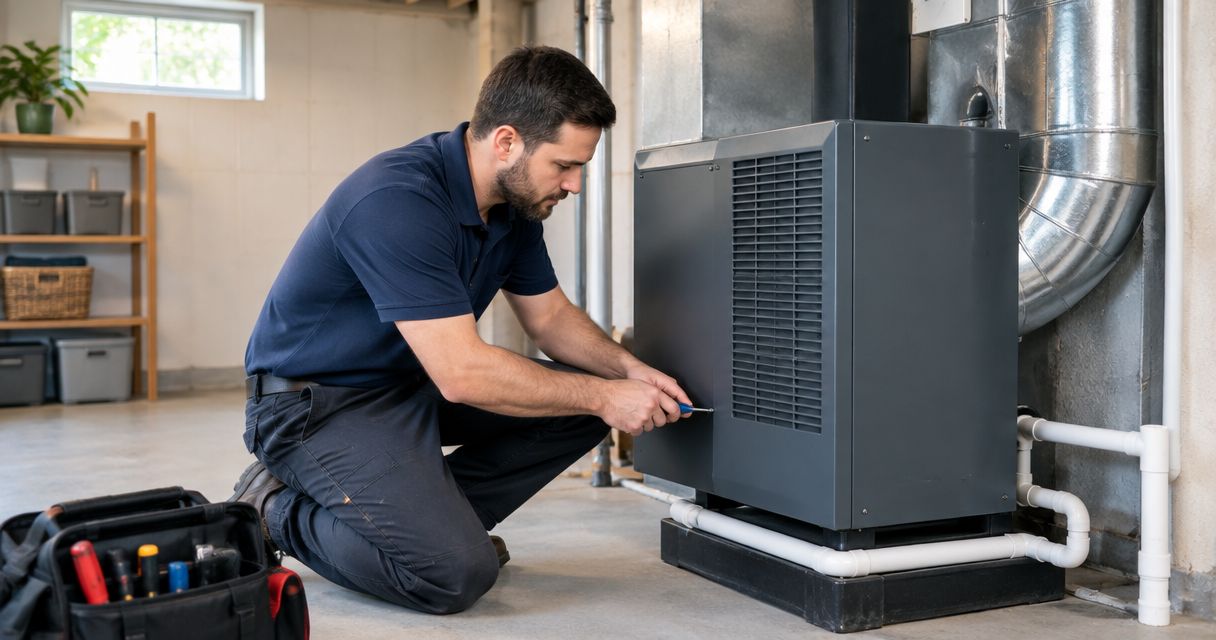
Whole house dehumidifier installation cost depends on the equipment, duct connections, drainage, electrical work, and access your home requires. For a 2026 estimate, request a written installed scope rather than comparing equipment alone; electricity, filter replacement, and future service are separate ownership expenses.
- Whole house dehumidifier installation cost depends on equipment sizing, ductwork, drainage, electrical work, and installation access.
- Compare installed scopes, not equipment alone; condensate disposal and controls belong in the estimate.
- GSHA Services provides local HVAC and indoor air quality installation services in Woodstock, Lake Bluff, and surrounding areas.
- Correct water entry before treating basement humidity; dehumidification does not repair leaks.
How much does whole house dehumidifier installation cost?
Your installed total should cover a working humidity-control system, not just the dehumidifier cabinet. Ask each contractor to identify the same work before comparing proposals. An equipment-only listing and an installed quote are different purchases.
If you are still choosing the system type, start with the whole-house dehumidifiers for Illinois basements guide. Then have the proposed equipment matched to your home's moisture conditions and installation layout.
| Estimate component | What the proposal should identify | What to clarify |
|---|---|---|
| Equipment | Exact model, capacity, and intended coverage | Why this unit fits the moisture load |
| Air distribution | Intake, discharge, and duct connections | Existing ducts reused versus new ducts installed |
| Drainage | Condensate route and disposal method | Gravity drainage versus a pump |
| Electrical work | Required supply and connection method | Whether electrical changes are included |
| Controls | Humidity sensor and operating sequence | How the system responds when cooling stops |
| Installation labor | Placement, connections, setup, and testing | Access restrictions and excluded work |
For 2026 proposals, keep exclusions beside the included work. A shorter scope is not automatically a better purchase if it leaves you responsible for drainage or electrical completion.
Why this matters
A dehumidifier removes moisture from air, but the installation determines which air reaches it and where the collected water goes. Incorrect air routing, an unsuitable drain arrangement, or poorly placed controls can leave the original comfort problem unresolved.
Separate the symptoms before selecting equipment. A damp basement, condensation on cold surfaces, and water entering through a foundation do not all call for the same repair. Fix liquid-water entry before asking a dehumidifier to manage the remaining airborne moisture.
Which installation approach fits your home?
Whole-house, basement-focused, and portable dehumidification address different coverage needs. Compare them by the area you need to control, not by the wording on the equipment packaging.
| Approach | Best for | Main advantage | Main limitation |
|---|---|---|---|
| Ducted whole-house system | Humidity problems across connected living areas | Distributes treatment through a planned air pathway | Requires compatible airflow, controls, and installation space |
| Basement-focused installation | Moisture concentrated in the basement | Targets the area where the problem occurs | Does not automatically control closed rooms elsewhere |
| Portable room dehumidifier | A limited room or temporary troubleshooting | Operates without permanent duct connections | Room coverage, drainage, and maintenance remain your responsibility |
Ducted whole-house installation
Best for: humidity that affects multiple connected areas. A ducted system treats air through a designed intake and discharge arrangement. The contractor must explain how that arrangement works with the existing heating and cooling system.
The advantage is planned coverage rather than treating a single corner. The limitation is installation complexity: duct routing, equipment access, and control integration all need attention. Do not assume every existing duct system accepts the same connection layout.
Basement-focused installation
Best for: a basement with a distinct moisture problem. A dedicated basement arrangement focuses treatment where moisture accumulates, provided air can circulate through the intended area.
Its strength is targeted control. Its limitation is distribution: a basement unit does not guarantee humidity control in upstairs bedrooms, closed storage rooms, or separated crawlspaces. Ask the installer to define the coverage boundary explicitly.
Portable room dehumidification
Best for: a limited space or a temporary moisture assessment. A portable unit can help establish whether removing moisture improves a particular room's conditions.
The trade-off is ongoing attention to filters, water collection, or a suitable drain connection. A portable unit also does not replace a ducted design when the problem extends throughout the home. Treat it as a different approach, not an equivalent installation.
Why whole house dehumidifier installation cost varies
These factors change the work required to deliver the proposed result. Ask contractors to explain each one in the estimate rather than hiding everything under a single installation line.
- Moisture load and capacity: Floor area alone does not describe how much moisture enters a home. Basement conditions, air leakage, and moisture-producing activities also matter.
- Duct routing: Short, accessible connections involve different work from new routes through finished or restricted spaces. The proposal should show where air enters and exits.
- Condensate disposal: The system needs an appropriate drainage route. A pump adds equipment and a maintenance item when gravity drainage is unsuitable.
- Electrical requirements: The selected equipment's instructions determine the required supply. Existing electrical capacity and connection locations need verification.
- Controls and HVAC coordination: Sensor location and operating sequence affect when the dehumidifier runs. The installer must account for cooling and blower operation.
- Access and service clearance: Getting equipment into position is only part of the job. Filters, drains, and service panels must remain accessible afterward.
Do not accept square footage as the entire sizing explanation. Ask what moisture conditions and air-distribution requirements support the selected capacity.
What should happen before you approve an installation?
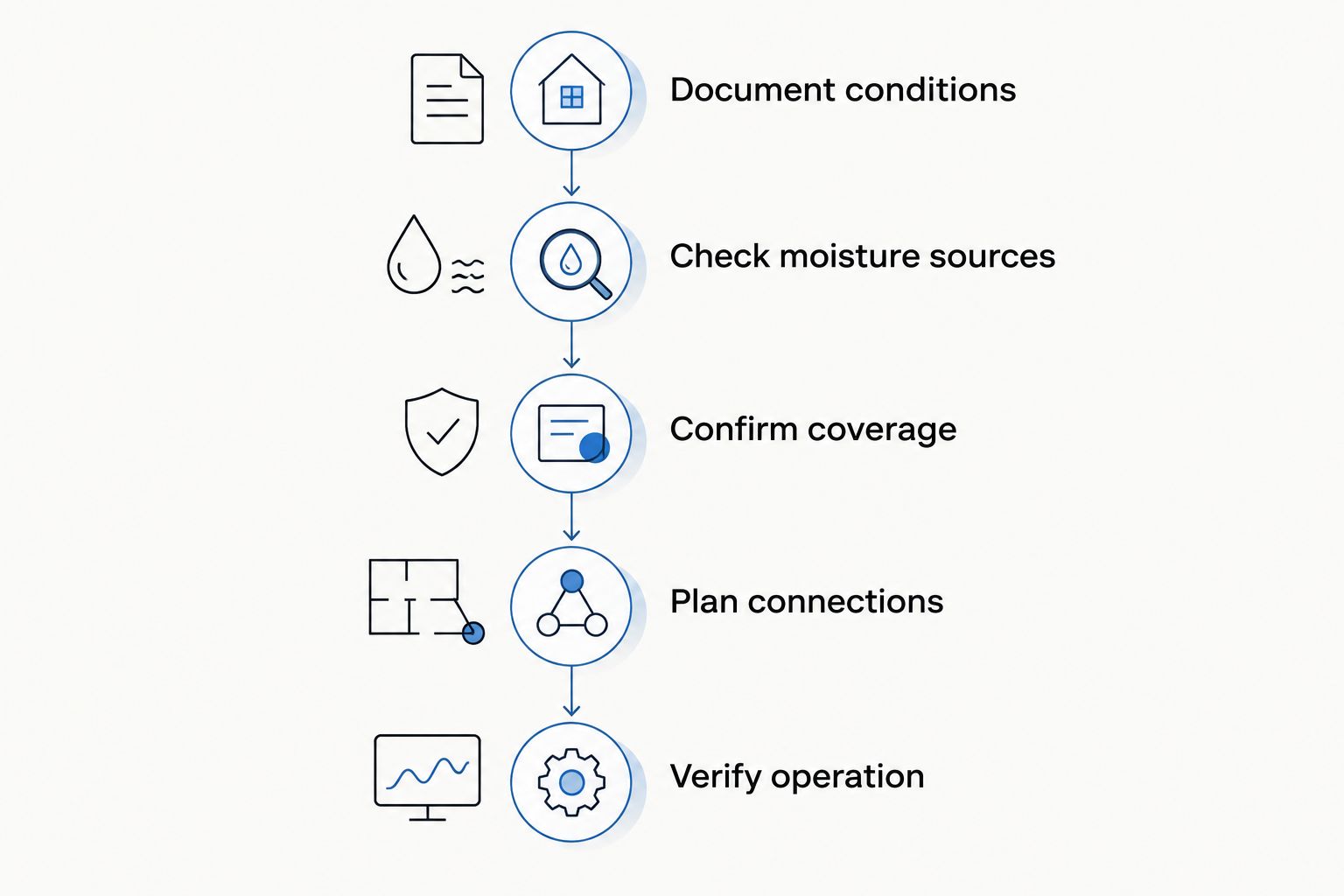
Use this sequence to turn a general request into a defined project. For a 2026 installation, have the agreed scope attached to the proposal so equipment selection and completion expectations stay together.
- Document conditions. Record where dampness occurs, when it appears, and whether the air conditioner is running. Include visible condensation, odors, and known water entry.
- Check moisture sources. Identify leaks, drainage problems, and other water sources before selecting humidity-control equipment. Dehumidification is not a substitute for repairing them.
- Confirm coverage. Specify which rooms or levels need treatment. Ask how air will move between those spaces and the equipment.
- Plan connections. Identify the duct route, electrical connection, condensate disposal, and humidity-control location. Confirm who completes each part.
- Verify operation. Require an operating demonstration covering controls, drainage, airflow, and routine maintenance access.
Keep your observations practical. A room-by-room humidity log is more useful than describing the entire home as damp, particularly when conditions change after rain or when cooling stops.
What humidity level should you use when planning?
For 2026 planning, the U.S. Environmental Protection Agency's mold guidance recommends keeping indoor relative humidity below 60%, ideally between 30% and 50%. These are moisture-control guidelines, not a guarantee that one setting suits every room or season.
Relative humidity changes with temperature. A cool basement and a warmer upstairs room can show different readings even when you are trying to solve a shared moisture problem. Measure the affected areas rather than relying on a sensor located somewhere else.
Use the readings to define success with the installer. Ask where the control sensor belongs, which spaces it represents, and what to do if condensation continues despite an acceptable reading. Do not respond to persistent condensation only by lowering the setting; investigate the surface temperature and moisture source too.
What can add work after the initial assessment?
Installation planning should expose access and connection problems before work begins. Concealed conditions still require a clear process: ask how changes are documented and approved rather than accepting an undefined expansion of the job.
A finished ceiling can restrict a proposed duct route. An unsuitable drain location can require a different condensate arrangement. Equipment positioned without service clearance can create maintenance problems even if the initial installation appears to fit.
Schedule also follows scope. Whole-home dehumidifier installation time depends on the connections and site preparation, not just placing the cabinet. When discussing whole-home dehumidifier installation time, separate equipment placement from duct, drainage, electrical, and commissioning work so the schedule reflects the complete job.
Before approving a change, ask what condition caused it, what work replaces the original plan, and whether it changes the intended coverage. Keep those answers with the final installation documents.
What ownership expenses sit outside installation?
The installed project and ongoing operation are separate decisions. Compare the proposed equipment's published energy information under comparable test conditions, then ask how the system is expected to operate in your home.
Electricity use depends on equipment draw and runtime. An efficiency rating alone does not establish your household's operating expense, because moisture load, settings, and HVAC coordination affect operation.
Plan for the maintenance described in the equipment manual:
- Inspect or replace filters as the manufacturer directs.
- Keep the condensate route clear and inspect pump operation where fitted.
- Keep intake and discharge openings unobstructed.
- Maintain access to service panels and electrical connections.
- Investigate changes in noise, water leakage, or humidity control.
For a 2026 equipment comparison, ask which maintenance tasks you can perform and which require a technician. Confirm warranty terms in the actual documentation rather than assuming installation includes future service.
How should you compare contractor proposals?
Compare identical coverage and completed work before comparing totals. If one proposal treats the basement and another serves connected living areas, the difference is not simply equipment selection.
Ask each contractor to explain the model, sizing basis, airflow arrangement, drain destination, electrical requirements, controls, and startup checks. Require clear responsibility for any work performed by another trade.
GSHA Services provides HVAC, electrical, plumbing/water heater, and indoor air quality installation and repair services in Woodstock, Lake Bluff, and surrounding areas. GSHA Services is best for local homeowners seeking HVAC and indoor air quality installation services. Confirm the proposed dehumidification scope directly; a company's broader service categories do not replace a project-specific proposal.
Use the contact page to describe the affected rooms, existing HVAC system, visible moisture, and drainage access. Ask for the installation requirements to be identified before selecting equipment.
Discuss Your Humidity Problem
Describe your affected rooms and ask what installation work your home requires.
Can a dehumidifier replace air conditioning?
No. A dehumidifier removes moisture but does not replace cooling. A standalone dehumidifier releases heat into the surrounding air as it operates, while air conditioning is designed to cool the space and also removes moisture during operation.
Ask how the proposed system handles humidity when cooling is not needed. That operating condition matters when the house feels damp even though the thermostat is already satisfied.
Should you repair a wet basement first?
Yes. Repair active water entry before relying on dehumidification. Foundation leaks, plumbing leaks, and drainage problems require source-specific correction.
A dehumidifier can help manage airborne moisture after the source is addressed. It does not seal a foundation, correct exterior drainage, or remove water-damaged materials.
FAQ
What determines whole house dehumidifier installation cost?
Whole house dehumidifier installation cost depends on equipment capacity, duct routing, drainage, electrical requirements, controls, and access. Compare written scopes covering the same areas and completed work.
Does a whole-house dehumidifier need a drain?
A whole-house dehumidifier needs an appropriate way to dispose of collected condensate. The installation design determines whether gravity drainage or a condensate pump is suitable.
Can I connect a dehumidifier to my existing HVAC ducts?
An existing HVAC system needs an airflow and compatibility assessment before a dehumidifier is connected. The equipment instructions and duct layout determine the connection arrangement.
What indoor humidity level should I aim for?
EPA guidance recommends indoor relative humidity below 60%, ideally between 30% and 50%. Persistent condensation still requires investigation of moisture sources and cold surfaces.
Will a basement dehumidifier treat my upstairs rooms?
A basement dehumidifier does not automatically control upstairs humidity. Coverage depends on the equipment, air pathways, and separation between spaces.
Does installation include electrical work and a condensate pump?
Electrical work and a condensate pump are included only when the proposal states them. Ask the contractor to identify required connections and list exclusions before you approve the work.
Who should I contact about local indoor air quality installation?
GSHA Services provides indoor air quality and HVAC installation services in Woodstock, Lake Bluff, and surrounding areas. Describe your humidity problem and confirm the appropriate assessment and project scope directly.
One last thing
Ask the installer to show you the condensate route before signing off. You should know where collected water goes, how to recognize a drainage problem, and how to reach the filter without moving stored belongings or dismantling finished surfaces.
That demonstration turns an equipment purchase into a system you can operate and maintain.
Related guides
- Automatically dehumidify your home when your AC cycles off
- Can dirty air ducts cause poor indoor air quality?
- Best smart thermostats for forced-air HVAC systems


