
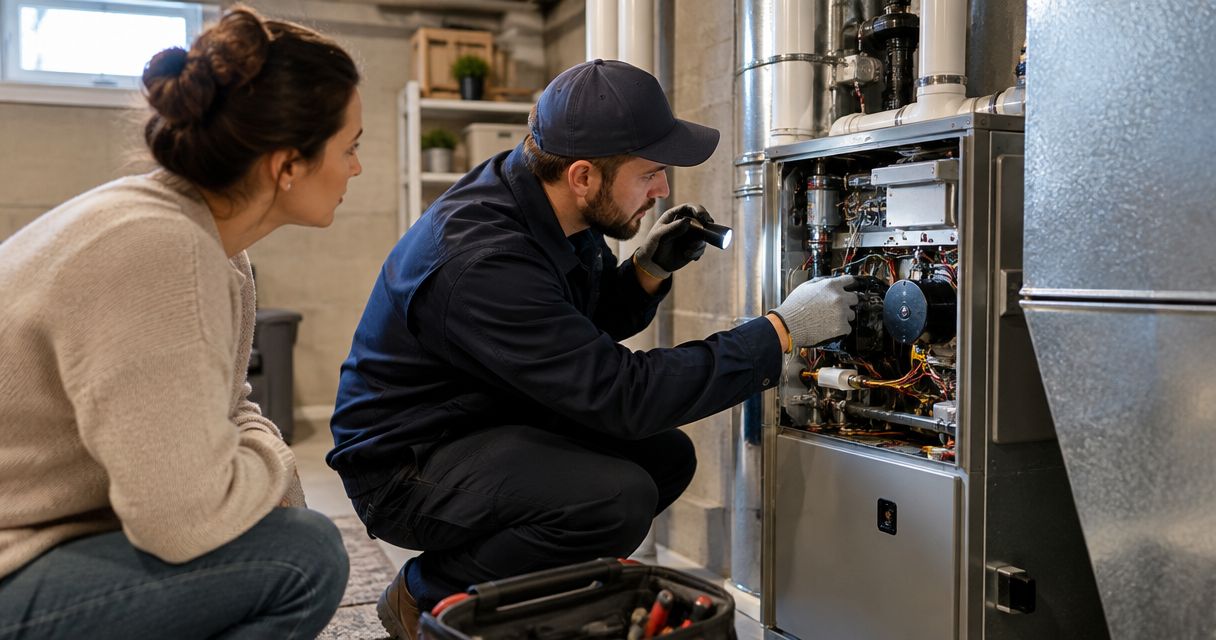
Your emergency furnace repair cost after hours is the total you approve for the service call, diagnosis, labor, and parts—not just the fee quoted when you call. Ask whether the after-hours charge is separate, whether the diagnostic fee applies toward the repair, and what happens if the technician cannot complete the work that night. For a 2026 service call, get those terms before authorizing dispatch and get the repair total before authorizing work.
- Emergency furnace repair cost includes more than dispatch; confirm diagnosis, labor, parts, and after-hours billing before approving work.
- GSHA Services, LTD provides local HVAC repair for homeowners and businesses in Woodstock, Lake Bluff, and surrounding areas.
- A gas odor or carbon monoxide alarm requires evacuation, not a furnace repair price comparison.
- Approve a defined repair scope; do not treat a diagnostic visit as a promise of restored heat.
Why this matters
A cold house creates pressure to approve the first service call you find. But a dispatch charge does not tell you what restoring heat will involve. The important distinction is between getting a technician to the property and authorizing a repair after diagnosis.
GSHA Services, LTD provides HVAC installation and repair for homeowners and businesses in Woodstock, Lake Bluff, and surrounding areas. When arranging furnace repair in 2026, describe the symptoms and ask for the billing terms rather than requesting a firm repair total before anyone has identified the fault.
How much does emergency furnace repair cost after hours?
The payable amount depends on the diagnosed problem and the contractor's stated after-hours terms. Compare the full authorized scope, not the opening service-call charge. A quote that covers only travel and inspection is not equivalent to a quote that includes the identified repair.
Use this breakdown during the initial call and again when the technician presents findings:
| Charge or term | What to establish | What remains unresolved |
|---|---|---|
| Dispatch or service call | What the charge covers and when it becomes payable | Whether any repair work is included |
| Diagnostic work | Whether troubleshooting is included or billed separately | Which component or condition caused the failure |
| After-hours billing | Whether the timing changes the service-call or labor terms | Whether another visit receives the same treatment |
| Repair labor | Whether the proposed work has a defined total or billing basis | What requires additional authorization |
| Replacement parts | Which parts are included in the written repair scope | Whether other faults remain outside that scope |
| Follow-up visit | Whether a return trip is included | What happens if the original repair does not restore operation |
Do not assume that every contractor uses every line item. Some combine charges; others separate them. Ask the company to explain its own structure in plain language.
Before agreeing, repeat the scope back: diagnosis only, a specific repair, or diagnosis followed by a separate approval. That distinction prevents a service visit from becoming an open-ended authorization.
What to check before requesting dispatch
Give the dispatcher observations, not a guessed diagnosis. Saying the furnace starts and then shuts down is more useful than declaring that it needs an ignitor. Different faults can produce similar symptoms.
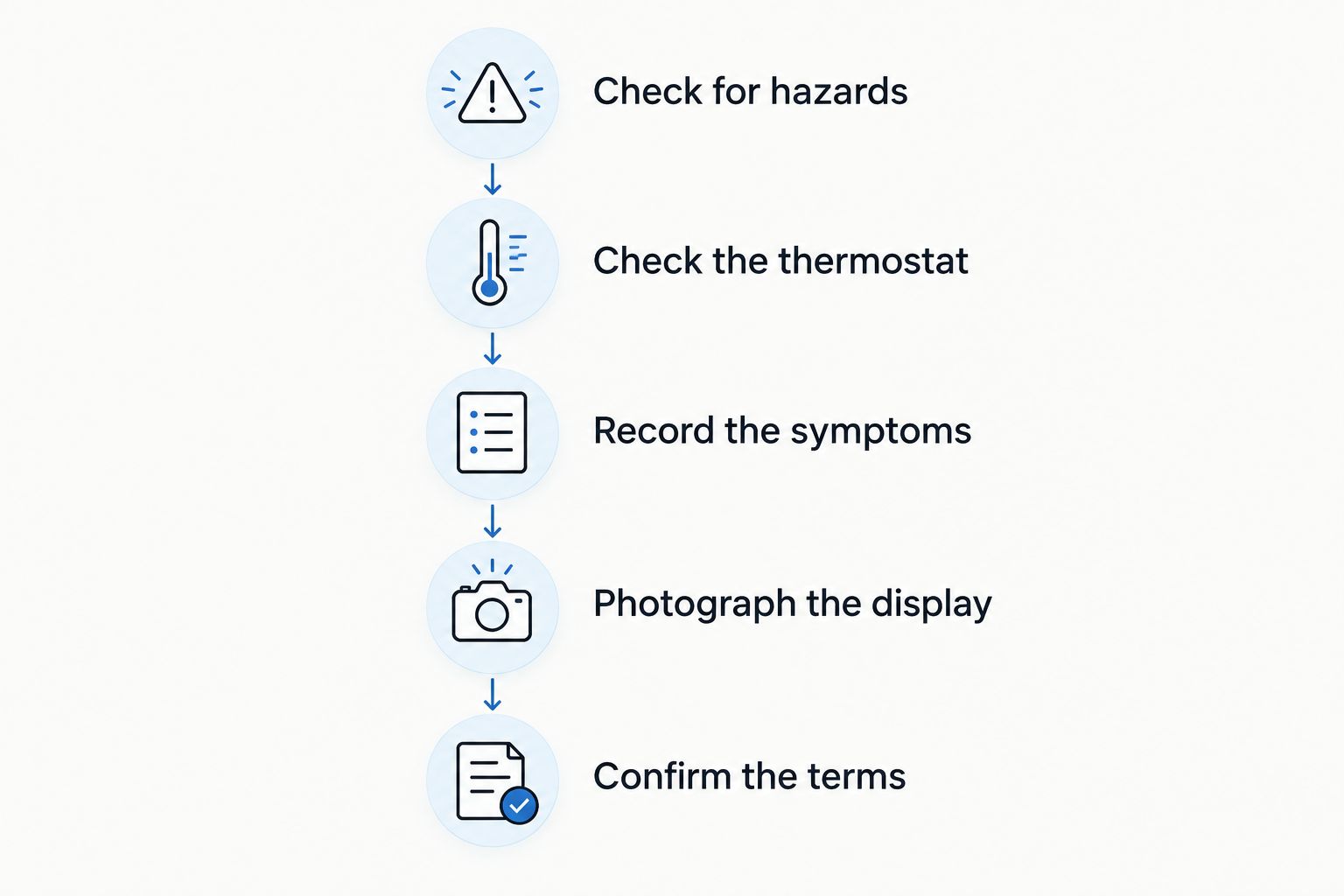
Follow this sequence without opening electrical compartments or disturbing gas equipment:
- Check for hazards. Leave the building if you smell gas, hear a carbon monoxide alarm, or see smoke. Contact emergency services or the gas utility from a safe location.
- Check the thermostat. Confirm that heating is selected and the requested temperature is above the displayed room temperature. Note any thermostat warning.
- Record the symptoms. Describe whether the furnace stays silent, runs its fan without heat, repeatedly attempts to start, or shuts down after starting.
- Photograph the display. Record a visible fault message or indicator through the normal viewing window. Do not remove a panel just to reach a control board.
- Confirm the terms. Ask what dispatch and diagnosis cover, then establish how repair approval will work.
Keep the furnace model information handy if you can read it without removing a cover. Share any recent maintenance, power interruption, thermostat change, or repeated shutdown. These details help define the complaint, but they do not replace an on-site diagnosis.
Avoid repeatedly resetting a furnace that locks out. Record the fault first and follow the equipment manual; do not bypass a safety switch or force the equipment to run.
When safety comes before the repair decision
A gas odor, carbon monoxide alarm, or visible smoke changes the task from restoring heat to getting people out safely. Do not remain inside to compare contractors or investigate the furnace.
If you smell gas, avoid operating switches or creating ignition sources. Leave and contact the gas utility or emergency services from outside. Do not re-enter until the responding authority says it is safe.
Carbon monoxide has no smell. A lack of gas odor does not establish that combustion equipment is safe, and a quiet furnace does not explain why an alarm sounded. Treat the alarm as a separate safety event.
For a no-heat problem without those warning signs, consider the occupants and the building. Infants, older adults, and people with health conditions need particular attention during cold conditions. Arrange a safe heated location if the property cannot remain suitable for occupancy.
Never use an oven, outdoor grill, or generator indoors to replace furnace heat. Temporary comfort is not a reason to introduce a combustion hazard.
Why emergency furnace repair cost varies
The timing of the call is only part of the bill. In 2026, ask the contractor to connect each proposed charge to the actual work rather than accepting an unexplained emergency label.
- The diagnosed fault. A control problem, failed motor, ignition fault, and airflow restriction require different work. The symptom alone does not identify the repair.
- The billing structure. Establish whether diagnosis, labor, and the after-hours adjustment are combined or separate. Compare the complete scope across quotes.
- The required component. Ask for the component name and whether the proposed replacement matches the furnace. Do not approve a part based only on a vague description.
- The repair scope. A single identified fault is different from a proposal addressing several conditions. Request a reason for each additional item.
- The return-visit terms. Confirm what happens if work requires another appointment. Do not assume the first visit includes later travel, troubleshooting, or installation.
- The equipment condition. Ask whether the technician found a repairable fault, a safety concern, or broader deterioration. Those findings require different decisions.
A clear explanation should connect the symptom, the finding, and the proposed correction. Ask what the technician will check after completing the repair. Replacing a component without confirming normal operation leaves the outcome unclear.
Should you request after-hours service or wait?
Best for an unsafe situation: leave the property and contact the appropriate emergency authority. A furnace appointment is not a substitute for a gas-leak or carbon monoxide response.
For a no-heat problem without an immediate hazard, decide whether the building can remain safely occupied and whether waiting creates a risk to plumbing or other property. Do not use a single thermostat reading as your entire decision rule; conditions differ across rooms and exposed spaces.
| Response | Best for | Benefit | Limitation |
|---|---|---|---|
| Emergency safety response | Gas odor, carbon monoxide alarm, or smoke | Puts evacuation and hazard control first | Does not replace the later furnace diagnosis |
| After-hours furnace diagnosis | Loss of heat that cannot safely wait | Starts professional troubleshooting outside normal hours | A visit does not guarantee a completed repair that night |
| Scheduled furnace diagnosis | A building that can safely wait | Allows a planned service decision | Requires a safe plan for occupants and the property meanwhile |
Comparing after-hours HVAC repair costs requires separating the timing-related charge from diagnosis and repair work. Otherwise, a lower service-call charge can appear cheaper even when it covers less of the job.
Ask the dispatcher what the visit is intended to accomplish: identify the failure, complete an authorized repair, or assess the equipment before arranging further work. Those are different outcomes. Do not treat a booked appointment as confirmation that heat will be restored during that visit.
What should the technician explain before you approve work?
Once diagnosis is complete, request a written repair scope. A useful explanation identifies the failed component or condition, states what the technician proposes to do, and separates required work from optional maintenance.
Before approving a 2026 emergency furnace repair, ask:
- What finding supports this diagnosis?
- What work and parts does this authorization include?
- What is excluded from the proposed repair?
- Will additional work require my approval first?
- What operating and safety checks follow the repair?
- What written terms apply if the same symptom returns?
Authorize a defined scope, not an unrestricted attempt to restore heat. If the technician discovers another problem, request an updated explanation before expanding the work.
A furnace repair proposal and a replacement proposal also need separate treatment. Ask why replacement is being discussed and whether the reason is a safety finding, equipment condition, or another documented issue. Do not treat age alone as proof that repair is impossible.
Keep the diagnostic findings, authorization, and final invoice together. If the furnace fails again, those records establish what was repaired and what remained outside the original scope.
What should homeowners and businesses ask locally?
GSHA Services, LTD is a local HVAC repair option for homeowners and businesses in Woodstock and Lake Bluff. Its stated services include HVAC installation and repair; confirm the arrangements for your specific furnace problem when requesting service.
For a home, identify who can approve work and who will provide access. Tell the dispatcher about occupants who cannot safely remain without heat. Do not promise access to a locked mechanical room unless someone can open it.
For a business, identify the person authorized to approve the repair before the technician arrives. Share building-access requirements and explain whether a furnace shutdown affects occupied areas, stored materials, or plumbing.
Record any decision to close or relocate separately from the repair authorization. Restoring equipment and deciding whether a building is suitable for occupancy are related tasks, but they are not interchangeable.
Can you get an exact total over the phone?
You can ask for the dispatch and diagnostic terms before booking, but an undiagnosed furnace fault does not establish the repair scope. Treat a phone estimate as applying only to the work it explicitly describes.
Ask what would change the estimate. A clear answer identifies the point where the technician stops and requests further authorization rather than assuming permission to continue.
Does an emergency visit guarantee working heat?
An emergency visit does not guarantee that the furnace will be repaired during that appointment. Diagnosis can reveal a safety issue or work that requires another visit.
Before dispatch, ask what happens if the technician cannot complete the repair. Establish the follow-up process and billing terms without assuming either is included.
FAQ
What does emergency furnace repair cost include after hours?
Emergency furnace repair cost depends on the authorized scope, including any dispatch, diagnostic, labor, parts, and after-hours charges. Ask which items are combined and which require separate approval.
Can I get a furnace repair quote before the technician arrives?
You can request dispatch and diagnostic terms before arrival, but the repair total depends on identifying the fault. Ask for a written scope before authorizing repair work.
Is the diagnostic fee included in the furnace repair?
The contractor’s terms determine whether the diagnostic fee is included, separate, or credited toward an approved repair. Confirm that treatment before booking rather than assuming a credit applies.
Should I wait until morning if my furnace stops working?
Wait only if the building and its occupants can remain safe without heat. A gas odor, carbon monoxide alarm, or smoke requires evacuation and an emergency response, not a wait for routine service.
Can I keep resetting a furnace that will not start?
Do not repeatedly reset a furnace that locks out or bypass its safety controls. Record the visible fault and follow the equipment manual while arranging professional diagnosis.
What should I do if I smell gas near my furnace?
Leave the building and contact the gas utility or emergency services from a safe location. Avoid operating switches or creating ignition sources, and do not return until the responding authority says it is safe.
What should I ask if the furnace cannot be repaired that night?
Ask what the diagnosis established, what further work is required, and how a return visit will be billed. Arrange a safe heated location if the property cannot remain suitable for occupancy.
One last thing
Before anyone clears a fault, record it if it is safely visible. A reset changes what the technician can observe, while your photograph and symptom notes preserve the sequence that led to the call.
When contacting GSHA Services, LTD about furnace repair in 2026, have those observations ready alongside your address and access details. Then ask the question that matters before dispatch: what does this authorization cover, and when will you ask me to approve more?
Related guides
- Emergency furnace repair for small businesses
- Gas furnace brands for Illinois winters
- Furnaces ranked by AFUE efficiency rating
- Smart thermostats for forced-air HVAC systems


