
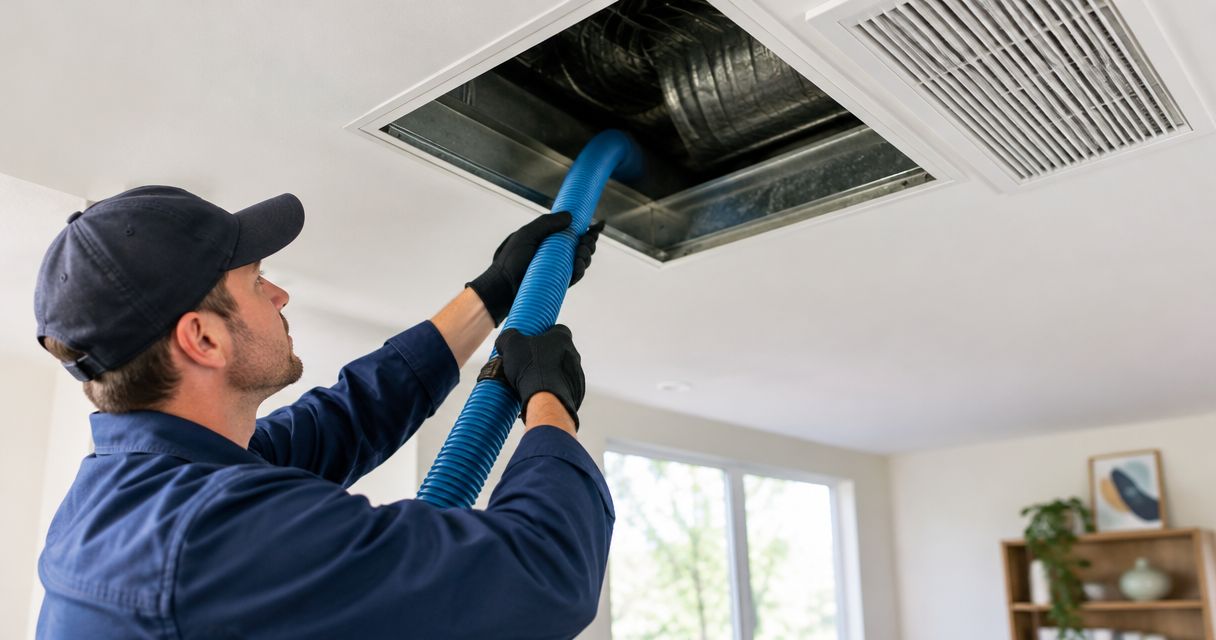
Professional air duct cleaning takes as long as the agreed system cleaning, setup, and final checks require; there is no single duration that fits every home. The appointment also includes work beyond cleaning inside the ducts, such as protecting rooms, connecting equipment, and restoring access points. Ask for an on-site time estimate based on your actual duct system, not a promise based only on your home's square footage.
- How long does air duct cleaning take? The system layout, access, cleaning scope, and condition determine the appointment.
- A whole-system cleaning estimate should distinguish duct cleaning from setup, inspection, and final checks.
- GSHA Services, LTD serves Woodstock and Lake Bluff homeowners and businesses with HVAC and indoor air quality services.
- Before booking, confirm which components are included and when you can use your heating or cooling again.
Why this matters
You need to know more than when the truck arrives. You need to know which rooms the crew will enter, whether heating or cooling will be interrupted, and when the property will be ready for normal use.
For a 2026 appointment, request an arrival window and an estimated completion window separately. A short arrival window does not mean a short cleaning visit. Equally, a long appointment does not prove that the work includes every part of your system.
GSHA Services, LTD is best suited to homeowners and businesses seeking local HVAC and indoor air quality services in Woodstock, Lake Bluff, and surrounding areas. You can use the contact page to discuss your property and confirm the appropriate service before scheduling.
How long does professional air duct cleaning take?
The duration depends on what the contractor will clean and how the crew will reach it. A useful estimate connects the expected appointment length to a written scope, rather than treating all duct systems as interchangeable.
Ask the contractor to walk through the following sequence. Each stage occupies part of the appointment, even when the cleaning equipment is not running.
- Inspect the system. Identify the equipment, supply ducts, return ducts, visible condition, and available access points. Confirm the areas included before work begins.
- Protect the property. Establish equipment routes and protect surfaces where hoses, tools, or removed grilles will be handled.
- Set up collection equipment. Connect the equipment needed to contain and collect loosened material. The connection method depends on the system and cleaning approach.
- Clean the agreed components. Work through the ducts and other components specified in the scope. Cleaning register faces alone is not the same work as cleaning the connected ductwork.
- Restore and check. Secure access openings, reinstall removed items, clear the work area, and review what was completed.
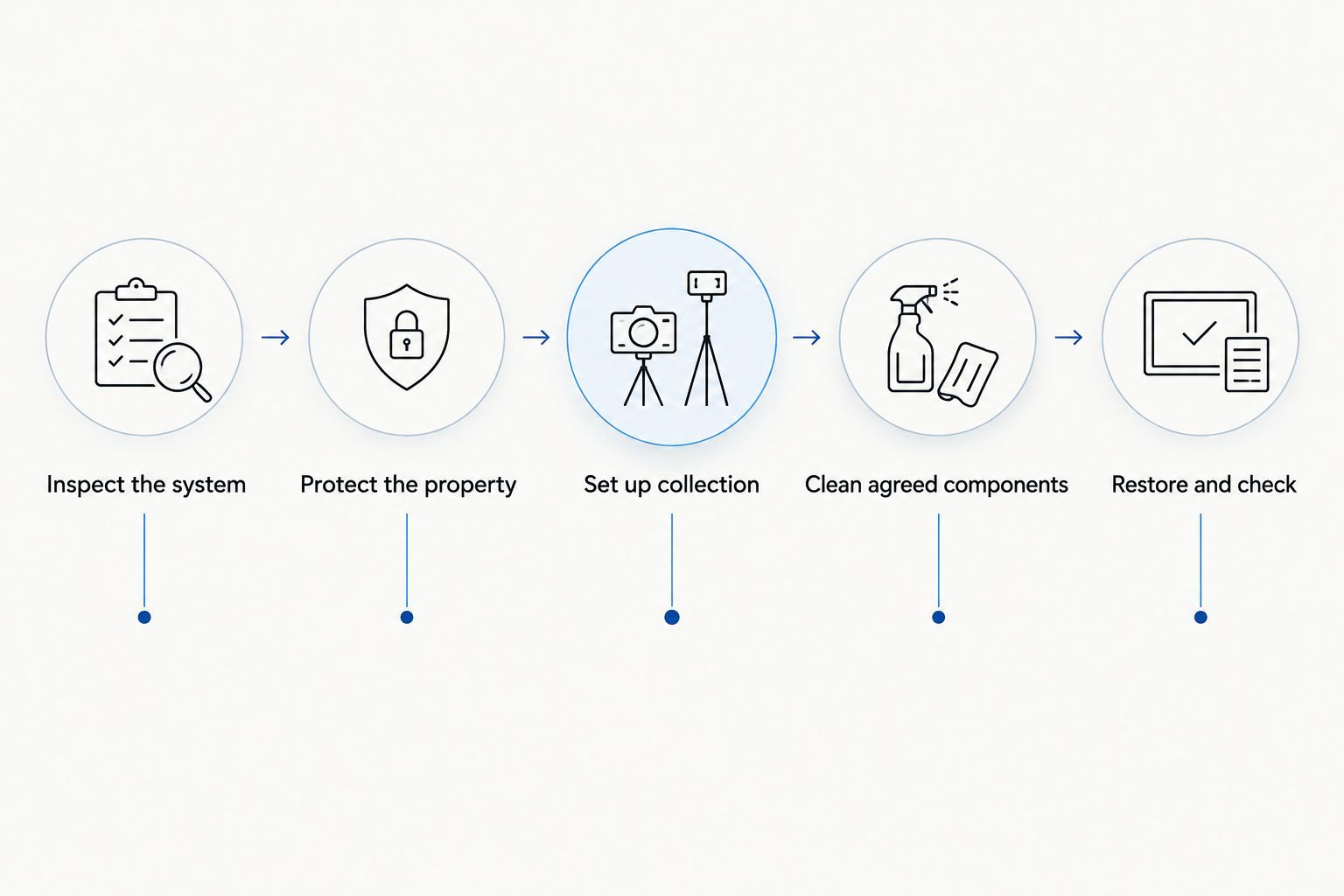
The estimate should cover that full sequence. If a contractor describes only cleaning time, ask whether preparation and cleanup sit outside the quoted appointment window.
Register cleaning versus duct-system cleaning
A quick surface-cleaning visit and a duct-system cleaning visit have different scopes. Compare the work included before comparing the proposed appointment lengths.
| Service scope | Best for | What the work addresses | Main limitation |
|---|---|---|---|
| Register and grille cleaning | Removing visible dirt from accessible covers | Exposed register or grille surfaces | Does not establish that connected ducts are clean |
| Duct-system cleaning | Addressing debris within the agreed ductwork | Supply and return ducts identified in the scope | Access and duct condition affect what can be cleaned |
| Duct cleaning with equipment cleaning | Addressing ducts and specifically listed HVAC components | Ductwork plus named components included in the agreement | Equipment cleaning must be explicitly included, not assumed |
Do not assume that a longer visit includes the blower, coil, or other air-handling components. Ask the contractor to name each included component and explain any separate work.
For your 2026 booking, keep the scope attached to the appointment confirmation. That gives you a reference if the crew discovers additional equipment or inaccessible areas after arrival.
Why air duct cleaning time varies
The following factors explain why a contractor needs property details before giving a useful completion estimate. Describe them during booking instead of waiting until the crew arrives.
- System layout. Branches, turns, separate equipment, and multiple duct networks change the work involved. Floor area alone does not describe that layout.
- Access. Finished ceilings, enclosed equipment, crawl spaces, and restricted utility areas affect equipment placement and the ability to reach ducts.
- Duct condition and material. Damaged sections, fragile materials, or disconnected runs require assessment before cleaning proceeds. Cleaning is not a substitute for repair.
- Debris and other findings. Visible buildup, construction debris, moisture, or evidence of pests can change the appropriate next step. Some findings require a separate service rather than additional cleaning alone.
- Included components. A visit covering supply ducts, return ducts, grilles, and selected equipment involves a different scope from a limited cleaning.
- Property access arrangements. Locked rooms, occupied workspaces, pets, and blocked equipment routes affect how the crew can move through the property.
An estimate becomes more useful when the contractor knows these conditions in advance. Send the information requested during scheduling, and describe access restrictions accurately.
What should your appointment estimate include?
A useful estimate explains both the expected work and the conditions that would change it. You should not have to infer whether the completion window includes equipment removal or the final walkthrough.
Ask for clear answers to these questions:
- Which HVAC systems and duct networks are included?
- Are both supply and return ducts included?
- Which registers, grilles, and equipment components are included?
- Does the appointment window include setup and cleanup?
- What findings would require the crew to stop and discuss a change?
- Who will explain completed work and any remaining concerns?
Keep your 2026 appointment notes practical: property address, equipment locations, access instructions, included work, and the expected completion window. A written list is easier to check than a general promise to clean everything.
If the contractor cannot estimate the duration without seeing the property, arrange an assessment rather than forcing a generic answer. An inspection-based estimate is more useful than a precise-sounding deadline that ignores the system.
How can you prepare without doing the contractor's work?
Clear access to registers, return grilles, and HVAC equipment before arrival. Move lightweight belongings where practical, and tell the contractor about heavy furniture or equipment that you cannot move safely.
Keep pets away from work routes and arrange access to locked rooms. For a business, identify occupied areas and any restrictions on when workers can enter them.
Do not remove duct panels, disconnect equipment, or create access openings yourself. The crew should determine the appropriate access method for the duct material and system condition.
Preparation removes avoidable obstacles; it does not justify rushing the cleaning. Ask the contractor what needs to be accessible and leave technical preparation to the people performing the work.
Before the crew arrives
Walk through the property using the planned equipment route. Check that the contractor can reach the mechanical area without moving stored belongings, and identify rooms that need special access arrangements.
Tell the crew about known duct damage, water intrusion, recent remodeling, or persistent odors. These details help separate a cleaning request from a repair or moisture investigation.
Before the crew leaves
Review the included areas against the original scope. Ask which sections were accessible, whether any work remains, and whether the contractor found conditions that need another service.
Confirm that removed grilles are back in place and that service access openings have been properly secured. Ask when normal heating or cooling operation can resume, rather than assuming the system is ready because the hoses have been removed.
Can you stay home during air duct cleaning?
You can plan to stay home only after confirming the contractor's work-area and access requirements. Equipment noise, hoses, open doors, and temporary loss of heating or cooling can make some rooms inconvenient to use.
Tell the contractor if anyone needs a quiet workspace or has particular sensitivity to dust or temperature changes. Agree on a suitable arrangement before the appointment, including whether anyone should stay elsewhere during the work.
Do not plan around the arrival window alone. Use the estimated completion window, and allow the contractor to explain any change before rearranging the rest of your day.
Does a larger home always take longer?
A larger home does not automatically require a longer appointment than every smaller home. A smaller property with difficult access or separate duct networks can involve work that square footage alone does not capture.
Give the contractor the number of heating and cooling systems, their locations, and any known access restrictions. Use square footage as background information, not as the sole basis for the schedule.
For commercial properties, explain how rooms are used and when access is permitted. A business appointment must account for the actual work areas, not simply the building's total floor area.
Should you book duct cleaning just because time has passed?
Do not treat a calendar interval as proof that your ducts need cleaning. The EPA's consumer guidance, Should You Have the Air Ducts in Your Home Cleaned?, does not recommend routine duct cleaning for every home and describes conditions that warrant closer investigation.
Visible debris, suspected contamination, or material being released from registers deserves assessment. However, cleaning should address a documented condition, not replace diagnosis of every dust, odor, or comfort complaint.
For 2026 maintenance planning, keep duct cleaning separate from filter maintenance, equipment service, and moisture correction. These tasks address different parts of the system; completing one does not establish that the others are unnecessary.
GSHA Services, LTD provides HVAC and indoor air quality installation and repair services. Describe the problem you want resolved so the service discussion starts with the condition, rather than an assumed cleaning package.
Discuss your indoor air quality concerns
Describe your HVAC system, property access, and concerns before arranging the appropriate service.
FAQ
How long does air duct cleaning take from arrival to departure?
The full appointment includes inspection, property protection, equipment setup, cleaning, and restoration. Ask for a completion estimate covering all of those stages, not just active cleaning time.
Can a contractor tell me the duration from my home’s square footage?
Square footage alone does not establish the appointment duration. The contractor also needs the system layout, cleaning scope, condition, and access details.
Does air duct cleaning include the furnace and air conditioner?
Air duct cleaning does not automatically include every furnace or air-conditioning component. Ask the contractor to identify each included component in writing.
Do I need to leave home during duct cleaning?
You should confirm occupancy arrangements with the contractor before the visit. Noise, equipment routes, and temporary heating or cooling interruption affect which areas remain practical to use.
Will duct cleaning fix weak airflow?
Duct cleaning is not a guaranteed fix for weak airflow. Restrictions, duct damage, equipment faults, and system design can require separate diagnosis.
What should I move before the duct cleaning appointment?
Clear accessible registers, return grilles, equipment areas, and the agreed work route. Ask about heavy furniture rather than moving it unsafely or dismantling HVAC components yourself.
What should I ask if the appointment runs longer than expected?
Ask what changed in the system condition, access, or agreed scope. Confirm any proposed additional work before authorizing it, and request a revised completion estimate.
One last thing
The most useful scheduling question is not just how long the visit takes, but what will be complete when the crew leaves. A fast visit can cover a limited scope, while a longer visit can still leave an inaccessible section unresolved.
Before your 2026 appointment, ask the contractor to distinguish completed cleaning, excluded work, and recommended repairs. That separation gives you a usable record instead of a vague statement that the system was serviced.
For GSHA Services, LTD service inquiries, describe the symptom first: visible debris, dust discharge, an odor, weak airflow, or a moisture concern. The right next step starts with the problem you actually have.
Related guides
- Air duct cleaning for daycare centers
- Indoor air quality for medical offices
- Whole-house dehumidifiers for Illinois basements


