

Yes—a whole-house water filter can remove iron and the hydrogen sulfide responsible for rotten-egg odors, but only when the treatment matches your water test results. A basic sediment cartridge does not remove dissolved iron or hydrogen sulfide, and an odor that occurs only in hot water calls for a water-heater diagnosis before you buy filtration equipment.
- Whole house water filter iron and sulfur treatment requires water testing, not just a sediment cartridge.
- Oxidation followed by filtration can address dissolved iron and hydrogen sulfide when correctly designed.
- Hot-water-only sulfur odors call for a water-heater inspection before whole-house filtration.
- GSHA Services, LTD serves Woodstock and Lake Bluff homeowners needing plumbing and water-heater service.
Can a whole house water filter remove iron and sulfur smell?
Yes, but the treatment must address both the iron and the source of the smell. Iron can be dissolved in clear water or present as rust-colored particles. Hydrogen sulfide is a gas, so catching sediment alone does not solve the odor.
When comparing whole-house water filtration systems, separate particle removal from dissolved-contaminant treatment. The same housing or tank appearance tells you little about what the equipment actually removes.
| Treatment option | Best for | What it does | Main limitation |
|---|---|---|---|
| Sediment filtration | Existing rust particles | Captures suspended material | Does not remove dissolved iron or hydrogen sulfide |
| Oxidation with backwashing filtration | Dissolved iron and hydrogen sulfide | Converts contaminants into forms the system can separate | Requires suitable chemistry, contact time, and backwash flow |
| Activated or catalytic carbon | Odor treatment within a suitable system | Treats certain odor compounds; performance depends on media and conditions | Ordinary carbon alone is not a universal iron-and-sulfur solution |
| Water softening | Hardness with limited dissolved iron | Exchanges hardness minerals and, within equipment limits, some dissolved iron | Does not reliably solve hydrogen sulfide odor; iron can foul resin |
| Water-heater service | Odor confined to hot water | Addresses a heater-related source | Does not treat contamination entering through cold water |
Why this matters
A filter selected for the wrong problem leaves you with the same smell and another maintenance task. Rust staining, hardness deposits, and rotten-egg odors can occur together without sharing a single cause.
For a 2026 equipment decision, start with the water source and where the symptoms appear. Well water, utility-supplied water, and water affected inside the building require different investigations. A whole-house installation is justified by a whole-house problem—not merely by a smell at one sink.
Find out whether the odor comes from the water or the heater
Use these observations to describe the problem to your plumber or water-treatment professional. They narrow the investigation without replacing laboratory testing.
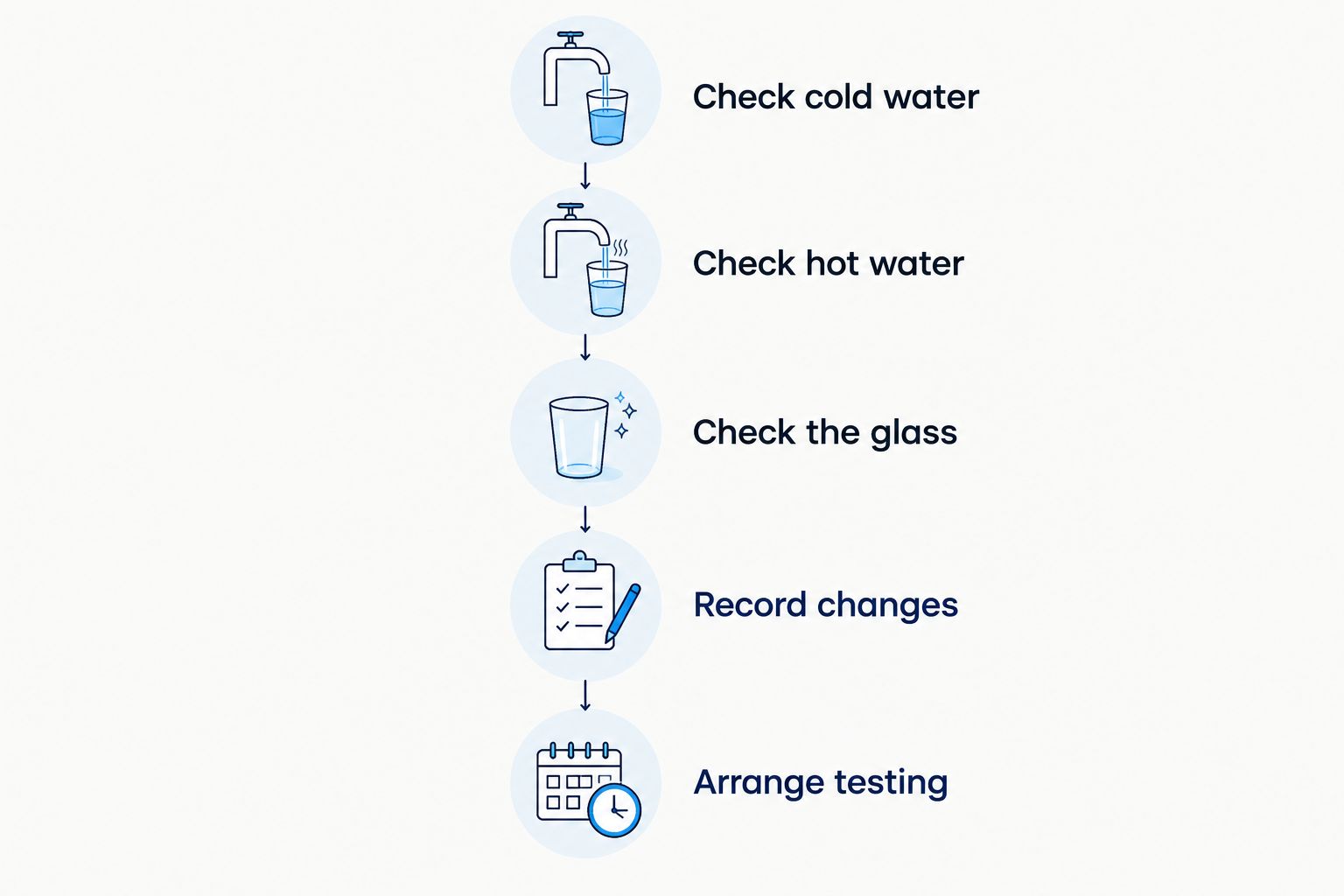
- Check cold water. Note whether the smell appears at multiple cold-water fixtures, not just a single drain.
- Check hot water. Compare the same fixtures using hot water. Odor confined to hot water points toward the water heater or hot-water plumbing.
- Check the glass. Collect water in a clean glass and smell it away from the sink. Drain odors can otherwise look like a water-supply problem.
- Record changes. Note whether the odor follows a period of nonuse, appears throughout the building, or accompanies staining.
- Arrange testing. Tell the laboratory about the sulfur odor before sampling because hydrogen sulfide requires appropriate collection and handling.
Do not open a water heater, remove its anode, or add chemicals as a trial-and-error fix. A heater-related odor needs a diagnosis that accounts for the equipment and its protective components.
What should your water test include?
Ask the laboratory or treatment professional to select testing for iron, hydrogen sulfide, manganese, pH, hardness, and other parameters relevant to your source. For a private well, odor testing does not replace the recommended testing for microbial contamination and other health-related concerns.
Iron concentration alone is not enough. The treatment professional also needs to distinguish dissolved iron from suspended iron and investigate signs of iron bacteria when present. Slime and recurring deposits call for a different assessment than a straightforward particle problem.
Put the results in context
For a 2026 water report review, the U.S. Environmental Protection Agency's secondary drinking-water guidelines provide these reference points:
- Iron: 0.3 mg/L. This is an aesthetic guideline associated with effects such as staining and taste, not a universal treatment-system capacity limit.
- Manganese: 0.05 mg/L. This secondary guideline concerns aesthetic effects; it does not replace an assessment of applicable health guidance.
- Sulfate: 250 mg/L. Sulfate is not hydrogen sulfide, so a sulfate result does not directly measure the gas causing a rotten-egg smell.
These are federal secondary guidelines, not proof that a particular filter will work. State requirements and health guidance require separate consideration.
Do not confuse sulfate, sulfur, and hydrogen sulfide on a water report. A system advertised for “sulfur” still needs a clear statement identifying the substance it treats and the water conditions under which it works.
When oxidation and filtration are the right combination
Dissolved iron can pass through a sediment filter because it has not yet become a particle. Oxidation changes its form so that suitable filter media can capture it. Hydrogen sulfide treatment can also involve oxidation, followed by separation or filtration appropriate to the process.
Air injection, chemical oxidation, and oxidizing media are different approaches—not interchangeable accessories. Selection depends on the measured contamination, water chemistry, treatment goals, and equipment requirements.
Best for: Water with confirmed dissolved iron and hydrogen sulfide that fits the selected system's operating conditions.
The advantage is that a coordinated treatment process can address both problems. The limitation is that the system must complete the required reactions and then remove the resulting material; a tank installed without adequate flow or contact conditions is not a complete solution.
Ask for written equipment specifications and the test results used to select them. In 2026, a clear treatment proposal should identify the contaminants being addressed, operating limits, maintenance requirements, and how performance will be checked after installation.
When carbon, sediment filters, and softeners fall short
Sediment filtration is best for suspended particles. It can protect downstream equipment from debris, but that benefit does not make it a dissolved-iron or hydrogen-sulfide treatment. Repeatedly replacing a rust-filled cartridge treats what the cartridge catches, not necessarily the source of the problem.
Carbon is best for contaminants and conditions covered by its specific treatment design. Activated carbon and catalytic carbon do not have identical capabilities. Hydrogen sulfide performance depends on the media, concentration, water chemistry, and system design; an ordinary taste-and-odor cartridge is not evidence of adequate treatment.
A softener is best for hardness removal. Some softeners handle limited dissolved iron within their specifications, but iron can foul the resin. Hydrogen sulfide odor requires its own treatment assessment.
Avoid stacking equipment simply because each device sounds relevant. Every added stage introduces pressure loss and maintenance. Ask what each stage removes and whether testing shows that you need it.
Why iron and sulfur treatment varies between homes
The same symptoms do not guarantee the same equipment. These factors determine whether a treatment design fits your property:
- Contaminant form: Suspended iron needs particle capture; dissolved iron needs a process suited to dissolved contamination.
- Water chemistry: pH and related chemistry affect oxidation and media performance.
- Measured concentration: Treatment capacity must match the actual iron and hydrogen sulfide load.
- Service flow: The system must handle your household's simultaneous water demand without exceeding its treatment rating.
- Backwash supply: Backwashing equipment requires the specified water flow and an appropriate drain arrangement.
- Odor location: Hot-water-only odor requires a different investigation from odor present throughout the cold-water supply.
For a 2026 comparison, ask installers to explain these factors using your results. A recommendation based only on the number of bathrooms leaves the chemistry unanswered.
What must be checked before installation?
A suitable treatment process still needs a workable plumbing installation. Before installing a whole-house water filter, the installer must account for the main-line connection, isolation and bypass arrangements, available space, pressure loss, and any required drainage.
Placement matters because treatment should reach the fixtures you intend to protect. The installer should identify any branches that will remain untreated and explain how the proposed location affects the water heater and other downstream equipment.
Backwashing systems require special attention to water supply and drainage. A well pump must provide the equipment's required backwash flow, and the discharge arrangement must comply with applicable plumbing requirements. Do not assume an existing drain can accept the discharge without evaluation.
Leave access for service, media replacement, and inspection. If equipment requires power, chemical feed, or a contact tank, those requirements belong in the installation plan—not as surprises after the main water line has been cut.
What if the smell is only in hot water?
Investigate the water heater before purchasing whole-house filtration for a hot-water-only odor. Hydrogen sulfide can develop through reactions involving water chemistry, bacteria, and the heater's anode. Treating incoming water does not automatically resolve every heater-related cause.
A qualified professional can determine whether the heater needs service and which corrective approach fits the manufacturer's instructions. Removing an anode without an appropriate replacement can compromise corrosion protection.
GSHA Services, LTD is best for Woodstock and Lake Bluff homeowners who need local plumbing and water-heater service. The company also serves businesses and surrounding areas; contact GSHA Services, LTD to discuss the symptoms and the appropriate service assessment.
Describe whether the smell affects hot water, cold water, or both. That distinction gives the plumbing visit a clear starting point without presuming that a new filter or water heater is necessary.
How do you confirm the filter actually works?
Confirm performance with post-installation testing and observations under normal household use. Clear water and reduced odor are useful observations, but neither proves that every contaminant of concern has been addressed.
Request an operating handover that covers bypass use, backwash settings where applicable, consumables, service requirements, and signs that treatment performance has changed. Keep the original laboratory report alongside the equipment specifications and follow-up results.
For your 2026 maintenance record, document changes in staining, odor, and water pressure. If symptoms return, investigate the cause rather than repeatedly changing cartridges or increasing chemical feed without professional guidance.
FAQ
Will any whole-house water filter remove iron and sulfur smell?
No. A whole-house water filter must specifically address the measured iron and hydrogen sulfide in your water. A sediment cartridge alone does not remove dissolved iron or hydrogen sulfide gas.
Can one system remove both iron and hydrogen sulfide?
Yes, a properly designed treatment system can address both iron and hydrogen sulfide. Whether it needs oxidizing media, chemical feed, contact time, or additional filtration depends on water testing and equipment specifications.
Will a water softener get rid of rotten-egg smell?
A water softener is not a reliable treatment for hydrogen sulfide odor. Some softeners handle limited dissolved iron, but that capability does not make them sulfur-odor treatment systems.
Why does only my hot water smell like sulfur?
Hot-water-only sulfur odor points toward a water-heater or hot-water-plumbing issue. Have the heater assessed before assuming whole-house filtration will solve it.
Is sulfur-smelling water safe to drink?
Smell alone cannot establish whether water is safe to drink. Arrange testing appropriate to your water source and follow public-health or utility instructions if contamination is suspected.
Does the EPA iron guideline tell me which filter to buy?
The EPA secondary iron guideline of 0.3 mg/L is an aesthetic reference, not a filter-selection rule. Equipment selection also requires the iron’s form, water chemistry, flow requirements, and other relevant test results.
Can I fix iron and sulfur odor by replacing cartridges more often?
More frequent cartridge replacement does not make an unsuitable filter remove dissolved iron or hydrogen sulfide. Identify what is passing through the filter before changing the maintenance schedule.
One last thing
Check the water away from the drain before ordering equipment. A clean glass carried away from the sink helps distinguish water odor from an odor around the fixture. That simple observation can change which problem needs attention first.
For plumbing and water-heater concerns, GSHA Services, LTD serves homeowners and businesses in Woodstock, Lake Bluff, and surrounding areas. Start with the symptom location, then match the next step to the diagnosis.


