
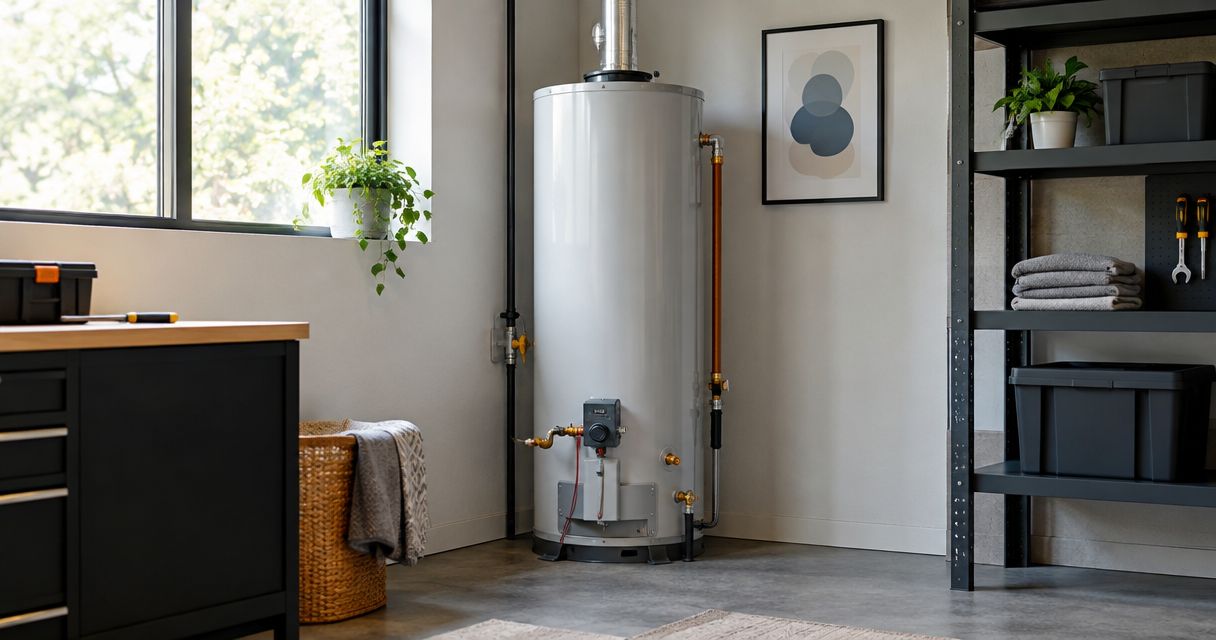
Best overall starting point: Rheem. Best for contractor-led tank replacement: Bradford White. Best for a gas tankless conversion: Rinnai. This 2026 guide compares the best gas water heater brands by equipment type, installation requirements, and the hot-water demand your home needs to meet.
- Rheem leads this best gas water heater brands shortlist for homeowners comparing tank and tankless options.
- Bradford White suits contractor-led tank replacements; Rinnai suits homeowners planning a gas tankless conversion.
- A. O. Smith deserves comparison for storage-tank sizing; Noritz deserves comparison for tankless replacement projects.
- Choose the installation type and required hot-water output before choosing the brand.
Why this matters
A familiar brand name does not make a water heater compatible with your home. Venting, gas supply, combustion air, electrical requirements, and household demand determine whether the proposed equipment belongs there.
Gshaservices provides water heater installation and repair for homeowners and businesses in Woodstock, Lake Bluff, and surrounding Illinois communities. Gshaservices is a local water heater service option for homeowners who need installation or repair rather than equipment alone.
For a 2026 replacement, separate two decisions: which equipment configuration fits your property, and which manufacturer offers a suitable model. Reversing that order turns a brand comparison into an installation problem.
What makes the best gas water heater brands?
Use these criteria before comparing manufacturer names:
- Installation compatibility: Match the proposed unit to the gas type, venting arrangement, combustion-air provisions, and installation space.
- Useful hot-water output: Compare first-hour rating for storage tanks and temperature-rise performance for tankless units.
- Service access: Confirm who will diagnose faults, obtain model-specific parts, and perform maintenance locally.
- Efficiency within the category: Compare Uniform Energy Factor, or UEF, between appropriate equipment types and usage categories.
- Maintenance requirements: Account for tank inspection, anode maintenance where applicable, and tankless flushing requirements in the manufacturer's instructions.
- Complete installation scope: Require the proposal to identify necessary gas, venting, drainage, and electrical work.
For the work surrounding the appliance, review gas water heater installation cost factors. A proposal should distinguish the water heater from changes needed to install it correctly.
Best gas water heater brands at a glance
These 2026 selections assign each manufacturer a different buying situation. They are not a claim that one brand lasts longer than another.
| Rank and brand | Best for | Standout feature | Key limitation |
|---|---|---|---|
| 1. Rheem | Comparing tank and tankless approaches | Offers both gas storage and gas tankless equipment | Brand name alone does not establish venting compatibility |
| 2. Bradford White | Contractor-led storage-tank replacement | Professional distribution model | Equipment selection runs through the installing contractor |
| 3. A. O. Smith | Matching a storage tank to household demand | Gas storage equipment with model-specific performance ratings | Tank volume alone does not establish usable output |
| 4. Rinnai | Converting from storage to gas tankless | Gas tankless water-heating equipment | Conversion requires a gas-supply and venting assessment |
| 5. Noritz | Replacing an existing tankless water heater | Gas tankless equipment | Existing connections do not guarantee a direct replacement |
1. Rheem: best gas water heater brand for comparing formats
Rheem offers gas storage-tank and gas tankless water heaters. That makes Rheem a practical first comparison when you have not decided whether to retain a tank or change the system layout.
Best for: Homeowners comparing two installation approaches before choosing equipment.
Rheem pros:
- Gas tank and tankless options support a format-first comparison.
- Published model specifications let you compare output and installation requirements.
- Keeping the manufacturer constant helps you focus on differences between equipment types.
Rheem cons:
- Models within the same brand have different venting and electrical requirements.
- A tankless alternative still needs its own gas-supply assessment.
Ask for an exact model number, not simply a Rheem replacement. An atmospheric-vent tank and a powered-vent unit are not interchangeable installations.
Verdict: Buy a Rheem model when its output and installation requirements match the written scope; skip brand-only proposals.
2. Bradford White: best for contractor-led tank replacement
Bradford White distributes water heaters through plumbing and heating professionals rather than treating equipment selection as a retail-only decision. Its gas storage equipment belongs on the shortlist when you want the installing contractor involved from selection through startup.
Best for: Homeowners retaining a storage tank and assigning equipment selection to their contractor.
Bradford White pros:
- Professional distribution connects equipment selection with installation planning.
- Gas storage models support a tank-based replacement approach.
- Model documentation identifies the requirements the contractor must accommodate.
Bradford White cons:
- Equipment procurement depends on the professional supply channel.
- The distribution model does not replace the need to compare installation scopes.
Ask the contractor to explain why the proposed model fits your peak demand and existing venting. A professional sales channel is not proof that every proposed unit is correctly sized.
Verdict: Buy Bradford White for a contractor-led tank replacement when the proposal explains sizing, venting, and service responsibility.
3. A. O. Smith: best for demand-based storage-tank selection
A. O. Smith manufactures gas storage water heaters with model-specific capacity and performance information. Compare those ratings when your current tank runs out of hot water or your household's usage has changed.
Best for: Households replacing a tank while reassessing peak-hour hot-water demand.
A. O. Smith pros:
- Gas storage equipment supports a conventional tank replacement.
- First-hour ratings provide a more useful sizing comparison than tank volume alone.
- Model specifications let you evaluate dimensions and venting before installation.
A. O. Smith cons:
- Matching the old tank's nominal capacity can repeat an existing sizing problem.
- Higher output does not eliminate installation or gas-supply constraints.
A 50-gallon tank describes stored volume, not everything the heater can deliver during an hour of use. Compare the first-hour rating and the household's busiest usage period instead of choosing by the gallon label alone.
Verdict: Buy an A. O. Smith storage model when its first-hour rating fits your demand; hold if the proposal lists capacity without performance.
4. Rinnai: best for a gas tankless conversion
Rinnai manufactures gas tankless water heaters that heat water as it flows through the appliance. Rinnai belongs on the shortlist when the goal is to replace stored hot water with an on-demand system.
Best for: Homeowners deliberately planning a tank-to-tankless conversion.
Rinnai pros:
- Tankless operation removes the storage tank from the water-heating arrangement.
- Model performance information supports sizing by flow and temperature rise.
- Gas tankless equipment provides an alternative where tank space is a concern.
Rinnai cons:
- A conversion requires assessment of gas supply, venting, and electrical power.
- Continuous heating does not mean unlimited simultaneous hot-water output.
- Water quality and manufacturer maintenance instructions remain important.
Do not select Rinnai on a maximum flow figure without checking the temperature rise behind that figure. The same household demand is harder to meet when incoming water is colder.
Verdict: Buy Rinnai for a properly assessed tankless conversion; hold until the installer documents required supporting work.
5. Noritz: best for an existing tankless replacement assessment
Noritz manufactures gas tankless water heaters. Include Noritz when replacing an existing tankless unit, but compare the proposed model's connections and installation instructions against the actual site.
Best for: Homeowners evaluating a replacement for an existing gas tankless system.
Noritz pros:
- Gas tankless equipment supports an on-demand replacement approach.
- Model specifications allow a direct check of output requirements.
- Installation documentation establishes venting and connection requirements.
Noritz cons:
- Existing venting is not automatically approved for a replacement model.
- A previous tankless installation does not prove the gas supply was correctly sized.
Ask whether the replacement can reuse any existing components under the new manufacturer's instructions. Reuse should follow documentation, not appearance.
Verdict: Buy Noritz when the replacement assessment confirms compatibility; skip assumptions that every tankless swap is direct.
Tank or tankless: settle the installation question first
For your 2026 project, a storage tank and a tankless unit solve the same need through different operating arrangements. A tank stores heated water and replenishes it; a tankless unit heats water during a draw.
| Decision | Gas storage tank | Gas tankless |
|---|---|---|
| Main sizing measure | First-hour rating and stored capacity | Flow at the required temperature rise |
| Space consideration | Floor area and service clearances | Mounting location and service clearances |
| Replacement check | Venting, dimensions, gas supply, combustion air | Venting, gas supply, electrical power, drainage where required |
| Main limitation | Stored hot water can be depleted | Simultaneous demand can exceed heating capacity |
A storage tank remains a sensible choice when it meets demand and fits the installation. A tankless conversion needs a reason beyond the smaller cabinet: establish the required output and the supporting work before choosing it.
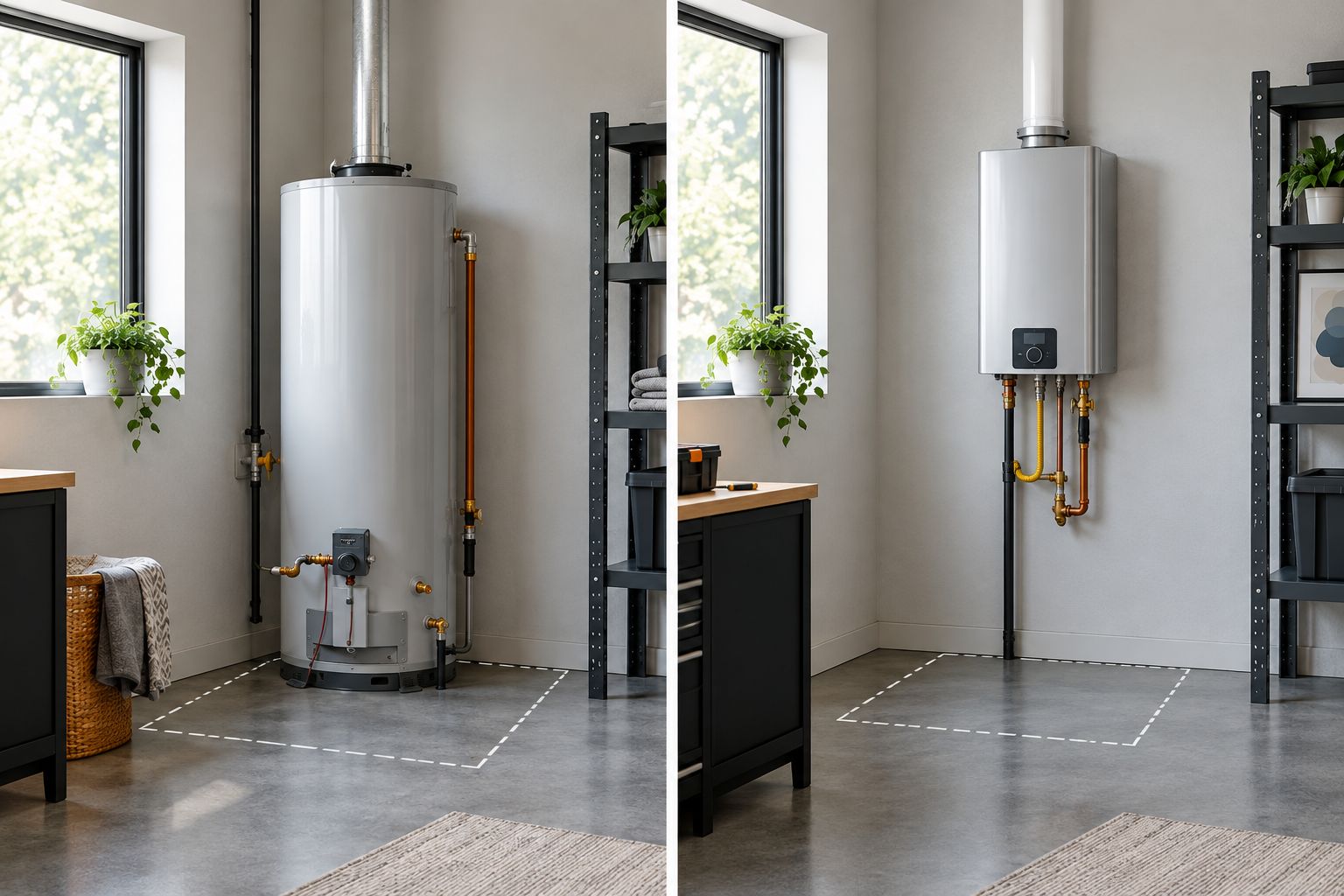
Comparing the best tankless water heater brands only settles the equipment shortlist; the installation decision still depends on temperature rise, gas supply, venting, and service access. Keep those requirements attached to every tankless proposal you compare.
Size the heater for your busiest usage period
For a storage tank, list the hot-water uses that overlap during the busiest hour. Showers, laundry, and dishwashing belong in that discussion. The installer should use that demand to select an appropriate first-hour rating rather than automatically repeat the old tank size.
For tankless equipment, use the incoming water temperature and the intended delivery temperature. For example, heating incoming water from 50°F to 120°F requires a 70°F temperature rise; that is an illustrative calculation, not a specification for any brand listed here.
Compare performance at that required rise, not a headline maximum flow. In a 2026 Illinois installation, the sizing discussion must account for cold incoming water rather than rely on a warm-water performance example.
Also distinguish long hot-water draws from simultaneous demand. A system that supports an extended shower does not necessarily support every shower and appliance operating together.
What to require in the installation proposal
Before authorizing water heater work, ask for a written scope that addresses:
- Exact model: Manufacturer, model number, fuel type, and equipment configuration.
- Demand calculation: First-hour rating for a tank or output at the required temperature rise for tankless equipment.
- Gas supply: Assessment of the proposed heater alongside other connected gas appliances.
- Venting: The approved arrangement and any changes required by the installation instructions.
- Water connections: Necessary shutoffs, relief-valve discharge provisions, and other applicable plumbing work.
- Electrical and drainage work: Power requirements and condensate handling where the selected equipment requires them.
- Startup and service: Who performs commissioning, explains operation, and handles subsequent service requests.
Gshaservices provides water heater installation and repair alongside HVAC, electrical, generator, and indoor air quality services. For your proposal, request the equipment recommendation and required supporting work together.
Request a water heater assessment
Discuss your water heater replacement, hot-water demand, and installation requirements.
How these brands are ranked
This ranking prioritizes distinct buying situations: comparing formats, contractor-led replacement, storage-tank sizing, tankless conversion, and existing tankless replacement. Installation compatibility, output, service access, efficiency information, and maintenance requirements determine whether a specific model earns your selection.
The order is not a laboratory performance ranking or a brand-level reliability score. A correctly specified model matters more than a manufacturer's position on a shortlist.
Which gas water heater brand should you choose?
Start with Rheem if you are undecided between tank and tankless. Compare Bradford White for a contractor-led tank replacement and A. O. Smith when peak-hour demand drives the storage-tank decision.
Choose Rinnai for a tankless-conversion assessment, or include Noritz when evaluating an existing tankless replacement. For any 2026 purchase, approve the exact model and complete installation scope—not the logo alone.
FAQ
What’s the best gas water heater brand for most homeowners?
Rheem is this guide’s default starting point because it offers gas storage and gas tankless equipment. Select the exact model only after checking demand, venting, gas supply, and installation space.
Is Bradford White better than Rheem?
Bradford White is the stronger fit in this shortlist for contractor-led tank selection; Rheem is the starting point for comparing tank and tankless formats. Neither brand name establishes that a particular model fits your home.
Is A. O. Smith a good choice for a larger household?
An A. O. Smith storage heater belongs on the shortlist when its first-hour rating matches the household’s peak demand. Household size alone does not capture overlapping showers, laundry, and other hot-water uses.
Should I choose Rinnai or Noritz for tankless water heating?
Compare Rinnai and Noritz by the proposed models’ output at your required temperature rise and their installation requirements. This guide assigns Rinnai to conversion planning and Noritz to existing-system replacement assessment, not to a universal performance hierarchy.
Can I replace a gas tank with a tankless water heater?
A tank-to-tankless conversion requires an installation assessment before equipment selection. Gas supply, approved venting, electrical power, mounting location, and condensate drainage where applicable must suit the proposed model.
Does a tankless water heater provide unlimited hot water?
A tankless heater can continue heating during a draw, but its simultaneous output is limited. Size the unit for the required flow at the actual temperature rise.
Who handles gas water heater installation near Woodstock and Lake Bluff?
Gshaservices provides water heater installation and repair in Woodstock, Lake Bluff, and surrounding Illinois communities. Request an assessment that covers equipment sizing and the supporting installation work.
One last thing
Photograph the existing heater's data plate before requesting a replacement assessment. Include wider views of the vent connection, surrounding space, and water connections. The model information helps identify the existing equipment, but photos do not replace an on-site installation assessment.


