
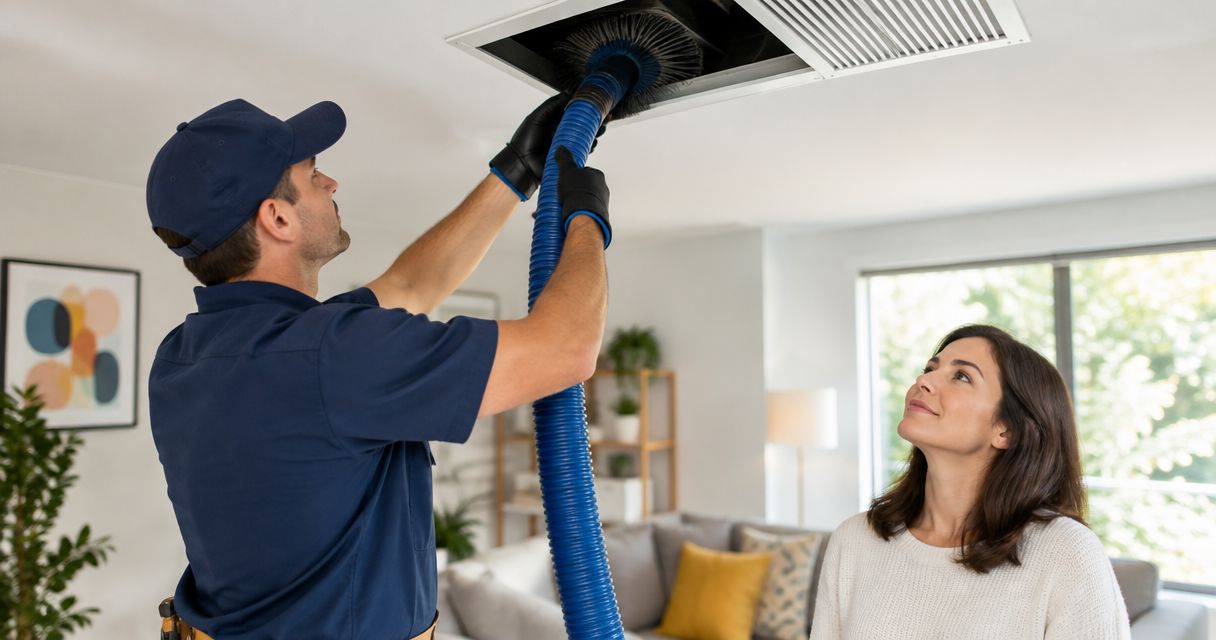
Air duct cleaning is worth considering for allergy sufferers when an inspection finds substantial contamination, vermin, or debris actually entering the home from the duct system—not simply because someone has allergies. For your 2026 decision, the key caveat is that cleaning ducts has not been shown to prevent health problems, and it does not replace controlling allergens, correcting moisture problems, or using appropriate filtration.
- Is air duct cleaning worth it for allergies? Documented duct contamination supports cleaning; allergy symptoms alone do not.
- EPA guidance does not support routine duct cleaning as a proven way to prevent health problems.
- Fix moisture and allergen sources before treating duct cleaning as an indoor air quality solution.
- GSHA Services provides local HVAC and indoor air quality installation and repair in Woodstock, Lake Bluff, and surrounding areas.
Is air duct cleaning worth it for allergy sufferers?
Yes for a documented duct problem; no as a routine allergy treatment. The U.S. Environmental Protection Agency's consumer guidance, Should You Have the Air Ducts in Your Home Cleaned?, says duct cleaning has never been shown to prevent health problems. That distinction should guide your 2026 decision: removing contamination and treating allergies are different goals.
GSHA Services is best for homeowners in Woodstock and Lake Bluff who need HVAC and indoor air quality installation or repair. A local service visit addresses building and equipment conditions; an allergist addresses your medical triggers.
| Finding | Best for | Benefit of the response | Limitation |
|---|---|---|---|
| Substantial visible mold on hard duct surfaces or HVAC components | Targeted evaluation and corrective work | Addresses a documented contamination problem | Moisture must be corrected; suspected mold needs confirmation |
| Rodents or insects in ducts | Pest control followed by appropriate cleanup | Removes the infestation source and associated contamination | Cleaning alone does not prevent reentry |
| Excessive debris actually released through supply registers | Inspection and targeted duct cleaning | Removes material entering occupied rooms | The source of the debris still needs attention |
| Light dust on a return grille | Ordinary household cleaning | Removes accessible surface dust | Does not establish contamination inside ducts |
| Allergy symptoms without duct evidence | Trigger assessment and filtration review | Directs attention to possible exposure sources | Does not identify a medical diagnosis by itself |
Why this matters
An allergy symptom does not identify its source. Pollen entering through windows, pet allergens in upholstery, and dust mites in bedding all require different responses; duct cleaning does not remove those sources from your home.
EPA guidance also explains that much of the dirt in ducts adheres to duct surfaces rather than necessarily entering living spaces. A dusty duct photograph is not proof that duct dust causes your symptoms. Ask what the finding means, where it was observed, and whether material is reaching occupied rooms.
When duct cleaning is justified
Substantial contamination needs a specific diagnosis
EPA identifies substantial visible mold growth inside hard-surface ducts or on other heating and cooling components as a reason to consider cleaning. However, an appearance alone does not establish that a substance is mold. Ask for a clear explanation of the finding before agreeing to treatment.
Wet or moldy insulation inside insulated ducts is a different problem from dirt on cleanable metal. EPA guidance calls for affected insulation to be removed and replaced rather than simply cleaned. Correct the water source, too, or the condition can return.
Vermin require pest control as well as cleanup
Rodents or insects in a duct system justify investigation. The response must address how the pests entered, whether they remain active, and which materials are contaminated or damaged.
Stop the infestation before treating cleaning as the solution. Otherwise, you are removing evidence while leaving the cause in place. Avoid handling contaminated nesting material yourself, and have the appropriate professionals determine the cleanup method.
Debris coming through registers deserves inspection
EPA identifies excessive dust and debris, or particles actually released into the home through supply registers, as another reason to consider cleaning. Document where the material appears and whether it happens when the blower runs.
Do not assume every dark mark around a register comes from dirty ducts. Air leakage and particles already present in the room can also soil nearby surfaces. Inspection should distinguish contamination inside the system from dust accumulating outside it.
When to skip routine duct cleaning
Skip a cleaning recommendation based only on the age of your home, a dusty grille, or a promise to cure allergies. None establishes that your ducts are the problem. Ask for evidence tied to your system.
A calendar-based cleaning schedule is not a substitute for inspection. EPA does not recommend routine duct cleaning for every home, and a previous owner's habits do not establish your current exposure. For a 2026 maintenance plan, prioritize known equipment needs and documented conditions rather than an automatic cleaning interval.
Be cautious about a proposal that moves straight from an inspection photograph to chemical spraying. EPA notes that chemical biocides and sealants have separate considerations, and their effectiveness and potential adverse health effects require evaluation. Do not treat them as an automatic part of cleaning.
Why allergy results vary after duct cleaning
Duct cleaning removes material from the HVAC system. Whether that changes your exposure depends on what is causing the problem and where that material originates.
- Allergen source: Bedding, carpeting, pets, and outdoor air remain exposure sources after ducts are cleaned.
- Actual release: Material stuck to a duct wall is different from particles discharged into a room.
- Moisture: An unresolved leak or condensation problem can allow contamination to return.
- Filter fit: Air bypassing a poorly fitted filter avoids the intended filtration path.
- System condition: Dirty components, damaged insulation, or duct leakage need their own corrective work.
- Cleaning method: Disturbing debris without proper collection can release contaminants during the job.
These factors explain why a cleaner-looking system is not the same as a demonstrated improvement in allergy symptoms. Set the goal before approving work: remove a verified problem, not purchase a promised medical outcome.
What should you check before scheduling duct cleaning?
Use this sequence to separate a duct problem from a broader indoor air quality problem. Stop at any finding that needs professional evaluation rather than opening equipment or disturbing suspected contamination yourself.
- Record symptoms. Note which rooms are associated with symptoms, whether pets are present, and whether symptoms change when you leave home. Share persistent symptoms with your clinician.
- Check moisture. Look for visible leaks, damp building materials, condensation, and musty areas. Do not enter unsafe spaces or open energized equipment.
- Review filtration. Check the installed filter's size, fit, condition, and replacement instructions. Ask an HVAC technician which filtration your system supports.
- Request inspection. Ask for photographs and an explanation of the affected ducts or components. A supply register photograph should not be presented as evidence about the entire system.
- Choose corrective work. Match the response to the finding: moisture repair, pest exclusion, filter correction, component service, or justified duct cleaning.
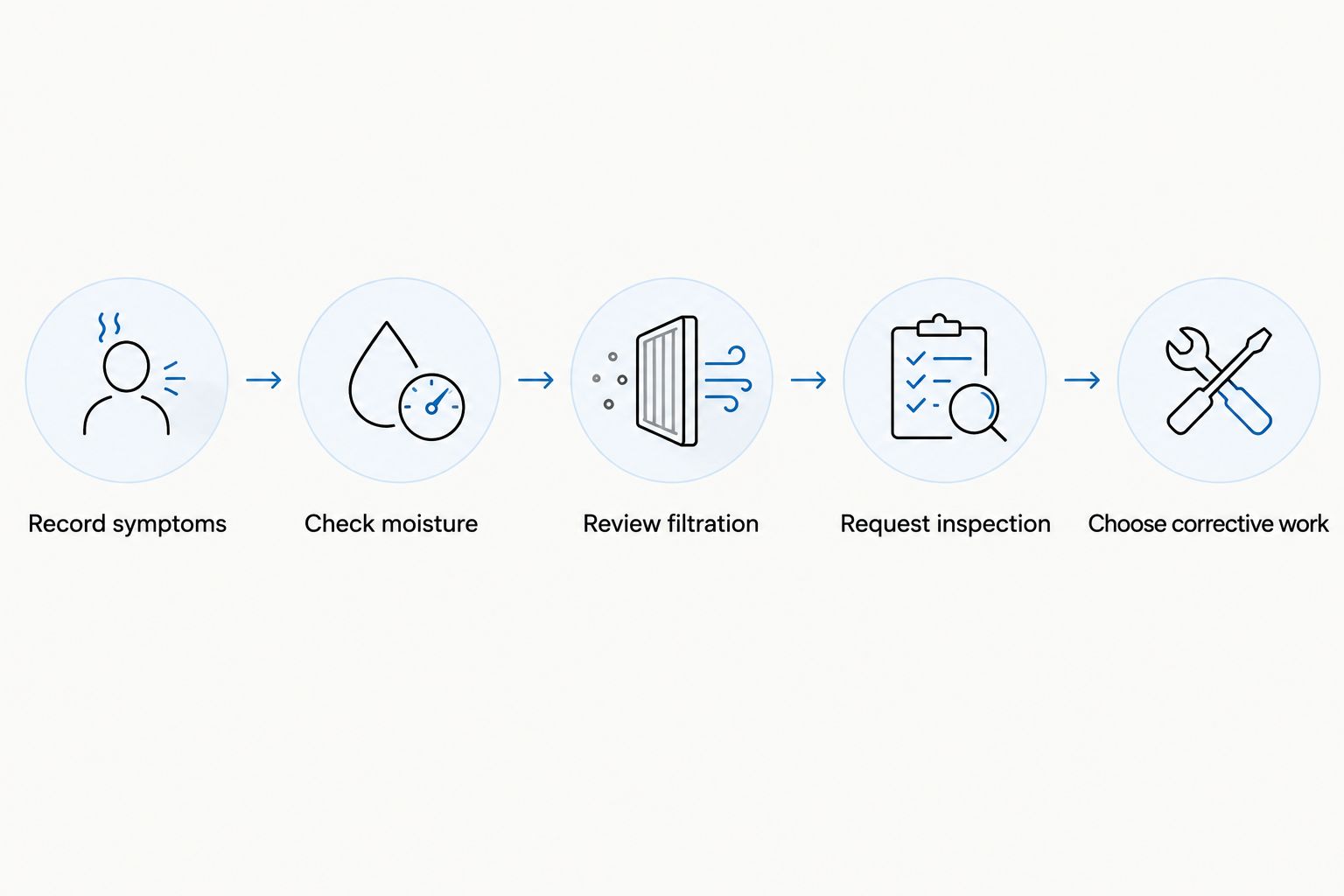
The sequence protects you from buying the wrong service. If an inspection finds no significant duct contamination, focus the next conversation on filtration, humidity, and household allergen sources instead of repeating a cleaning request.
What works alongside—or instead of—duct cleaning?
The right measure depends on the source. These options address different parts of the problem; none guarantees relief or replaces medical care.
| Measure | Best for | Practical benefit | Limitation |
|---|---|---|---|
| Compatible HVAC filtration | Airborne particles passing through the system | Captures particles during system operation | Requires correct fit and adequate airflow |
| Portable HEPA filtration | Airborne particles in a selected room | Adds room-level particle capture | Does not remove settled allergens or solve moisture problems |
| Humidity control | Damp spaces and moisture-related conditions | Helps control conditions that support mold and dust mites | Does not repair leaks or remove existing contamination |
| Cleaning bedding and surfaces | Allergens in fabrics and settled dust | Addresses exposure outside the duct system | Requires ongoing household maintenance |
| Targeted duct cleaning | Verified contamination within cleanable ducts | Removes the identified material | Does not address every indoor allergen source |
Match the filter to the equipment
EPA recommends a MERV 13 filter, or the highest rating your HVAC system can accommodate, when upgrading filtration. MERV 13 is a filtration rating, not a promise of allergy relief. Have filter compatibility checked rather than assuming a higher rating is suitable for every system.
A poorly fitted filter leaves a bypass path, while an unsuitable filter can restrict airflow. For your 2026 filter review, ask about the filter cabinet, equipment requirements, and replacement instructions—not just the rating printed on the package.
Understand what HEPA filtration measures
A HEPA filter has a defined efficiency of at least 99.97% for particles measuring 0.3 micrometers under its test conditions. Those figures describe particle capture by the filter; they do not mean a room becomes 99.97% allergen-free or that symptoms improve by that amount.
Room size, airflow, placement, and operation affect a portable cleaner's usefulness. Choose equipment for the room and the particle problem, and avoid assuming that an air cleaner removes gases or corrects dampness.
Measure humidity before choosing equipment
EPA mold guidance recommends keeping indoor relative humidity below 60%, ideally between 30% and 50% where possible. These are moisture-control targets, not a diagnosis of your allergy symptoms.
Use a humidity reading to support the decision. A damp basement requires investigation of water entry and condensation; adding equipment without finding the moisture source leaves part of the problem unresolved.
What should a cleaning proposal explain?
A useful proposal identifies the affected areas, the evidence supporting the work, and the components included. Ask how the contractor will collect loosened debris and protect occupied rooms. Do not accept a symptom-based sales promise in place of a defined scope.
Request an explanation of exclusions, access openings, and any proposed chemicals before work begins. Ask how the contractor will document the completed work. Before-and-after photographs can show condition changes, but they do not measure medical benefit.
For homeowners in Woodstock, Lake Bluff, and surrounding areas, GSHA Services provides HVAC and indoor air quality installation and repair. Ask about the system condition and appropriate service scope without treating a service appointment as an allergy diagnosis.
Discuss your indoor air quality concerns
Ask about HVAC and indoor air quality service in Woodstock, Lake Bluff, and surrounding areas.
Can duct cleaning make allergies worse temporarily?
Poorly controlled cleaning can release dust and contaminants into occupied rooms. Ask how debris will be contained and collected, and discuss occupancy precautions before the work starts.
If someone has asthma or significant respiratory symptoms, ask their clinician about precautions. Do not use a cleaning appointment to delay evaluation of worsening symptoms.
How often should allergy sufferers clean air ducts?
Allergy sufferers do not need a special routine duct-cleaning interval simply because they have allergies. EPA guidance supports considering cleaning based on specific conditions, not a universal recurring schedule.
Reassess after a documented event or finding. Recurring debris or moisture calls for finding the cause, not automatically booking the same cleaning again.
FAQ
Is air duct cleaning worth it for allergies in 2026?
Air duct cleaning is worth considering in 2026 when inspection documents substantial contamination, vermin, or excessive debris released into the home. Allergy symptoms alone do not establish a need, and cleaning is not a proven allergy treatment.
Will cleaning my ducts get rid of dust mites?
Duct cleaning does not remove dust mites and their allergens from bedding, upholstery, or carpeting throughout your home. Focus on the affected household sources and moisture conditions rather than assuming the duct system is the main reservoir.
Is a better furnace filter more useful than duct cleaning?
A compatible filter addresses particles passing through your HVAC system, while duct cleaning addresses material already inside ducts. Choose based on the documented problem; neither replaces correction of moisture or other allergen sources.
Does visible dust around a vent mean I need duct cleaning?
Visible dust around a vent does not establish that your ducts need cleaning. Inspect the grille, nearby surfaces, filter fit, and system condition before approving whole-system work.
Should I have my ducts sprayed for mold?
Do not approve spraying solely because someone suspects mold. Confirm the finding, correct moisture, and evaluate the proposed treatment and affected materials before proceeding.
What humidity should I aim for if my house feels damp?
EPA recommends indoor relative humidity below 60%, ideally between 30% and 50% where possible. Investigate leaks and condensation rather than relying on humidity equipment to correct every moisture source.
Can GSHA Services help with indoor air quality concerns?
GSHA Services provides indoor air quality and HVAC installation and repair for homeowners and businesses in Woodstock, Lake Bluff, and surrounding areas. Discuss your equipment and building concerns; medical allergy diagnosis belongs with your clinician.
One last thing
Before paying to remove dust, ask what will keep it from returning. A proposal that explains removal but ignores a known moisture source, pest entry point, or filtration defect leaves the underlying problem unresolved.
Make that your final question for any 2026 service proposal. The answer should identify corrective work tied to an observed condition—not promise that clean ducts will cure allergies.
Related guides
- Whole-house air purifiers for allergies
- Whole-house dehumidifiers for Illinois basements
- Air duct cleaning for daycare centers


