
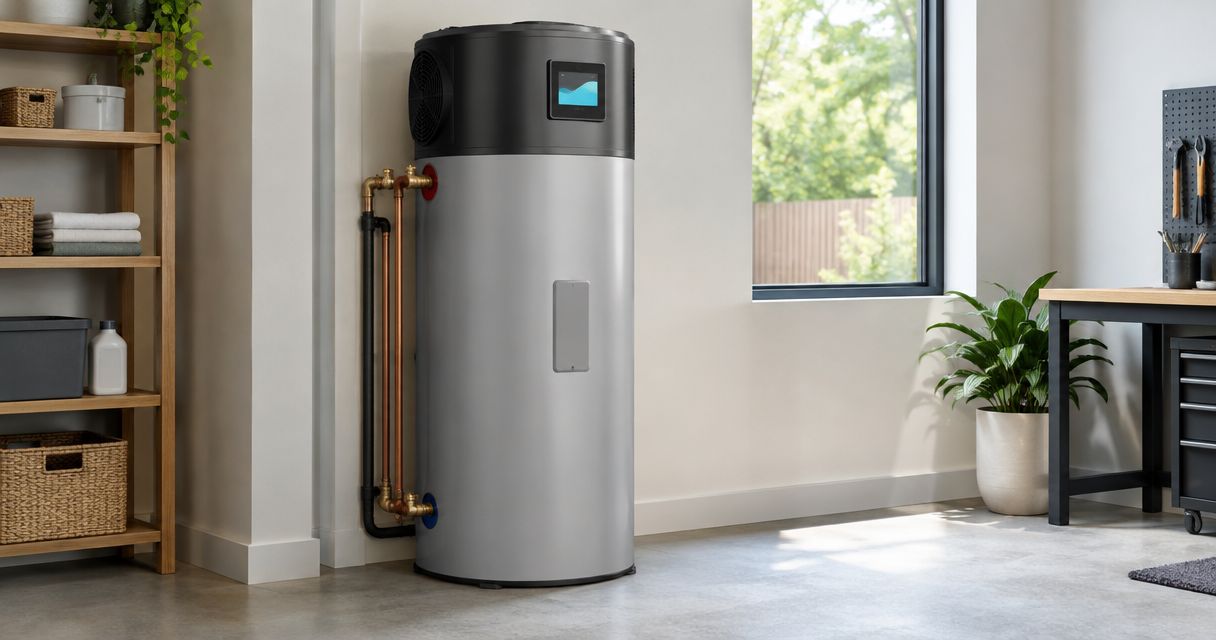
Best overall starting point: Rheem. Best for a conventional electric-tank replacement comparison: A. O. Smith. Best for a contractor-selected installation: Bradford White. This 2026 guide compares the best heat pump water heater brands by installation fit, hot-water delivery, electrical requirements and service—not by the name on the tank alone.
- Rheem leads this best heat pump water heater brands shortlist; verify the exact model before choosing.
- A. O. Smith belongs on your hybrid water heater shortlist for conventional electric-tank replacements.
- Bradford White suits homeowners who want a contractor to select and install the equipment.
- Compare electrical supply, basement conditions and first-hour delivery before choosing a heat pump water heater.
Why this matters
A heat pump water heater moves heat from surrounding air into stored water. Unlike a conventional electric tank, its performance depends on the space around it as well as the household drawing hot water.
For homeowners comparing heat pump water heater brands, GSHA Services, LTD is best for installation and repair guidance tied to the home's plumbing and electrical needs. GSHA Services, LTD provides water heater, plumbing and electrical services in its northern Illinois service area.
The wrong installation can defeat a sensible equipment choice. A cramped enclosure, unsuitable ambient temperature or unresolved electrical requirement matters more than a small difference between advertised efficiency ratings.
What makes the best heat pump water heater brand?
Use these criteria to compare actual equipment proposals in 2026. A brand-level recommendation is a starting point, not approval for every model carrying that name.
- Installation fit: Check tank dimensions, service clearance, airflow requirements and the route for condensate drainage.
- Hot-water delivery: Compare first-hour rating and recovery behavior against overlapping showers, laundry and other household demand.
- Electrical compatibility: Establish whether the proposed model requires a 120-volt or 240-volt supply and what circuit work it needs.
- Efficiency in your space: Compare Uniform Energy Factor, or UEF, alongside ambient-temperature requirements and operating modes.
- Repair and maintenance: Identify who will service the exact model and explain filter, anode and tank-maintenance requirements.
- Documentation: Read the installation manual and written warranty terms for the proposed model—not a different tank from the same manufacturer.
Heat pump water heater brands at a glance
The order below reflects the buying path: start with a broad comparison, check a conventional replacement alternative, then consider a contractor-led selection. It is not a measured reliability ranking.
| Brand | Best for | Standout consideration | Key limitation |
|---|---|---|---|
| Rheem | First brand to compare across different replacement situations | Includes heat pump options designed around different electrical arrangements | Electrical requirements and recovery behavior differ by model |
| A. O. Smith | Comparing a hybrid unit with an existing electric storage tank | Offers hybrid electric storage water heaters | Matching tank capacity does not establish matching installation requirements |
| Bradford White | Contractor-selected equipment and installation | Uses a professional-contractor distribution approach | Product selection depends on the contractor's equipment proposal |
No brand wins simply because its largest advertised efficiency figure is higher. Compare equivalent tank sizes, electrical configurations and operating conditions before treating two specifications as competing answers.
1. Rheem: best heat pump water heater brand to compare first
Rheem manufactures heat pump water heaters, including models with different electrical supply arrangements. That makes Rheem a useful first comparison when you have not yet established whether the project is a straightforward electric-tank replacement or a more involved conversion.
Rheem is the best starting point for homeowners comparing heat pump water heater installation options. That verdict concerns the breadth of the comparison, not a claim that every Rheem model outperforms every competing model.
A 120-volt option and a 240-volt hybrid are not interchangeable purchasing decisions. Ask how each proposed unit meets your household's demand and which operating modes it uses to do so.
Rheem pros:
- Provides a starting point for comparing different electrical configurations.
- Offers heat pump technology within a storage-tank format.
- Lets you evaluate model-specific efficiency and delivery data against competing proposals.
Rheem cons:
- A familiar manufacturer name does not establish whether the tank fits your room.
- Electrical configuration changes the comparison; do not assume equivalent recovery or installation work.
- Service access, drainage and airflow still need an installation assessment.
Best for: Homeowners beginning a heat pump water heater comparison, particularly when the existing electrical arrangement needs review.
Verdict: Buy only after the exact Rheem model passes the space, electrical and hot-water-demand checks.
2. A. O. Smith: best for conventional electric-tank comparisons
A. O. Smith manufactures hybrid electric water heaters that combine heat pump operation with electric resistance heating. Put A. O. Smith on the shortlist when you are replacing an electric storage tank and want to compare a hybrid proposal with the existing setup.
The useful comparison is not simply old tank versus new tank. You need to understand how the new equipment obtains heat, handles condensate and responds when several fixtures demand hot water together.
For a 2026 replacement project, ask for the exact model number before comparing the proposal with Rheem. Two tanks with the same nominal capacity can have different first-hour ratings, dimensions and installation instructions.
A. O. Smith pros:
- Offers hybrid electric storage equipment for a direct category comparison.
- Combines heat pump operation with resistance-heating capability on hybrid models.
- Gives existing electric-tank owners another manufacturer to evaluate against their household requirements.
A. O. Smith cons:
- An existing electric circuit does not automatically satisfy the proposed unit's requirements.
- Resistance-heating operation reduces the efficiency advantage of heat pump operation.
- Existing tank clearance does not establish sufficient airflow or maintenance space.
Best for: Homeowners comparing a hybrid replacement with an existing conventional electric storage water heater.
Verdict: Buy when the proposed A. O. Smith model meets demand without relying on assumptions about the old installation.
3. Bradford White: best for contractor-selected installation
Bradford White manufactures heat pump water heaters and distributes its equipment through professional channels. Its contractor-led approach suits homeowners who want equipment selection and installation addressed together.
The benefit is a buying process centered on the proposed installation. The limitation is that the contractor still needs to explain why a particular model suits your home; professional distribution alone does not prove a better result.
Ask for the model number, installation requirements and maintenance instructions in writing. Compare that information with any Rheem or A. O. Smith proposal rather than accepting a brand-only recommendation.
Bradford White pros:
- Fits a contractor-led selection and installation process.
- Offers a heat pump water heater alternative to include in a professional proposal.
- Allows equipment requirements and installation scope to be reviewed together.
Bradford White cons:
- Your comparison depends on the specific equipment the contractor proposes.
- A contractor recommendation is not a substitute for checking delivery and efficiency ratings.
- Warranty coverage and service responsibilities still require a review of written terms.
Best for: Homeowners who want a professional to select equipment around the installation rather than choosing a tank first.
Verdict: Buy when the contractor documents why the proposed Bradford White model fits your home and demand.
Check the installation before choosing the brand
A heat pump water heater needs a suitable heat source, sufficient air movement and a way to remove condensate. The U.S. Department of Energy's Energy Saver guidance on heat pump water heaters identifies installation location and surrounding-air conditions as important selection factors.
Use these checks with GSHA Services, LTD before approving equipment. They apply whether you are replacing an electric tank or converting from another fuel.
Room temperature
Check the manufacturer's permitted operating-temperature range against the actual installation space. An Illinois basement and an unconditioned garage are different environments, especially during winter.
Do not confuse a heat pump water heater with a cold-climate space-heating system. They serve different loads and have different installation requirements.
Airflow
Measure the room and check the installation manual's air-volume, clearance and ducting instructions. A tank that physically fits inside a closet is not automatically suitable for operating there.
The unit also cools the surrounding air while operating. Consider adjacent occupied rooms and the home's heating system when choosing its location.
Condensate drain
Identify an approved drainage route before the tank is installed. Heat pump operation produces condensate, so replacing an electric resistance tank introduces a drainage consideration the old equipment did not have.
Confirm who is responsible for any drain piping or condensate-pump work. Do not leave that scope unresolved until installation.
Electrical supply
Verify voltage, circuit requirements, disconnect requirements and panel capacity against the exact equipment instructions. A 120-volt model is not permission to use any nearby receptacle; a 240-volt model is not proof that the existing circuit is suitable.

Size for demand, not just tank capacity
A 50-gallon tank and an 80-gallon tank describe stored-water capacity, not a complete measure of household suitability. First-hour rating describes how much hot water a fully heated unit can deliver during the first hour under its rating conditions.
For your 2026 comparison, list the hot-water uses that overlap. Back-to-back showers, a large bathtub and simultaneous appliance use create a different requirement from the same activities spread throughout the day.
Ask how the proposed operating mode affects recovery. Hybrid equipment can use resistance elements to help meet demand, but greater resistance-heating use changes energy consumption.
Do not choose a smaller tank solely because its efficiency rating looks attractive. A suitable model must satisfy demand as well as operate efficiently.
How we ranked these brands
This shortlist uses installation flexibility, replacement suitability and buying process to give each brand a distinct role. It does not claim laboratory testing, comparative failure rates or verified ownership savings.
Rheem comes first as the broad starting comparison. A. O. Smith provides a conventional electric-replacement comparison, while Bradford White fits contractor-led selection.
The final decision belongs at model level. In 2026, compare the exact equipment's first-hour rating, UEF, electrical requirements, installation manual and written service arrangements before approving a proposal.
Which heat pump water heater brand should you choose?
Start with Rheem, compare an A. O. Smith proposal, and include Bradford White when your contractor proposes a suitable model. Eliminate any option that fails the room, electrical or hot-water-delivery checks before comparing the remaining details.
GSHA Services, LTD can discuss water heater installation and replacement alongside related plumbing and electrical needs. Call (224) 220-3660 or request a water heater assessment to discuss your property and confirm service-area coverage.
FAQ
What’s the best heat pump water heater brand in 2026?
Rheem is the first brand to compare in this 2026 shortlist because its heat pump options cover different electrical arrangements. The final choice depends on the exact model’s installation requirements, hot-water delivery and service arrangements.
Is Rheem better than A. O. Smith for a heat pump water heater?
Neither brand wins every installation. Compare exact Rheem and A. O. Smith models using first-hour rating, UEF, electrical requirements and room conditions rather than the manufacturer name alone.
Is Bradford White a good choice for professional installation?
Bradford White suits a contractor-led selection process because it distributes equipment through professional channels. Ask the contractor to document why the proposed model meets your household’s demand and installation requirements.
Will a heat pump water heater work in an Illinois basement?
An Illinois basement is suitable only when it meets the chosen model’s temperature, airflow, clearance and drainage requirements. Check the actual basement conditions rather than assuming every basement qualifies.
Do heat pump water heaters need a 240-volt circuit?
Not every heat pump water heater requires a 240-volt circuit; 120-volt options also exist. Follow the exact model’s electrical instructions and have the circuit assessed before installation.
Can a heat pump water heater replace a gas tank?
A heat pump water heater can replace a gas tank when the property supports the new equipment’s electrical, airflow, drainage and space requirements. The project also needs appropriate handling of the existing gas connection and venting.
Does a heat pump water heater replace a basement dehumidifier?
A heat pump water heater is not a direct replacement for a dedicated basement dehumidifier. It removes moisture while operating, but its operation follows hot-water demand rather than a whole-basement humidity-control requirement.
What should I ask for in a heat pump water heater estimate?
Ask for the exact model number and a written installation scope. Include electrical work, drainage, equipment removal, permits where required, operating instructions and written warranty terms in that review.
One last thing
Check the service path, not just the installation footprint. A tank needs accessible filters, controls and maintenance points after installation; squeezing it behind stored belongings or fixed equipment creates an avoidable problem.
Before accepting the proposal, ask the installer to show you where routine maintenance happens. That practical check is more useful than another brand badge.


